
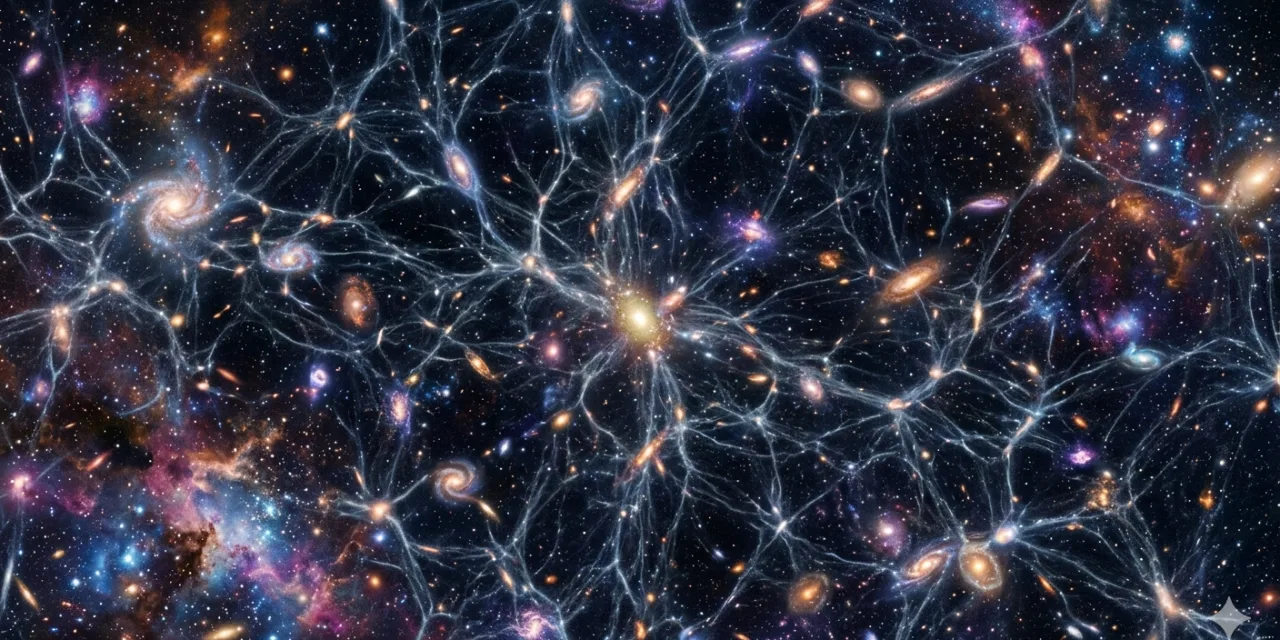
Look up at the night sky on a clear evening and you are seeing almost nothing. Not in the poetic sense — in the literal, scientific sense. Every star, galaxy, nebula, and planet visible to the naked eye or the most powerful telescope ever built accounts for roughly five percent of everything that exists. The rest — the other 95 percent of the universe — is invisible, passes through ordinary matter as though it is not there, and has never been directly detected by any instrument ever built. We call the larger portion of it dark energy. The smaller but still enormous portion — about 27 percent of the universe — we call dark matter.
Dark matter is not a gap in our knowledge in the sense of a minor rounding error. It is a fundamental component of the cosmos without which nothing in the universe — not a single galaxy, not a single star system, not a single planet — would exist in anything like its current form. It is the invisible scaffolding on which everything visible is built. And in 2026, thanks to the James Webb Space Telescope, a landmark Chinese physics experiment, and a cascade of theoretical breakthroughs, we understand it better than ever — and we have also discovered that it is far stranger and more complex than the prevailing model assumed.
This is the complete, accessible guide to dark matter: what it is, why we know it exists despite never having directly seen it, what it does, what scientists currently think it is made of, the extraordinary new discoveries of 2025 and 2026 that are reshaping our picture of it, and what it would mean for physics and cosmology if we finally detect it directly. No prior knowledge of physics required. Just a genuine curiosity about the invisible stuff that holds the universe together.
The Problem That Started It All: Why Galaxies Should Not Exist
The story of dark matter begins not with a particle physicist in a laboratory but with an astronomer looking at how fast galaxies spin. In the 1970s, American astronomer Vera Rubin was measuring the rotation curves of spiral galaxies — plotting the orbital speed of stars at different distances from the galactic centre against their distance. According to Newtonian gravity, stars at the outer edges of a galaxy, far from the concentrated mass at the centre, should orbit more slowly — just as the outer planets of the solar system orbit the Sun more slowly than the inner ones. Instead, Rubin found that outer stars orbited at roughly the same speed as inner stars, or in many cases faster. The rotation curves were flat when they should have been declining.
There were only two possible explanations: either the laws of gravity work differently at galactic scales than we thought — an idea that has attracted periodic scientific interest and is still explored today — or there is substantially more mass in galaxies than the visible matter we can see. Not a little more. About five to six times more. For every kilogram of visible matter — every star, every gas cloud, every planet, every asteroid — there are roughly five kilograms of matter that emits no light, reflects no light, absorbs no light, and interacts with ordinary matter only through gravity. This invisible mass came to be called dark matter.
Rubin’s observations were not an isolated anomaly. They were the first in a long chain of independent observations across completely different scales and measurement techniques, all pointing to the same conclusion: something massive and invisible pervades the universe. The gravitational lensing of light around galaxy clusters — the bending of light from distant objects by the gravity of intervening mass — consistently reveals far more mass than is visible. The observed large-scale structure of the universe — the web of galaxy filaments, voids, and clusters that spans billions of light years — could not have formed in the time available since the Big Bang without dark matter providing the gravitational seeds around which ordinary matter condensed. The cosmic microwave background, the faint afterglow of the Big Bang still detectable today, carries encoded information about the relative proportions of ordinary matter, dark matter, and dark energy — and the numbers match the independent observations from galaxy rotation, gravitational lensing, and structure formation with extraordinary precision. Dark matter is not a hypothesis. It is a measured, confirmed, repeatedly cross-verified component of the universe.
What Dark Matter Does: The Invisible Architecture of Everything
To understand why dark matter is so important, it helps to understand what the universe looks like on its largest scales. If you could step back far enough to see the structure of the cosmos across billions of light years, you would not see a uniform distribution of galaxies scattered randomly through space. You would see a vast, intricate web — galaxy filaments stretching hundreds of millions of light years, intersecting at nodes where enormous galaxy clusters contain thousands of galaxies each, surrounding vast empty regions called voids where almost nothing exists. This structure — the cosmic web — is the skeleton of the observable universe.
In January 2026, scientists using NASA’s James Webb Space Telescope published the most detailed dark matter map ever produced, covering a region of sky 2.5 times larger than the full Moon and containing nearly 800,000 galaxies. “This is the largest dark matter map we’ve made with Webb, and it’s twice as sharp as any dark matter map made by other observatories,” said Diana Scognamiglio of NASA’s Jet Propulsion Laboratory, the lead author of the paper published in Nature Astronomy. The map revealed in unprecedented detail how dark matter filaments connect galaxy clusters, how the invisible substance overlaps and intertwines with the visible matter in galaxies, and how closely the two have tracked each other throughout cosmic history. As co-author Richard Massey of Durham University put it: dark matter and ordinary matter have always been in the same place. They grew up together. This is not coincidence. It is the gravitational partnership that built the universe.
The cosmic web exists because of dark matter. In the very early universe, shortly after the Big Bang, the distribution of matter was almost perfectly uniform — but not quite. There were tiny quantum fluctuations, regions fractionally denser than average. Dark matter, which interacts only through gravity and has no competing electromagnetic forces to push it around, began collapsing around these overdensities first. Ordinary matter — hydrogen and helium gas — then fell into the gravitational wells that dark matter had created, condensing further, igniting into stars, gathering into galaxies. Without dark matter to create those initial gravitational wells, the universe’s ordinary matter would have spread too uniformly to condense into stars and galaxies. The cosmic web, every galaxy in it, and every star in every galaxy owes its existence to the gravitational scaffolding provided by dark matter that formed first.
Dark matter also holds galaxies together. A spiral galaxy like the Milky Way sits inside a roughly spherical cloud of dark matter called a dark matter halo — far larger than the visible disc of stars and gas, extending perhaps ten times further from the galactic centre than the visible galaxy reaches. It is this halo that provides the additional gravitational pull that keeps outer stars orbiting at their observed speeds rather than flying off into intergalactic space. Without the dark matter halo, the Milky Way as we know it could not exist in its current form.
What Dark Matter Is Not: Clearing Away the Misconceptions
Dark matter’s name generates two persistent misconceptions that are worth addressing before going further. First: dark matter is not antimatter. Antimatter is a known component of physics — particles with opposite charge to their normal counterparts — and we produce and detect it routinely in particle accelerators. Antimatter interacts with light in the same way ordinary matter does. Dark matter does not. Second: dark matter is not a black hole — or at least, black holes of the type we know about cannot account for more than a small fraction of the dark matter. Black holes form from the death of massive stars. The number of such black holes in any galaxy is far too small to account for the observed dark matter mass. (Though a February 2026 paper from the Royal Astronomical Society did propose the intriguing possibility that the Milky Way’s galactic centre may be dominated by an ultra-dense concentration of fermionic dark matter rather than a supermassive black hole — a hypothesis that could simultaneously explain the observed orbital speeds of stars near the centre and the galaxy’s outer rotation curve.)
Dark matter is also not simply gas, dust, or any other ordinary matter we have failed to observe. We know this from multiple lines of evidence, most decisively from observations of galaxy clusters that have collided. In the Bullet Cluster — two galaxy clusters that passed through each other — the hot gas of the two clusters, which interacts electromagnetically, slowed and piled up in the middle. The dark matter halos of the two clusters, which interact only gravitationally, passed straight through each other and separated. Gravitational lensing maps of the Bullet Cluster show the mass — and therefore the dark matter — located in two separate clouds ahead of the gas, exactly as the collision hypothesis predicts. This observation provides perhaps the most direct and compelling evidence that dark matter is a distinct component of matter that does not interact electromagnetically, and it definitively rules out modifications of gravity as the complete explanation for the missing mass problem on galaxy cluster scales.
What Scientists Think Dark Matter Is Made Of: The Candidates
After nearly a century of searching, no confirmed dark matter particle has been detected. But the theoretical landscape of candidates has been thoroughly mapped, and the hunt is far from abandoned — if anything, it is more inventive and better equipped than ever.
WIMPs — Weakly Interacting Massive Particles — were the leading candidate for decades. WIMPs are hypothetical particles with masses in the range of 10 to 1,000 times the proton mass that interact with ordinary matter through the weak nuclear force and gravity, but not through electromagnetism. Their theoretical appeal was their “WIMP miracle”: the calculation showed that a particle with these properties, produced in the conditions of the early universe, would naturally produce exactly the right dark matter abundance we observe today. Multiple major experiments — PandaX in China, XENON in Italy, LUX-ZEPLIN in the United States — built extraordinarily sensitive underground detectors designed to catch the rare collisions between WIMPs and atomic nuclei. Texas A&M University researchers reported in January 2026 that their detectors are now sensitive enough to spot particle interactions that might occur once in years or even decades. Despite this extraordinary sensitivity, no confirmed WIMP signal has emerged. The most popular version of WIMPs — the lightest supersymmetric particle predicted by supersymmetry — has been progressively ruled out across the most theoretically favoured mass range. WIMPs are not dead as a hypothesis, but the parameter space has been substantially constrained.
Axions are a lighter, more theoretically motivated alternative. Originally proposed to solve an unrelated problem in particle physics involving why the strong nuclear force does not violate certain symmetries, axions turned out to also make excellent dark matter candidates. They are extraordinarily light — perhaps a trillion trillion times lighter than the electron — and interact with ordinary matter so weakly that their detection requires entirely different experimental approaches than WIMP searches. Microwave cavity experiments, which try to convert axions into photons in the presence of a strong magnetic field, are the primary detection strategy. Several such experiments are currently operating or under construction.
Sterile neutrinos represent a third major candidate. The neutrinos we know — which interact weakly but measurably with ordinary matter — come in three flavours. Sterile neutrinos would be a fourth type that interacts with ordinary matter only through gravity. They are heavier than ordinary neutrinos, potentially produced in the early universe in sufficient quantities to account for the observed dark matter density, and their decay might produce faint X-ray signals detectable by space-based X-ray observatories. An anomalous 3.5 keV X-ray line detected in galaxy clusters by several independent observations remains a subject of active investigation.
Ultralight “fuzzy” dark matter is a newer and theoretically compelling candidate. In these models, dark matter particles are extraordinarily light — with masses so tiny that their quantum wave behaviour becomes relevant on galactic scales. Rather than behaving like classical particles, fuzzy dark matter would form wave-like interference patterns throughout galaxies. In 2026, improved observations and simulations showed that some galactic features previously attributed solely to star formation effects might also be consistent with wave-based dark matter behaviour — a rare direct intersection between quantum mechanics and astrophysical observations on cosmic scales.
Self-interacting dark matter has attracted significant fresh attention in 2026. In January, researchers at the Perimeter Institute published a new simulation framework for dark matter that can collide with itself but not with ordinary matter. This self-interacting dark matter could trigger collapses in the cores of dark matter halos — heating and densifying their centres in ways that might explain observed anomalies in the central density profiles of small galaxies and dwarf galaxies. Standard cold dark matter models predict dense “spikes” at galactic centres that are not always observed. Self-interacting dark matter provides a natural mechanism for smoothing these spikes without abandoning the broader dark matter framework.
The 2026 Breakthroughs: What This Year Has Already Changed
The first months of 2026 have been among the most scientifically productive for dark matter research in years, with a cluster of independent discoveries and theoretical advances that are genuinely reshaping the picture.
The Webb dark matter map published in January 2026 represents the sharpest view of dark matter’s large-scale structure ever achieved. Published in Nature Astronomy by JPL astrophysicist Diana Scognamiglio and co-authors, the map covers the COSMOS survey field — one of the most thoroughly observed patches of sky in astronomy — and shows the dark matter distribution with resolution twice that of any previous map. The map confirms with new precision that dark matter and ordinary matter have tracked each other throughout cosmic history, with the dark matter scaffolding consistently present wherever visible matter congregates. This is not merely confirmatory: the resolution and scale of the Webb map provide new constraints on the properties of dark matter that will sharpen the search for its nature.
The first direct experimental evidence of the Migdal effect, published in Nature in January 2026, opens a new detection pathway for light dark matter. The Migdal effect — proposed theoretically by Soviet physicist Arkady Migdal in 1939 — predicts that when a nucleus recoils after being struck by a particle, the sudden shift in the atom’s electric field can eject an orbiting electron. A Chinese research team achieved the first direct laboratory confirmation of this effect, using a gas pixel detector with neutron bombardment. The significance for dark matter detection is substantial. Standard nuclear recoil detectors are inherently blind to dark matter particles lighter than a few protons’ mass, because the recoil they produce is too faint to register. The Migdal effect converts that imperceptible recoil into a detectable electron signal, in principle allowing detectors to capture 100 percent of the interaction energy. This could extend the detectable dark matter mass range by several orders of magnitude, opening a vast new territory of light dark matter candidates to experimental search.
University of Minnesota researchers published a major challenge to the cold dark matter paradigm in January 2026. Dark matter has long been assumed to be “cold” — meaning its constituent particles move at speeds far below the speed of light, enabling them to cluster gravitationally and seed galaxy formation. The Minnesota team, working with colleagues at Université Paris-Saclay, showed that dark matter could have been born blazing hot — moving near the speed of light in the post-inflationary reheating period shortly after the Big Bang — and still have cooled down sufficiently to perform its galaxy-seeding role. This “warm start” for dark matter is not merely an academic distinction. If dark matter began hot, its thermal history would have left different fingerprints on the cosmic microwave background and on the distribution of small-scale structure — fingerprints that current and next-generation surveys may be able to detect.
The Royal Astronomical Society published a paper in February 2026 proposing that the Milky Way’s galactic centre may be dominated by fermionic dark matter rather than a supermassive black hole. The hypothesis holds that an ultra-dense clump of dark matter could produce gravitational effects indistinguishable from a black hole for the stars near the galactic centre while simultaneously explaining the broader rotational dynamics of stars further out. This is a radical suggestion — Sagittarius A*, the object at the Milky Way’s centre, is generally accepted to be a four-million-solar-mass black hole on the basis of stellar orbits observed over decades. But the paper demonstrates that a compact fermionic dark matter concentration could produce observationally consistent results with a different physical mechanism. Testing this hypothesis against the detailed orbital data from the next generation of galactic centre observations will be a significant scientific project.
How Scientists Search for Dark Matter: The Experiments
The search for dark matter proceeds on three parallel fronts, each approaching the detection problem from a different direction and each sensitive to different potential dark matter candidates.
Direct detection experiments attempt to catch dark matter particles colliding with ordinary atomic nuclei in ultra-sensitive underground detectors. The underground setting — often miles beneath the surface in former mines or purpose-built caverns — shields the detectors from cosmic ray background that would otherwise overwhelm the signals. The detectors use liquid xenon, germanium crystals, liquid argon, and other materials chosen for their sensitivity and the clarity of their recoil signals. The LUX-ZEPLIN experiment in the Sanford Underground Research Facility in South Dakota, PandaX in China, and XENON1T and its successors in the Gran Sasso laboratory in Italy represent the current generation of these experiments. Texas A&M University’s MINER detector, using sapphire detection material, is designed to push into the low-energy neutrino and light dark matter territory that the larger liquid xenon experiments cannot efficiently access. These detectors are now sensitive enough, in principle, to detect particle interactions that occur once in years or even decades — but no confirmed dark matter signal has yet emerged from any of them.
Indirect detection experiments search for the products of dark matter annihilation or decay. If dark matter particles occasionally collide and annihilate each other, or if unstable dark matter particles occasionally decay, they should produce secondary particles — gamma rays, neutrinos, positrons — that could be detected by space-based and ground-based observatories. The Fermi Gamma-ray Space Telescope has spent over a decade scanning the galactic centre and dwarf galaxies for excess gamma-ray emission consistent with dark matter annihilation. The IceCube Neutrino Observatory at the South Pole searches for anomalous neutrino flux from dark matter annihilation in the Sun’s core. In 2026, several space-based observatories reported anomalous excesses in gamma-ray and neutrino data that current astrophysical models cannot fully account for. None of these signals yet constitutes confirmed evidence of dark matter, but their spectral features have motivated new theoretical models involving very long-lived or metastable dark matter particles.
Collider production experiments attempt to create dark matter particles in the high-energy collisions of the Large Hadron Collider at CERN. If dark matter particles exist and can be produced from The Energy of proton collisions, they would escape the detector invisibly — but the missing energy and momentum would be detectable as an imbalance in the observed collision products. The LHC has now explored an enormous range of particle masses and interaction strengths without finding evidence for WIMPs in the most theoretically favoured parameter space. This does not eliminate dark matter candidates, but it does substantially constrain the WIMP parameter space and has accelerated interest in lighter, more weakly coupled candidates.
The Alternatives: What If It Is Not a Particle?
The particle dark matter hypothesis is the mainstream scientific position, strongly supported by the body of observational evidence. But a small and creative community of physicists continues to explore whether the observational evidence might be explained by modifications to our understanding of gravity rather than by a new particle.
Modified Newtonian Dynamics, or MOND, proposed by Israeli physicist Mordehai Milgrom in 1983, postulates that Newton’s law of gravity deviates from the standard inverse-square relationship at very low accelerations. The theory successfully predicts the flat rotation curves of many individual galaxies from their visible matter alone, without invoking dark matter. In November 2025, a new theoretical framework proposed that dark matter and dark energy might not exist as physical substances at all — that they might be side effects of the universe’s changing forces, explainable by rethinking gravity and cosmic timelines. And in February 2026, research by Naman Kumar proposed an “infrared running” scheme where gravity’s strength changes over galactic distances, potentially replacing the need for a dark matter particle in cosmological models.
These alternative models face a significant challenge: while some can account for galaxy rotation curves, they struggle to simultaneously explain the Bullet Cluster observations, the cosmic microwave background data, and the large-scale structure of the cosmic web — all of which are naturally and consistently explained by particle dark matter. The Bullet Cluster observation in particular — Where the dark matter distribution physically separated from the gas during a cluster collision — is very difficult to account for with any pure gravity modification, because whatever is causing the gravitational effects clearly moved independently of the ordinary matter during the collision. This does not make modified gravity theories wrong, but it does make them substantially harder to reconcile with the full observational picture.
What Detection Would Mean: Why It Matters
The direct detection of a dark matter particle would be among the most consequential scientific discoveries in human history — comparable in significance to the confirmation of the Higgs boson, the detection of gravitational waves, or the discovery that the universe’s expansion is accelerating. It would not merely add a new particle to the standard model. It would open an entirely new physics sector: the dark sector. If dark matter is a particle, it almost certainly exists within a broader framework of dark particles and forces that interact among themselves but not with ordinary matter. The detection of one dark matter particle would be the first window into that invisible universe.
The cosmological implications would be equally profound. Understanding the properties of dark matter precisely — its mass, its interaction cross-section, its thermal history — would allow far more accurate modelling of galaxy formation and cosmic structure evolution. It would resolve the tensions between the standard Lambda-CDM cosmological model and some of the small-scale structure observations that current cold dark matter models struggle with. It would potentially shed light on the nature of dark energy and the early universe conditions that produced both the matter and the dark matter we observe today.
Perhaps most importantly for the longer-term arc of science, finding dark matter would confirm that the universe operates according to physical principles that are radically more extensive than the ones we have discovered so far. Five percent of the universe follows the physics we know. The other 95 percent follows physics we are only beginning to map. The detection of dark matter would be the first foothold in a vast, unexplored territory of physical reality — invisible, pervasive, and responsible for the existence of everything we can see.
The Universe Through Fresh Eyes
For nearly a century, dark matter has been the most important thing in the universe that we know exists and cannot see. The evidence for its existence is overwhelming, coming independently from galactic rotation, gravitational lensing, the cosmic microwave background, the large-scale structure of the cosmos, and now from the extraordinarily detailed maps produced by The James Webb Space Telescope. The 2026 Webb dark matter map — twice as sharp as any previous map, showing 800,000 galaxies interwoven with their invisible gravitational skeleton — represents the state of our knowledge at its most precise and its most awe-inspiring: a picture of the invisible framework on which the visible universe is built, rendered in detail we could not achieve a decade ago.
The hunt for what that framework is actually made of continues with more sophisticated tools, more creative theoretical models, and a wider range of experimental approaches than at any previous point in the search. The Migdal effect breakthrough means detectors can now, in principle, reach mass ranges previously inaccessible. The warm dark matter challenge to cold dark matter orthodoxy opens new directions for observational tests. The self-interacting dark matter simulations provide new ways to reconcile models with small-scale structure observations. And the radical suggestion that the Milky Way’s galactic centre may be a dark matter concentration rather than a black hole — however speculative — illustrates that 2026 is a year in which the most fundamental assumptions about dark matter’s behaviour are open for re-examination.
The universe is 95 percent invisible. We built everything we know about physics, chemistry, and cosmology from the five percent we can see. What we will find when we finally see the rest is a question that ranks among the most thrilling and most important in all of science.




0 Comments
No comments yet. Be the first to share your thoughts!