
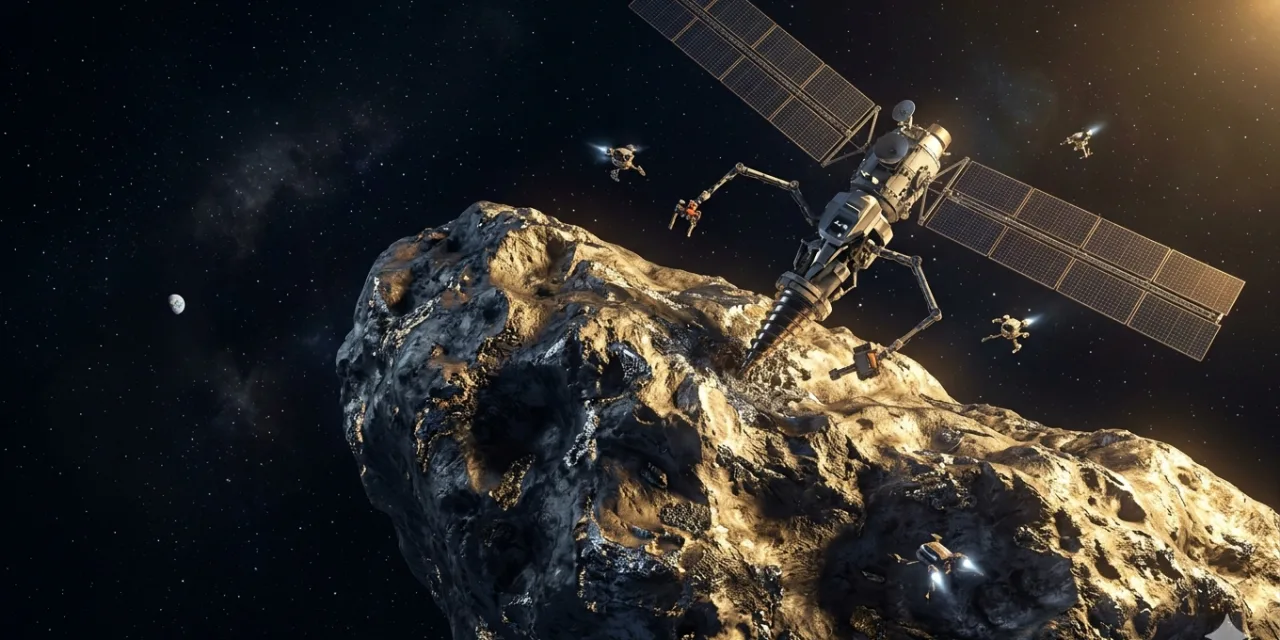
The asteroid 16 Psyche, orbiting the Sun between Mars and Jupiter, is believed to contain approximately 1.7 × 10¹⁹ kilograms of nickel-iron — enough iron alone to supply global production requirements for several million years. Its estimated value in metals has been cited at figures ranging from $700 quintillion to essentially incomprehensible multiples of the entire global economy. A single 30-metre S-type near-Earth asteroid might contain $20 to $50 billion worth of metals. Asteroid tracking catalogues like Asterank estimate approximately 700 known asteroids with individual values exceeding $100 trillion each. The solar system’s asteroid belt contains more than one million objects larger than one kilometre in diameter, and collectively represents a reservoir of mineral resources that dwarfs anything accessible on Earth’s surface by orders of magnitude.
These numbers provoke a reasonable question: if the asteroids are worth this much, why aren’t we mining them already? The answer is equally simple and profound — getting to an asteroid, extracting material from it in microgravity, processing it usefully, and either returning it to Earth or using it in space is an engineering challenge at the frontier of human capability, requiring technologies that are only now being developed and demonstrated. The asteroid mining industry in 2026 is better described as a prospecting era than a production era: multiple private companies and national space agencies have missions currently underway or planned to characterise asteroid composition, test extraction hardware in space, and demonstrate the feasibility of the technologies that commercial extraction will eventually require. The market for asteroid mining services stands at approximately $2.05 billion in 2025, projected to reach $5.42 billion by 2030 at a 21.4 percent compound annual growth rate. Full-scale commercial extraction is, by the most optimistic credible timelines, a decade or more away. But the foundation is being laid, the missions are flying, and the question is no longer whether asteroid mining will happen — only when, and who will lead it.
This guide covers what is actually in asteroids, why their resources matter economically and strategically, the two fundamentally different asteroid mining business models, the companies currently working in this space and what they have achieved and what has failed, the technical challenges of extracting and using asteroid resources, the legal framework that does and does not exist to govern it, and the realistic timeline from prospecting to production.
What Is Actually in Asteroids: The Three Types That Matter
The popular image of asteroid mining — harvesting platinum and gold from space rocks to bring back to Earth and become incomprehensibly wealthy — is technically accurate in its identification of what some asteroids contain, but significantly misleading about what makes asteroid resources actually valuable in the near and medium term. Understanding the three main asteroid types and what they contain is essential context for evaluating which resources are worth pursuing and on what timeline.
C-type asteroids — carbonaceous asteroids — are the most abundant, comprising approximately 75 percent of known asteroids. They are dark, carbon-rich, and typically contain significant amounts of water bound in hydrated clay minerals, along with organic compounds, carbon, and some phosphorus. C-type asteroids are not the richest in precious metals, but they are the most commercially important in the near term for one reason: water. Water in space is extraordinarily valuable — not for drinking, but because it can be electrolysed by solar power into hydrogen and oxygen, which are the components of rocket propellant. Rocket fuel is the most expensive commodity in the space economy, because every kilogram of propellant used beyond Earth orbit has to be lifted from Earth’s surface against gravity at enormous cost. A source of water in space — orbiting near the destinations that spacecraft need to reach — would dramatically reduce the cost of space operations and enable missions that are currently economically infeasible. Water is, as industry analysts describe it, “the oil of the solar system.”
S-type asteroids — stony or silicaceous asteroids — contain significant metal fractions, primarily iron, nickel, and cobalt, with trace amounts of precious metals including platinum-group elements. S-type asteroids are more likely than C-type to contain economically interesting concentrations of metals, though the precious metal content still requires careful assessment of individual targets. They are common in the inner asteroid belt and include many near-Earth asteroids that are more accessible from Earth than main-belt targets.
M-type asteroids — metallic asteroids — are the richest in metals, containing high concentrations of iron, nickel, and platinum-group metals. They are rarer than C-type and S-type objects and are believed to be the remnant metallic cores of differentiated planetesimals — bodies that were large enough to differentiate into distinct metal core and rocky mantle layers before being disrupted by collisions. 16 Psyche is the largest known M-type asteroid — it is approximately 232 kilometres in diameter and is currently being studied by NASA’s Psyche spacecraft, which entered orbit around the asteroid in 2023. The platinum-group metals in M-type asteroids are of particular commercial interest because they are exceptionally rare on Earth’s surface (concentrated in very few deposits) and are essential for hydrogen fuel cells, catalytic converters, electronics, and cancer treatment drugs — applications whose demand is growing rapidly.
Two Business Models: Space-for-Earth and Space-for-Space
The strategic divide that defines asteroid mining in 2026 is the distinction between two fundamentally different business models, with very different timelines, capital requirements, and markets.
Space-for-Earth mining targets high-value, low-mass materials — primarily platinum-group metals — with the objective of returning them to Earth for sale in terrestrial commodity markets. The economic logic is straightforward: platinum-group metals are rare enough on Earth that even a small quantity returned from an asteroid would be worth enormous amounts. The practical challenge is equally straightforward: a round trip to a near-Earth asteroid capable of returning significant metal mass requires a spacecraft with propulsion, extraction equipment, processing capability, and a return vehicle — all of which must be launched from Earth at current launch costs, survive the journey to a target that may be tens of millions of kilometres away, operate autonomously in the challenging microgravity and thermal environment of an asteroid surface, extract and process material efficiently, and return a payload that justifies the total mission cost. The economics are theoretically viable for platinum-group metals, which are worth approximately $30,000 to $60,000 per kilogram depending on the specific element — but they require extraction efficiencies and launch costs that do not currently exist at commercial scale.
Space-for-Space mining targets materials useful in space — primarily water for propellant production — without the need to return them to Earth. The economic logic here may actually be more near-term viable: the in-space fuel market, even at current launch rates, represents single-digit billions of dollars per year in potential revenue, and providing propellant from asteroid-derived water in orbit would be worth substantially more than its terrestrial equivalent because of the enormous cost of launching fuel from Earth. A refuelling depot in cislunar space or at a Lagrange point, supplied by water extracted from near-Earth asteroids and electrolysed into hydrogen and oxygen, would reduce the cost of every subsequent mission that used it — creating a genuinely transformative economic infrastructure that the nascent space economy would rapidly depend on. Most credible industry analysts in 2026 assess the space-for-space water/propellant model as the more plausible first market, with metal extraction to Earth as a longer-term opportunity that depends on cost reductions in launch and extraction that will take longer to achieve.
The Companies and Their Progress: Who Is Actually Working on This
The asteroid mining space has seen both excitement and attrition over the past decade. Planetary Resources and Deep Space Industries — the two most prominent early commercial asteroid mining ventures — both failed to reach operational missions before being acquired or shut down by 2020, casualties of the capital-intensive nature of the industry and the difficulty of achieving returns on the timescales that investors expected. The current generation of companies has learned from those failures, and the 2026 landscape includes a smaller number of more focused operators pursuing more realistic near-term milestones.
AstroForge (California) is the most advanced commercial asteroid mining company by flight heritage. In February 2025, AstroForge launched its Odin spacecraft — a mass approximately comparable to a microwave oven — becoming the first private company ever to receive a licence to send a spacecraft into deep space. Odin’s mission was to rendezvous with a near-Earth asteroid and characterise its composition using sensors, providing the data needed to evaluate it as a mining target. Unfortunately, Odin developed communication problems shortly after launch, and as of early 2026 the spacecraft has not been able to complete its primary mission. AstroForge has characterised this as a valuable learning experience rather than a mission failure and is proceeding with its next mission. The Vestri spacecraft — a 200-kilogram vehicle using Safran electric propulsion, planned to launch with Intuitive Machines’ IM-3 mission in 2026 — is intended to travel to the same target asteroid as Odin, directly characterise its composition, and potentially collect samples. If Vestri reaches its target, it would be the first private spacecraft to rendezvous with a body outside the Earth-Moon system. AstroForge CEO Matt Gialich has been blunt about the stakes: “We’re going to mine asteroids or go bankrupt, and we’re going to probably figure that out in the next five years.”
Karman+ is pursuing a water-focused model, planning a 2026 mission to go directly to an asteroid and test excavation equipment for extracting water and volatile compounds. Their approach — targeting the arguably more commercially near-term water/propellant market rather than the more headline-friendly metal extraction narrative — reflects the industry’s growing consensus about which market is more achievable first. Their cost targets for in-space propellant production are aggressive, and the company has not yet demonstrated flight hardware beyond conceptual design, making them earlier-stage than AstroForge in terms of demonstrated capability.
Asteroid Mining Corporation (AMC) (UK) has taken a distinctive approach to the capital problem: building revenue-generating applications of its technology on Earth before attempting space operations. AMC’s SCAR-E (Space Capable Asteroid Robotic Explorer) robot — a 20-kilogram, six-legged autonomous system designed to operate in microgravity and traverse rugged surfaces — is currently contracted to inspect ship hulls in terrestrial marine applications, generating revenue in a $13 billion global market while the space applications develop. In 2026, AMC plans a demonstration mission analysing soil on the Moon’s surface, in partnership with Japan’s ispace under a memorandum of understanding signed in 2024. The SCAR-E approach — building commercially deployable technology that happens to work on asteroids rather than asteroid-specific technology that needs space applications to monetise — represents a more capital-efficient path to operational capability than prior asteroid mining ventures pursued.
TransAstra (Los Angeles) is developing its patented Optical Mining process — using concentrated sunlight rather than mechanical drilling to extract volatiles from asteroid material — alongside orbital logistics systems for transporting extracted resources. TransAstra targets water and volatiles from C-type asteroids for in-space propellant production, positioning itself in the space-for-space market. The company’s founder, Dr. Joel Sercel, brings 14 years of JPL experience and patents in spacecraft propulsion to the venture.
China’s presence in asteroid resource utilisation is notable. Origin Space has an asteroid-observing satellite in Earth orbit, testing mining-relevant technology in a lower-risk environment. China’s Tianwen-2 spacecraft, launched in 2025, is a sample-return mission targeting the near-Earth asteroid 469219 Kamo’oalewa — planned to arrive at the asteroid in 2026 and return samples in 2027, making it the first mission to return material from a near-Earth asteroid since OSIRIS-REx’s return of 122 grams from Bennu in 2023. Tianwen-2’s data will provide the most detailed chemical and physical characterisation of a near-Earth asteroid ever achieved, directly relevant to future extraction mission planning.
The Technical Challenges: What Makes This Hard
Asteroid mining faces a set of engineering challenges that are qualitatively different from terrestrial mining or even other space applications, and understanding them is essential context for evaluating the realistic timeline to commercial operations.
The microgravity problem is fundamental. Asteroids are small — their gravitational fields are negligible compared to any planet or large moon. A person standing on the surface of a small near-Earth asteroid would weigh approximately as much as a piece of paper — and a mining machine that exerts any significant force on the asteroid surface will push itself away rather than into the rock. Every action has an equal and opposite reaction, and when the asteroid’s gravity cannot counteract the reaction forces from drilling or excavating, conventional earthmoving approaches simply do not work. Attachment systems — anchors, nets, gripping mechanisms — that can secure a spacecraft to an irregular, rotating body in microgravity are an active research and engineering challenge. SCAR-E’s six-legged design, capable of gripping and traversing rugged surfaces autonomously, is specifically designed to address this challenge.
Communication delay creates an autonomous operations requirement that adds significant complexity. A near-Earth asteroid at typical close-approach distances is roughly 10 to 100 light-seconds away — meaning round-trip communication delays of 20 seconds to 3 minutes. Main-belt targets like Psyche are tens to hundreds of light-minutes away. At these distances, real-time teleoperation from Earth is impossible. Every mining system must be capable of fully autonomous operation — making decisions, adapting to unexpected surface conditions, diagnosing and responding to equipment failures — without the ability to ask a human for guidance. The AI and autonomy systems required for reliable autonomous operation in the diverse, unpredictable conditions of asteroid surfaces are among the most technically demanding aspects of the mission architecture.
Composition uncertainty is an economic risk that current prospecting missions are specifically designed to address. Ground-based spectroscopic observations of asteroids provide composition estimates, but the mapping between spectral signatures and actual extractable resource concentrations in the subsurface is uncertain. AstroForge’s Odin and Vestri missions — and Tianwen-2’s sample return — are specifically aimed at reducing this uncertainty. Before any company commits the capital for a full extraction mission, they need high-confidence characterisation of their target asteroid’s actual resource content and physical properties. The failure of Odin’s communication system illustrates exactly what happens when this data is not obtained: without reliable composition data, the mission cannot proceed to extraction with confidence.
Extraction and processing in space adds further complexity. Even if an asteroid’s composition is well-characterised and physical attachment is achieved, extracting material efficiently in microgravity — drilling, scraping, or heating to release volatiles — and processing it into usable form (refining metals, electrolyzing water into propellant) requires equipment that must operate reliably in the deep-space thermal environment (extreme temperature swings between sunlit and shadowed regions), vacuum conditions, and the radiation environment of interplanetary space. No asteroid mining extraction system has yet been operated on an asteroid surface, though laboratory demonstrations and analogue testing on Earth are progressing.
The Legal Framework: Who Owns What in Space
The foundational document governing activity in outer space is the 1967 Outer Space Treaty — a Cold War-era agreement among spacefaring nations that establishes that outer space, including the Moon and other celestial bodies, “is not subject to national appropriation by claim of sovereignty, by means of use or occupation, or by any other means.” Nations cannot own asteroids. The treaty, however, is silent on whether private entities can own resources extracted from asteroids — a distinction that has become commercially and legally significant as asteroid mining approaches feasibility.
Several national governments have moved to clarify this ambiguity in favour of their commercial space sectors. The United States passed the Commercial Space Launch Competitiveness Act in 2015, which explicitly states that US citizens engaged in commercial recovery of an asteroid resource “shall be entitled to any asteroid resource or space resource obtained.” Luxembourg passed similar legislation in 2017, and the UAE, Japan, and several other nations have followed with national space resources laws. The Artemis Accords — signed by over 40 nations as of 2026 — include provisions supporting the right to extract and use space resources as part of responsible space exploration.
What remains unresolved is the absence of an international framework that harmonises these national laws and provides a globally recognised system for registering resource extraction activities, adjudicating disputes between operators from different nations, and preventing the kind of unilateral occupation of the best resource sites that the Outer Space Treaty’s prohibition on sovereignty was intended to prevent. The 1967 treaty is being “stretched to its breaking point,” as industry analysts describe it, by the approach of actual commercial extraction — and the creation of a coherent “Space Resource Protocol” that allows commercial extraction while maintaining the treaty’s commitment to space as the province of all humanity is among the most important unresolved governance challenges in the field.
The Economic Case: Space-for-Space First, Earth Markets Later
The headline numbers associated with asteroid mining — quintillions of dollars worth of metals, enough platinum to transform global supply chains, 16 Psyche’s iron supply for millions of years — are technically accurate and practically irrelevant to the near-term business case. Flooding the terrestrial platinum market with asteroid-derived supply would immediately crash the price that makes the mission economically worthwhile in the first place. The economics of asteroid mining for Earth markets are inherently self-limiting: the more successful extraction becomes at scale, the less valuable the extracted material becomes.
The space-for-space market does not have this problem. Every kilogram of water extracted from a near-Earth asteroid and converted to propellant in orbit replaces a kilogram of propellant that would otherwise have to be launched from Earth at costs that currently run $2,000 to $10,000 per kilogram (and even lower with reusable vehicles like Starship, but still substantially positive). The demand for propellant in space will grow as the space economy expands — more satellites, more commercial space stations, more lunar and Mars missions all require fuel — and the marginal value of in-space propellant is determined by the cost of the Earth-launch alternative, not by any commodity market that asteroid extraction would flood.
The overall space economy reached approximately $626 billion in 2026 — a sector that already includes satellite communications, Earth observation, GPS services, and government space programmes. Within this, asteroid mining currently represents a tiny fraction focused on prospecting and demonstration. The market research projection of $2.05 billion in 2025 growing to $5.42 billion by 2030 at 21.4 percent CAGR reflects mission services, technology development, and early operational activities — not yet commercial resource sales. The $500 billion estimate for space resources by 2050 represents the longer-horizon vision if multiple successful extraction and utilisation systems are operating by then.
NASA’s Psyche Mission: Science Informing Commerce
While commercial ventures are developing extraction technology, NASA’s Psyche spacecraft — which entered orbit around the asteroid 16 Psyche in 2023 — is conducting the most detailed scientific characterisation of an M-type metallic asteroid ever attempted. Psyche the asteroid is believed to be the exposed metallic core of an early planetesimal — a body that differentiated into a metal core and rocky mantle before being stripped of its outer layers by collisions. Studying it provides unique insight into the interior structure of differentiated planetary bodies, including Earth itself, whose metal core is inaccessible to direct sampling.
For the asteroid mining industry, Psyche’s data has direct commercial relevance: understanding the composition, density, and surface properties of the most valuable type of asteroid — at higher resolution than any previous observation — directly informs mission planning for future commercial extraction attempts. The data on how metallic asteroid surfaces behave, what their regolith (surface material) properties are, and how their gravity fields and rotation compare to models will reduce the technical uncertainty facing every company planning extraction missions to M-type targets.
The Realistic Timeline: What to Expect and When
The asteroid mining industry in 2026 is at exactly the stage that the oil industry was in the 1850s — when the first wells were being drilled and the technical feasibility of extracting a resource was being demonstrated, while the full infrastructure of production, transportation, refining, and distribution that would eventually make it an industrial backbone was decades away from existence. The analogy is imperfect in many ways, but it captures the character of the moment: something real is being built, but the distance between the current state and the mature industry envisioned in the most optimistic projections is substantial.
In the near term — 2026 to 2030 — the realistic milestones are: AstroForge’s Vestri mission reaching its target asteroid and returning useful composition data; Karman+ completing a water extraction demonstration; China’s Tianwen-2 returning the first samples from a near-Earth asteroid; and the accumulation of the technical learning from these missions that will inform the design of first-generation extraction systems. Market revenues in this period will be dominated by mission services and technology development, not resource sales.
In the medium term — 2030 to 2040 — the first operational in-space water extraction systems could become viable if the technical demonstrations succeed and launch costs continue declining. Early propellant depot operations, initially small-scale, could begin providing in-space fuel for commercial and government missions. Metal extraction for terrestrial markets would remain a longer-horizon activity, requiring advances in autonomous processing and return vehicle technology that are not yet at demonstration stage.
In the long term — 2040 and beyond — the convergence of declining launch costs (enabled by fully reusable launch systems), mature autonomous extraction technology, demonstrated in-space resource processing, and growing demand from an expanding space economy could enable the kind of large-scale commercial asteroid mining that today’s valuations suggest is possible. The trillion-dollar resources of the asteroid belt are not going anywhere. The question of when and how humanity accesses them is being answered, incrementally and imperfectly, by the missions flying and the companies building in 2026.





0 Comments
No comments yet. Be the first to share your thoughts!