
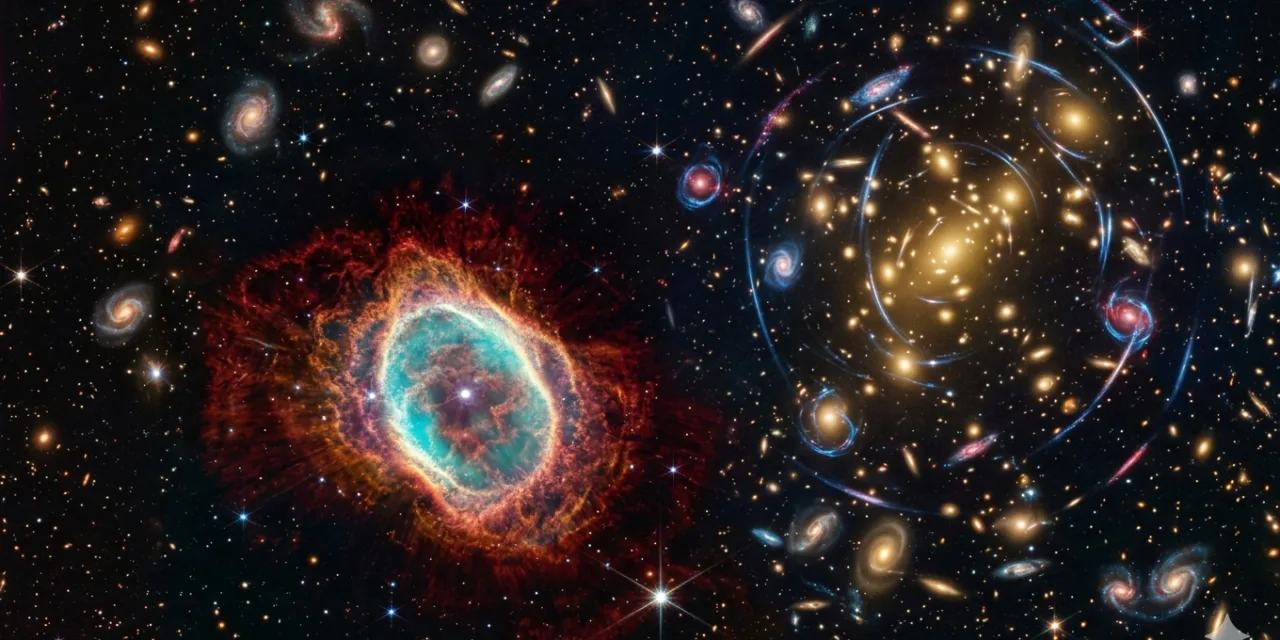
In January 2026, the James Webb Space Telescope confirmed the existence of MoM-z14 — a brilliantly luminous galaxy that existed just 280 million years after the Big Bang. Its redshift of 14.44 makes it the most distant galaxy ever confirmed, sitting at the edge of what we can observe in time and space. The MIT lead researcher on the discovery described what Webb has been showing us with characteristic honesty: “With Webb, we are able to see farther than humans ever have before, and it looks nothing like what we predicted, which is both challenging and exciting.” That phrase — it looks nothing like what we predicted — has become the defining theme of Webb’s scientific programme. Again and again, in domain after domain, the telescope has produced results that contradict existing models, upend long-held assumptions, and require the scientific community to build new explanations for phenomena it thought it understood.
The James Webb Space Telescope was launched on Christmas Day 2021, after three decades of development and a series of delays that made it one of the most anticipated scientific instruments in history. It became operational in 2022, and within its first four years of science operations it has produced more significant discoveries than most observatories achieve across their entire lifetimes. Its design — a 6.5-metre segmented primary mirror optimised for infrared wavelengths, positioned at the L2 Lagrange point 1.5 million kilometres from Earth — gives it capabilities that no predecessor possessed: the ability to see the light of the universe’s first galaxies directly, to characterise the atmospheric chemistry of planets around other stars with unprecedented precision, and to peer through the dust and gas that obscured entire categories of cosmic objects from every previous telescope.
This guide covers the most significant categories of Webb’s discoveries through 2026 — not just the breathtaking images, but the scientific meaning of what those images have revealed. Some of Webb’s discoveries represent advances within existing frameworks: seeing things we expected to see but had never seen so clearly. Others are genuinely disruptive: findings that require reconsideration of the theoretical foundations of cosmology, galaxy formation, and our understanding of what the early universe was actually like. The distinction matters for understanding why Webb represents not just a new telescope but a new era in humanity’s ability to understand the cosmos.
How Webb Works: The Engineering That Made It Possible
Understanding what Webb has discovered requires a brief explanation of what makes it different from its predecessors — because the differences are not incremental but categorical.
The Hubble Space Telescope, which launched in 1990 and remains operational, was designed primarily for ultraviolet and visible light observation. Hubble has produced some of the most iconic astronomical images in history and enabled discoveries that reshaped cosmology, including the confirmation of the universe’s accelerating expansion. But the most distant and most ancient objects in the universe are invisible to Hubble: the expansion of the universe stretches the light from early galaxies to such long wavelengths — a phenomenon called cosmological redshift — that their light shifts entirely out of the visible and ultraviolet range that Hubble can detect, into the infrared.
Webb was designed specifically to see this redshifted light. Its instruments span near-infrared wavelengths from 0.6 to 5 microns (covered by NIRCam, the Near InfraRed Camera, and NIRSpec, the Near InfraRed Spectrograph) and mid-infrared wavelengths from 5 to 28 microns (covered by MIRI, the Mid-Infrared Instrument). This infrared capability does two things that define Webb’s scientific programme. First, it allows Webb to see objects at cosmological distances whose light has been redshifted beyond Hubble’s reach — the first galaxies, the first stars, the structures of the universe at its earliest and most distant epochs. Second, infrared light passes through dust and gas that absorbs visible and ultraviolet light — allowing Webb to see into dusty stellar nurseries, the enshrouded cores of galaxies, and planetary systems in formation in a way that would be impossible for an optical telescope.
Webb’s sensitivity is also qualitatively different from Hubble’s. Its primary mirror, at 6.5 metres in diameter, collects approximately six times as much light as Hubble’s 2.4-metre mirror. Combined with its L2 location — far from Earth’s warmth and shielded by a five-layer sunshield the size of a tennis court that keeps the telescope at operating temperatures near absolute zero — Webb can detect extraordinarily faint infrared signals that would be overwhelmed by thermal noise in any warmer instrument. The telescope’s precise alignment of 18 hexagonal mirror segments into a single coherent optical surface, adjusted with nanometre-scale precision after launch, was itself one of the most technically challenging achievements in the history of space engineering.
The Universe-Breaker Galaxies: Rewriting the Story of Cosmic Dawn
The discovery that has generated the most sustained scientific upheaval since Webb began operations is the systematic detection of massive, luminous galaxies existing at much earlier cosmic times than standard models of galaxy formation predicted possible. These objects — many of which are significantly more massive and more luminous than any galaxy that existing theoretical frameworks suggested could exist so early — have been informally dubbed “universe breakers” by the astronomical community, reflecting the challenge they pose to the Lambda-CDM model of cosmology that has served as the standard description of cosmic structure formation for decades.
The scale of the challenge became clear shortly after Webb began operations. In its first deep field images, Webb detected numerous galaxies at high redshifts — meaning they existed very early in cosmic history — that were far more massive and far more luminous than expected. The discovery of MoM-z14 in early 2026, existing just 280 million years after the Big Bang at a redshift of 14.44, is the most extreme example yet of this pattern. But the extraordinary thing about MoM-z14 is not just its distance — it is what Webb’s spectroscopy revealed about its composition. The galaxy’s light shows high concentrations of nitrogen — an element that is not produced during the Big Bang itself but forms deep inside stellar cores and is dispersed only when massive stars explode as supernovae. Finding significant nitrogen enrichment in a galaxy just 280 million years old implies that the galaxy had already gone through multiple generations of stellar birth, evolution, and death in an extraordinarily short time — a timeline that existing models of star formation do not accommodate without substantial revision.
The pattern repeats across Webb’s high-redshift galaxy census. The “little red dots” — compact, intensely red objects identified in Webb’s deep field images and initially assumed to be active galactic nuclei powered by actively feeding black holes — are revealing extraordinary diversity in their nature as follow-up observations accumulate. In January 2026, Harvard’s Center for Astrophysics revealed that at least some little red dots are consistent with being supermassive stars of approximately one million solar masses: short-lived cosmic behemoths that produce all the spectral signatures Webb has been detecting without requiring the complex machinery of black hole accretion, and that would collapse directly into the seeds of supermassive black holes — explaining both the early galaxy puzzle and the early supermassive black hole puzzle simultaneously.
ESA’s Webb team framed the collective implication of these discoveries clearly: the early universe appears to have been far more efficient at forming stars, building massive galaxies, and growing supermassive black holes than any model built before Webb’s observations predicted. The Lambda-CDM model, which describes how gravity pulls dark matter and ordinary matter together to form cosmic structures hierarchically — small structures forming first and merging into larger ones over time — appears to be producing structures too slowly in its earliest phases to match what Webb is actually seeing. Something in the first few hundred million years of cosmic history was significantly different from — and more productive than — current models describe. Working out what that something is represents one of the most active and consequential frontiers in cosmology.
Exoplanet Atmospheres: Reading the Chemical Fingerprints of Distant Worlds
If Webb’s early universe discoveries are rewriting cosmology, its exoplanet atmospheric characterisation programme is rewriting astrobiology — by making the search for life beyond Earth not a theoretical aspiration but an active observational programme yielding real, analysable data.
Webb characterises exoplanet atmospheres through a technique called transmission spectroscopy. When a planet passes in front of its star, a tiny fraction of the star’s light filters through the planet’s atmosphere on its way to our detectors. Different molecules in the atmosphere absorb specific wavelengths of that light, leaving characteristic “fingerprints” in the spectrum that reveal the atmosphere’s chemical composition. Webb’s sensitivity and infrared capabilities make it far more powerful for this application than any previous telescope — it can detect molecular signatures that were too faint or at too long a wavelength for Hubble, Spitzer, or ground-based facilities to identify.
The most significant exoplanet atmospheric discovery of Webb’s mission so far is the detection of possible biosignature gases at the sub-Neptune hycean world K2-18b, covered in detail in our exoplanets article. But K2-18b is far from the only striking atmospheric detection. Webb made the first-ever detection of carbon-based molecules in the atmosphere of a planet in a star’s habitable zone — methane and carbon dioxide in K2-18b’s atmosphere — establishing the principle that complex organic chemistry can exist in the atmospheres of habitable-zone worlds. Webb confirmed in its first science observations that the gas giant WASP-96b’s spectrum shows clear water vapour signatures with unprecedented precision. It detected a thick atmosphere around the ancient magma-ocean world TOI-561b — a planet so hot and so close to its star that, by every previous rule, it should be a bare rock with no atmosphere at all.
Webb’s characterisation of the TRAPPIST-1 system has been scientifically complex in its implications. TRAPPIST-1 b, the innermost planet, was confirmed to have no significant atmosphere — its surface baked bare by the star’s radiation. TRAPPIST-1 d was similarly found to apparently lack an Earth-like atmosphere. But these findings about the inner planets have concentrated scientific attention on the three outer, habitable-zone planets — TRAPPIST-1 e, f, and g — whose atmospheric analyses remain in progress and represent the highest-priority targets for continued Webb observation in 2026 and beyond. Webb’s first direct measurements of a potential moon-forming disc around a giant exoplanet also extended its planetary science reach in an unexpected direction, providing the first direct observational evidence for a process theorised to produce the moons of gas giants — a discovery relevant to the formation of moon systems across the galaxy.
For the TRAPPIST-1 system specifically, Webb has identified that TRAPPIST-1 d’s spectrum is not consistent with a water-dominated or CO2-dominated atmosphere, narrowing the range of atmospheric compositions consistent with the data. The negative results on inner TRAPPIST-1 planets are in one sense discouraging — they reduce the probability that these specific planets are habitable. In another sense, they are scientifically productive: they establish constraints on how red dwarf stellar environments affect atmospheric retention that will shape all future assessments of TRAPPIST-like systems. Understanding the conditions under which planets lose their atmospheres to stellar radiation is as important for the search for life as understanding what atmospheres contain when they survive.
The Building Blocks of Life, Found Across the Universe
In February 2026, Webb produced a discovery with profound implications for astrobiology that received less attention than the biosignature headlines from K2-18b but is in some ways more far-reaching: the detection of an extraordinary concentration of organic molecules — including benzene, methane, acetylene, diacetylene, triacetylene, and the highly reactive methyl radical — deep inside the dust-enshrouded core of the ultra-luminous infrared galaxy IRAS 07251-0248. The methyl radical detection was the first of its kind beyond the Milky Way. The concentrations found were “far higher than predicted by current theoretical models,” according to the team leader from Spain’s Center for Astrobiology.
This finding matters for astrobiology not because it indicates life in a distant galaxy — the conditions inside an ultra-luminous infrared galaxy are inhospitable to biology as we understand it — but because it demonstrates that the chemical precursors to life’s building blocks form naturally and abundantly in the extreme environments associated with intense star formation and supermassive black hole activity. The organic molecules found in IRAS 07251-0248’s core are not themselves biological, but they represent steps in the chemical pathway from simple atoms to the amino acids, nucleotides, and lipids that life requires. Finding them in concentrations far exceeding theoretical predictions indicates that the universe’s chemistry is richer and more productive of complex organic molecules than current models assume — a finding that supports the hypothesis that prebiotic chemistry is widespread throughout the cosmos.
Webb made a complementary discovery in November 2025: detecting the building blocks of life frozen in ices around a young star in a neighbouring galaxy — including complex organic molecules that could serve as the precursors to amino acids and other biologically relevant compounds. The finding suggested that the molecular ingredients for life are deposited into young planetary systems not just locally but throughout galaxies beyond our own — extending the distribution of prebiotic chemistry to a cosmological scale. Taken together, these discoveries are building a picture in which complex organic chemistry is not an accident unique to the conditions that produced Earth’s biosphere but a systematic feature of the universe’s chemistry wherever the right conditions for molecular complexity exist.
Sagittarius A*: Webb’s Intimate Portrait of Our Own Black Hole
While much of Webb’s attention has been directed outward toward the distant universe, some of its most striking observations have focused on objects within and near our own galaxy — including the supermassive black hole at the Milky Way’s centre, Sagittarius A*.
Using Webb’s NIRCam instrument to observe Sagittarius A* over 48 hours of continuous observation spread across one year, a team of astrophysicists produced the most detailed and longest-duration infrared view ever obtained of our galaxy’s central black hole. The results were surprising in their vividness: Sagittarius A* generates five to six major flares per day and numerous smaller sub-flares, with its accretion disk never entering a state of true rest. This contradicted earlier impressions of Sagittarius A* as a relatively dormant black hole — it is genuinely active, with its accretion disk continuously generating energetic events across multiple timescales from seconds to hours.
The multi-wavelength nature of the flare analysis revealed details about the physical processes occurring near the black hole. The time delay between flares detected at different infrared wavelengths indicates that particles lose energy over the course of flares faster at shorter wavelengths than at longer ones — consistent with synchrotron radiation from particles spiralling around magnetic field lines in the intense magnetic environment of the accretion disk. These observations are informing physical models of how matter and energy behave in the strong-gravity, strong-magnetic-field environment immediately surrounding a massive black hole — a regime where the interplay between gravity, magnetism, and relativistic particle physics is complex enough that direct observational constraints are invaluable.
Cosmic Dawn: The First Stars and the Epoch of Reionisation
One of Webb’s primary science objectives was to observe the “cosmic dawn” — the period approximately 100 to 500 million years after the Big Bang when the universe’s first stars ignited and began transforming the opaque, neutral gas that filled the early universe into the ionised, transparent medium we observe today. This era, called the Epoch of Reionisation, left its mark on every subsequent structure in the universe — but it occurred so long ago and the objects responsible for it are so intrinsically faint that no previous telescope could observe it directly.
Webb is providing the first direct observational constraints on the Epoch of Reionisation by detecting and characterising the galaxies and quasars that existed during and immediately after it. The detection of active supermassive black holes at redshifts above 8 — existing when the universe was less than 600 million years old — through the confirmed detection of the galaxy CANUCS-LRD-z8.6 at just 570 million years post-Big Bang is one dimension of this effort. The ESA Webb team notes that this discovery “challenges existing theories about the formation of galaxies and black holes in the early Universe” and that “the discovery connects early black holes with the luminous quasars we observe today” — establishing an observational link between the earliest cosmic structures and the phenomena we observe in the more mature universe.
Webb has also characterised the chemical composition of galaxies across cosmic time in ways that constrain when and how rapidly the universe was enriched with the heavy elements produced by stellar nucleosynthesis. A Carnegie Science team studied 33 “teenage” galaxies from 2 to 3 billion years after the Big Bang, detecting not just the expected oxygen signals but unexpected signatures of sulfur and argon — chemical elements whose abundance at that cosmic epoch had not previously been measurable. These findings are building a more detailed picture of how the universe’s chemical composition evolved from the pure hydrogen and helium of the Big Bang to the rich elemental diversity required for rocky planets and biology.
The Hubble Tension: Webb’s Role in One of Cosmology’s Biggest Problems
One of the most significant unresolved problems in modern cosmology is the “Hubble tension” — a significant discrepancy between two independent measurements of the universe’s current rate of expansion, known as the Hubble constant. The value derived from measurements of the cosmic microwave background (the afterglow of the Big Bang, studied in extraordinary detail by the Planck satellite) gives a Hubble constant of approximately 67 kilometres per second per megaparsec. The value derived from measuring the distances and recession velocities of nearby galaxies using a “distance ladder” of calibrated standard candles gives a value of approximately 73 kilometres per second per megaparsec. The discrepancy between these values — approximately 8 percent — is large enough that statistical fluctuation cannot explain it, yet systematic error in either method has been difficult to identify despite intensive investigation.
Webb was specifically equipped to help resolve this tension by providing more precise measurements of Cepheid variable stars — the pulsating stars used as standard candles in the distance ladder — at distances far enough to reduce the systematic uncertainties that could affect ground-based measurements. Webb’s first results on this front were significant but not conclusive: they confirmed that the Hubble measurements using Cepheids are not contaminated by systematic errors from stellar crowding that had been proposed as an alternative explanation for the tension. The tension persists after Webb’s Cepheid measurements. Either the distance ladder measurements are systematically off in a way Webb has not yet identified, or the cosmic microwave background measurements are, or — most provocatively — the standard cosmological model is missing some physical ingredient that affects the expansion rate at different cosmic epochs. The tension has been confirmed by Webb as real; its resolution remains one of cosmology’s most pressing open questions.
Planetary Science Within Our Own Solar System
While Webb’s primary scientific programme focuses on the distant universe and on exoplanets around other stars, its infrared sensitivity has also produced striking new observations of objects within our own solar system that no previous space telescope could characterise at comparable resolution and spectral coverage.
Webb and Hubble joined forces in late 2024 to capture complementary views of Saturn — Webb in the infrared, Hubble in the visible — revealing Saturn’s dynamic atmosphere and ring system in strikingly different ways and providing new data on seasonal atmospheric changes on the ringed planet. Webb provided the first three-dimensional mapping of auroras on Uranus — revealing the structure of the ice giant’s auroral emissions in unprecedented detail and providing constraints on its magnetic field that have implications for the planned future Uranus orbiter mission. The telescope also observed Neptune’s rings and moons with infrared sensitivity that complements Voyager’s flyby data from 1989 and provides the most detailed characterisation of Neptune’s system since that encounter.
Webb intercepted and observed interstellar comet 3I/ATLAS — the third confirmed interstellar object detected passing through our solar system — using its Near-Infrared Spectrograph instrument. The observation characterised the comet’s composition as it approached the Sun, revealing it to be rich in methanol and providing the first spectroscopic characterisation of the material from another stellar system that can be compared directly to the composition of comets from our own solar neighbourhood. These comparisons will eventually help establish whether the building blocks of our solar system are typical of what other stellar systems produce, or whether our particular chemistry is in some way unusual.
Dying Stars and Nebulae: Seeing the Familiar With New Eyes
Webb has not only extended our reach to the most distant corners of the observable universe — it has also transformed our understanding of familiar objects much closer to home, by revealing structure and chemistry in dying stars, nebulae, and stellar nurseries that was previously invisible to both ground-based and space-based telescopes operating at visible wavelengths.
In 2025, Webb provided its most detailed views yet of the Butterfly Nebula (NGC 6302) — a planetary nebula produced by a dying star expelling its outer layers in a complex bipolar outflow. The Webb observations revealed unprecedented detail in the nebula’s dense, dusty torus, its outflowing jets, and the intricate internal structure of its gas shells — detail that the team described as “a never-before-seen portrait of a dynamic and structured planetary nebula.” Webb also provided what ESA described as “the clearest infrared look” at the Helix Nebula, one of the closest planetary nebulae to Earth, revealing internal structure at a resolution that surpasses every previous imaging of the object.
Beyond nebulae, Webb has made the first direct identification of a supernova progenitor — the star that existed before a supernova explosion — that was invisible to Hubble despite extensive searching. The progenitor, a red supergiant in a nearby galaxy, was obscured by dust that blocked the visible light Hubble is sensitive to but passed the infrared light that Webb detects. This capability — seeing through dust — is enabling a new generation of stellar evolution studies in which the connections between specific progenitor stars and the explosions they produce can be established directly rather than inferred from population statistics.
What Webb Means for Science — and for Us
The James Webb Space Telescope is now four years into its science programme and showing no signs of diminishing scientific productivity. Its fuel reserves — used for orbital maintenance — are sufficient for at least a decade of further operations, and possibly significantly longer. The scientific community’s allocation of Webb observation time is competitive and oversubscribed by factors of eight to ten, reflecting a demand for its capabilities that far exceeds the supply of observation hours. Webb is not merely a new telescope. It is a new sensory organ for science — revealing a universe that previous instruments could not see, in ways that previous models did not predict, with results that previous theories do not fully explain.
The pattern of Webb’s discoveries is consistent and significant: the early universe contains more structure, more complexity, and more chemical richness than the models built before Webb predicted. Whether this means those models need minor adjustments or foundational revisions is a question that the scientific community is actively debating. The Lambda-CDM model that describes cosmic structure formation has survived extraordinary empirical challenges in its 30-year history as the standard cosmological framework — but it has survived because each new observation could be accommodated with parameter adjustments or subsidiary model extensions. What Webb is producing, cumulatively, is a dataset that is harder to accommodate incrementally and that is increasingly motivating more fundamental reconsideration of early universe physics.
For the question that ultimately matters most — are we alone? — Webb’s contributions have been remarkable. The detection of possible biosignatures at K2-18b, the characterisation of atmospheric chemistry at multiple exoplanets, the discovery of organic molecules far more abundant than predicted across multiple galactic environments, and the establishment of a prioritised list of the 45 most promising habitable-zone rocky worlds for immediate follow-up are collectively pushing the search for life beyond Earth from speculation to observation. Webb cannot definitively answer the question — that will require confirmation observations, possibly the Extremely Large Telescope, and ultimately the Habitable Worlds Observatory. But it has transformed the question from “is there anything to find?” to “where exactly should we look next?” — and that transformation is one of the most significant scientific advances of the 21st century.
The MIT researcher who described MoM-z14 captured something essential about what Webb means: “It looks nothing like what we predicted.” In science, that is not a failure. It is the sound of understanding advancing.
0 Comments
No comments yet. Be the first to share your thoughts!