
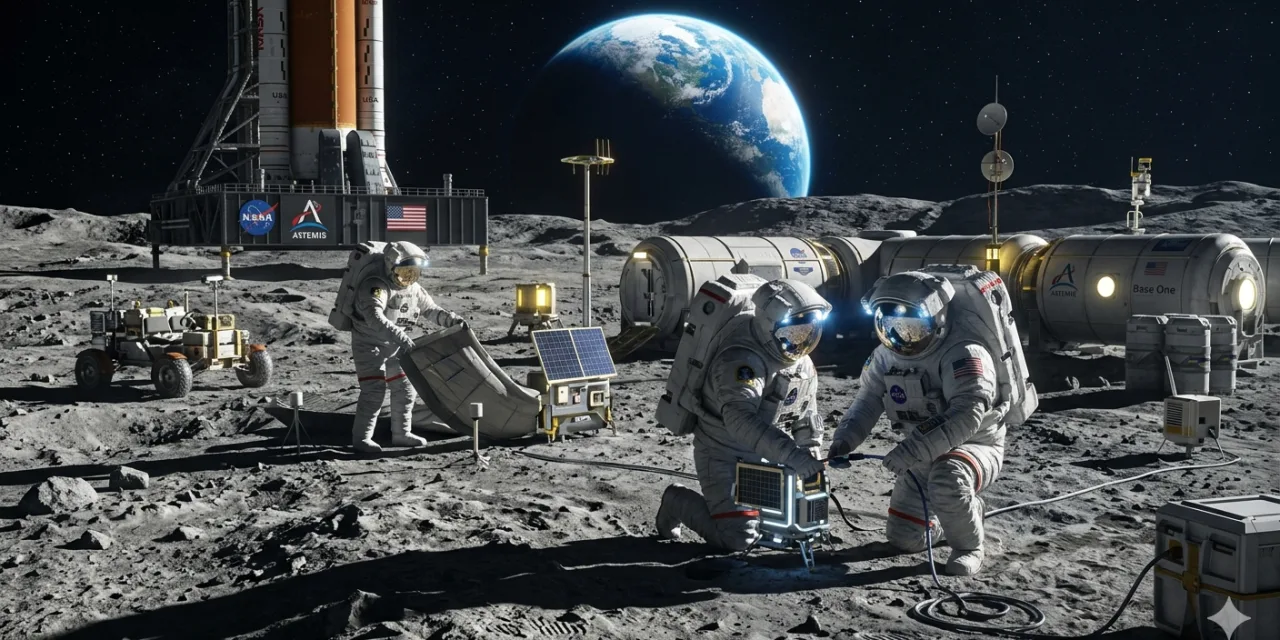
At 6:35 p.m. EDT on Wednesday, April 1, 2026, a 98-metre Space Launch System rocket lifted off from Launch Pad 39B at Kennedy Space Center in Florida and carried four astronauts toward the Moon. Inside the Orion spacecraft — which the crew had named Integrity — were Commander Reid Wiseman, Pilot Victor Glover, Mission Specialist Christina Koch, and Canadian Space Agency astronaut Jeremy Hansen. The moment the rocket cleared the launch tower, Victor Glover became the first Black astronaut to travel beyond low Earth orbit. Christina Koch became the first woman. Jeremy Hansen became the first non-American to venture to the vicinity of the Moon. Reid Wiseman became the oldest person to leave Earth orbit.
The following day, on April 2, 2026, mission control polled “Go” for the translunar injection burn — a five-minute-and-55-second firing of Orion’s main engine that accelerated the spacecraft to 1,274 feet per second faster than its orbital velocity and sent it on a free-return trajectory looping around the far side of the Moon and back to Earth. “For the first time since 1972 during Apollo 17, human beings have left Earth orbit,” said Dr. Lori Glaze, acting associate administrator for NASA’s Exploration Systems Development Mission Directorate, at the post-burn press briefing. Astronaut Christina Koch, speaking to mission control from aboard Orion, marked the moment with words that will be remembered: “With this burn to the Moon, we do not leave Earth. We choose it.”
As this article is published, Artemis II’s crew is in deep space — travelling toward the Moon for the first time in more than half a century, testing the systems that will carry future astronauts to the lunar surface, and setting records for how far from Earth any human being has ventured since the last Apollo crew splashed down in December 1972. What is happening right now is the beginning of humanity’s return to the Moon. This is the complete guide to the Artemis programme — what it is, how we got here, what Artemis II is doing, what the path to a lunar landing looks like, and why any of it matters.
Why We Stopped Going and Why We Are Going Back
The Apollo programme achieved something that, measured by any objective standard, remains the most technically demanding and audacious endeavour in human history. Between July 1969 and December 1972, twelve human beings walked on the surface of another world. They collected 382 kilograms of lunar rocks, planted flags, drove a rover across the regolith, and returned safely to Earth on six separate occasions. Apollo 17, the final mission, splashed down in the Pacific on December 19, 1972. No human being has been further from Earth than low Earth orbit since that day — a gap of more than 53 years.
The reason is simultaneously mundane and sobering. Apollo was an enormously expensive emergency programme, born in the geopolitical crisis of the Space Race and sustained by Cold War urgency that evaporated after the first Moon landing. Once the strategic goal had been achieved — demonstrating to the world that American technology could put a man on the Moon before the Soviet Union — the political will to fund the programme at Apollo-level cost dissipated rapidly. Subsequent Apollo missions were cancelled. The hardware was decommissioned. The institutional knowledge began to disperse as engineers retired. The political context that had made an investment of approximately $25 billion (in 1960s dollars, equivalent to roughly $260 billion today) politically viable ceased to exist.
NASA attempted two major programmes aimed at returning humans to the Moon in the decades that followed. The Constellation programme, announced by President George W. Bush in 2004, was cancelled in 2010 before any crewed hardware had flown. Its successor — the Artemis programme, announced in 2017 under the direction that NASA should return to the Moon “by 2024” — has taken longer than initially planned but has, as of yesterday, sent its first crew to lunar distance. The name Artemis is deliberate: in Greek mythology, Artemis is the twin sister of Apollo. The programme’s core ambition goes beyond the Apollo template. Rather than planting flags and returning, Artemis aims to establish a sustained human presence on and around the Moon — a foundation for the long-term exploration of the solar system, with Mars as the eventual horizon.
The Machines: SLS, Orion, and the European Service Module
The Space Launch System is the most powerful rocket ever to carry astronauts to space. Standing 98 metres tall — taller than the Statue of Liberty with its base — and generating 8.8 million pounds of thrust at launch, it is more powerful than the Saturn V rockets that sent Apollo crews to the Moon. Like the Saturn V, it is a expendable rocket: its core stage and solid rocket boosters are not recovered after launch. Unlike modern commercial rockets designed around reusability, SLS is a single-use vehicle — a design choice that has been extensively and fairly criticised for its cost implications, with each SLS launch estimated to cost approximately $4 billion.
SLS uses a core stage powered by four RS-25 engines — the same engines that powered the Space Shuttle, now expended in the ocean after each launch rather than refurbished for reuse as they were during the Shuttle programme. The core stage is flanked by two five-segment solid rocket boosters, also derived from Shuttle technology. Above the core stage sits the Interim Cryogenic Propulsion Stage, which provides the final push for missions beyond Earth orbit. The SLS has flown twice: first on the uncrewed Artemis I mission in November 2022, and now on Artemis II. Both flights have been technically successful.
The Orion spacecraft is the crew vehicle that sits atop the SLS. Comparable in concept to the Apollo capsule but with a significantly larger interior and far more sophisticated systems, Orion is designed to sustain up to four astronauts on deep-space journeys lasting weeks to months. Its heat shield — the largest ablative heat shield ever built — is designed to withstand the high-velocity reentry from lunar distance, which reaches approximately 25,000 miles per hour and subjects the shield to temperatures around 2,760 degrees Celsius. After Artemis I, NASA identified unexpected erosion in sections of the heat shield and conducted an extended analysis to understand and address the anomaly before committing to a crewed mission. That analysis was one of the factors that pushed Artemis II from its earlier target windows into its April 2026 launch.
The European Service Module — provided by the European Space Agency as part of an international partnership — attaches to the base of the Orion capsule and provides its power, propulsion, thermal control, and consumables: water, oxygen, and the nitrogen used to maintain cabin atmosphere. Each of Orion’s four solar array wings extends outward from the service module, giving the fully deployed spacecraft a wingspan of approximately 63 feet. The European contribution to Orion reflects the international character that Artemis, unlike Apollo, was designed to embody from the outset.
The Artemis II Mission: What Is Happening Right Now
Artemis II is explicitly a test flight, and its crew and mission controllers are emphatic about this framing. “Artemis II is a test flight, and the test has just begun,” said NASA Associate Administrator Amit Kshatriya at the post-launch press conference. “Over the next 10 days, Reid, Victor, Christina, and Jeremy will put Orion through its paces so the crews who follow them can go to the Moon’s surface with confidence.” Everything that happens on Artemis II generates data and operational experience that reduces risk for the missions that follow.
The mission launched on April 1, 2026, with Orion entering an elliptical Earth orbit approximately 49 minutes after liftoff when the upper stage fired to place it on its initial trajectory. The spacecraft then performed a proximity operations demonstration — a manual piloting test in which the crew guided Orion through a controlled approach and separation from the upper stage, demonstrating the spacecraft’s handling characteristics in space at close range to another object. This capability will be essential for the docking manoeuvres required on future Artemis missions that involve rendezvous with commercial landers. The toilet was also briefly offline following the proximity operations demonstration — a non-critical but attention-getting early systems issue that the crew resolved quickly.
After a perigee raise manoeuvre and an apogee raise burn to refine Orion’s trajectory, the mission management team polled “Go” for the translunar injection burn on April 2. The five-minute-and-55-second burn, executed by Orion’s main engine on the European Service Module, added 1,274 feet per second to the spacecraft’s velocity and sent it on a free-return trajectory. A free-return trajectory is a mathematically elegant solution to a practical problem: because of orbital dynamics and the Moon’s gravity, a spacecraft placed on the right trajectory will loop around the Moon and return to Earth even if its engine never fires again. This design choice — comparable to that used on Apollo 8 and Apollo 13 — provides a built-in abort capability. If Orion’s propulsion system fails entirely, the crew will still return to Earth safely.
The planned mission profile runs for approximately ten days. The four-day outbound journey brings Orion to the Moon’s vicinity, where on approximately April 6 the spacecraft will perform a close lunar flyby — coming within roughly 8,000 kilometres of the lunar surface and swinging around the far side. During this flyby, the crew will be the first people in 54 years to see the Moon’s far side with human eyes, and will take photographs and make observations of terrain areas that no astronaut has ever seen from such proximity. The spacecraft will then arc back toward Earth on a figure-eight path, with splashdown in the Pacific Ocean near San Diego, California, targeted for approximately April 10, 2026.
Throughout the flight, the crew will conduct a systematic programme of systems testing. Life support systems — critical to all future long-duration deep-space missions — are being evaluated for the first time with actual crew members generating the heat, carbon dioxide, and humidity loads that real humans produce. The Orion crew survival system spacesuits — designed not just for launch and reentry but for emergency use including pressurisation in the event of cabin depressurisation — are being tested in space for the first time, including pressurisation, donning, and life support functions. Medical equipment including thermometers, blood pressure monitors, stethoscopes, and other health monitoring tools are being checked. The Deep Space Network communications system is being evaluated. AVATAR — A Virtual Astronaut Tissue Analog Response — is flying as a payload for the first time beyond the International Space Station and the Van Allen Belt, gathering data about how deep-space radiation affects biological tissue that will inform crew health planning for future missions.
The crew also brought a zero-gravity indicator with them: a mascot called “Rise,” designed by eight-year-old Lucas Ye of Mountain View, California, who won NASA’s global design competition from among 2,600 submissions representing over 50 countries. Rise — which evokes the famous Earthrise photograph from Apollo 8 by depicting the Moon wearing Earth as a baseball cap — floats freely in the cabin as a visual indicator of weightlessness, serving the same function as the stuffed toys and action figures that have floated aboard spacecraft since the earliest days of human spaceflight. More than a hundred million people entered their names online for inclusion on an SD card inside Orion, receiving digital “boarding passes” for the mission — a gesture that gives the flight a dimension of public participation that Apollo never had.
The Crew: Records, Firsts, and the People Making History
Commander Reid Wiseman, a US Navy captain and NASA astronaut who previously flew to the International Space Station in 2014, leads the crew. He is the oldest person to travel beyond low Earth orbit, at 58 years old at the time of launch. Wiseman served as Chief of the Astronaut Office before being assigned to Artemis II, giving him unusual institutional knowledge of the programme’s objectives and challenges.
Pilot Victor Glover, a US Navy aviator who flew on SpaceX Crew-1 to the International Space Station in 2020 and conducted multiple spacewalks during that mission, is the first Black astronaut assigned to a lunar mission and the first person of colour to travel beyond Earth orbit. Glover’s selection for Artemis II carries historical weight that he has acknowledged with characteristic directness: “The best way that I can honour those who came before me and those who will come after me is to do my job well.” He is 49 years old.
Mission Specialist Christina Koch, a NASA astronaut who Holds the record for the longest single spaceflight by a woman — 328 days aboard the International Space Station between 2019 and 2020 — brings unmatched experience in long-duration spaceflight physiology and operations. She is the first woman to travel to the vicinity of the Moon, 57 years after Apollo 8 made the same journey with an all-male crew. Koch is 47. Her comment at the translunar injection burn — “With this burn to the Moon, we do not leave Earth. We choose it” — will endure alongside the great statements of human exploration.
Mission Specialist Jeremy Hansen, a Canadian Space Agency astronaut and former Royal Canadian Air Force fighter pilot, is the first non-American to travel to the Moon’s vicinity. Canada’s participation in Artemis reflects a broader international partnership that extends to contributions in hardware, crew selection, and eventually, surface access — an agreement under which a Canadian astronaut is committed to fly on a later lunar landing mission. Hansen is 50.
Together, this crew embodies the stated demographic expansion of the Artemis programme relative to Apollo — not as a token exercise in diversity but as a genuine reflection of the scientific workforce and international partnerships that have built the programme, and as a deliberate signal that the return to the Moon belongs to more of humanity than the return that happened in 1969.
The Road to the Surface: Artemis III, IV, and the Lunar Landing Plan
Artemis II is the second of what is currently planned as a five-mission sequence leading to regular crewed lunar surface operations. Understanding where II sits in that sequence requires understanding how the overall plan has evolved — because it has changed significantly from its original design, and those changes reflect genuine engineering and programmatic realities rather than mere bureaucratic shuffling.
Artemis I flew in November 2022, an uncrewed 25-day mission that sent the Orion spacecraft on a distant retrograde orbit around the Moon and back, carrying mannequins instrumented to measure radiation exposure and an array of small science payloads. The mission was technically successful, demonstrating that SLS could reach orbit with its full upper-stage configuration and that Orion could survive the deep-space radiation environment and the high-velocity reentry. The unexpected heat shield erosion discovered after reentry was the mission’s most significant technical finding and prompted the extended analysis that preceded Artemis II.
Artemis III, targeted for mid-2027, has been substantially redesigned from its original mission profile. It was originally planned as the first crewed lunar landing — sending two astronauts to the lunar south pole aboard SpaceX’s Starship Human Landing System, which would have been the first humans on the Moon since Apollo 17. In late February 2026, NASA administrator Jared Isaacman announced a revised plan: Artemis III will instead be a crewed low Earth orbit mission in which Orion will rendezvous and dock with one or both commercially developed lunar landers — SpaceX’s Starship HLS and Blue Origin’s Blue Moon — and test the Axiom Space extravehicular activity suits in the space environment. This mission is comparable in concept to Apollo 9, which tested the lunar module in Earth orbit before committing to a lunar orbital mission. The cancellation of the Lunar Gateway space station in March 2026 — which had previously been planned as an orbital waystation — was accompanied by a restructuring of mission objectives that pushed the first landing to Artemis IV.
Artemis IV, targeted for 2028, is now planned as the first crewed lunar landing since Apollo 17 — the mission where astronauts will actually set foot on the Moon’s south pole. The mission profile involves launching crew on SLS and Orion to lunar orbit, where they will transfer to either SpaceX’s Starship HLS or Blue Origin’s Blue Moon lander and descend to the surface for a stay of approximately one week including at least two spacewalks. The south polar region is the mission’s target for a specific and important scientific reason: permanently shadowed craters near the poles contain deposits of water ice, confirmed by orbital observations and robotic lander data. Water ice at the lunar south pole is not merely scientifically interesting. It is a potential resource — splittable into hydrogen and oxygen for rocket propellant, drinkable with purification, decomposable into breathable air. A sustained human presence on the Moon that does not have to ship all its water from Earth is significantly more feasible than one that does.
Artemis V, targeted for late 2028, would be the second crewed lunar landing, and the programme plans to establish a cadence of approximately annual crewed lunar missions after that point. Each successive mission would expand surface capabilities, build toward the infrastructure of what NASA is now calling a “Moon Base,” and gather the operational experience of sustained human presence on another world that Mars exploration will ultimately require.
The Commercial Partners: SpaceX, Blue Origin, and a New Model for Exploration
One of the most structurally significant differences between Artemis and Apollo is the role of commercial partners. Apollo was built almost entirely by government contractors operating under cost-plus contracts, with NASA maintaining direct control over hardware design and manufacturing. Artemis uses a fundamentally different model for some of its most critical elements: NASA specifies the capability it needs — a system to land astronauts on the lunar surface — and pays fixed-price contracts to commercial companies to develop and operate those systems using their own engineering approaches.
SpaceX’s Starship Human Landing System is the primary commercial lander under development. Starship is a massive, fully reusable launch system — the same vehicle being tested for potential future Mars missions and Space Tourism — adapted for lunar landing by modifying its upper stage to operate in the vacuum of space and dock with Orion in lunar orbit. The Starship HLS, unlike the Apollo Lunar Module, is designed to be refuelled on orbit and potentially reused, which could dramatically reduce the long-term cost per lunar mission. Blue Origin’s Blue Moon lander is the second contracted system, providing redundancy and competition that NASA expects will drive down costs and improve reliability.
Blue Origin’s January 2026 decision to pause its New Shepard suborbital tourism programme for at least two years — redirecting those resources to lunar lander development — reflects the company’s commitment to its $3.6 billion NASA contract and its target to have Blue Moon participate in Artemis V, planned for 2029. Both landers are still in development and have not yet flown crewed missions to the lunar surface, which is why Artemis III was redesigned to test the docking interface between Orion and the landers in Earth orbit before committing to a lunar landing on Artemis IV.
The commercial model also extends to surface operations. The Commercial Lunar Payload Services programme has already delivered scientific instruments and technology demonstrations to the lunar surface using small commercial landers, laying groundwork for the robotic infrastructure that will support human surface operations. NASA plans up to 30 robotic CLPS landings starting in 2027, delivering rovers, hoppers, drones, and supplies to the south polar region ahead of and alongside crewed missions.
The Science: What Artemis Is Actually Going to Find Out
The Artemis programme is sometimes described primarily as a geopolitical exercise — a competition with China’s ambitious lunar programme (which targets its first crewed lunar landing by 2030) rather than a scientifically motivated exploration. This framing is not entirely wrong — geopolitics is genuinely part of what sustains the programme’s political support — but it significantly underestimates the scientific content of what Artemis is designed to accomplish.
The lunar south pole is scientifically distinct from the Apollo landing sites in the equatorial and near-equatorial regions. The Apollo missions returned samples from six sites that were geologically similar — ancient mare basalts from the vast flat plains that dominate the lunar nearside. The south polar region contains some of the oldest terrain on the Moon, including heavily cratered highlands that record the earliest period of solar system bombardment; permanently shadowed craters where temperatures drop below minus 200 degrees Celsius and water ice can survive indefinitely; and volcanic features that may record more recent geological activity than previously understood. The diversity of the south polar scientific targets exceeds what all six Apollo landing sites combined could offer.
The water ice question is both scientifically fundamental and practically crucial. Understanding the origin of lunar water — whether it arrived via comets and asteroids, was produced by solar wind interactions with lunar soil, or represents ancient volcanic outgassing — addresses basic questions about water delivery in the early solar system that have implications for understanding how water-bearing planets like Earth got their oceans. And the practical implications for a sustained human presence on the Moon are enormous. Confirmed accessible deposits of water ice, combined with solar power for electrolysis, would provide astronauts with oxygen to breathe and hydrogen and oxygen for rocket propellant — the building blocks of a lunar economy that does not depend entirely on cargo launched from Earth.
Beyond the south pole specifically, the science that Artemis II is conducting right now — gathering data on life support system performance, crew radiation exposure in deep space, and spacecraft systems behaviour with live crew — directly informs the design of future long-duration missions. The AVATAR payload testing how synthetic biological tissue responds to deep-space radiation beyond the protection of Earth’s magnetosphere is gathering data that has no equivalent from the International Space Station, which sits within the magnetosphere and experiences a fundamentally different radiation environment. Understanding deep-space radiation biology is essential prerequisite for the eventual human Mars mission, where crew members will spend months in the open solar system rather than days in transit to the Moon.
The Challenges: What Could Still Go Wrong
Artemis II has already demonstrated that even the most thoroughly tested aerospace systems encounter unexpected problems close to launch. The mission faced two scrub events before its April 1 launch: a liquid hydrogen leak during a simulated countdown in early February, and a helium flow issue in the upper stage that required the SLS to be rolled back from the launch pad to the Vehicle Assembly Building in late February for repairs. On launch day itself, a last-minute Flight Termination System issue briefly placed the mission in “No-Go” status before engineers resolved it using legacy Space Shuttle-era equipment. The programme’s history of delays and the challenges involved in testing new systems in the most demanding environment possible are features, not bugs, of how complex spaceflight development works.
The heat shield question looms over the entire programme. After Artemis I, the erosion of Orion’s heat shield was unexpected and required extensive investigation. NASA concluded that the spacecraft and crew were never in danger — temperatures inside the crew module remained within design limits — but the behaviour of the ablative material was not what pre-flight models predicted. Artemis II will gather real data from the heat shield under crewed conditions and at the reentry velocity of a deep-space return, which is higher and more demanding than any heat shield environment the Shuttle or ISS crews experienced. If the heat shield performs as designed, it will substantially close the uncertainty that Artemis I opened. If additional anomalous behaviour is detected, it will require further analysis before Artemis III can proceed.
The commercial lander situation introduces additional uncertainty. Neither SpaceX’s Starship HLS nor Blue Origin’s Blue Moon has flown a crewed mission of any kind, let alone a lunar landing. Starship continues its test flight programme — Flight 12 is expected in late April 2026 — and the path from current test status to a crewed lunar landing in 2028 is ambitious. Artemis III’s revised mission of testing the docking interface in Earth orbit before committing to a lunar landing is explicitly designed to reduce the risk of this compressed timeline. But the dependency on commercial lander development creates a potential constraint on the overall programme timeline that NASA does not entirely control.
The broader political and budgetary environment also matters. The Trump administration’s May 2025 budget proposal included language proposing to cancel SLS and Orion after Artemis III — a suggestion that would have terminated the programme just as it reaches the surface landing phase. The One Big Beautiful Bill Act, signed into law on July 4, 2025, allocated funding for continued SLS and Orion development beyond Artemis III, providing some political protection. But the programme’s cost — particularly the $4 billion per SLS launch — ensures that pressure for a transition to lower-cost commercial architecture will continue throughout the 2020s. The specific shape of how SLS, Orion, and commercial systems coexist in the second half of the decade remains genuinely uncertain.
Why This Moment Matters: The View from Right Now
As this article is published, four human beings are hurtling through deep space — beyond the reach of Earth’s protective magnetosphere, further from home than any person has been since 1972, moving toward the Moon at thousands of miles per hour aboard a spacecraft named Integrity. Their voices travel from lunar distance to Earth in just over a second. Their images will be downlinked and shared with a planet watching in real time, on devices and platforms that did not exist during Apollo and that transform the relationship between the mission and its audience.
The significance of what is happening is not primarily technological, although the technology is extraordinary. It is human. Christina Koch’s words at the translunar injection burn — “We do not leave Earth. We choose it” — speak to something deeper than propulsion mathematics. The return to lunar distance is an affirmation of the impulse that sent Apollo crews there in the first place: the recognition that exploration of the universe beyond Earth is not an optional luxury but an expression of what human beings are, at their most aspirational and their most purposeful.
Apollo happened in a geopolitical emergency and ended when the emergency passed. Artemis is being built on a different foundation: international partnership, commercial architecture, incremental risk reduction, and a stated commitment to presence rather than visitation. Whether that foundation will prove more durable than Apollo’s political urgency is a question that the rest of this decade will answer.
What is certain is that on April 1, 2026, for the first time in 53 years, human beings left Earth orbit. For the first time in 53 years, a Black astronaut, a woman, and an international partner are among them. And for the first time in 53 years, the Moon has people heading toward it — not to plant a flag and come home, but as the first step of a programme designed to stay.
The trajectory is set. The burn is complete. Integrity and her crew are on their way.





0 Comments
No comments yet. Be the first to share your thoughts!