
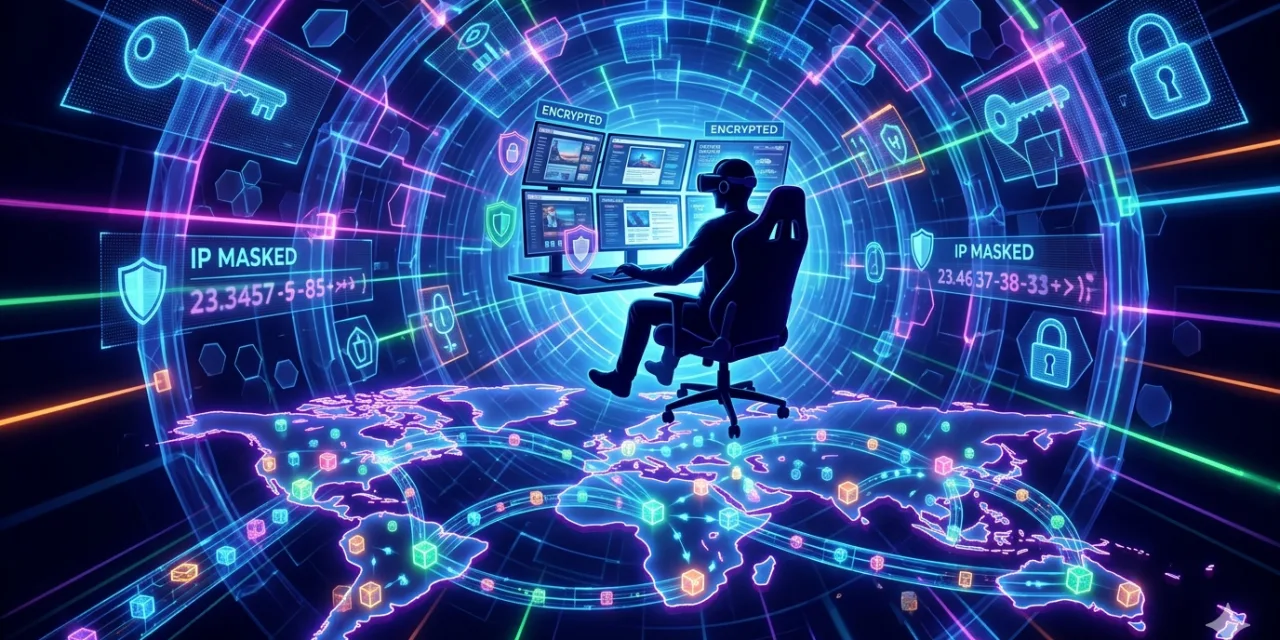
A journalist in Tehran switches on her laptop, connects to a server in Frankfurt, and opens a news website that her government has blocked. A remote developer in Lagos routes his traffic through a VPN before accessing his employer’s internal codebase over public Wi-Fi. A family in Melbourne installs a VPN because they read that their internet provider has been logging browsing histories and selling that data to third-party advertisers. A student in Shanghai uses one because without it, half the internet simply does not exist for him.
These are not edge cases. They are ordinary everyday scenarios playing out across more than 1.75 billion devices worldwide — which is roughly one in every four people on the internet, and the number is still growing. The global VPN market was valued at $71.25 billion in 2025 and is projected to reach $86.02 billion in 2026, growing at a compound annual rate of 20.7 percent. VPN apps alone generated $5.9 billion in revenue in 2024, a 15.6 percent increase on the previous year. By any measure, the VPN has moved from a technical tool used by security professionals and privacy activists to infrastructure that ordinary people reach for as instinctively as a seatbelt.
And yet, despite that scale of adoption, genuine understanding of what a VPN does, how it works, what it cannot do, and how to choose one intelligently remains surprisingly rare. Most people who use a VPN understand it at the level of “it makes me private” or “it lets me watch content from other countries.” That is not wrong — but it is incomplete enough to cause real problems. It leads people to trust a free VPN with their most sensitive browsing. It leads businesses to use consumer VPN tools for enterprise access management. It leads people to believe they are anonymous when they are not, and to miss the genuine protections a well-chosen VPN does provide.
This is the complete guide. What VPNs are, exactly how they work, the protocols that power them in 2026, every meaningful use case, the limitations and myths that lead people into false security, how to choose between free and paid services, the business VPN question, where VPNs are legally restricted, and where the technology is headed. By the end, you will understand VPNs well enough to make every relevant decision about them confidently.
What Is a VPN? The Precise Definition
A Virtual Private Network is a service that creates an encrypted, authenticated connection between your device and a remote server operated by the VPN provider, then routes your internet traffic through that connection. To any website or online service you visit, your traffic appears to originate from the VPN server — not from your device. To anyone monitoring the network between your device and the VPN server — your internet service provider, a Wi-Fi network operator, a government surveillance system, a malicious actor on the same network — your traffic appears as encrypted data moving to a VPN server, with the actual destination and content concealed.
The word “virtual” describes the fact that the private network is created through software rather than physical dedicated infrastructure. The word “private” describes the encryption that makes the connection inaccessible to outside observers. The word “network” describes the fact that you are connecting to a server infrastructure, not simply using a local encryption tool. All three components matter. The encryption without the server routing would protect your data but not mask your IP address or location. The server routing without the encryption would mask your origin but leave your traffic readable. Together, they produce the privacy and security properties that make VPNs valuable.
The origins of VPN technology go back to the mid-1990s, when businesses first needed secure ways to connect employees working remotely with corporate networks. Early VPNs were entirely enterprise tools — complex to configure, dependent on dedicated hardware, and designed for IT professionals managing site-to-site connectivity. The consumer VPN market began taking shape in the late 2000s and early 2010s, as internet privacy became a mainstream concern driven by government surveillance revelations, high-profile data breaches, and growing awareness of advertising tracking. Edward Snowden’s 2013 disclosures about NSA mass surveillance programmes sent a notable spike through VPN adoption statistics that researchers can still observe in historical search trend data. The COVID-19 pandemic produced another surge, with VPN usage spiking 124 percent in the United States as millions of employees needed secure remote access to corporate systems. Today, the technology has stabilised into a consumer utility used for purposes its enterprise origins never anticipated.
How a VPN Actually Works: Inside the Tunnel
The mechanism behind a VPN involves several distinct technical processes operating in sequence, and understanding each one explains both what the VPN protects and where its protection ends.
The handshake and authentication. When you connect to a VPN, your device and the VPN server begin by establishing a secure connection through a process called a handshake. During the handshake, both sides verify each other’s identity using cryptographic certificates or keys, negotiate which encryption algorithms they will use, and establish the session keys that will encrypt the actual data transfer. This process happens in milliseconds and is invisible to the user, but it is the foundation on which everything else depends. A compromised or poorly implemented handshake is the point at which VPN security can fail before a single byte of your actual data has been transmitted.
Encryption. Once the connection is established, all data you send and receive is encrypted before it leaves your device. Encryption transforms your readable data — the web pages you request, the messages you send, the files you upload — into ciphertext that is mathematically unintelligible without the decryption key. The strength of this encryption is determined by the VPN protocol in use. Modern VPN protocols use encryption that is, for all practical purposes, unbreakable through brute force with current computing technology. The specific algorithms — ChaCha20, AES-256, and others — differ by protocol but all provide encryption strong enough that the weaknesses in VPN security almost never involve breaking the encryption itself. They involve implementation flaws, protocol vulnerabilities, or user behaviour.
Tunnelling. Your encrypted data is then wrapped inside additional protocol layers and transmitted through what is called a tunnel — a logical pathway between your device and the VPN server that carries your encrypted traffic as its payload. The tunnel does not create a new physical pathway; it uses the existing internet infrastructure. What it does is encapsulate your encrypted data inside packets that the internet can route to the VPN server, concealing the encrypted content from network observers who can see the outer packet but not what is inside it.
IP address substitution. When your encrypted request reaches the VPN server, the server decrypts it, extracts your original request, and forwards it to the destination — a website, an API, a streaming service — on your behalf. From the destination’s perspective, the request originated from the VPN server’s IP address, not from yours. The server receives the response, encrypts it, and sends it back through the tunnel to your device, where your VPN client decrypts it and delivers it to your browser or application. This substitution is what makes geo-restriction bypassing possible and what masks your real location from the services you use.
DNS protection. A fully implemented VPN also routes your DNS queries — the lookups that translate domain names like techvorta.com/ into the IP addresses that servers actually use — through its own encrypted infrastructure. Without DNS protection, your DNS queries travel unencrypted to your ISP’s DNS servers even when your browsing traffic is encrypted, which allows your ISP to maintain a log of every domain you visit despite the VPN. Most reputable commercial VPN providers include encrypted DNS routing as a standard feature, but it is worth confirming for any service you evaluate.
VPN Protocols in 2026: WireGuard, OpenVPN, and IPSec Compared
The protocol is the rulebook that defines how a VPN connection is established, how data is encrypted, and how it is transmitted. Different protocols make different trade-offs between speed, security, compatibility, and obfuscation capability. In 2026, the protocol landscape has largely consolidated around one dominant modern option and two established alternatives that retain relevance for specific use cases.
WireGuard has become the dominant protocol for most consumer and enterprise deployments in 2026. Created by Jason Donenfeld in 2015 and integrated into the Linux kernel in 2020, WireGuard represents a fundamental rethinking of VPN protocol design. Its entire implementation consists of approximately 4,000 lines of code — compared to OpenVPN’s 600,000-plus lines and some IPSec implementations that approach 400,000 lines. This is not a limitation. It is the defining design choice, and it produces a cascade of practical advantages. A smaller codebase has a smaller attack surface. It can be comprehensively audited by security researchers. It contains fewer opportunities for implementation bugs to create exploitable vulnerabilities. And it is dramatically more efficient, delivering throughput that benchmark testing consistently places 2-3 times higher than OpenVPN in typical configurations, with latency low enough to make it suitable for voice and video applications that suffer from high jitter on slower protocols.
WireGuard uses exclusively modern, peer-reviewed cryptographic primitives: Curve25519 for key exchange, ChaCha20 for symmetric encryption, Poly1305 for message authentication, and BLAKE2 for hashing. These are not legacy algorithms with decades-old design assumptions. They are current best practice, chosen for both security and performance — particularly on mobile devices where hardware AES acceleration may not be available. WireGuard also handles network changes gracefully, maintaining connections as devices move between Wi-Fi and cellular networks without requiring re-authentication, which matters enormously for mobile use.
WireGuard does carry limitations that matter in some contexts. It does not natively support obfuscation to disguise VPN traffic as regular HTTPS traffic, which means it can be detected and blocked by deep packet inspection systems — a meaningful limitation in countries or networks that actively filter VPN traffic. Its identity management model relies on public key authentication without built-in certificate infrastructure, which works well for small deployments but requires additional tooling at enterprise scale. Several major VPN providers — NordVPN’s NordLynx implementation, ExpressVPN’s enhanced variant — have built proprietary solutions around WireGuard that address the privacy edge cases in the default implementation while preserving its performance characteristics.
OpenVPN remains the most flexible option for complex enterprise requirements. Released in 2001 and audited extensively over more than two decades, OpenVPN uses TLS for its encryption layer and supports a wider range of configuration options than WireGuard, including TCP transport for environments where UDP is blocked, and extensive integration with certificate authorities, LDAP, and RADIUS for enterprise identity management. Its performance is measurably lower than WireGuard — the TLS-based design creates overhead that limits throughput and increases latency, and OpenVPN’s userspace processing means it cannot take advantage of kernel-level optimisation the way WireGuard does. For organisations with existing OpenVPN infrastructure and complex enterprise requirements around authentication and routing, the migration cost to WireGuard may not be justified. For new deployments, WireGuard is the default choice unless specific enterprise features require OpenVPN.
IPSec remains embedded in enterprise infrastructure and built into most operating systems. IPSec is not a single protocol but a suite of protocols operating at the IP layer, and it is the foundation of many enterprise VPN solutions as well as the underlying technology behind site-to-site VPN connections between corporate offices. It is built into Windows, macOS, iOS, and Android, which means it requires no additional client software for basic deployments. Well-configured IPSec can approach WireGuard’s performance, particularly with hardware cryptographic acceleration, but its configuration complexity — significantly higher than either WireGuard or OpenVPN — frequently results in suboptimal deployments that underperform both alternatives.
Why 1.75 Billion People Use VPNs: The Real Use Cases
Surfshark’s analysis of global VPN search data found that approximately 50 percent of VPN searches worldwide are related to work, 23 percent to security, 15 percent to gaming, 7 percent to travel, and 5 percent to privacy. In the United States, work-related searches account for 59 percent. These proportions reveal something important: the mental model of VPNs as primarily a privacy tool does not match how most people actually use them. The reality is more varied, more practical, and in some dimensions more urgent.
Secure remote access to corporate networks remains the largest single use case. Ninety-three percent of organisations worldwide use VPN services to provide employees with secure access to internal systems, databases, and applications from outside the office. During the COVID-19 pandemic, 71 percent of companies had to scale up their VPN capacity to accommodate the surge in remote employees. Many of those policies became permanent: as of 2023, 72 percent of organisations planned to make remote or hybrid work a permanent arrangement for at least part of their staff. The business VPN is not a privacy tool in the consumer sense. It is access infrastructure — the mechanism through which an employee working from a home network, a hotel room, or a café gets authenticated access to the systems their job requires, with that access encrypted in transit.
Protection on public Wi-Fi is among the most widely cited personal use cases. Approximately 58 percent of personal VPN users report using their VPN when connecting to airports, cafés, hotels, and other public hotspots — and this number is rising as awareness of man-in-the-middle attacks increases. An unencrypted connection on a public Wi-Fi network is readable by any other device on the same network with the right tools. A VPN encrypts traffic before it leaves your device, making that interception useless. The threat is real: public Wi-Fi attacks are among the most practically executable network-level attacks available to anyone with basic technical capability and a few inexpensive tools. Using a VPN on public Wi-Fi is one of the most straightforwardly effective personal security measures available.
Privacy from ISP tracking and data profiling has become a growing driver. Internet service providers in many countries are legally permitted to log browsing activity and sell that data to advertisers and data brokers. In the United States, the FCC’s 2017 repeal of broadband privacy rules left ISPs free to monetise customer browsing data without explicit consent. Approximately 74 percent of personal VPN users report using VPNs specifically to keep their browsing private from their ISP, advertisers, and data profiling systems. A VPN prevents the ISP from seeing destination domains and browsing activity — though it does not prevent the VPN provider itself from seeing that traffic, which is why the provider’s logging policy matters so significantly.
Geographic content access is the use case that most casual users encounter first. Streaming services licence content on a country-by-country basis, which means a show available on Netflix in the United Kingdom may not be available on Netflix in Australia. A VPN that routes traffic through a UK server makes the user’s traffic appear to originate from the UK, giving access to the UK content library. Statista data found that 57 percent of mobile VPN users and 54 percent of PC users access VPNs at least partly to reach better entertainment content. This is the use case that makes VPNs feel like a consumer lifestyle tool rather than a security product — and it is also the use case that streaming platforms spend the most engineering effort trying to block, continuously updating their detection of known VPN server IP ranges. The effectiveness of any given VPN for streaming purposes therefore varies significantly and changes over time.
Circumventing censorship and government internet restrictions is a use case whose urgency varies dramatically by geography. VPNs are partially banned or heavily restricted in ten countries including China, Russia, Iran, and the UAE. And yet demand within those countries is intense precisely because the restrictions are severe. In late January 2026, VPN demand in Iran jumped 579 percent following internet restrictions implemented during a period of mass civil unrest. When Australia implemented mandatory age verification requirements on social media platforms and adult sites, Proton VPN alone reported an 1,800 percent increase in downloads of its app. Political events and internet freedom restrictions drive VPN demand spikes that dwarf anything driven by streaming convenience or corporate remote access policy. For users in politically restricted environments, a VPN is not a lifestyle choice. It is infrastructure for accessing information that their government has decided they should not be permitted to read.
What a VPN Cannot Do: The Myths That Create False Security
The marketing around consumer VPNs has, in aggregate, overstated what VPNs protect against in ways that create genuine security problems. Understanding the limitations is as important as understanding the protections — because a person who believes their VPN makes them anonymous will make different decisions than one who understands it does not.
A VPN does not make you anonymous. It shifts which entity can identify you, not whether you can be identified. Without a VPN, your ISP and the websites you visit can identify you by your IP address. With a VPN, the websites you visit see the VPN server’s IP address rather than yours — but the VPN provider can identify you, because you connected to their server using your real IP address and, in most cases, an account you created with an email address and paid for with a payment method. Anonymity requires not just masking your IP but also avoiding account logins, blocking tracking cookies and fingerprinting scripts, using cash or privacy-preserving payment methods, and other measures that go well beyond what any VPN provides on its own. Calling a VPN an anonymity tool is not merely imprecise — it is the specific misrepresentation most likely to cause real harm to users who act on it.
A VPN does not protect you from malware, phishing, or most application-layer attacks. A VPN encrypts the connection between your device and the VPN server. It does not inspect what you download, does not block malicious websites by default (though some premium VPNs include optional DNS-based ad and malware blocking as an add-on feature), and does not prevent you from entering your credentials into a convincing phishing page. If you download malware through an encrypted VPN tunnel, the malware executes on your device with exactly the same effect it would have had without the VPN. The tunnel protects the transport layer. It does not make the content you receive safe.
A VPN does not protect you from websites that track you through cookies, browser fingerprinting, and account logins. When you log into Google, Facebook, or any service that requires authentication, that service identifies you through your account credentials — not through your IP address. Your VPN masks your IP, but Google still knows it is you because you told them so when you logged in. Browser fingerprinting — the technique of identifying users by the unique combination of their browser version, installed fonts, screen resolution, and dozens of other technical characteristics — does not depend on IP address at all. It works regardless of whether you are using a VPN. A significant proportion of the tracking that people hope a VPN will prevent operates entirely above the IP address layer, in ways a VPN does not touch.
A VPN is only as trustworthy as its provider. This is the limitation most frequently underemphasised by VPN marketing. A VPN does not eliminate surveillance of your traffic — it redirects it. Without a VPN, your ISP can see your browsing activity. With a VPN, your VPN provider can see your browsing activity. If the provider logs connection data or browsing activity, that data is potentially available to anyone who can legally compel the provider to produce it, anyone who can hack the provider’s infrastructure, or anyone the provider voluntarily shares it with. The privacy claim of a VPN service is therefore fundamentally a trust claim about the provider’s logging practices, jurisdiction, and operational security. A VPN provider that keeps detailed logs, is headquartered in a jurisdiction with aggressive data retention laws, and has been acquired by a company with opaque ownership provides meaningfully less privacy than one that has been independently audited, maintains a verified no-logs policy, and operates under a jurisdiction with strong privacy law.
Free VPN vs Paid VPN: What the Difference Actually Means
In the United States, 44.2 percent of VPN users opt for free services and 51.2 percent choose paid ones. The appeal of free VPNs is obvious. The risks are less obvious but significant enough to warrant careful consideration before trusting a free service with your network traffic.
Free VPNs sustain their operations through business models that are often incompatible with user privacy. Running a VPN service requires substantial infrastructure investment — servers in multiple countries, bandwidth, technical staff, security audits. A service that charges nothing for this infrastructure is financing it some other way. The most common monetisation approaches for free VPN services include selling anonymised or semi-anonymised user data to advertisers and data brokers, displaying in-app advertising, using subscribers’ devices as exit nodes for the provider’s paid service, and in the worst documented cases, injecting tracking cookies into user traffic or logging and selling detailed browsing histories. A 2020 analysis of free VPN apps found that a substantial proportion contained malware or aggressive data collection practices. The service that appears to protect your privacy may be the mechanism through which your privacy is being monetised.
There are legitimate free VPN offerings from reputable providers, but they come with deliberate limitations. Proton VPN offers a genuinely free tier with no data caps, no advertising, and a verified no-logs policy — funded by subscribers to its paid tiers. The free tier is limited to servers in three countries and one simultaneous connection, which makes it suitable for occasional use but not a comprehensive solution. Windscribe offers 10 GB of free monthly data. These are exceptions. The distinguishing characteristic of a trustworthy free tier is that the limitations are designed to encourage upgrade to a paid plan, not that the user’s data is the product being sold. The operational question when evaluating any free VPN is simple: if you are not paying for the service, how is it being funded? If the answer is not clear, that opacity is itself informative.
Paid VPN services in 2026 are inexpensive enough that cost is rarely the genuine obstacle. Monthly prices without discounts average approximately $10.88. On discounted 1-3 year subscription plans, the average drops to around $3.65 per month, with some reputable services available for as little as $2.03 per month on promotional pricing. The cost of a paid VPN subscription for a full year is comparable to a single month of a streaming service. For users who use a VPN regularly — and particularly for anyone using a VPN for purposes that depend on genuine privacy rather than convenience — the cost difference between free and paid is an extremely poor justification for the privacy risk differential.
How to Choose a VPN in 2026: The Criteria That Actually Matter
The VPN market in 2026 contains hundreds of services making broadly similar claims about speed, security, and privacy. Distinguishing among them requires looking beyond marketing language at the specific, verifiable characteristics that determine whether a VPN actually delivers what it promises.
The no-logs policy must be independently verified, not merely claimed. Every VPN service claims not to log user activity. The claim is not evidence. What matters is whether the policy has been verified by an independent third-party security audit, and whether there is any real-world evidence of the provider’s commitment to the policy under pressure — such as a case where the provider received a government request for user data and had nothing to produce because the data had not been retained. NordVPN, ExpressVPN, Mullvad, and Proton VPN have all undergone independent audits and/or have documented track records of producing nothing in response to data requests. These are meaningful signals. A claimed no-logs policy from a provider that has never been audited and has no documented track record is an unverified assertion.
The provider’s jurisdiction determines the legal framework governing its data. A VPN provider incorporated in a country with aggressive data retention laws or that is a member of the intelligence-sharing alliances known as the Five Eyes, Nine Eyes, or Fourteen Eyes may be legally compelled to collect and share user data regardless of its stated policy. Providers based in Iceland, Switzerland, Panama, or the British Virgin Islands operate under different legal frameworks with stronger privacy protections and no data retention mandates. Jurisdiction matters most for users with specific threat models — journalists, activists, or anyone whose traffic might be sought by a government actor. For the majority of users whose primary concern is ISP tracking and commercial data profiling, jurisdiction is a secondary consideration after logging policy and audit history.
Protocol support determines the security and performance floor of the service. A VPN that supports WireGuard alongside OpenVPN offers the current best option for most use cases while maintaining flexibility for networks where WireGuard is blocked. A provider that still relies primarily on older protocols without a roadmap to WireGuard adoption is falling behind the security and performance state of the art. For users in countries where VPN traffic is actively filtered, obfuscation capability — the ability to disguise VPN traffic as regular HTTPS traffic to bypass deep packet inspection — becomes essential. Not all providers offer it, and those that do implement it with varying effectiveness.
Server network size and geographic distribution determine practical usability. A larger server network in more countries provides better performance through geographic proximity to servers, more options for bypassing geo-restrictions, and less congestion per server. More important than raw server count is server quality — providers that own their server infrastructure rather than renting shared hosting provide better security assurance, because they control physical access to the hardware and can implement RAM-only server architectures that leave no persistent storage for log data even if physical hardware is seized.
The kill switch is a non-negotiable feature for privacy-dependent use cases. A VPN kill switch cuts your internet connection if the VPN connection drops unexpectedly, preventing your traffic from being exposed on your regular connection during the interruption. For users who are relying on the VPN for genuine privacy protection — rather than merely for streaming convenience — a kill switch is the safety net that ensures the protection is continuous. A momentary VPN dropout without a kill switch can expose identifying traffic during exactly the window when it matters most.
Business VPNs and the Zero Trust Question
Enterprise VPN use is the largest component of global VPN adoption, and 2026 is the year in which the traditional business VPN model is most directly confronting the challenge posed by Zero Trust Network Access as an alternative architectural approach.
The traditional enterprise VPN model creates access problems that modern work patterns have exposed. A corporate VPN authenticates a user and then grants them access to the corporate network — effectively treating authenticated access as equivalent to trusted access to internal resources. This worked adequately in an era when internal resources lived on physical servers in a corporate data centre and the threat model was primarily about protecting the perimeter. In 2026, with corporate applications distributed across multiple cloud environments, SaaS platforms, and external APIs, the network perimeter that a traditional VPN protects no longer maps to where the resources actually are. An employee who connects through the corporate VPN gains broad network access that may be far in excess of what their role requires, creating lateral movement risk if their account is compromised.
Zero Trust Network Access addresses these limitations through a fundamentally different model. Rather than granting network-level access based on VPN authentication, ZTNA grants application-level access based on continuous verification of identity, device health, location context, and behavioural signals. Access is not granted to a network; it is granted to specific applications, and that access is continuously re-evaluated rather than granted once at connection time. This model is better suited to cloud-distributed infrastructure and provides more granular, auditable access control than a traditional VPN. Cisco’s AnyConnect VPN currently holds approximately 28.6 percent of the enterprise VPN market — the single largest share of any one platform — but the trend toward ZTNA is measurable and accelerating.
The practical reality for most organisations in 2026 is a hybrid model rather than a binary choice. ZTNA does not eliminate the need for VPN in all enterprise contexts. Site-to-site VPN connections between office locations, legacy application access that cannot be easily adapted to ZTNA architectures, and specific compliance requirements that mandate network-level encryption all create ongoing use cases for traditional VPN infrastructure. Most organisations are implementing ZTNA for new cloud-native access patterns while maintaining existing VPN infrastructure for use cases it handles well. The replacement of enterprise VPN by ZTNA is a directional trend, not an event with a clear completion date.
VPNs and the Law: Where They Are Restricted and Why It Matters
VPNs are legal in the vast majority of countries. Using a VPN is not, in most of the world, the same as doing something illegal — it is using a tool for privacy and security that is as legally and ethically neutral as using HTTPS. The legal complexity arises in a specific set of countries where governments have determined that the privacy and access capabilities of VPNs are incompatible with their internet censorship or surveillance objectives.
China prohibits the use of VPN services that have not been approved and licensed by the government — which means approved VPNs are by definition accessible to and controllable by government oversight. Russia has mandated that VPN providers register with the government and comply with blocking orders for prohibited content. Iran, North Korea, Belarus, and Turkmenistan maintain outright bans. Several other countries including Egypt, Venezuela, the UAE, India, and Myanmar impose partial restrictions, mandatory registration requirements, or targeted enforcement against specific providers. The practical effect of these restrictions varies: China’s Great Firewall actively blocks known VPN server addresses and VPN protocol signatures, requiring providers to continuously update their obfuscation techniques to remain accessible. In countries with less technically sophisticated enforcement, restrictions may be nominally in force but practically difficult to enforce against individual users.
The use of VPNs to conduct illegal activity remains illegal regardless of whether the VPN itself is legal. This point is worth stating clearly because it is sometimes misunderstood. A VPN protects your privacy from network-level observation. It does not provide legal immunity. If you use a VPN to engage in activity that is illegal in your jurisdiction, the VPN may make detection harder, but it does not make the underlying activity legal, and it does not provide complete protection against detection through non-network forensic methods. The VPN is a privacy tool, not a legal shield, and conflating the two creates misunderstandings in both directions — among users who incorrectly believe it makes illegal activity safe, and among critics who incorrectly associate VPN use with illegal activity rather than with entirely legitimate privacy interests.
The 2026 Threat That Makes VPNs More Relevant, Not Less
There is a technology on the horizon that is sometimes invoked as a reason VPNs might become obsolete, and a more immediate reality that is actually making them more urgent. The technology is artificial intelligence. The reality is the proliferation of AI-powered surveillance and traffic analysis.
AI-powered deep packet inspection and traffic analysis can, in principle, identify VPN traffic patterns and user behaviour characteristics even within encrypted tunnels — not by breaking the encryption, but by analysing the metadata, timing, volume patterns, and other observable characteristics of the encrypted traffic. This is a meaningful and advancing threat to VPN privacy in the hands of sophisticated state actors with access to large-scale traffic monitoring infrastructure. It is the driving force behind the development of obfuscation technologies that disguise VPN traffic as random noise or ordinary HTTPS traffic, and behind multi-hop VPN architectures that route traffic through multiple servers to complicate traffic correlation analysis.
At the same time, AI is expanding the capabilities of commercial surveillance, advertising tracking, and data profiling in ways that make the baseline privacy protections of a VPN more valuable for ordinary users rather than less. The combination of AI-powered cross-device tracking, behavioural fingerprinting, and data broker aggregation creates a surveillance ecosystem around ordinary internet use that is more comprehensive in 2026 than it has ever been. A well-configured VPN with an audited no-logs policy is not a complete defence against this ecosystem, but it is a meaningful component of it.
Post-quantum cryptography is the longer-horizon challenge that the VPN industry is beginning to address. Quantum computers capable of breaking current public-key cryptography do not yet exist at the scale required to threaten operational VPN security, but the development trajectory is clear enough that forward-looking security planning needs to account for the eventual deprecation of algorithms like RSA and standard elliptic curve Diffie-Hellman key exchange. WireGuard’s Curve25519 key exchange, while excellent by current standards, would be vulnerable to a sufficiently powerful quantum computer. ExpressVPN and several other providers have begun implementing post-quantum key exchange options in their enhanced protocol implementations. This is a transition that will take years to complete across the industry, but it is underway, and organisations with long-horizon security requirements should be tracking provider roadmaps on this issue.
The Future of VPNs: Where the Technology Is Heading
VPN adoption statistics show a technology that has reached mainstream utility without yet reaching saturation. As of early 2026, 23.1 percent of global internet users report regular VPN use — nearly one in four. Growth is projected to continue, but the nature of that growth is shifting from the rapid adoption curve of a new technology to the slower, steadier expansion of a utility that more people are discovering over time.
WireGuard-based implementations will continue to dominate new deployments, with WireGuard 2.0 extending the protocol’s capabilities for enterprise environments while maintaining the performance and simplicity that made the original a breakthrough. The integration of VPN capabilities into broader cybersecurity suites — bundles that include VPN, antivirus, password management, and identity protection in a single subscription — is an accelerating trend that reflects the market’s recognition that privacy and security are not separable concerns addressable by independent point tools.
Mobile will be the primary growth surface. Approximately 75 percent of VPN users currently access services via desktop, while about two-thirds use VPN on smartphones. As mobile internet use continues growing relative to desktop, and as mobile threat vectors — malicious hotspots, carrier-level tracking, mobile advertising ecosystems — become more significant, mobile VPN optimisation will drive the next generation of protocol and product development. WireGuard’s efficient handling of network transitions between Wi-Fi and cellular, and its low battery impact relative to older protocols, position it well for this mobile-first direction.
The relationship between VPNs and Zero Trust architectures will continue evolving. The prediction that ZTNA will kill the VPN has consistently been premature, and the more accurate picture is a complementary coexistence: ZTNA for enterprise application access management, VPN for encrypted transport where network-layer protection is needed, with the boundaries between the two becoming more fluid as vendors build products that incorporate elements of both models.
What This Means for You
The practical question that most people arrive at after understanding VPNs properly is not “should I use a VPN” but “which VPN should I use, and for which specific purposes.” The answer depends on your threat model — the specific privacy and security risks you are most exposed to and most concerned about.
If your primary concern is protecting traffic on public Wi-Fi and preventing ISP-level tracking, any well-audited paid VPN service that supports WireGuard, maintains a verified no-logs policy, and includes a kill switch will serve you well. If you are a remote worker whose employer provides a corporate VPN, that VPN covers your work access needs but does not necessarily protect your personal traffic on the same device — a separate consumer VPN for personal use, or a split-tunnelling configuration, may be relevant. If you are in a country where internet censorship is active, obfuscation capability becomes the highest-priority technical feature, and the provider’s track record of remaining accessible in restricted environments matters more than any other characteristic. If you are a journalist, activist, or researcher with specific adversary threat models, the combination of an audited no-logs provider, a privacy-preserving jurisdiction, Tor integration, and multi-hop routing begins to make sense.
What no one should do is use a free VPN with opaque ownership and no audit history for anything that actually matters to them. The economics of free VPN services are structured against user privacy, and the specific use cases that make a VPN most valuable — protecting sensitive communications, bypassing government censorship, preventing corporate surveillance — are exactly the use cases where the consequences of trusting the wrong provider are most serious.
Over 1.75 billion people have concluded that a VPN is worth having. The question the data cannot answer for you is whether you are using yours correctly. Understanding what your VPN protects, what it does not, and how the choices you make about providers and configurations determine the actual privacy you receive is the difference between a VPN that genuinely serves you and one that merely feels like it does.




0 Comments
No comments yet. Be the first to share your thoughts!