
There is a particular moment in the history of a scientific instrument when its output stops being impressive and starts being transformative — when the data it returns does not simply fill in gaps in what we know, but forces scientists to reconsider the frameworks they have used to understand what they are looking at. The Hubble Space Telescope had such a moment. The COBE satellite had one. The Voyager probes had them, one after another.
The James Webb Space Telescope is having that moment right now — and has been having it continuously since its first science images were released in July 2022.
Nearly four years into its operational life at the second Sun-Earth Lagrange point, 1.5 million kilometres from Earth, Webb is not simply returning beautiful images. It is returning data that is actively breaking theoretical models of how the universe works, discovering objects that should not exist according to our best understanding of cosmic evolution, and answering questions that astronomers have been asking for decades while simultaneously generating new questions nobody thought to ask. It is the most productive scientific instrument in the history of astronomy — and its best discoveries, according to the scientists who work with it daily, are still ahead of it.
This article is the complete account of Webb’s most significant discoveries and observations across 2025 and into 2026 — from the farthest galaxies ever seen, to planets losing their atmospheres in real time, to the strange magnetic forces warping giant planets in our own solar system. Each discovery is contextualized for what it means, why it matters, and what it has done to our understanding of the cosmos. You do not need a background in astrophysics to read this. You need only a genuine curiosity about where we came from, what we are surrounded by, and what the universe looked like before the Earth existed.
What Makes Webb Different: A Quick Primer on Why This Telescope Changes Everything
Before exploring what Webb has found, it is worth spending a moment on why it finds things that its predecessors could not — because the technical reasons are not abstract engineering details. They directly explain why Webb is producing discoveries that would have been genuinely impossible with any previous instrument.
Webb sees in infrared light — wavelengths longer than the red end of the visible spectrum, invisible to the human eye, but enormously scientifically productive. This matters for two interconnected reasons that drive virtually every major Webb discovery.
The first reason is cosmological redshift. The universe is expanding, and the expansion stretches the wavelengths of light as it travels through space. Light emitted by the most ancient, most distant galaxies — light that left those galaxies when the universe was only a few hundred million years old — has been stretched by the expansion of space from its original ultraviolet or visible wavelengths into the infrared. Hubble, which was primarily an optical and ultraviolet instrument, could not see this ancient light clearly. Webb was specifically designed to detect it, giving it a window into the first billion years of cosmic history that was simply closed to previous telescopes.
The second reason is dust penetration. Dust is the great obscurer of astronomy — it blocks visible light and hides the most active, most dynamic regions of star formation, galaxy evolution, and planetary birth behind impenetrable clouds. Infrared light passes through dust far more easily than visible light, allowing Webb to peer into stellar nurseries, galaxy cores, and protoplanetary disks that were effectively invisible to Hubble and its predecessors. Discoveries that would have required patiently waiting for dust to clear — if that were even possible — can now be made by simply switching to the wavelengths that dust does not block.
Webb also carries four science instruments — NIRCam, NIRSpec, MIRI, and FGS/NIRISS — that together provide imaging and spectroscopy across wavelengths from 0.6 to 28 microns with sensitivity and spatial resolution that exceed anything previously flown in space. The combination of spectroscopy capability — the ability to decompose light into its constituent wavelengths and identify the chemical fingerprints of specific atoms and molecules — with Webb’s extreme sensitivity and infrared reach is what enables the chemical characterization of distant galaxy cores, exoplanet atmospheres, and interstellar organic chemistry that represents some of the telescope’s most consequential science.
Webb also arrived at its destination in better condition than anyone dared hope. The telescope’s mirrors aligned more precisely than pre-launch predictions, and its fuel consumption during the journey to Lagrange Point 2 was more efficient than anticipated, extending the projected mission lifetime from a minimum of ten years to potentially twenty or more. That extended lifetime transforms Webb from a revolutionary instrument into a generational one — a telescope that may still be returning science when researchers who are currently graduate students retire.
Rewriting the Early Universe: Galaxies That Should Not Exist
Among Webb’s most consistently stunning and scientifically disruptive contributions has been its systematic dismantling of theoretical models for how galaxies form and evolve in the universe’s first billion years. One discovery after another has produced a reaction from cosmologists that was captured perfectly in the headline from Space.com in early 2026: “It looks nothing like what we predicted.”
The standard model of galaxy formation — developed over decades and refined by data from Hubble, ground-based telescopes, and theoretical simulations — predicted that the very early universe would contain small, irregular, unevolved galaxies. These young galaxies, by this model, should be dim, sparse, and chemically primitive, containing mostly hydrogen and helium with few of the heavier elements produced by stellar evolution. The universe should have been a much simpler, quieter place in its first few hundred million years — a cosmic adolescence before the mature, complex structures we see around us today had time to develop.
Webb has found something quite different. In galaxy after galaxy from the universe’s first billion years, it has discovered structures that are brighter, more compact, more massive, and more chemically complex than our models predicted should exist. The galaxy MoM-z14 is described by NASA as “brighter, more compact, and more chemically enriched” than astronomers anticipated for such an early era, and among its most surprising features are elevated levels of nitrogen, suggesting that massive stars may have formed and evolved more rapidly in the dense early universe than current models predict.
The nitrogen finding is particularly striking. Nitrogen at the levels Webb detected in MoM-z14 requires multiple generations of massive stars to have been born, lived, died, and enriched the surrounding gas — a process that takes significant time. Finding it this early in the universe suggests either that some physical process accelerated stellar evolution in the early cosmos, or that our understanding of nitrogen production in stellar interiors requires revision. Scientists at Space.com describe the growing tension between theory and observation as “a growing chasm” that “presents compelling questions to be explored going forward.”
The “little red dots” — a class of faint, compact, red objects detected across the distant universe since Webb began operating — have proven to be another source of productive theoretical disruption. Scientists at the Center for Astrophysics at Harvard and Smithsonian reported in January 2026 that little red dots may actually be gigantic, short-lived stars — supermassive stars roughly one million times the mass of our Sun, loosely bound and on the verge of collapsing into black holes. Previous explanations for little red dots required complicated arrangements involving black holes, accretion disks, and dust clouds. The new model is more elegant: a single extraordinarily massive star can naturally produce all of the key observational signatures — extreme brightness, a distinctive spectral shape, and specific hydrogen emission patterns. If confirmed, this interpretation has profound implications for our understanding of how the first supermassive black holes formed in the early universe, since these giant stars would collapse directly into black holes without the intermediate steps that later stellar evolution requires.
In March 2026, astronomers at the University of Waterloo reported spotting the most distant jellyfish galaxy ever observed using Webb — a cosmic oddity streaming long, tentacle-like trails of gas and newborn stars as it speeds through a dense galaxy cluster, appearing as it was 8.5 billion years ago. Jellyfish galaxies — named for their flowing gas streams that resemble tentacles — form when a galaxy moves through the dense gas of a galaxy cluster and the ram pressure of that medium strips gas from the galaxy’s outer regions. Finding one this old and this far away reveals that the early universe was “far more violent than scientists expected,” with the dense clustering of galaxies and the ram pressure stripping process beginning much earlier in cosmic history than models predicted.
The cumulative picture from three years of Webb early-universe science is a cosmos that evolved faster, built structure earlier, and produced chemical complexity sooner than the standard cosmological model anticipated. This does not mean the Big Bang model is wrong — it is one of the most rigorously tested theories in all of science. It means that the details of how matter organized itself in the first billion years after the Big Bang require significant revision. Webb is not just filling in the details of a story we thought we understood. It is changing the story.
The Black Hole Revelations: Giants in the Early Darkness
Supermassive black holes — the extraordinary concentrations of mass that lurk at the centres of most large galaxies, sometimes containing billions of times the mass of our Sun — present one of the deepest puzzles in modern astrophysics. In our current universe, they are well-studied and relatively well-understood. The mystery is how they got so massive so quickly in the early universe, when there had not been enough time for them to grow to observed sizes through the normal processes of gas accretion.
Webb has been accumulating discoveries that bear directly on this mystery, and none more dramatically than the confirmation of actively growing supermassive black holes in galaxies from the universe’s earliest epochs. Researchers using Webb have confirmed an actively growing supermassive black hole within a galaxy just 570 million years after the Big Bang — part of a class of small, very distant galaxies that has mystified astronomers and that challenges existing theories about the formation of galaxies and black holes in the early universe.
Five hundred and seventy million years after the Big Bang sounds like a long time, but it is extraordinarily early in cosmic history. The universe is approximately 13.8 billion years old. Finding a fully formed, actively growing supermassive black hole at 570 million years means it assembled an extraordinary amount of mass in a tiny fraction of the universe’s age — faster than conventional models of black hole growth allow. Either the initial “seeds” from which early black holes grew were much more massive than standard models predict, or there was some mechanism for accelerating mass assembly — or both.
The “direct collapse” hypothesis for early black hole formation — in which massive gas clouds collapse directly into black holes without passing through the intermediate stage of a star — received support from Webb observations in mid-2025. NASA’s Webb found possible evidence of a “direct collapse” black hole in a blog post from August 2025 — a finding that, while still awaiting full peer review, would provide the first direct observational support for a mechanism that theorists have proposed but never been able to confirm.
Separately, Webb’s Mid-Infrared Instrument (MIRI) discovered evidence suggesting the presence of a long-sought supermassive black hole at the heart of the nearby spiral galaxy Messier 83, revealing highly ionised neon gas that could be a telltale signature of an active galactic nucleus — a growing black hole at the centre of a galaxy. The finding was described as “surprising” because Messier 83 had not been expected to harbour an actively growing central black hole based on previous observations with less sensitive instruments. The ability to detect the specific spectral signatures of highly ionised gas — gas that has been stripped of electrons by the intense radiation from material falling into a black hole — is precisely the kind of science that Webb’s MIRI instrument was designed to enable, and this discovery illustrates why the mid-infrared capability matters as much as the near-infrared sensitivity that gets more public attention.
Exoplanet Science: Reading the Atmospheres of Other Worlds
The characterization of exoplanet atmospheres — determining what gases are present in the atmospheres of planets orbiting distant stars — is among the most exciting and practically significant scientific programmes Webb is conducting. It is the programme that most directly bears on one of humanity’s oldest questions: are we alone in the universe?
Webb’s spectrographic instruments can analyze starlight that has passed through an exoplanet’s atmosphere as the planet transits — crosses in front of — its host star from our perspective. Different molecules absorb light at characteristic wavelengths, leaving distinctive fingerprints in the transmitted spectrum that allow scientists to determine the chemical composition of the atmosphere in extraordinary detail. This capability has already been used to detect water, carbon dioxide, methane, and sulfur dioxide in various exoplanet atmospheres — the first time these molecules have been directly detected in exoplanet atmospheres from any instrument.
One of the most dramatic atmospheric observations of 2025-2026 was the extended study of the ultra-hot gas giant WASP-121b. Astronomers from the University of Geneva followed gas escaping from WASP-121b’s atmosphere continuously for nearly 37 hours — covering more than one complete orbit — using Webb’s NIRISS instrument. They found that the escaping helium does not form a single stream but splits into two distinct tails, one trailing behind the planet and one stretching ahead toward its star, spanning more than half the planet’s entire orbit. This is the most extended continuous observation of atmospheric escape ever recorded around any planet, providing unprecedented detail about the process by which close-orbiting gas giants slowly lose their atmospheres to stellar radiation.
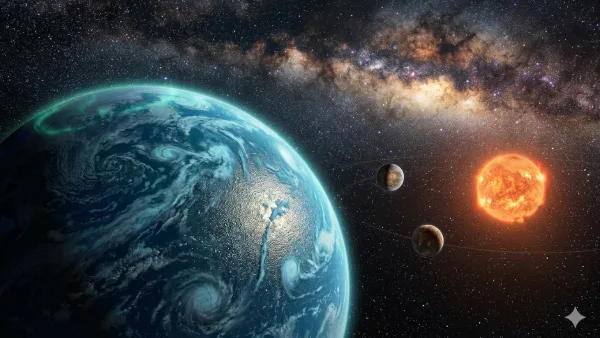
The TRAPPIST-1 system — seven Earth-sized rocky planets orbiting a small red dwarf star, three of which sit in the star’s habitable zone where liquid water could potentially exist on their surfaces — has been a priority Webb target from the beginning of its science operations. The latest results from the system are sobering. According to a new study using Webb data, the exoplanet TRAPPIST-1 d does not have an Earth-like atmosphere — a finding that constrains, though does not eliminate, the possibility of habitability. The lack of a substantial atmosphere means the surface of TRAPPIST-1 d would be exposed to more stellar radiation than Earth, and without atmospheric pressure and greenhouse warming, liquid water on the surface is less likely than initial optimism suggested.
The broader TRAPPIST-1 campaign continues, with observations of the other six planets providing increasingly detailed atmospheric characterization. The negative results — confirming that some planets lack Earth-like atmospheres — are themselves scientifically valuable, helping astronomers understand what kinds of stars and planetary systems are more or less likely to harbour habitable worlds. The positive detection of a biosignature gas — a molecule produced primarily by biological processes, like oxygen alongside methane — in any exoplanet atmosphere would be among the most significant scientific events in human history. Webb has the sensitivity to detect such signatures in nearby systems. The question of whether any such signals exist remains open.
Meanwhile, Webb found strong evidence of a giant planet orbiting a star in the stellar system closest to our own Sun — a discovery that, if confirmed, would mean a planet exists in the Alpha Centauri system, just 4.37 light-years away. The detection of planets in our nearest stellar neighbours has significant implications for the long-term question of interstellar exploration and for understanding the prevalence of planetary systems around the types of stars most common in our galactic neighbourhood.
Our Own Solar System Through Webb’s Eyes: Auroras, Moons, and Interstellar Visitors
While the headlines from Webb’s most distant observations tend to dominate public coverage, some of the telescope’s most striking discoveries have been made much closer to home — within our own solar system, where Webb’s unique infrared capabilities reveal features of familiar worlds that no previous instrument could detect.
Webb has captured bright auroral activity on Neptune for the first time — luminous atmospheric phenomena caused when energetic particles from the Sun become trapped in the planet’s magnetic field and strike the upper atmosphere. Neptune had been predicted to have auroras based on its known magnetic field structure, but detecting them required the sensitivity and infrared capability that Webb uniquely provides. The auroras of our distant ice giant neighbours have been largely invisible until now.
Uranus has been the subject of particularly rich Webb observations in 2025 and 2026. In August 2025, Webb discovered a new moon orbiting Uranus — adding to the planet’s known collection and reflecting the telescope’s ability to detect faint objects in the outer solar system that previous telescopes could not resolve. More dramatically, research published in Geophysical Research Letters in February 2026 revealed that Webb had captured strange magnetic forces warping Uranus, with researchers using NIRSpec’s Integral Field Unit to observe Uranus continuously for 15 hours on January 19, 2025. The observations revealed the vertical structure of Uranus’s ionosphere — the electrically charged outer layer of its atmosphere — in unprecedented detail, showing the complex interplay between the planet’s unusually tilted magnetic field and the upper atmosphere in ways that challenge previous models of ice giant atmospheric physics.
In one of the most intriguing recent observations, Webb’s Near-Infrared Spectrograph observed interstellar comet 3I/ATLAS on August 6, 2025 — marking a remarkable scientific opportunity. 3I/ATLAS is only the third confirmed interstellar object to pass through our solar system, following ‘Oumuamua in 2017 and Borisov in 2019. Unlike those two objects, which were detected late in their solar system traversal when observing windows were limited, 3I/ATLAS was detected early enough for Webb to perform detailed spectroscopic characterization. The results — determining the chemical composition of material from another star system that has drifted through interstellar space before entering our solar neighbourhood — provide a window into the chemistry of planetary systems around other stars that no other observation technique can match.
These solar system observations illustrate a dimension of Webb’s science programme that deserves more attention than it typically receives in coverage focused on the telescope’s deepest cosmic observations. The same infrared sensitivity and spectroscopic capability that reveals the chemical composition of galaxies 13 billion light-years away can also reveal the chemical composition of a comet’s coma, the structure of a giant planet’s ionosphere, and the auroral activity of a world four billion kilometres from Earth. Webb is not just a telescope for looking at the ancient universe. It is a complete solar system observatory — and a transformative one.
Life’s Building Blocks: Organic Chemistry Across the Cosmos
Among the most philosophically resonant discoveries Webb has made is the increasing evidence that the chemical building blocks of life — complex organic molecules — are far more widespread across the universe than previous generations of astronomers dared hope. This is not yet evidence of life beyond Earth. It is evidence that the chemistry that preceded life on Earth is not unusual. It appears to be a common feature of the universe wherever stars are forming and planets are developing.
In November 2025, astronomers using Webb uncovered a trove of complex organic molecules frozen in ice around a young star in a neighbouring galaxy — including the first-ever detection of these specific molecules outside the Milky Way. The discovery was made by peering through thick clouds of gas and dust in an infrared-transparent window that only Webb can open, detecting carbon-rich compounds including benzene, methane, and the highly reactive methyl radical. Finding these molecules frozen in the protostellar ice of another galaxy demonstrates that the organic chemistry of planet-forming environments is not unique to the Milky Way. It is a universal feature of regions where stars and their planetary systems are being born.
A separate investigation led by the Center for Astrobiology uncovered an extraordinary concentration of small organic molecules deep inside the heavily concealed core of a nearby ultra-luminous infrared galaxy, using JWST spectroscopic data spanning wavelengths from 3 to 28 microns and combining measurements from both the NIRSpec and MIRI instruments. The complexity of the organic chemistry detected — including molecules at temperatures and abundances far beyond what theoretical models predicted — revealed a cosmic chemical factory operating at the heart of a galaxy where traditional telescopes could see essentially nothing through the concealing dust.
The relevance of these organic chemistry discoveries to the question of life’s origins is indirect but important. The theory of panspermia — the hypothesis that the building blocks of life, or possibly even life itself, can travel between planetary systems through space — requires that organic molecules be durable enough to survive the transit and abundant enough to be available in the environments where planets form. Webb’s discoveries are strengthening the case that the organic chemistry required for life is not a rare fluke concentrated in a few privileged locations. It is sewn into the fabric of star-forming regions throughout the observable universe.
Star Formation Supercharged: How Webb Is Revolutionising Our Understanding of Stellar Birth
Star formation — the process by which clouds of gas and dust collapse under gravity to ignite the nuclear reactions that make a star shine — has been studied for decades, but always through the frustrating veil of the dust that clouds where it happens. Infrared light passes through that dust, and Webb has penetrated it in ways that have produced a revolution in star formation science that its practitioners describe as genuinely transformational.
NASA’s own characterization of Webb’s contribution to star formation science as having “supercharged” what astronomers know — with its sharp near- and mid-infrared observations — reflects a genuine consensus among researchers in the field. Before Webb, the earliest stages of star formation — the collapse of molecular cloud cores, the formation of protostars, the creation of the circumstellar disks from which planets eventually form — were understood primarily through theoretical models and limited observations at resolutions too coarse to distinguish the fine structures involved. Webb’s resolution and sensitivity have changed this fundamentally.
Webb has revealed new details in the core of the Butterfly Nebula, NGC 6302, including the dense, dusty torus surrounding the star hidden at the nebula’s centre and its outflowing jets, painting a never-before-seen portrait of a dynamic and structured planetary nebula. The Butterfly Nebula — named for its distinctive two-lobed shape — had been photographed by Hubble and appeared beautiful but structurally simple. Webb’s infrared view reveals it to be a far more complex environment, with jets, a dusty equatorial ring, and material in multiple physical states interacting in ways that inform models of how dying stars shed their outer layers and enrich the interstellar medium with the heavy elements that subsequent generations of stars and planets inherit.
Webb has also taken the most detailed image of planetary nebula NGC 1514 to date, bringing out nuances including its “fuzzy” dusty rings and holes in the central region where material has broken through. These structures — the result of two central stars shaping the ejected material over thousands of years — provide a detailed laboratory for studying the complex gas dynamics of planetary nebulae and the chemical enrichment they contribute to the interstellar medium.
Galaxy disk formation across cosmic time is another area where Webb has produced transformative results. Using Webb, scientists spotted thin and thick disk structures in galaxies as far back as 10 billion years ago — something never seen before. These observations reveal that galaxies built their orderly disk structures far earlier than previous models predicted. The disks of spiral galaxies like our Milky Way were previously thought to be a relatively recent structural development, appearing as galaxies matured and their chaotic early dynamics settled into ordered rotation. Webb is showing this process beginning much earlier — suggesting that the ordered, disk-dominated morphology of galaxies is a more fundamental and rapidly achieved feature of galaxy evolution than we understood.
The Gamma-Ray Burst Detective: Tracing Explosions Across Cosmic Time
Gamma-ray bursts — the most energetic explosions in the universe, generated when massive stars collapse into black holes or when neutron stars merge — are cosmic events visible across billions of light-years, making them powerful probes of the conditions in the early universe. Webb’s ability to quickly repoint to a new target and observe a gamma-ray burst’s fading afterglow before it disappears has made it an important asset for the rapidly evolving field of gamma-ray burst science.
Webb confirmed the source of a super-bright gamma-ray burst generated by an exploding massive star when the universe was only 730 million years old — and for the first time for such a remote event, detected the supernova’s host galaxy, providing the first complete picture of such an early cosmic explosion. Knowing both the properties of the gamma-ray burst itself and the characteristics of the galaxy in which it occurred allows astronomers to correlate the properties of the explosion — its energy, its duration, its spectral evolution — with the properties of the stellar population that produced it. This connection between explosion characteristics and stellar environment is one of the most productive lines of current research in gamma-ray burst science, and Webb is enabling it at distances and look-back times that were not accessible before.
In February 2026, Webb located the former star that exploded as supernova SN 2025pht in NGC 1637, a spiral galaxy 40 million light-years away. Identifying the progenitor star of a supernova — the star that existed at that location before the explosion — provides direct information about which stellar types produce which kinds of supernovae, testing theoretical models of stellar evolution and death that have been difficult to verify directly. The ability to match a post-explosion neutron star or black hole to its progenitor star in a well-observed galaxy is a capability that Webb’s resolution and infrared sensitivity uniquely enable.
Challenging the Textbooks: What Webb Has Broken in Cosmology
The cumulative impact of Webb’s discoveries on theoretical cosmology deserves specific attention, because several of its findings have created tensions with the standard cosmological model that are significant enough to be described by working cosmologists as genuine challenges rather than minor adjustments.
The Hubble tension — the discrepancy between different measurements of the universe’s expansion rate that has been building for over a decade — received further scrutiny from Webb observations that provided independent measurements of key distance calibrators. Webb’s measurements have not resolved the tension; if anything, they have sharpened the discrepancy by providing more precise values that differ from each other in ways that are harder to attribute to measurement error alone.
The early galaxy problem — the finding that galaxies in the first few hundred million years are too massive, too bright, and too structured to fit models of how quickly matter can assemble under gravity — has been a consistent theme running through Webb’s early-universe science programme. A headline from Space.com captures the cumulative sentiment: “James Webb Space Telescope finds most distant galaxy ever detected: It looks nothing like what we predicted.” The science behind that headline reflects a systematic pattern in which observation after observation of the early universe has found more structure, more complexity, and more evolved morphology than the standard model predicts should exist at those epochs.
Theoretical cosmologists are actively working on modifications to the standard model that could accommodate these observations. Some invoke a different form of dark energy that varies with time. Some propose modifications to the initial conditions of the universe. Some suggest revisions to the relationship between galaxy mass and star formation efficiency in the early universe. None of these modifications has yet achieved the status of a preferred solution — the theoretical response to Webb’s early-universe data is still very much a work in progress. What is not in progress is the observational programme that is generating the challenge. Webb is continuing to observe, and the data continues to accumulate.
The Threat in Our Own Neighbourhood: Webb and Asteroid 2024 YR4
Not all of Webb’s science involves looking billions of years into the past. In one of its most practically significant recent observations, the telescope turned its attention to a potential threat much closer to home.
In July 2025, Webb’s observations updated the odds of asteroid 2024 YR4 impacting the Moon — using data collected when the asteroid was too distant for Earth-based telescopes to detect reliably. The ability to characterize near-Earth objects with greater precision than ground-based systems — determining their size, shape, rotation state, and composition from infrared spectra — is a planetary defence capability that Webb was not primarily designed to provide but has demonstrated it can offer when circumstances call for it. Understanding the size and composition of a potentially hazardous asteroid is essential for assessing impact consequences and designing mitigation missions, and Webb’s observations demonstrated that the telescope’s capabilities extend to this domain of immediate practical importance.
Webb’s Future: What Comes Next for the Universe’s Greatest Eye
Webb’s extended mission lifetime — potentially twenty years or more given the fuel efficiency of its launch and orbital insertion — means that the discoveries described in this article represent only the early chapters of a science programme that will span decades. Understanding where the telescope is likely to focus its future observations provides a sense of the scientific landscape that lies ahead.
The exoplanet atmosphere programme will continue to intensify, with habitable zone rocky planets around nearby red dwarf stars the primary targets for biosignature searches. The TRAPPIST-1 campaign will eventually characterize all seven planets in that system with enough detail to determine which, if any, retain atmospheres and what those atmospheres contain. The detection of oxygen alongside methane — the combination most strongly indicative of biological activity — in any nearby exoplanet atmosphere would trigger immediate follow-up observations and would represent the most significant finding in the history of astronomy.
The early-universe programme will push to even greater distances as Webb’s observing efficiency improves and deeper integration times accumulate. The goal of characterizing the very first stars and the very first galaxies — objects from the universe’s first hundred million years, before the first stellar populations had enriched the universe with any heavy elements — is within reach of Webb’s capabilities with sufficiently deep exposures. Finding the true first light of the cosmos would complete the observational programme that Webb was primarily designed to address.
Solar system science will benefit from systematic survey programmes of outer solar system objects — dwarf planets, Kuiper Belt objects, moons of the giant planets — whose composition and surface chemistry Webb can characterize in detail that ground-based or even Hubble-based observations cannot match. The characterization of Pluto, Europa, Titan, and Enceladus in the infrared, and the search for additional irregular moons of Uranus and Neptune, represent programmes that will produce significant new knowledge about the outer solar system’s composition and history.
The interstellar object programme — observation of any future ‘Oumuamua-like visitors from other star systems — has been specifically enabled by what Webb learned from its observation of 3I/ATLAS. The procedures for rapidly scheduling and executing observations of newly discovered interstellar objects have been developed and tested. The next interstellar visitor, whenever it arrives, will be observed with unprecedented detail.
Why Webb’s Discoveries Matter Beyond Astronomy
The discoveries described in this article are scientific achievements of the highest order. But their significance extends beyond the professional community of astronomers who interpret them and the academic journals where they are published. They matter to everyone who cares about understanding the nature of the reality we inhabit.
The finding that galaxies in the early universe are more structured and chemically complex than models predicted is not merely a detail adjustment to be worked into the next generation of simulations. It is evidence that the story of how the universe built itself is different from what we thought — that some process or processes we have not yet identified were at work in the first billion years, accelerating the assembly of matter into the ordered structures we see around us. Understanding what those processes were is not optional knowledge for a civilization that wants to understand its own origins.
The characterization of organic chemistry in star-forming regions and galaxy cores across cosmic distances is not merely a catalogue of interesting molecules. It is the progressive assembly of an answer to the question of whether the chemistry that led to life on Earth is typical of the universe or exceptional within it. Every detection of complex organic chemistry in a new environment is another data point in that answer — and each new data point shifts the balance of probability toward a universe in which the raw materials for life are pervasive rather than rare.
The detection of exoplanet atmospheres, the search for biosignatures, and the characterization of habitable zone rocky planets are not academic exercises. They are the observational programme that will, within the lifetime of the James Webb Space Telescope itself, either detect the first evidence of life beyond Earth or determine that such evidence is not present in the nearest samples. Either result transforms our understanding of what we are and where we fit in the cosmos.
Conclusion
The James Webb Space Telescope is three and a half years into an operational life that may span two decades, and it has already fundamentally changed what we know about the universe. It has found galaxies that should not exist according to our best models. It has detected organic molecules in places they were not expected to be found. It has observed planets losing their atmospheres in real time, mapped auroras on distant worlds, discovered new moons and interstellar visitors, and confirmed black holes growing at the edges of cosmic time. It has broken multiple theoretical models and forced cosmologists back to their whiteboards to build new ones.
None of this is cause for alarm. It is cause for wonder — and for intellectual humility. The universe is more complex, more dynamic, more chemically rich, and more structurally ordered than we thought. Our models were good, given the data available to build them. Webb is providing better data. Better models will follow.
The telescope floating 1.5 million kilometres from Earth, its golden mirror segments aligned to a precision measured in nanometres, its instruments cooled to within a few degrees of absolute zero, is not merely an instrument. It is humanity’s clearest eye yet turned toward the cosmos it inhabits — an eye capable of seeing light that left its source before the Earth existed, carried across thirteen billion years to fall on sensors that translate it into knowledge. That translation is the deepest act of curiosity our species has ever performed at this scale.
And it is only getting started.
TechVorta covers space exploration and scientific discovery with the depth and accuracy the subjects deserve. Not with hype. With evidence.
0 Comments
No comments yet. Be the first to share your thoughts!