
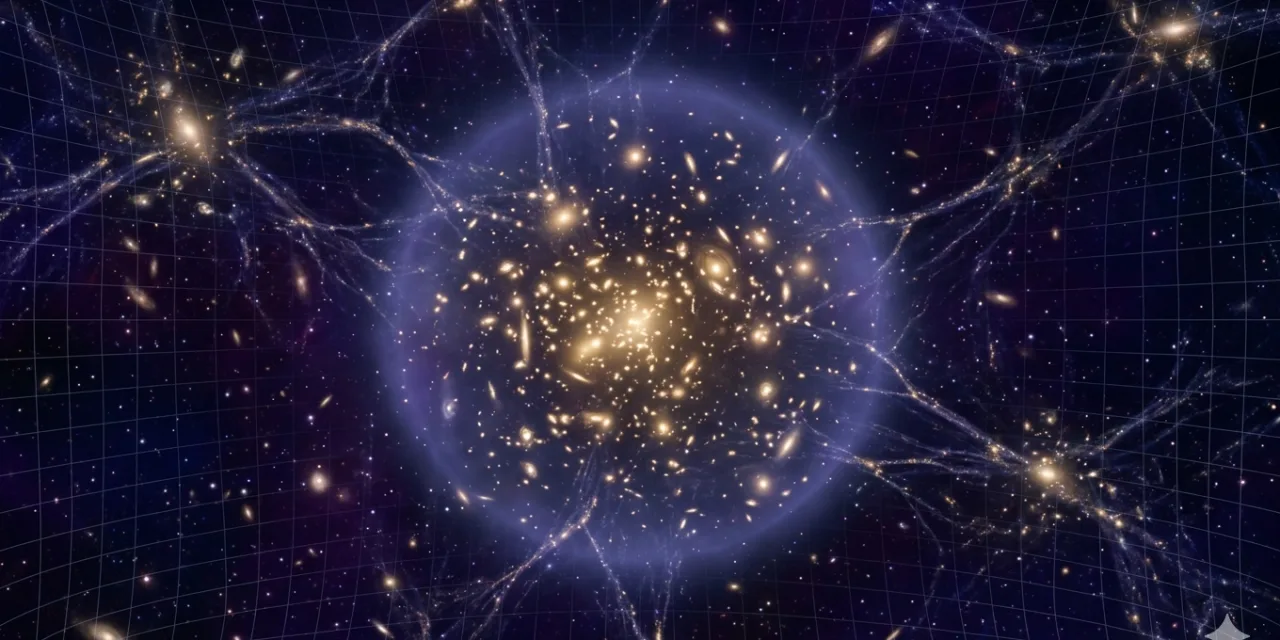
Everything you can see — every star, planet, galaxy, nebula, black hole, and every atom of gas and dust in the universe — accounts for approximately 5 percent of what exists. The other 95 percent is divided between two things that we cannot directly detect, have never directly measured, and do not understand at a fundamental level. Dark matter makes up roughly 27 percent of the universe’s total content. Dark energy makes up the remaining 68 percent. Together they constitute the overwhelming majority of reality, and together they represent what many physicists consider the greatest unsolved problem in all of science: what, exactly, are they?
In 2026, this question is more pressing — and more productively contested — than at any previous moment in the history of cosmology. The Dark Energy Spectroscopic Instrument (DESI), which has assembled the largest three-dimensional map of the universe ever created by surveying the positions and distances of tens of millions of galaxies, released its second major data set in 2025, providing what multiple independent analyses have described as compelling evidence that dark energy is not a static, unchanging constant but a dynamic phenomenon that evolves over cosmic time. If confirmed by forthcoming data, this would represent the most significant revision to the standard model of cosmology in decades. Meanwhile, the James Webb Space Telescope has produced new maps of dark matter distribution in galaxy clusters with unprecedented resolution — revealing the “invisible scaffolding of the universe,” as NASA described it, with a clarity that no previous instrument could achieve. And the persistent tension between two independent measurements of the universe’s expansion rate has deepened to roughly six standard deviations — a level of discrepancy that increasingly demands a new explanation beyond the current standard model.
This guide explains what dark matter and dark energy are, why we believe they exist, how we detect something we cannot see, what the leading candidate explanations are, and what the most significant new findings of 2025 and 2026 tell us about whether our current understanding of the universe is correct.
The Composition of Everything: A Universe We Mostly Cannot See
The standard model of cosmology — the Lambda Cold Dark Matter model, or ΛCDM — is the most successful large-scale description of the universe ever developed. It accurately describes the universe’s structure from the cosmic microwave background (the afterglow of the Big Bang, visible as a faint radiation in every direction) through the distribution of galaxies on the largest scales, the abundance of light elements formed in the first minutes after the Big Bang, and the rate at which the universe is expanding. Its success in explaining so many disparate observations is the reason cosmologists take it seriously — and the reason the anomalies that are emerging in 2025 and 2026 are so significant.
According to ΛCDM, the universe’s total energy-mass content is divided as follows: ordinary matter — the atoms, molecules, stars, planets, gas, dust, and black holes that make up everything we can directly observe — constitutes approximately 5 percent of the total. Cold dark matter constitutes approximately 27 percent. Dark energy — represented in the equations as the cosmological constant, denoted by the Greek letter Lambda — constitutes approximately 68 percent. The Lambda and Cold Dark Matter in ΛCDM’s name refer to these two dominant but mysterious components; the model is named for the things it cannot explain.
The unease that physicists feel about this situation is proportionate to its strangeness. It is not merely that 95 percent of the universe is invisible. It is that the two invisible components have essentially nothing in common with ordinary matter or with each other, and that our theoretical understanding of each is either absent or plagued with fundamental inconsistencies that suggest something important is missing from the picture.
Dark Matter: The Invisible Scaffolding of the Cosmos
The evidence for dark matter does not come from detecting dark matter directly. It comes from observing its gravitational effects on ordinary matter — and that evidence is overwhelming, diverse, and mutually consistent across scales ranging from individual galaxies to the entire observable universe.
The first systematic evidence came from galactic rotation curves. In the 1970s, astronomer Vera Rubin and her collaborator W. Kent Ford measured the rotational velocities of stars at different distances from the centres of spiral galaxies. According to Newtonian gravity, stars farther from the galactic centre — where most of the visible mass is concentrated — should orbit more slowly, just as the outer planets of our solar system orbit more slowly than the inner ones. What Rubin and Ford found was that outer stars orbit just as fast as inner stars — that the rotation curves of galaxies are flat rather than declining. The only explanation consistent with the observed velocities was the presence of an enormous amount of invisible mass distributed in a roughly spherical halo extending far beyond the visible disc of each galaxy. This halo — dark matter — provided the gravitational “glue” holding galaxies together at the speeds they rotate.
Independent evidence from gravitational lensing — the bending of light from distant objects by the gravity of intervening mass — provides a direct, observation-independent measurement of mass distribution. When light from a distant galaxy passes near a massive galaxy cluster, the cluster’s gravity bends and distorts the light into arcs and multiple images — an effect called strong gravitational lensing. By measuring the degree of distortion, astronomers can calculate the total mass of the lensing cluster. Consistently, these calculations reveal far more mass than is visible in the cluster’s stars and gas — typically five to ten times more. The excess mass must be dark matter, distributed in a halo around the visible cluster.
The most dramatic single piece of evidence is the Bullet Cluster — two galaxy clusters that collided approximately 100 million years ago. When galaxy clusters collide, their hot gas (which makes up most of their ordinary matter) is slowed by electromagnetic interactions and piles up between the clusters. But in the Bullet Cluster, observations combining X-ray imaging (which shows the hot gas) with gravitational lensing maps (which show the total mass distribution) reveal something striking: the mass — as measured by lensing — has passed straight through the collision largely undisturbed, while the hot gas has been slowed and separated from it. This spatial separation of mass from gas is exactly what would happen if most of the clusters’ mass were dark matter — which interacts gravitationally but not electromagnetically, passing through the collision zone as if the other cluster were barely there.
At the largest scales, the distribution of galaxies across the universe — the cosmic web of filaments, sheets, and voids that structures the cosmos on hundreds of millions of light-year scales — matches the predictions of models in which dark matter condensed first, providing the gravitational seeds around which ordinary matter clumped to form galaxies and galaxy clusters. Without dark matter, the universe would look dramatically different from what we observe: galaxies would not have formed as quickly, their internal structure would differ, and the large-scale cosmic web would not match the pattern that galaxy surveys reveal.
What Is Dark Matter? The Leading Candidates
Despite overwhelming evidence for dark matter’s existence through its gravitational effects, its fundamental nature — what it actually is at a particle physics level — remains unknown. This is not for lack of trying. Decades of underground detectors, particle accelerator searches, and indirect astrophysical observations have eliminated enormous ranges of candidate dark matter properties without finding a positive signal. The space of what dark matter could be has been narrowed substantially; the space of what it actually is remains open.
The most theoretically motivated candidate for decades was the WIMP — Weakly Interacting Massive Particle. WIMPs are hypothetical particles with masses in the range of a few to a few thousand times the proton mass that interact through gravity and the weak nuclear force but not electromagnetism or the strong force. WIMPs were attractive candidates because the same physics that explains their relic abundance from the Big Bang naturally produces roughly the right amount of dark matter — a coincidence theorists call the “WIMP miracle.” Large underground detectors filled with xenon, germanium, or other target materials have searched for the rare collisions between WIMPs and atomic nuclei that weak-force interactions would occasionally produce, and collider experiments including CERN’s Large Hadron Collider searched for WIMP production in high-energy collisions. Despite increasingly sensitive searches, no confirmed WIMP detection has been made. WIMPs remain possible, but the most straightforward models are increasingly constrained.
Axions are lighter, theoretically better-motivated alternatives that emerged from particle physics for reasons entirely independent of dark matter before being recognised as viable dark matter candidates. They interact extremely weakly with ordinary matter and light, making them even harder to detect than WIMPs, but recent advances in detector technology — including microwave cavity experiments that search for the conversion of axions to photons in strong magnetic fields — have extended the experimental search into previously inaccessible parameter space. No confirmed axion detection has been made, but the sensitivity frontier is advancing rapidly.
Primordial black holes — black holes formed in the early universe from density fluctuations, before the formation of stars — represent a macroscopic rather than particle-physics candidate. Gravitational wave detections from LIGO and Virgo have found a population of black hole mergers whose mass distribution is suggestive of a primordial origin, and ongoing gravitational microlensing surveys are constraining what fraction of dark matter could be in black hole form. The current data do not support primordial black holes as the sole or dominant dark matter component, but they remain a viable contributor.
The James Webb Space Telescope, in a remarkable February 2026 publication, produced the highest-resolution dark matter map of a region of sky ever assembled — improving dramatically on the previous best Hubble Space Telescope map of the same region. The JWST observations confirmed with new precision that dark matter and ordinary matter are spatially co-located in the same galaxy clusters and cosmic structures — the large-scale alignment is too precise to be coincidental, and is exactly what is expected if dark matter’s gravity has been pulling ordinary matter toward it throughout cosmic history. “Wherever we see a big cluster of thousands of galaxies, we also see an equally massive amount of dark matter in the same place,” NASA noted. The Webb results add to the case that dark matter is a gravitationally active, massive component that structures the universe at all scales — while leaving the question of its particle physics identity as open as ever.
Dark Energy: The Force Driving the Universe Apart
If dark matter’s existence was surprising, dark energy’s discovery in 1998 was frankly shocking. Two independent teams of astronomers — the Supernova Cosmology Project and the High-Z Supernova Search Team — were using observations of Type Ia supernovae to measure the universe’s expansion rate at different points in cosmic history. Type Ia supernovae have approximately the same intrinsic brightness everywhere and at all times, making them “standard candles” — their apparent brightness in the sky directly indicates how far away they are. By comparing the distances inferred from supernovae’s apparent brightness with their redshifts (which measure how fast they are receding, and therefore how far away they are by Hubble’s law), the teams expected to find the universe’s expansion slowing down over time — because gravity should be pulling everything back together.
Instead, both teams found that distant supernovae are fainter than expected — they are farther away than they should be if the expansion were decelerating. The expansion of the universe is not slowing down. It is accelerating. Something is pushing the universe apart at an increasing rate, overpowering gravity’s pull on cosmic scales. That something was named dark energy — a term chosen more for its evocativeness than its explanatory content, since nobody knows what it is.
In the standard ΛCDM model, dark energy is represented as the cosmological constant — Einstein’s Lambda, which he originally introduced into his field equations as a fudge factor to produce a static universe (before Hubble’s observations showed the universe was expanding) and then famously called his “greatest blunder.” The cosmological constant corresponds to a fixed, unchanging energy density of empty space — the vacuum energy of quantum field theory. Space itself has energy, and as the universe expands and creates more space, the total dark energy increases, driving ever-faster expansion. The cosmological constant model fits all existing observations to date with impressive accuracy.
The problem is theoretical. Quantum field theory predicts a vacuum energy density that is between 50 and 120 orders of magnitude larger than the value of the cosmological constant measured from cosmological observations. This discrepancy — between what the cosmological constant should be according to quantum physics and what it observationally is — is arguably the worst quantitative disagreement between theory and observation in all of physics. It is called the cosmological constant problem, and it has been unresolved since its precise articulation in 1989.
DESI and the Possibility That Dark Energy Is Not Constant
The most significant development in dark energy research in 2025 and 2026 is the growing body of evidence that the cosmological constant may not, in fact, be constant — that dark energy may evolve over cosmic time rather than remaining fixed. This would not resolve the cosmological constant problem, but it would mean that the simple Lambda model is incomplete, and that dark energy has a more complex character than the standard model assumes.
The Dark Energy Spectroscopic Instrument is a spectrograph on the Nicholas U. Mayall Telescope at Kitt Peak National Observatory in Arizona that can simultaneously observe the spectra of 5,000 galaxies, measuring their distances and recession velocities by the baryon acoustic oscillation technique — using the predictable scale of density fluctuations imprinted on the cosmic matter distribution by acoustic waves in the early universe as a “standard ruler” whose apparent size at different cosmic distances traces the universe’s expansion history. DESI has assembled the largest three-dimensional map of the universe ever created, surveying tens of millions of galaxies across a wide range of cosmic epochs.
DESI’s Data Release 2, analysed in late 2025 and into 2026, provides what multiple independent research groups describe as compelling evidence for dynamical dark energy — dark energy whose equation of state, the relationship between its pressure and energy density, varies with redshift (and therefore with cosmic time) rather than remaining fixed at the cosmological constant value. The DESI collaboration describes this preference for dynamical dark energy over a static cosmological constant at between 2.8 and 4.2 standard deviations in most analyses — a substantial but not yet definitive signal. In combination with supernova data from the Dark Energy Survey’s final analysis, which independently found a preference at around three standard deviations for dynamical dark energy, the evidence from multiple independent probes pointing in the same direction is what makes the current moment significant.
Researchers have used DESI DR2 data to reconstruct the equation of state of dark energy as a function of redshift — the history of how dark energy’s properties have evolved over cosmic time. The results are striking: the equation of state appears to cross the value of negative one (the cosmological constant value) at different cosmic epochs, behaving as so-called phantom dark energy (more negative than negative one) at some times and quintessence-like (less negative than negative one) at others. This “Quintom-B” behaviour, if confirmed, would represent a fundamentally new type of dark energy component that no simple scalar field model straightforwardly produces.
The standard scientific caution is appropriate here. The signal is compelling but not definitive. DESI’s five-year survey is ongoing, and the current data represent a subset of the final dataset. Independent probes — gravitational wave standard sirens, the growth rate of cosmic structure, weak gravitational lensing surveys from the Euclid space telescope — will provide additional constraints that will either strengthen or weaken the case for dynamical dark energy. The scientific community has been appropriately measured: the DESI results are described as “hints” and “compelling evidence,” not proof. But the fact that multiple independent instruments and analysis approaches are consistently finding the same departure from the standard model is exactly the pattern that precedes major paradigm shifts in science.
The Hubble Tension: A Crack in Cosmology
Compounding the dark energy puzzle is a separate but related problem known as the Hubble tension. The Hubble constant — the rate at which the universe is currently expanding, expressed in kilometres per second per megaparsec — can be measured in two fundamentally independent ways. The early-universe method measures the universe’s composition and initial conditions from the cosmic microwave background and then calculates what the Hubble constant should be today given how the universe has evolved since. The late-universe method measures the Hubble constant directly today using calibrated “distance ladders” — chains of measurement from nearby Cepheid variable stars through to distant Type Ia supernovae.
These two methods disagree. The early-universe value, from the Planck satellite’s CMB measurements, gives a Hubble constant of approximately 67.4 kilometres per second per megaparsec. The late-universe value, from measurements combining the Hubble Space Telescope and James Webb Space Telescope by Adam Riess and colleagues, gives approximately 73.8 kilometres per second per megaparsec. The discrepancy is now approximately six standard deviations — a level of statistical significance that in particle physics would unambiguously indicate a real effect rather than measurement error. The Hubble tension has survived every attempt to explain it as a systematic measurement error and has only grown stronger as both sets of measurements have become more precise.
A six-sigma tension between two well-validated measurement methods is a serious problem for cosmology. Either one of the measurement chains contains an unidentified systematic error that has so far resisted discovery — which remains possible but seems increasingly unlikely as the measurements are refined — or the standard cosmological model is incomplete in some way that produces different effective Hubble constants at different epochs. If dark energy is truly dynamical and evolving over cosmic time rather than constant, this could contribute to the tension by affecting the expansion history that connects early-universe to late-universe measurements. Multiple analyses using DESI DR2 data have examined whether dynamical dark energy can resolve the Hubble tension, and the current conclusion is mixed: dynamical dark energy helps but does not fully resolve the tension, suggesting that new physics beyond even a time-varying dark energy may be required.
The Search for Dark Matter Particles: Detectors Getting More Sensitive
While the theoretical landscape of dark matter candidates remains broad, experimental capabilities are advancing rapidly. A January 2026 report from underground dark matter detection programmes noted that detectors are becoming so sensitive that they can detect particle interactions that might occur only once in years — approaching the threshold at which neutrino-nucleus scattering (the “neutrino floor,” a background that dark matter detectors cannot distinguish from hypothetical WIMP signals without additional discrimination) begins to constrain sensitivity. The next generation of experiments — including LUX-ZEPLIN (LZ) in the Sanford Underground Research Facility, XENONnT at Gran Sasso, and PandaX-4T in China — are operating at sensitivities that cover essentially all of the theoretically favoured WIMP parameter space. If WIMPs exist in the most theoretically natural mass and interaction ranges, they will be detected — or definitively excluded — within this decade.
For axions, the ADMX (Axion Dark Matter eXperiment) and related experiments are scanning through the axion mass range with increasing sensitivity. The detection principle — using a resonant microwave cavity in a strong magnetic field to stimulate the conversion of dark matter axions into microwave photons that can then be detected — requires scanning through possible axion masses one frequency range at a time, and the process is slow. But the technology is advancing, and the parameter space where axions could solve both the dark matter problem and a separate particle physics anomaly (the strong CP problem) is being probed for the first time.
Modified Gravity: The Alternative to Dark Matter
A conceptually distinct possibility is that dark matter does not exist as a physical substance at all — that the galactic rotation curves, gravitational lensing signals, and large-scale structure observations attributed to dark matter instead reflect a misunderstanding of how gravity behaves at low accelerations or large scales. The most developed alternative is Modified Newtonian Dynamics (MOND), proposed by Mordehai Milgrom in 1983, which suggests that Newtonian gravity is modified at very low accelerations — the regime that characterises the outer parts of galaxies — producing flat rotation curves without requiring additional mass.
MOND has notable successes: it predicts galactic rotation curves from visible matter alone with striking accuracy, it captures a relationship between the distribution of visible and dark matter in galaxies (the radial acceleration relation) that appears in the data, and it makes specific predictions about dwarf galaxies and ultra-diffuse galaxies that have been confirmed observationally. Its failures are equally notable: it does not straightforwardly explain galaxy cluster dynamics (which require more dark matter than MOND can account for even with its modifications), and it does not naturally reproduce the large-scale structure of the universe without significant additional theoretical machinery. The most comprehensive relativistic extension of MOND — called MOND-like covariant theories — remains less predictively successful than ΛCDM for the full range of cosmological observations.
The scientific consensus in 2026 remains that dark matter as a physical substance is significantly more likely than modified gravity alternatives, primarily because dark matter models fit the full range of observations more coherently. But the MOND community continues to identify predictions that the standard dark matter paradigm struggles to explain — a productive tension that has produced genuine improvements in both theoretical camps.
What We Are Left With: The Honest Picture
The honest picture of our understanding of dark matter and dark energy in 2026 is one of extraordinary observational richness combined with profound theoretical uncertainty. We know with very high confidence that 95 percent of the universe is not ordinary matter. We know with high confidence that dark matter is a gravitationally active, collision-less substance that structures galaxies and the cosmic web. We know with high confidence that dark energy is accelerating the universe’s expansion. We have compelling, growing evidence from DESI and the Dark Energy Survey that dark energy may be evolving over time rather than remaining constant — which, if confirmed, would require new physics beyond the standard model. And we have a six-sigma tension between two independent measurements of the universe’s expansion rate that increasingly demands an explanation beyond systematic measurement error.
What we do not know is what dark matter is made of — despite decades of searches that have eliminated most of the theoretically motivated candidate parameter space. What we do not know is whether dark energy is the cosmological constant, a dynamic scalar field, a modification of gravity on cosmic scales, or something conceptually new. And what we do not know is how to reconcile the observed value of the cosmological constant with the quantum field theory prediction — a discrepancy of up to 120 orders of magnitude that remains the most embarrassing quantitative failure of modern theoretical physics.
DESI will complete its five-year survey, providing a definitive test of whether the current hints for dynamical dark energy represent a real physical signal or a statistical fluctuation. The Euclid space telescope is now conducting its own independent galaxy survey that will provide complementary constraints. The next generation of dark matter detectors will either discover WIMPs in the remaining allowed parameter space or close that space definitively, forcing a rethink of the leading dark matter paradigm. The universe is keeping its deepest secrets well. But the instruments and methods that are chipping away at them have never been more powerful — and the pace at which those secrets are yielding, in 2025 and 2026, suggests that the next decade of cosmology may be the most revelatory in the field’s history.




0 Comments
No comments yet. Be the first to share your thoughts!