
The atmosphere already holds approximately one trillion excess tonnes of carbon dioxide from human industrial activity. Greenhouse gas concentrations have reached historic highs. The ten warmest years on record have all occurred since 2010, and the hottest single year ever recorded was the one that just ended. By any honest accounting, the situation is severe.
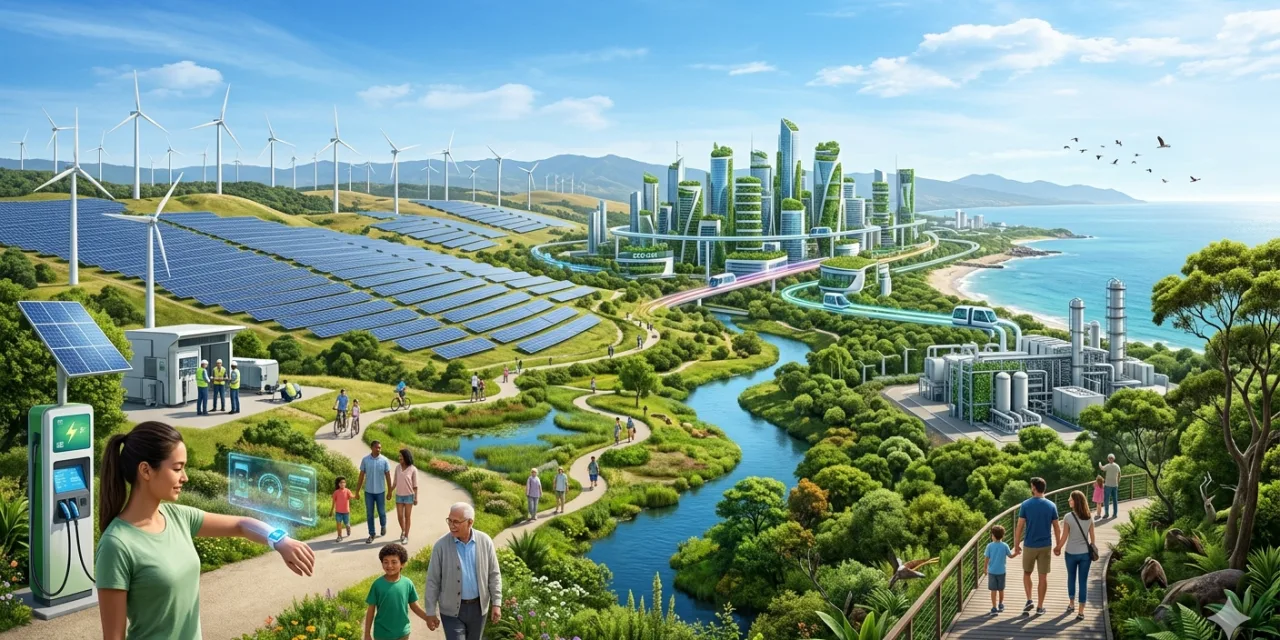
And yet, if you look at what is happening in laboratories, factories, and deployment sites across the world in 2026, a different kind of story is also true. Clean energy has reached 40 percent of global electricity generation. Combined global investment in clean energy technologies has topped $2 trillion annually for the first time — a new record for a sector that barely existed in its current form fifteen years ago. The International Energy Agency’s 2026 State of Energy Innovation report identifies more than 150 notable innovation developments across the energy landscape this year alone, including advances in perovskite solar cells, fusion energy, sodium-ion batteries, and next-generation geothermal that collectively achieved 50 technology readiness level upgrades among emerging energy technologies. Around one in ten patents worldwide now relates to energy — surpassing chemicals, pharmaceuticals, and transportation. The sector has become a hub of innovation at a scale that, measured by the concentration of scientific and engineering talent directed toward a single problem, is historically unprecedented.
The honest picture of 2026 is not one of solved problems. It is one of genuine, accelerating, measurable progress on multiple simultaneous fronts — and a race between how fast the climate changes and how fast the technology can deploy. This guide covers the major technologies at the centre of that race: what they are, where they stand, what the 2026 breakthroughs mean, and which ones are most likely to matter at the scale and speed the problem demands.
The Scale of What Science Must Accomplish
Before examining the technologies, it helps to understand the magnitude of the task they face. The goal of limiting global warming to 1.5 degrees Celsius above pre-industrial levels — the target established by the Paris Agreement — requires global net carbon dioxide emissions to reach zero by approximately 2050. That means not merely slowing the rate at which humanity adds carbon dioxide to the atmosphere, but eliminating it entirely across every sector: electricity generation, transport, industry, agriculture, and buildings. And it increasingly means not just eliminating new emissions but actively removing carbon dioxide that is already in the atmosphere — a much harder problem that no current technology can solve at sufficient scale and cost.
The IPCC has stipulated the need for carbon dioxide removal strategies targeting 85 million metric tonnes of CO₂ removed annually by 2030, escalating to 980 million metric tonnes by 2050 to support net-zero scenarios. Current direct air capture capacity globally stands at a tiny fraction of these targets. The gap between where current deployment stands and Where It needs to be is vast — but the rate at which costs are falling, efficiencies are improving, and new approaches are entering the field is equally extraordinary. The question is whether the technology can close that gap faster than the climate deteriorates.
MIT Technology Review’s 2026 Breakthrough Technologies list — now in its 25th year — placed three climate-related technologies on its shortlist: sodium-ion batteries, next-generation nuclear reactors, and hyperscale AI data centres (the last representing the dual-edged relationship between the AI boom and energy demand). These three choices tell a coherent story about where 2026 sits in the arc of climate technology development: at the inflection point between laboratory demonstration and commercial deployment, Where the decisions made about which technologies to scale, finance, and build will shape the energy system of the 2030s and beyond.
Solar’s Next Leap: Perovskite Cells and the 34% Efficiency Wall
Silicon solar panels have dominated the renewable energy transition for twenty years. They are reliable, now extraordinarily cheap, and deployed at gigawatt scale across every continent. They are also approaching a hard physical limit. The best commercial silicon panels achieve roughly 22 percent efficiency in real-world conditions, and the theoretical maximum for a single-junction silicon cell is approximately 27 percent. Engineers have been closing in on that ceiling for years. Closing it entirely would require something fundamentally different.
Perovskite solar cells are that something different. Perovskite is a class of crystalline materials — named after a 19th-century Russian mineralogist — whose crystal structure can be chemically tuned to absorb different wavelengths of light with high efficiency. Where silicon cannot efficiently capture the high-energy blue and green end of the solar spectrum, perovskite cells can. When a thin perovskite layer is stacked on top of a conventional silicon cell in what is called a tandem configuration, the two layers share the solar spectrum between them — the perovskite absorbs the blue-green light while the silicon handles red and near-infrared — and together they achieve efficiencies that neither material can reach alone.
In January 2026, researchers at the University of Manchester achieved perovskite cells with 25.4 percent efficiency while retaining over 95 percent of their performance after 1,100 hours of testing — a significant durability milestone for a class of materials that has historically degraded faster than silicon in real-world conditions. More dramatically, tandem perovskite-silicon cells have now reached laboratory efficiencies up to 34.6 percent — results published in Nature that represent a major step beyond silicon’s ceiling. These numbers are not merely academic. A 34 percent efficient panel produces dramatically more power from the same roof area than a 22 percent panel, which reshapes project economics for rooftop installations where roof area is the binding constraint, solar farms where land costs matter, and portable applications where weight and compactness are critical.
What makes 2026 genuinely significant for perovskite solar is that several manufacturers are moving beyond pilot lines into the first real commercial product launches. The question is no longer whether perovskite-silicon tandems can work in a laboratory. It is whether they can survive the financial test of 20-plus-year performance guarantees in outdoor conditions — the bankability threshold that large utility-scale contracts require. Encapsulation techniques that protect perovskite layers from moisture, oxygen, and heat degradation are the central engineering challenge of 2026 perovskite manufacturing. Manufacturing costs are projected to come in 30 to 40 percent lower than traditional silicon panels once production scales, which would make the efficiency advantage additive to a cost advantage. The intersection of higher efficiency and lower cost, if it arrives as projected, could accelerate solar deployment significantly faster than silicon alone could achieve.
The Energy Storage Revolution: Sodium-Ion, Iron-Air, and the Long-Duration Problem
More solar and wind power on the grid is only as useful as the storage that smooths over the hours, days, and weeks when the sun is not shining and the wind is not blowing. Lithium-ion batteries have dominated short-duration storage — they are excellent at balancing fluctuations over minutes and hours, and they power the electric vehicle transition. But they use relatively scarce and geographically concentrated materials, and they are not optimised for the multi-day storage that a grid running primarily on variable renewables ultimately needs. Two battery chemistries advancing into commercial production in 2026 address different parts of this problem.
Sodium-ion batteries are the technology that MIT Technology Review placed on its 2026 Breakthrough Technologies list, and the choice reflects the timing precisely. China’s CATL — the world’s largest battery manufacturer — began manufacturing sodium-ion batteries at industrial scale in 2025, launching its “Naxtra” line in earnest in 2026. Sodium is the sixth most abundant element on Earth and is found in seawater — effectively unlimited supply at negligible extraction cost compared to lithium, which is concentrated in a small number of geographically and geopolitically sensitive deposits. Sodium-ion batteries offer lower energy density than the best lithium packs, meaning they are somewhat heavier for the same energy capacity, but they deliver higher discharge rates, lower fire risk than lithium-iron-phosphate chemistry, and reliable performance across a wider temperature range — including extreme cold where lithium batteries lose capacity rapidly. These characteristics make sodium-ion attractive for grid-scale stationary storage, city buses, and the lower end of the electric vehicle market where cost matters more than maximum range. CATL’s move to mass production signals that major automakers and grid operators see sodium-ion not as an alternative to lithium-ion but as a complementary technology addressing different use cases in a diversified storage portfolio.
Iron-air batteries address the long-duration storage problem that lithium and sodium cannot solve economically. Iron-air batteries store energy by oxidising iron — essentially rusting it — when discharging, and reversing the process during charging. Iron is extraordinarily cheap and abundant. The chemistry lends itself to very large storage containers that can hold energy for days or weeks rather than hours. The energy density is low compared to lithium — iron-air batteries would be far too heavy for a vehicle — but for grid-scale stationary storage where the battery sits in a field and weight does not matter, energy density per kilogram is irrelevant. Cost per kilowatt-hour of stored energy is what matters, and iron-air’s chemistry has the potential to deliver multi-day storage at a fraction of the cost of lithium-ion systems. Several pilot plants for iron-air battery systems are proving their design in real operating conditions in 2026, with the critical questions centring on how they perform during extended real-world use — particularly during the multi-day winter storms where long-duration storage matters most.
Together with the continued cost improvements in lithium-ion systems, the emergence of sodium-ion at commercial scale and iron-air at pilot scale in 2026 represents a meaningful diversification of the energy storage portfolio. A grid with cheap, abundant lithium-ion for short-duration balancing, sodium-ion for cost-sensitive applications and cold climates, and iron-air for multi-day reserves would look very different — and more robust — than one depending entirely on lithium chemistry.
Next-Generation Nuclear: Small Modular Reactors and the Baseload Question
Nuclear fission generates approximately 10 percent of global electricity as reliably dispatchable, weather-independent, near-zero-carbon power. It is the only low-carbon baseload technology currently deployed at gigawatt scale. But the traditional model of nuclear power — enormous, bespoke reactors costing billions and taking over a decade to build, with significant risk of cost overrun and delay as demonstrated by recent projects in the United Kingdom, Finland, and the United States — has made new nuclear construction economically challenging in many markets.
Small modular reactors are designed to change that equation. Rather than building one enormous reactor, small modular reactors use designs that can be factory-manufactured in standardised units of 50 to 300 megawatts, shipped to site, and assembled — enabling economies of repetition that replace the site-specific economies of scale of traditional large reactors. The factory manufacturing model also allows quality control processes not possible in on-site construction, potentially improving both reliability and safety. Multiple competing small modular reactor designs are advancing through regulatory approval processes in the United States, Canada, the United Kingdom, and elsewhere. MIT Technology Review placed next-generation nuclear on its 2026 Breakthrough Technologies list specifically because several designs are genuinely closer to becoming commercially available options than at any previous point — the inflection moment from sustained promise to real engineering choice that engineers can actually evaluate.
Next-generation geothermal has also emerged as a significant development in 2026. Traditional geothermal power has been limited to regions with naturally high subsurface temperatures close to the surface — volcanic areas, tectonic boundaries. Advanced geothermal systems, using horizontal drilling techniques pioneered by the oil and gas industry, can access the consistent heat present in rock formations at depth almost anywhere on Earth, creating geothermal power potential that is geographically unrestricted. TechCrunch’s investor panel from January 2026 identified next-generation geothermal as one of the most promising near-term climate technologies alongside sodium-ion batteries, with multiple projects demonstrating viability. The Emerald VC climate tech trends analysis notes that geothermal timelines are similar to nuclear — potent but requiring around a decade to bring to full capacity — which makes 2026 the moment to be investing in it, not the moment to expect widespread deployment.
Fusion Energy: The Long Game and the 2026 Tritium Breakthrough
Nuclear Fusion — the process that powers the sun, fusing light hydrogen isotopes into helium and releasing enormous energy — has been the subject of serious research since the 1950s. It promises effectively limitless clean energy, no long-lived radioactive waste, and no risk of runaway chain reactions. It has also been “twenty years away” for approximately sixty years.
2026 is not the year fusion arrives. But it is, the Emerald VC analysis argues, the year fusion shifts from science fiction promise to strategic reality — the moment when the question changes from “will fusion ever work?” to “how do we prepare for when it does?” Private investment in fusion has accelerated sharply: magnetic confinement companies including Commonwealth Fusion Systems (which achieved a world-record magnetic field strength with high-temperature superconducting magnets in 2021 that its SPARC device will use) and TAE Technologies, alongside inertial confinement approaches, have collectively attracted billions in private capital. Commonwealth Fusion Systems aims for SPARC to achieve net energy gain — more fusion energy out than energy in — in the late 2020s. NIF’s 2022 ignition achievement at Lawrence Livermore National Laboratory demonstrated that inertial confinement fusion can produce net energy, though scaling from a laboratory laser experiment to a power plant remains an enormous engineering challenge.
The specific 2026 development that moves fusion from background progress to active news is not plasma confinement records but a quieter, more fundamental problem: tritium supply. Fusion reactors of the type most seriously pursued use deuterium and tritium as fuel. Deuterium is easily extracted from water. Tritium is radioactive, has a half-life of just twelve years, and exists in global stocks estimated at only a few tens of kilograms — enough, in total, to fuel a single commercial 1-gigawatt fusion plant for perhaps one year. A commercial fusion energy sector requires breeding tritium from lithium inside the reactor itself, using the high-energy neutrons produced by fusion reactions to transmute lithium into tritium. This tritium breeding blanket is one of the least-studied but most critical engineering challenges in the entire fusion development programme.
In 2026, Canadian Nuclear Laboratories and Japanese firm Kyoto Fusioneering are building Unity-2 — a research installation specifically designed to test how tritium can be handled, bred, and recycled safely in a continuous loop. Unity-2 will not generate electricity, but it addresses the supply-chain plumbing that any commercial fusion plant will depend on. Data from this facility will feed directly into the business cases of private fusion startups and government fusion programmes planning pilot plants in the 2030s. The fact that the tritium problem is being seriously addressed in a dedicated research facility in 2026, rather than deferred to a later phase, represents the kind of engineering seriousness that distinguishes credible long-term development from perpetual promise.
Direct Air Capture: Pulling Carbon from the Sky
Even if humanity stopped emitting carbon dioxide entirely tomorrow, the one trillion excess tonnes already in the atmosphere would continue warming the planet for decades. Stabilising the climate at acceptable temperatures almost certainly requires not just eliminating new emissions but actively removing some of what is already there. Direct air capture — systems that extract carbon dioxide directly from ambient air — is the most technically mature approach to this removal challenge, though “most mature” is a relative description in a field that is still far from the scale required.
Direct air capture works by passing large volumes of air through chemical sorbents or liquid solutions that bind to carbon dioxide, then heating the resulting compounds to release a concentrated stream of CO₂ that can be stored underground or converted into fuels and materials. The technology works. The problem is cost and energy intensity. Current direct air capture costs range from approximately $300 to $1,000 per tonne of CO₂ depending on the technology, energy source, and scale — compared to the social cost of carbon that most economists place in the range of $50 to $200 per tonne. The energy required to power direct air capture at meaningful scale is enormous: a 100-million-tonne-per-year direct air capture sector — a small fraction of what 2050 net-zero scenarios require — would need something approaching the electricity generation capacity of a large country.
The cost trajectory is moving in the right direction. Direct air capture costs have been falling with scale and technology improvement, and the US Department of Energy’s investment of more than $1 billion through its Direct Air Capture Hub programme — funding two commercial direct air capture facilities in Texas and Louisiana — is designed to accelerate the scale-up that drives those costs down. DOE research has found that pairing direct air capture systems with advanced nuclear reactors could lower the levelised cost by up to 13 percent over fossil-fuel-powered systems, by providing consistent, carbon-free heat and electricity that optimises the chemistry of the capture process. Concentrated solar thermal has also been identified as an underexplored energy source for direct air capture, particularly for high-temperature process heat requirements.
The Scene for Dummies climate tech analysis from January 2026 notes that 2026 is specifically the moment when direct air capture moves “from proof of concept to scalable solutions with economic upside” — not a claim that the cost problem is solved, but a recognition that the first commercial-scale plants are demonstrating that the technology can operate reliably at scale, which is the prerequisite for the cost reductions that further scale will bring.
AI and the Climate: Defender and Threat Simultaneously
Artificial intelligence has a complicated relationship with climate change in 2026 — and understanding both sides of that relationship is important for anyone trying to assess the technology’s net impact.
On the beneficial side, AI Is Transforming virtually every dimension of climate action. In grid management, AI-powered systems continuously optimise electricity dispatch, predict demand fluctuations, identify opportunities to balance variable renewable generation, and reduce transmission losses — doing in real time what human operators could not physically accomplish. Algorithmic solutions that unlock new power using existing infrastructure — companies like Gridcare and ThinkLabs AI identified by TechCrunch’s investor panel — can squeeze meaningfully more capacity from transmission and distribution assets without building new infrastructure. In agriculture, AI-powered precision farming tools manage water, soil chemistry, and crop health with sensor-driven accuracy that reduces irrigation water use, cuts fertiliser-related emissions, and improves yields under increasingly variable climate conditions. In climate science itself, AI weather models are producing forecasts of unprecedented accuracy and resolution, enabling better prediction of extreme weather events and longer-range climate projections that inform adaptation planning.
On the threat side, the AI boom is creating a dramatic surge in electricity demand from data centres. Hyperscale AI data centres — facilities requiring a gigawatt or more of power each, approaching the output of an entire conventional nuclear power plant for a single building — are being proposed and built at a pace that is straining electricity grids in multiple regions and driving a significant increase in overall power demand. MIT Technology Review included hyperscale AI data centres on its 2026 Breakthrough Technologies list not as an unambiguously positive development but as a major force reshaping energy demand, sparking public pushback in communities hosting proposed facilities, and emerging as a key driver of the need for new electricity generation of every type — including, inevitably, carbon-emitting sources in grids where clean alternatives are not growing fast enough. The ICL Group climate tech trends analysis identifies the convergence of AI and energy as one of the five major trends defining 2026 investment: “In 2026, where climate technologies are manufactured is becoming as strategically important as the technologies themselves.”
The net assessment is that AI is a powerful tool in the climate technology toolkit — but it is also accelerating the energy demand problem that the toolkit exists to solve. The race between AI as a climate solution and AI as an energy consumer is one of the defining tensions of the current moment.
Water Technology: The Overlooked Climate Frontier
Climate change is as much a water crisis as an energy crisis, and the technologies addressing water scarcity are among the most important and least discussed in climate conversations. Nearly half of the world’s population is beginning to experience water stress — living in areas where water demand is approaching or exceeding sustainable supply. Droughts are intensifying. Groundwater depletion is accelerating. Glaciers that supply fresh water to major river systems are retreating at rates that threaten long-term water security for hundreds of millions of people.
Venture investment in water technology hit a record $864 million in 2023 and remained near that level in 2024 — nearly double the average of the late 2010s — reflecting the recognition that water security has moved from an environmental concern to a board-level business continuity issue. Emerald VC’s 2026 climate tech trends analysis identifies water technology as “poised for a breakout” in 2026: once an overlooked subset of climate tech, it is now a major focus as droughts and water scarcity make headlines and corporations recognise that supply chain disruptions, agricultural failures, and operational shutdowns linked to water stress represent material financial risks.
The specific technologies attracting investment include low-energy desalination — improving the energy efficiency of salt removal from seawater to make desalination more affordable and deployable in water-stressed coastal regions — smart leak detection in ageing urban water infrastructure, and atmospheric water generation. MIT engineers developed a passive device that harvests clean drinking water from desert air without electricity — a window-sized panel using a hydrogel-desiccant combination that absorbs vapour at night and releases it through sunlight-driven condensation during the day. A 2025 breakthrough enables low-cost deployment of atmospheric water generation in arid regions, disaster zones, and off-grid communities. These technologies do not solve the water crisis. But they address specific, acute dimensions of it with approaches that are technically viable and increasingly affordable.
Clean Technology Investment: From Boom to Discipline
The investment landscape for climate technology has matured significantly from the speculative boom of 2020 to 2022, and that maturation is arguably healthy for the long-term deployment of the technologies that matter. Combined global clean energy investment topped $2 trillion annually in 2025 — a new record — but the character of that investment has shifted. The ICL Group’s climate tech trends analysis describes the atmosphere as one of “cautious pragmatism, with fewer speculative ventures and an emphasis on blended finance and meticulously costed project-based structures.”
Investors are applying sharper metrics. Scale is becoming a more significant determining factor for what gets financed. Projects that can demonstrate viability, durability, and measurable impact are advancing faster than broad platform concepts with distant timelines. Breakthrough Energy, Khosla Ventures, and DCVC launched a $300 million fund in early 2026 to support climate tech firms as they scale — specifically targeting the transition from first-of-a-kind projects (which are inherently expensive and risky) to nth-of-a-kind projects (which benefit from learning and repetition). This “FOAK to NOAK” transition — from first-of-a-kind to nth-of-a-kind — is identified by multiple analysts as the most critical and most underfunded phase in the climate technology deployment pipeline. The science works. The pilot projects prove it. The challenge is financing the second, fifth, and twentieth project at a cost structure that makes the technology economically self-sustaining.
The IEA notes that funding for fusion, next-generation nuclear fission, critical minerals, geothermal energy, carbon dioxide removal, and low-emissions industrial technologies has grown sharply since 2021, offsetting declines in some earlier-stage categories. Regional patterns are also significant: China continues to dominate in corporate R&D and patenting in energy storage and industrial efficiency, with international patent applications rising sharply. Europe’s public energy R&D intensity has reached approximately 0.08 percent of GDP — approaching record highs last seen in the 1980s and now surpassing other major advanced economies. The US remains the largest single climate tech market but faces policy durability questions that investors are increasingly pricing into their assessments of long-term subsidy dependability.
From Hype to Execution: What 2026 Actually Represents
The defining characteristic of climate technology in 2026 is not a single breakthrough discovery but a systemic shift in the relationship between innovation and deployment. Multiple technologies that spent years as laboratory demonstrations or costly pilot projects are simultaneously crossing the line into real commercial products, initial factory production, and first utility-scale contracts. Perovskite solar is launching its first commercial modules. CATL is ramping sodium-ion at industrial scale. Iron-air battery pilots are proving multi-day storage in real grids. Small modular reactors are advancing through regulatory approval. Next-generation geothermal is demonstrating viability. Unity-2 is beginning to address fusion’s fuel problem. Direct air capture is moving from proof of concept to first commercial scale.
None of these transitions eliminates the climate problem. The gap between current deployment and the scale required for net-zero by 2050 remains enormous, and the pace of climate change is not waiting for the technology to catch up. But the convergence of multiple technologies simultaneously crossing from demonstration to deployment in 2026 — driven by falling costs, maturing manufacturing, increasing policy support in key markets, and the sheer scale of investment now directed at the problem — represents the kind of inflection point that historical energy transitions have needed to accelerate.
The coal-to-steam transition, the oil-to-electricity transition, and the analogue-to-digital transition all looked gradual in the middle and sudden in hindsight. The clean energy transition may follow the same pattern. The question that 2026 poses is whether the gradual phase is ending and the sudden phase is beginning — and whether it is beginning fast enough.
The science says: possibly. The technology says: we have more tools than ever before, and they are getting cheaper faster than almost anyone predicted ten years ago. The investment says: trillions of dollars believe it is worth trying. What the next decade actually delivers will depend on whether the execution matches the ambition — on factories, grids, regulations, and supply chains that convert laboratory excellence into deployed infrastructure at the scale and speed the planet requires.




0 Comments
No comments yet. Be the first to share your thoughts!