

Somewhere in the Texas borderlands, a rocket taller than a thirty-story building is being prepared for a journey that no machine has ever completed with a human crew. Starship — SpaceX’s stainless-steel colossus, the most powerful launch vehicle ever built — is the centrepiece of what Elon Musk describes as humanity’s most important project: the colonization of Mars. The ambition is not modest. The timeline is not conservative. And the obstacles standing between where we are today and where Musk wants humanity to be by 2050 — a self-sustaining city of one million people on the surface of another planet — are not small.
Welcome to the most audacious engineering and civilizational project in human history. Let us look at it honestly.
In 2026, the Mars colonization story is simultaneously more advanced and more complicated than the headlines suggest. On February 9th, 2026, Elon Musk announced a delay in SpaceX’s Mars ambitions for “about five to seven years” in order to focus on lunar missions — a significant recalibration that surprised many observers who had been tracking SpaceX’s stated timelines. Yet the underlying technological progress that makes Mars colonization physically conceivable, if not yet practically imminent, is real and substantial. The rockets are getting bigger and more capable. The engineering solutions for surviving on Mars are taking shape in laboratories and simulation chambers. The international competition to reach the Red Planet — with China pursuing its own methodical multi-decade programme — has given the endeavour a geopolitical urgency that transcends any single company’s timeline.
This article is the complete, honest account of where the Mars colonization project stands in March 2026 — the genuine progress, the real obstacles, the revised timelines, the competing national visions, the unsolved scientific challenges, and the profound questions about governance, ethics, and human physiology that nobody who is serious about Mars can afford to ignore. The dream is real. The difficulty is equally real. Understanding both is the prerequisite for understanding what may be the defining technological story of the next three decades.
Why Mars? The Case for Making Humanity Multiplanetary
Before examining the how, it is worth spending time with the why — because the justification for the enormous investment, risk, and sacrifice that Mars colonization requires is not self-evident, and the people making the case for it make arguments that are worth understanding on their own terms.
The existential insurance argument is the one Musk returns to most consistently. The logic is straightforward: all of humanity’s accumulated knowledge, culture, civilization, and genetic heritage currently resides on a single planet. A sufficiently large asteroid impact, a catastrophic pandemic, a nuclear exchange, or any number of lower-probability but non-negligible extinction-level events could end the human story on Earth before we have backed it up anywhere. A self-sustaining colony on Mars — one that could survive independently of Earth — transforms humanity from a single-point-of-failure civilization into a distributed one. The cost of establishing that backup, measured against the value of everything humanity has built and might still build, is arguably the most favourable insurance premium in history.
The scientific argument is equally compelling for a different constituency. Mars preserves a geological and atmospheric record of the solar system’s early history in ways that Earth, with its active tectonics and erosion, does not. Evidence of past liquid water — now well-documented by decades of robotic exploration — raises the possibility that Mars once harboured life, and may still harbour microbial life in subsurface environments where liquid water may persist. Finding life on Mars — or definitively determining that it never existed despite the conditions that should have favoured it — would be among the most consequential scientific discoveries in human history, with profound implications for our understanding of biology, the origin of life, and the likelihood of life elsewhere in the universe.
The economic argument is more contested but gaining traction. The resources available in the broader solar system — asteroids rich in platinum-group metals, helium-3 deposits on the Moon with potential fusion energy applications, the virtually unlimited solar energy available beyond Earth’s atmosphere — represent economic value that dwarfs anything available on Earth’s surface. Mars, as a relatively nearby planet with an atmosphere and surface gravity that is not too different from Earth’s, is a plausible staging post for the broader development of the solar system economy. The infrastructure required to establish a Mars colony — in-situ resource utilization, long-duration life support, interplanetary logistics — is substantially the same infrastructure required to develop the rest of the solar system.
None of these arguments is without counterpoint. Resources invested in Mars colonization could address immediate human needs on Earth. The risks to early colonists are severe and possibly fatal for many. The legal and governance frameworks for who owns what on Mars and who governs its settlers are completely unresolved. The environmental ethics of potentially contaminating another world — or of terraforming it in ways that would destroy evidence of any life that exists there — are genuinely complex. These are not questions to be dismissed. They are questions that any honest account of Mars colonization must engage with, and they will become more pressing as the project advances from aspiration to operation.
Where We Actually Are: The Honest Status Report for March 2026
The Mars colonization project in March 2026 is best understood as being at the end of its preparatory phase and the beginning of its demonstration phase — the transition from building the vehicles and technologies in theory to testing whether they work in the environments for which they were designed.
SpaceX announced that it would launch the first uncrewed Starship missions to Mars by 2026 to take advantage of the next Earth-Mars transfer window. The plan was to send five Starships, and Elon Musk stated that these missions would focus on testing whether Starships could reliably land intact on Mars. That ambition, as of February 2026, has been revised. Musk announced a delay in SpaceX’s Mars ambitions for “about five to seven years” in order to focus on lunar missions. The 2026 Earth-Mars launch window — which opens based on orbital mechanics, not corporate schedules — will likely pass without Starship launches to Mars.
What does that mean practically? It means the next realistic opportunity for uncrewed Starship landings on Mars falls in the 2028-2029 launch window, with crewed missions potentially following in the early 2030s if those uncrewed demonstrations succeed. Short visits to the Martian surface are plausible within the next decade. SpaceX could land humans by the early 2030s if Starship development stays roughly on track. That is still an extraordinary timeline by any historical measure — the first humans on Mars within a decade is an ambition that would have seemed fantastical to most space scientists as recently as 2015.
The pivot to lunar missions is not simply a detour. NASA’s role in Mars missions focuses on long-term planning and technology validation for safe human exploration. NASA Artemis Mars pathfinder — lunar missions help test life support, radiation shielding, and surface technologies transferable to Mars. Every system that must work on Mars — closed-loop life support, in-situ resource utilization, surface mobility, habitat construction — can be tested on the Moon at a fraction of the communication delay and with much faster emergency resupply capability. The Moon is, in a genuine sense, the practice run for Mars. Organizations that understand this see the lunar focus not as abandoning Mars but as de-risking it.
As of early 2026, preparations intensify for the first uncrewed Starship Mars flights, leveraging the December launch window. These pioneers will test precision landings, deploy robotic scouts, and validate life-support prototypes, potentially including Tesla’s Optimus humanoid robots for initial site assessments and construction tasks. Whether those launches happen in 2026 or 2028, the engineering work in preparation for them is real and progressing — and it is producing knowledge about how to land a large vehicle on Mars that has never existed before.
Starship: The Vehicle That Changes Everything — If It Works
No discussion of Mars colonization in 2026 can proceed without a serious examination of Starship, because the entire colonization architecture depends on it. Starship is not just a rocket. It is the foundational technology that makes Mars colonization economically conceivable — the difference between a programme that requires the GDP of a large nation and one that might be achievable by a private company.
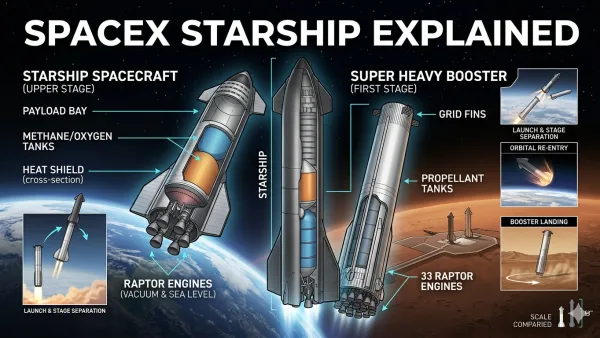
The logic is straightforward. Every previous Mars mission concept required extremely expensive, expendable launch vehicles — single-use rockets that were consumed in the process of delivering their payload. The cost per kilogram to Mars was measured in millions of dollars, making large-scale colonization economically impossible regardless of the engineering. Starship is designed to be fully reusable — both the Super Heavy booster and the Starship upper stage return to the launch site and are caught by the launch tower’s mechanical arms, then refuelled and relaunched within hours. Full reusability, if achieved reliably, reduces the marginal cost of each launch by orders of magnitude. Musk’s stated target is a cost per launch below ten million dollars — less than one percent of what comparable capability would cost with expendable vehicles.
For SpaceX’s plan to work, the behemoth Starship-Super Heavy design must reach orbit as reliably as the company’s Falcon 9 workhorse, which in September logged its 500th flight. Falcon 9’s reliability was not achieved quickly or easily — it took years of incremental development, multiple failures, and relentless iteration to reach the extraordinary reliability it demonstrates today. Starship is a far more complex system and is at an earlier stage of development. The iterative approach that produced Falcon 9’s reliability is being applied to Starship, but the timeline for reaching comparable reliability is measured in years, not months.
The orbital refuelling challenge is one of the most critical unresolved technical problems in the entire Mars architecture. Among the techniques SpaceX has yet to demonstrate is refuelling a Starship in Earth orbit. A Starship bound for Mars cannot carry enough propellant for the journey from Earth orbit — it needs to be refuelled by tanker Starships after reaching orbit. By those calculations, the five Starships leaving Earth in 2026 would require 60 tanker launches — ample opportunity to test Murphy’s law, and an unprecedented stress test of ground infrastructure. That refuelling manoeuvre itself is sound in theory, but there is scant evidence from practice. Demonstrating reliable cryogenic propellant transfer in orbit — with liquid oxygen and liquid methane at temperatures far below freezing, in the vacuum of space — is a genuinely novel engineering challenge that has never been solved at this scale.
None of this is to say Starship will not work. The engineering is fundamentally sound. SpaceX has demonstrated the ability to develop and iterate on complex launch vehicle technology faster than any other organization in history. The question is not whether Starship will eventually achieve the reliability and operational cadence that Mars colonization requires. It is when — and whether the broader technical prerequisites for human Mars missions will be resolved in the same timeframe.
The Survival Problem: What Humans Actually Need to Live on Mars
Getting to Mars is the problem that captures headlines. Surviving on Mars — indefinitely, without continuous resupply from Earth — is the harder problem, and the one that determines whether a Mars programme becomes a series of expensive flag-planting exercises or the beginning of genuine civilizational expansion.
The Martian environment is hostile to human life in every dimension that matters. Understanding those dimensions concretely — not just acknowledging that Mars is “harsh” — is essential to appreciating both the engineering challenges and the remarkable progress being made toward addressing them.
Radiation is the most immediate and most intractable challenge. Mars has no global magnetic field and only a thin atmosphere — roughly one percent of Earth’s atmospheric pressure — providing essentially no protection against solar radiation or cosmic rays. During a round trip to Mars — roughly 180 days flying each way, with a 600-day stay on the surface while waiting for the planets to realign — an astronaut would absorb roughly 1.1 sieverts of radiation, enough to meaningfully increase cancer risk. Long-term colonists face cumulative radiation exposure that would be unacceptable by any current occupational health standard without substantial shielding. Permanent settlement requires shielding populations with thick soil or utilizing underground lava tubes to mitigate chromosome mutations caused by solar radiation. Mars’s geology, fortunately, includes extensive networks of ancient lava tubes — cave systems created by flowing lava billions of years ago that left hollow channels beneath the surface. These natural structures could provide radiation shielding equivalent to several metres of regolith, offering a ready-made solution to the radiation problem for long-term habitation at the cost of finding, accessing, and pressurising them.
Atmosphere and pressure make the surface immediately lethal without protection. Mars’s atmospheric pressure is about 0.6 percent of Earth’s — far too low for the human body to function without pressure suits. The atmosphere itself is approximately ninety-five percent carbon dioxide, with trace amounts of nitrogen and argon and almost no oxygen. Every breath on Mars’s surface without a pressurised habitat or suit is fatal within seconds. Building and maintaining pressurised habitats that can withstand the pressure differential indefinitely, resist micrometeorite impacts, and be repaired if they develop leaks — with no hardware store within 55 million kilometres — is an engineering challenge that requires solutions significantly beyond current state-of-the-art.
Water is scarce on the surface but may be accessible in subsurface ice. Mars’s surface has abundant evidence of past liquid water — ancient riverbeds, lake basins, and mineralogy consistent with long-period water exposure. Current water exists primarily as ice in the polar caps and as subsurface permafrost at higher latitudes. In-situ resource utilization technologies like oxygen and methane production reduce reliance on Earth supplies. Extracting water from subsurface ice, electrolyzing it into hydrogen and oxygen for breathing and fuel, and recycling every drop of water in a closed-loop system are the operational requirements that ISRU technology aims to meet. The Perseverance rover’s MOXIE experiment demonstrated that oxygen can be produced from the Martian atmosphere’s carbon dioxide — a proof of concept for the oxygen production systems that life support and fuel manufacturing require.
Food production is among the hardest unsolved problems. Farming on Mars introduces a perchlorate problem. Martian soil cannot be used for growing crops until those toxic salts are removed. Perchlorates — salts that are toxic to humans — are present throughout Martian soil at concentrations that prevent direct agricultural use without treatment. Biological processing systems that can detoxify regolith for agricultural use, combined with closed-loop hydroponic systems that recycle nutrients and water in controlled environments, are the food production architecture that Mars colonization requires. Inflatable modules expand from compact payloads into spacious living areas, incorporating hydroponic gardens for fresh food and air regeneration. These systems work in terrestrial laboratory settings. They have never been operated in Martian gravity, Martian temperature swings, and Martian dust storm conditions simultaneously.
Psychological sustainability is as important as physical survival. The isolation, confinement, communication delay — signals take between three and twenty-two minutes one-way between Earth and Mars, making real-time communication impossible — and the absolute dependence on engineered systems for survival create psychological conditions that no current training programme has fully prepared humans for. Long-duration space missions on the International Space Station provide useful data, but the duration, isolation, and irreversibility of a Mars mission are qualitatively different. While spaceflight has existed for 65 years, research like Scott Kelly’s mission highlights the psychological and physical tolls of living in isolated, extraterrestrial environments for extended periods. The psychological dimension of Mars colonization — selecting people who can thrive under these conditions, building communities that maintain social cohesion over years, and managing mental health without easy access to specialised care — deserves as much engineering attention as the habitat pressure systems.
The Competition: China’s Mars Programme and the New Space Race
The public narrative around Mars colonization is heavily SpaceX-centric, for understandable reasons — no other organization has published as detailed a roadmap or made as much hardware progress toward interplanetary travel. But the story of who reaches Mars first, and on what terms, has an important second protagonist: China.
China has outlined a methodical, multi-decade plan. Representatives from China’s Deep Space Exploration Lab and the China National Space Administration have been consistent in these timelines at international conferences. Unlike SpaceX’s sprint approach, China’s plan builds incrementally: orbit first, then land, then build. China’s Tianwen-1 mission successfully placed a lander and rover on Mars in 2021 — making China only the second country after the United States to successfully operate a rover on the Martian surface. The Zhurong rover explored Utopia Planitia and returned valuable surface data. These were not trivial achievements.
China’s longer-term Mars ambitions include crewed orbital missions targeting the mid-2030s and crewed surface landings potentially in the 2040s. A 2024 U.S. Air University analysis concluded there are “ample authoritative signs” that China is progressing toward an orbit-only crewed mission before 2050. China’s approach is more conservative and more methodical than SpaceX’s — more in the tradition of the original Apollo programme than the startup iteration culture that characterises SpaceX’s development methodology. This means China is less likely to achieve a dramatic early landing but also less exposed to the spectacular failures that accompany the aggressive testing philosophy.
The geopolitical dimension of the Mars competition extends beyond national prestige. The 1967 Outer Space Treaty, signed by over 100 nations including the US and China, states that outer space and celestial bodies are not subject to national appropriation by claim of sovereignty, by means of use or occupation, or by any other means. But the treaty was written with Cold War-era government programmes in mind. It does not clearly address what happens when a private company establishes a permanent settlement and effectively controls the resources and infrastructure of a significant portion of Mars. The governance vacuum — who makes laws, who enforces them, who resolves disputes between settlers, and what claim if any the colonizing nation or company has to Martian territory and resources — is one of the most consequential unresolved questions in the entire Mars colonization project.
The US response to China’s growing space capabilities has been to accelerate the Artemis programme — the Moon-focused effort that SpaceX has now prioritized in place of its earlier Mars timeline. The lunar south pole is the strategic terrain both nations are focused on: its confirmed water ice deposits make it the natural location for the first permanent off-Earth human settlement, and whoever establishes substantial infrastructure there first will be in a position to shape the governance norms and resource access regimes of the wider cis-lunar economy. The Moon is, in this geopolitical reading, both a proving ground for Mars technology and a contested frontier in its own right.
The Technology Stack: What Must Be Invented Before Mars Is Liveable
A useful way to understand the current status of Mars colonization technology is to map the complete set of systems required for a self-sustaining Mars colony, and assess honestly which are ready, which are in development, and which remain research projects. The picture that emerges is of a technology stack where the propulsion layer is the most mature, and the sustainability layer — the systems that make permanent habitation possible rather than just initial landing — is the least mature.
Propulsion and transit: Starship represents genuine state-of-the-art progress toward the propulsion system Mars colonization requires. The Raptor engine — burning liquid methane and liquid oxygen, both of which can be produced on Mars from local resources — is a strategic choice that makes the entire logistics chain of Mars colonization more sustainable. Full stack reusability, orbital refuelling, and high-cadence launch operations are the specific capabilities that must be demonstrated before the transit layer can be considered mature. Progress is real and accelerating. Full maturity is three to five years away under optimistic assumptions.
Landing and surface operations: Landing a large vehicle on Mars requires a combination of atmospheric braking, supersonic retropropulsion, and terminal guidance that has never been demonstrated at Starship’s scale. Upcoming Mars missions include multiple Starship uncrewed landings planned around the 2026 Earth-Mars launch window. These missions aim to test landing reliability, cargo delivery, and autonomous operations using robotics. Even if those landings slip to 2028, they represent the critical demonstration that will either validate the architecture or force significant redesign. Autonomous construction robotics — the systems that will prepare the landing site, deploy solar arrays, and begin habitat construction before humans arrive — are in active development, with Tesla’s Optimus robot being positioned as the primary platform for early surface operations.
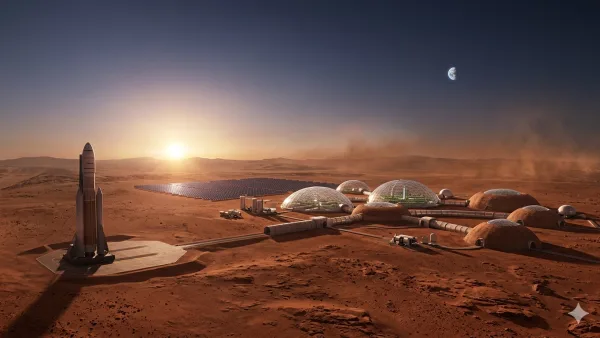
In-situ resource utilization: Fuel production via the Sabatier reaction mixes CO2 with hydrogen to create methane propellant, enabling return flights and powering habitats. Regolith processing sinters soil into bricks or extracts metals for tools, reducing launch mass by 80%. Solar arrays, backed by compact nuclear fission reactors for baseload power, ensure reliability. ISRU’s lunar trials by 2026 will refine these for Mars, promoting a closed-loop economy where waste becomes input, slashing resupply needs and boosting autonomy. ISRU is one of the most critically enabling technologies in the entire Mars architecture. A colony that can produce its own propellant, building materials, water, and oxygen from local resources does not depend on Earth resupply for survival — which is the difference between an outpost and a colony. The individual ISRU processes are well understood in laboratory settings. Integrating them into a robust, autonomous, reliable system that operates continuously in Martian conditions is the engineering challenge that remains to be solved.
Habitat and life support: New concepts from NASA integrate AI-driven environmental controls to optimize lighting and humidity, countering low-gravity effects with exercise regimes and centrifugal simulators. Closed-loop life support — recycling air, water, and waste with high efficiency — is significantly more mature than it was a decade ago, driven partly by ISS research and partly by the commercial investment that Mars colonization ambitions have attracted. Long-duration reliability in the Martian environment remains undemonstrated. Radiation-hardened electronics, dust-tolerant mechanical systems, and self-repairing habitat structures are specific challenges that current laboratory designs address in principle but have not been proven in the operational conditions they will face.
Medical capability: A Mars colonist who develops appendicitis cannot be evacuated to an Earth hospital. The colony must have the medical capability to perform complex procedures, manage chronic conditions, deliver babies, and provide psychiatric care — all in a small, resource-constrained environment, without the medical supply chains that terrestrial healthcare depends on. Telemedicine with a twenty-two minute communication delay is not medicine. AI-assisted diagnostic and surgical systems, pharmaceutical manufacturing from local resources, and comprehensive medical training for non-specialists are all required capabilities that are far less developed than the propulsion and structural engineering that gets most of the attention.
The Physical Toll: What Mars Does to the Human Body
The human body was built by millions of years of evolution for one specific environment: Earth’s surface, with its atmospheric pressure, its gravitational field, its radiation shielding, its circadian rhythms, and its microbial ecology. Mars provides none of these at Earth-normal levels, and the consequences for colonist health over years and decades of Martian residence are among the least well-understood variables in the entire colonization equation.
Martian gravity is approximately 38 percent of Earth’s. The effects of long-duration low gravity on human physiology are understood in their broad outlines from ISS research in microgravity, but Martian gravity is not zero gravity — it is a different environment with potentially different physiological consequences that cannot simply be extrapolated from ISS data. Bone density loss, muscle atrophy, cardiovascular deconditioning, and fluid redistribution are documented consequences of microgravity exposure. Whether Martian gravity is enough to prevent these effects, partially mitigate them, or produce its own distinct set of physiological consequences is genuinely unknown.
Human evolution will likely accelerate due to reduced gravity and the unique microbiome of alien habitats. Without constant maintenance, settlers face weaker bone structures, making childbirth riskier and potentially leading to larger cranial development in future generations. The transgenerational question — what happens to children born and raised on Mars, who develop in lower gravity with higher radiation exposure and a completely different microbial environment — is perhaps the most profound unknown in the entire colonization project. It is not a question that can be answered before the first colonists arrive. It is a question that the first generations of Mars children will answer with their bodies.
The radiation exposure question was addressed earlier in this article, but its long-term implications for a permanent colony deserve emphasis. Cancer risk increases with cumulative radiation exposure. A colonist who spends thirty years on Mars will accumulate radiation doses that would be considered unacceptable occupational exposure on Earth. The colony will need to accept this risk, mitigate it through shielding and protective behaviour, and develop medical capabilities for managing the cancers and other radiation-related conditions that will result — in the absence of the advanced medical infrastructure that Earth-based cancer treatment depends on.
The Legal Vacuum: Who Governs Mars?
The governance question for Mars colonization is not a secondary consideration to be addressed once the engineering problems are solved. It is a primary consideration that will shape who colonizes Mars, how they live, what rights they have, and how conflicts between settlers and between nations are resolved — and the current legal framework is completely inadequate for the scenario that is approaching.
The 1967 Outer Space Treaty states that outer space and celestial bodies are not subject to national appropriation by claim of sovereignty, by means of use or occupation, or by any other means. No country can claim Martian territory. The treaty was written with Cold War-era government space programs in mind and does not clearly address private companies or permanent settlements. Who governs a SpaceX colony?
This is not an abstract legal question. It is a question with immediate practical implications for every person who might emigrate to Mars. Does US law apply to American citizens on Mars? Does the company that built the habitat have the authority to make rules for its residents? What recourse does a settler have if the company that operates their life support decides to evict them for violating its terms of service? What happens if two nations’ colonists have competing claims to the same resource deposit? What rights does a child born on Mars have — are they a citizen of their parents’ nation, a stateless person, a citizen of Mars itself?
SpaceX’s proposed governance model, to the extent it has been articulated, involves Mars operating under its own self-governing constitution — directly democratic, with laws developed by the colonists themselves. Musk has suggested that Earth law should not apply to Mars and that settlers should govern themselves. This is a philosophically interesting position but an operationally unresolved one. A company that controls the life support, the food production, the communication systems, and the departure vehicles of a small, isolated colony has structural leverage over that colony’s governance that makes genuine self-determination difficult to guarantee regardless of the stated intent.
International space law scholars are actively working on frameworks that could govern Mars colonization more adequately than the 1967 treaty — drawing on analogies from Antarctic governance, the law of the sea, and the governance of international space stations. The urgency of this work is increasing as the timeline to the first human Mars missions shortens. The legal and governance architecture for Mars needs to be substantially developed before colonists arrive, not after — because the choices made in the first years of Martian settlement will establish precedents and power structures that will be very difficult to change once they exist.
The Environmental Ethics: What Do We Owe Mars?
The ethics of Mars colonization include a dimension that is rarely discussed in mainstream coverage but is genuinely important: the question of what obligations humanity has to Mars itself — and specifically to any life that may exist there.
The possibility of extant Martian life — particularly microbial life in subsurface environments where liquid water may persist — cannot currently be ruled out. No mission has directly sampled subsurface Martian environments at depths and locations where liquid water is most plausible. If life does exist on Mars, and if human colonization introduces Earth microbes that outcompete or kill it before we have the chance to discover and study it, we will have destroyed one of the most scientifically and philosophically significant findings in human history without ever knowing what we lost.
The Planetary Protection protocols maintained by NASA and the Committee on Space Research (COSPAR) require that spacecraft destined for Mars be sterilized to minimize the introduction of Earth organisms. These protocols are well-developed for robotic missions. They are essentially unworkable for human missions — humans are walking ecosystems, carrying trillions of microbes both on their surfaces and inside their bodies, and no sterilization process can produce a microbe-free human. The moment humans arrive on Mars, the potential for biological contamination of Martian environments becomes essentially impossible to prevent.
This does not mean humans should not go to Mars. It does mean that the scientific community has a limited window — before permanent human presence begins — to conduct the robotic searches for extant Martian life that would be compromised by human colonization. The prioritization of life-detection science before the colonization window closes is an ethical obligation that the Mars science community is actively advocating for, with some urgency.
What the Next Decade Actually Looks Like: The Realistic Forecast
Setting aside both the most optimistic SpaceX timelines and the most pessimistic assessments, what does the Mars colonization programme actually look like over the next ten years under a reasonably evidence-based forecast?
The years 2026 to 2028 will be dominated by lunar activities. Four Artemis II astronauts aboard the Orion spacecraft will orbit the Moon, being the first humans to leave Low Earth orbit since the Apollo 17 mission. These lunar missions will test the life support, radiation management, and surface operations technologies that Mars missions require. SpaceX will continue Starship development, with orbital refuelling demonstration and high-cadence launch operations the critical milestones. Whether the 2026 Mars launch window is used for uncrewed Starship missions depends on whether orbital refuelling is demonstrated before that window closes.
The 2028-2029 window is the most realistic target for the first uncrewed Starship landings on Mars — missions carrying Optimus robots and ISRU demonstration equipment to test whether the core systems of the colonization architecture function as designed in actual Martian conditions. Success here could accelerate crewed missions to 2029, aligning with the next optimal window in early that year. That timeline is aggressive. The early 2030s is the more defensible forecast for a first crewed Mars landing under optimistic but not unrealistic assumptions.
A more conservative reading of the technology gaps suggests true colonization — where people live on Mars without depending on Earth for survival — is unlikely before the 2050s or 2060s. This is not failure. It is an accurate description of the scale of the engineering challenge. The Apollo programme landed humans on the Moon eight years after Kennedy’s challenge. A self-sustaining Mars colony thirty years after the first crewed landing is not an embarrassment — it is an extraordinary achievement of the scope of the industrial revolution compressed into a single generation.
Why This Matters Even If You Never Plan to Go
The Mars colonization story matters to far more people than those who might ever board a Starship. The technology developed in pursuit of Mars colonization — advanced life support systems, closed-loop resource recycling, in-situ resource utilization, radiation medicine, long-duration human factors engineering — has direct applications to challenges on Earth. Closed-loop water recycling for arid regions. Advanced food production systems for resource-constrained environments. Radiation medicine advances for cancer treatment. Remote medical capabilities for underserved populations. The history of space technology consistently demonstrates that investments made to solve problems in space produce applications on Earth that were not anticipated at the outset.
The broader civilizational significance is harder to quantify but no less real. The aspiration to become a multiplanetary species represents the most ambitious statement of optimism about the human future that the current generation has produced. In an era where many of the most consequential developments in technology generate as much anxiety as excitement, the Mars project is unambiguously a story of expansion, possibility, and the ambition to extend the reach of life and consciousness beyond its single current address in the cosmos.
Whether SpaceX’s specific timelines hold, whether China reaches Mars before or after American colonists, whether the governance frameworks for Mars are resolved before or after the first settlers arrive — these are the details that will determine the character of this story. The story itself — humanity’s first serious attempt to become a multiplanetary species — is the most important technological and civilizational story of the next thirty years. Understanding it clearly, without either the hype of promotional material or the deflation of reflexive scepticism, is the prerequisite for engaging with it intelligently.
Conclusion
The Mars colonization project in 2026 is exactly what you would expect from the early stages of humanity’s most ambitious engineering undertaking: more real than sceptics claim, more difficult than advocates acknowledge, and more important than either camp fully appreciates.
The rockets are real. The engineering challenges are real. The timeline delays are real. The geopolitical competition is real. The unsolved problems of radiation, food production, governance, and human physiology are real. And the possibility — increasingly, the plausibility — that the first humans to stand on Martian soil are alive today, currently training or working on the technologies that will take them there, is real.
The question is not whether humanity will reach Mars. The trajectory of the technology, the investment, and the institutional commitment makes that increasingly inevitable on some timescale. The question is what kind of Mars programme humanity builds — one that prioritizes science and the search for Martian life before contaminating its environment, that develops fair and transparent governance before the first settlers arrive, that distributes the benefits of the technologies it produces rather than concentrating them, and that treats the enormous human risks of early colonization with the ethical seriousness they deserve.
Those are choices still to be made. The people making them will shape what it means to be human in the century that is just beginning.
TechVorta covers space exploration, scientific discovery, and the technologies shaping humanity’s future. Not with hype. With evidence.



0 Comments
No comments yet. Be the first to share your thoughts!