
On January 16, 2025, a pair of giant steel chopsticks caught a falling skyscraper. That is not a metaphor — the mechanical arm system SpaceX calls Mechazilla, mounted on the launch tower at Starbase in Boca Chica, Texas, reached out and caught the Super Heavy booster as it descended from the sky at speed, ending the booster’s flight by returning it to the same tower it launched from. The demonstration was the most visually dramatic moment in the history of spaceflight since Neil Armstrong stepped onto the Moon. It was also the operational proof of the most audacious engineering principle in Starship’s design: full and rapid reusability, not as an aspiration but as demonstrated hardware capability. If a rocket as large as a thirty-storey building can be caught mid-air by a mechanical arm and returned to service, the economics of space access change fundamentally.
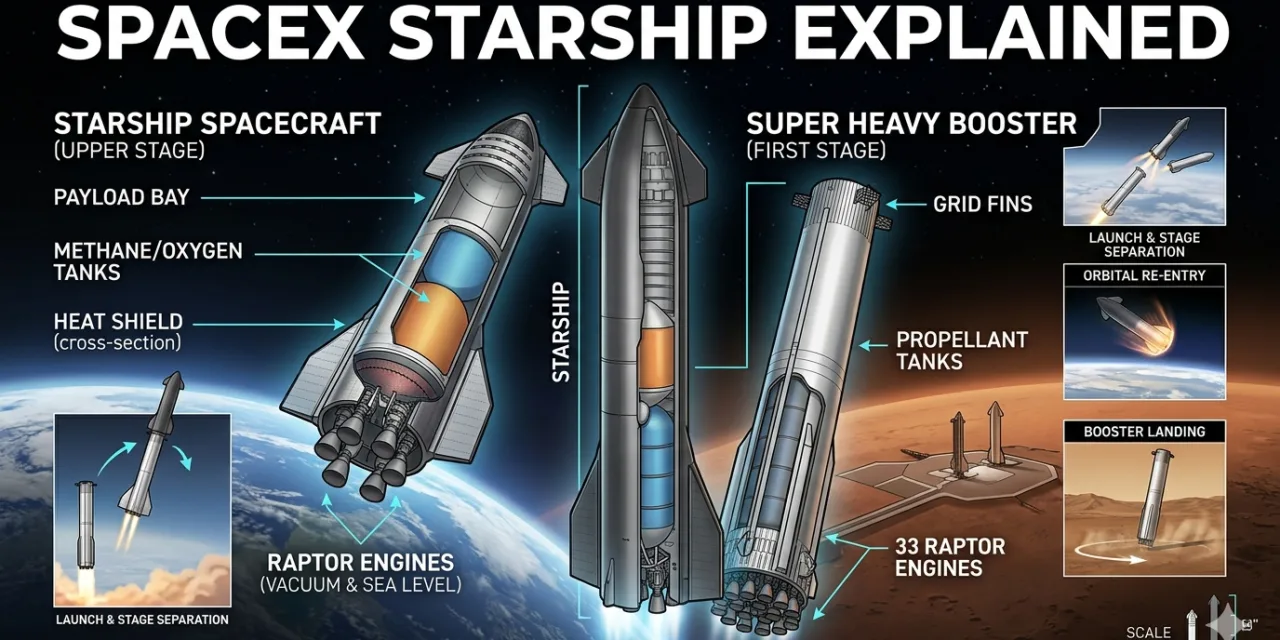
Starship — the combined system of the Super Heavy booster and the Starship upper stage — is the most powerful rocket ever built. Its 33 Raptor engines generate more than 16 million pounds of thrust at liftoff, roughly twice the thrust of the Saturn V that sent Apollo astronauts to the Moon. At 397 feet (121 metres) tall in its current configuration and growing to 408 feet in the Version 3 configuration currently in development, it is the tallest rocket ever flown. Its payload capacity — over 100 metric tonnes to low Earth orbit in the expendable configuration, and potentially 150 tonnes in the fully reusable configuration once propellant transfer is demonstrated — exceeds any rocket previously flown or currently in development anywhere in the world.
These specifications matter not because large numbers are impressive but because they determine what is possible. Payload capacity and launch cost per kilogram are the two variables that determine which space missions are economically viable. Starship is designed to achieve both simultaneously: more capacity and lower cost than any previous rocket, by combining the scale needed for large payloads with the reusability needed to eliminate the per-launch manufacturing cost that makes conventional rockets expensive. If those design goals are achieved in full operation, space access becomes a fundamentally different proposition — not just for SpaceX’s ambitions for Mars colonisation, but for every mission that uses it.
How Starship Actually Works
Starship consists of two distinct vehicles that work together as a single launch system. The first stage — Super Heavy — is the massive booster that provides the thrust to lift the entire stack off the ground and push it through the atmosphere toward orbit. Super Heavy stands approximately 232 feet (71 metres) tall and carries 33 Raptor engines on its base. After burning its propellant and separating from the upper stage, Super Heavy performs a boostback burn to reverse its trajectory, a descent burn to control its approach, and a final landing burn to decelerate before being caught by Mechazilla’s mechanical arms. The entire return takes approximately seven minutes from separation to catch.
The Starship upper stage — also called “Ship” — is the spacecraft that carries payloads, crew, or fuel to orbit and beyond. At 171 feet (52 metres) tall, it is itself larger than many complete rockets currently in operation. It carries six Raptor engines — three optimised for sea-level operation and three optimised for vacuum operation — and a large propellant-filled header tank at its nose used for the flip-and-burn landing manoeuvre. After reaching orbit or completing its mission, Ship performs a belly-flop aerodynamic descent using its large body flaps to control attitude and decelerate through the atmosphere before performing its own flip-and-burn landing. The goal is for Ship to also eventually be caught by Mechazilla — a demonstration that has not yet been achieved for Ship specifically.
Raptor engines are the technological core that makes Starship’s performance possible. They use methane and liquid oxygen as propellants — a combination chosen partly for its performance characteristics and partly because methane can theoretically be manufactured from carbon dioxide and water on Mars using the Sabatier reaction, creating the possibility of in-situ propellant production that enables return missions from Mars without Earth-supplied fuel. Raptor engines operate in a full-flow staged combustion cycle — an engine architecture so thermodynamically efficient that no other operational rocket engine in history has used it successfully, because it requires manufacturing tolerances and materials that were not practically achievable before SpaceX invested the engineering resources to make them so. The result is an engine whose specific impulse (fuel efficiency) approaches the theoretical limit of chemical propulsion.
The Test Flight Programme: Learning to Fly the Hard Way
SpaceX’s approach to Starship development reflects the same “test to failure, iterate rapidly” philosophy that characterised Falcon 9’s development — the rocket that became the world’s most-launched vehicle by flying frequently, accepting failures as data, and improving systematically from each one. Starship’s test programme has been both more public and more spectacular than most rocket development programmes, because Starship’s failures involve a 397-foot rocket exploding in dramatic fashion over the Gulf of Mexico or the Caribbean.
The first four integrated flight tests in 2023 and 2024 each achieved significant milestones while also producing significant failures. The first test in April 2023 ended in the vehicle’s destruction at altitude. The second in November 2023 achieved stage separation for the first time before both vehicles were lost. The third in March 2024 reached orbit-class velocity and demonstrated Ship’s ability to survive reentry before losing the vehicle on descent. The fourth in June 2024 achieved the first successful splashdown of Ship in the Indian Ocean and demonstrated Super Heavy performing a controlled water landing. The fifth, in October 2024, achieved the Mechazilla booster catch that represented the single most dramatic demonstration of Starship’s reusability architecture.
The 2025 test programme encountered setbacks. Flights 7 and 8 both ended in explosions — the eighth flight test in March 2025 saw Starship explode ten minutes into the mission, causing flight disruptions over Florida and Caribbean islands and triggering an FAA safety investigation that grounded subsequent flights for weeks. SpaceX made vehicle improvements and received FAA authorisation for Flight 9 under new rules permitting up to 25 Starship launches annually from Starbase. The FAA’s increasing comfort with SpaceX’s operations — reflected in the higher annual launch allotment — reflects both SpaceX’s safety record across its Falcon 9 programme and the agency’s recognition that more frequent testing is how complex new vehicles are validated.
By April 2026, Starship has continued its iterative development programme. The Version 3 configuration — taller, with improved engines and refined systems — is in advanced development. The critical technology milestone of propellant transfer between two Starships in orbit — necessary for the high-energy missions to the Moon and Mars that require more propellant than Starship can carry at launch — has been demonstrated in initial form. The FAA-licensed 25 annual launches from Starbase provide the test cadence needed to accumulate the flight experience that operational reliability requires.
The Economics: Why Full Reusability Changes Everything
The transformative claim for Starship is economic, not merely technical. SpaceX’s ambition is to reduce the cost of access to orbit from thousands of dollars per kilogram — which is where even SpaceX’s highly reusable Falcon 9 operates — to hundreds of dollars per kilogram, and ultimately to tens of dollars per kilogram as production scales and the vehicle’s operational cadence increases. The mechanism is simple in principle and extraordinarily difficult in execution: if both stages of the rocket are returned to service within hours of landing and relaunched within days, the cost per flight is the cost of propellant (relatively cheap), operations (scaling with cadence), and maintenance (gradually reducing as the system matures). The manufacturing cost that dominates expendable rocket economics — building a new rocket for every mission — is eliminated.
SpaceX CEO Elon Musk has discussed a target of $2 million per Starship flight at scale — compared to $67 million per Falcon 9 flight and historically much higher costs for NASA rockets. The credibility of this target depends on assumptions about propellant costs, operational costs, and maintenance requirements that full operational experience has not yet validated. But the directional logic is sound and the mechanism is demonstrated: catching a Super Heavy booster with Mechazilla and returning it to the launch stand eliminates the manufacturing cost of the most expensive component. What happens when both components can be relaunched within days of return will determine the operational economics that make Mars colonisation financially conceivable.
Starship’s Missions: More Than Mars
Starship’s development is driven by the Mars colonisation vision that has animated Elon Musk’s founding rationale for SpaceX. But in the near and medium term, Starship serves multiple distinct mission categories that individually justify its development regardless of whether Mars colonisation succeeds on Musk’s timeline.
NASA’s Artemis programme selected Starship as the Human Landing System for Artemis III — the mission that will return humans to the lunar surface. In this application, Starship launches from Earth uncrewed, refuels in orbit (requiring multiple propellant transfer flights from Earth), and travels to lunar orbit to rendezvous with the Orion spacecraft carrying the Artemis crew. The crew transfers to Starship for the lunar surface descent, conducts surface operations, and returns to lunar orbit to transfer back to Orion for the trip home. This mission profile — which Starship was specifically designed for — represents the single most important near-term commercial application of the vehicle, with NASA paying billions for the development and operational service.
Starlink satellite deployment is the other major near-term application. SpaceX’s Starlink internet constellation, currently consisting of over 7,000 satellites in low Earth orbit, needs regular replenishment as satellites reach end of life and as SpaceX expands the constellation’s capacity. Starship’s capacity to deploy large numbers of satellites in a single launch — potentially hundreds per flight — makes it dramatically more efficient for this application than Falcon 9. With Starlink generating significant revenue for SpaceX, the commercial incentive to get Starship operational for satellite deployment is substantial and independent of any government programme.
Point-to-point Earth transportation — flying passengers from one city to another in less than an hour using suborbital Starship flights — is a longer-term vision that Musk has described as commercially attractive at scale but that faces regulatory, safety validation, and infrastructure challenges that make it a considerably later-stage application than orbit or Moon missions.
The Mars Timeline: Ambitious, Uncertain, and Genuinely Possible
Elon Musk announced in March 2025 that Starship would carry Tesla’s Optimus humanoid robots to Mars by the end of 2026, targeting the November-December 2026 launch window when Earth and Mars are optimally aligned for the roughly seven-to-nine-month transit. He estimated a fifty-fifty probability of meeting that target — an unusually honest assessment of uncertainty from an entrepreneur whose predictions have a well-documented tendency toward optimism. The FAA’s restrictions on Starship launch frequency, the unresolved propellant transfer technology required for Mars-range missions, and the general complexity of conducting the first interplanetary mission with a vehicle still in active development all create real risk that the 2026 window is not met. The 2028 window would be the next opportunity.
If the 2026 or 2028 uncrewed missions succeed — if Starship can land on Mars, survive the Martian environment, and demonstrate the propellant production that would enable future crewed missions — the subsequent timeline accelerates significantly. Musk’s plan calls for approximately 20 ships to Mars between 2028 and 2029 if the first missions go well, scaling to 100 ships per launch window by 2031, and eventually to the 1,000-ship-per-window cadence that would be needed to transport the million people Musk considers necessary for a self-sustaining Mars civilisation. The scaling assumptions are aggressive. The engineering challenges of life support, surface habitation, resource extraction, and human health in Mars gravity over extended periods are not yet solved. But the vehicle that would transport humans to Mars is real, flying, and improving.
The broader significance of Starship extends beyond any specific mission or even the specific goal of Mars colonisation. It represents the most ambitious attempt in the history of spaceflight to fundamentally change the economic equation of access to space. If it succeeds in approaching the cost targets SpaceX has described — if launch costs do fall by an order of magnitude from where they are today — the range of space activities that become economically viable expands correspondingly. Scientific missions that currently require decades of budget approval become achievable at lower thresholds of institutional commitment. Commercial applications that do not currently exist become conceivable. The space-based solar power, manufacturing, and resource extraction activities that advocates have discussed for decades become progressively less economically absurd. Starship is not just the most powerful rocket ever built. It is, if its ambitions are realised, the vehicle that opens the solar system.





0 Comments
No comments yet. Be the first to share your thoughts!