
On July 12, 2022, NASA released the first full-colour science images from the James Webb Space Telescope — and they redefined what humanity could see. The Webb Deep Field showed galaxies behind galaxies behind galaxies, some so distant that their light had been travelling for 13.1 billion years to reach the telescope’s mirror. They were sharper, deeper, and more detailed than anything Hubble had produced in its equivalent deep-field images, and they represented not just a new telescope but a genuinely new era in observational astronomy. Scientists who had spent decades designing and waiting for Webb’s capabilities described the images with words typically reserved for religious experience. The universe, seen in infrared light at the highest resolution ever achieved, looked different from what had been expected — not slightly different, but fundamentally different in ways that required immediate revision of established theories.
By April 2026, Webb has completed nearly four full years of science operations. The cumulative impact of those four years — measured in peer-reviewed discoveries, challenged theories, confirmed phenomena, and scientific paradigm revisions — is extraordinary even by the standards of transformative space observatories. Webb is not just finding new things. It is forcing revisions to things we thought were settled. Galaxies that should not exist at their observed distances do exist. Exoplanet atmospheres contain molecules whose presence demands explanation. Star formation regions reveal structures invisible to any previous instrument. And the most fundamental questions in cosmology — about dark matter, dark energy, the rate of the universe’s expansion, and the nature of the first light — are being addressed with data of unprecedented quality.
This guide covers Webb’s greatest discoveries across its four major science themes: the early universe, exoplanet atmospheres, the life cycle of stars and nebulae, and solar system objects — with the most significant 2025 and 2026 findings given particular attention. It explains not just what Webb found but why each finding matters and what it changes about our understanding of the universe.
How Webb Works: The Technology That Changes Everything
The James Webb Space Telescope launched on Christmas Day 2021, deployed its mirror and sunshield over the following weeks, and reached its operating position at the Sun-Earth L2 Lagrange point — approximately 1.5 million kilometres from Earth in the direction away from the Sun — in January 2022. Science operations began in mid-2022 following commissioning and calibration.
Webb’s primary mirror measures 6.5 metres across, composed of 18 hexagonal gold-coated beryllium segments that unfold from the folded configuration required to fit inside the Ariane 5 rocket that launched it. This mirror collects more than six times as much light as Hubble’s 2.4-metre mirror — a difference that is not merely quantitative but enables qualitatively different science. More light means shorter exposure times to reach a given depth, which means more objects can be studied in a given time, and fainter objects are accessible that Hubble could not see at all.
Webb’s infrared optimisation is the capability that distinguishes it most clearly from Hubble and makes its specific discoveries possible. Webb observes in infrared wavelengths spanning 0.6 to 28.5 microns. This matters for two connected reasons. First, the expansion of the universe stretches the light from the most distant galaxies — those formed in the universe’s first few hundred million years — into infrared wavelengths that optical telescopes like Hubble cannot detect. Webb can see galaxies that are literally invisible to Hubble because their light has been redshifted out of Hubble’s range. Second, dense dust clouds that block visible light are transparent at infrared wavelengths, allowing Webb to see directly into star-forming regions, the dust-shrouded cores of galaxies, and planetary system formation processes that were completely hidden from optical observatories. Webb operates at approximately -233 degrees Celsius — a temperature maintained by its five-layer tennis-court-sized sunshield that keeps the telescope perpetually in shadow — because infrared detectors must be colder than the infrared light they are trying to detect.
Discovery One: The Impossible Early Galaxies
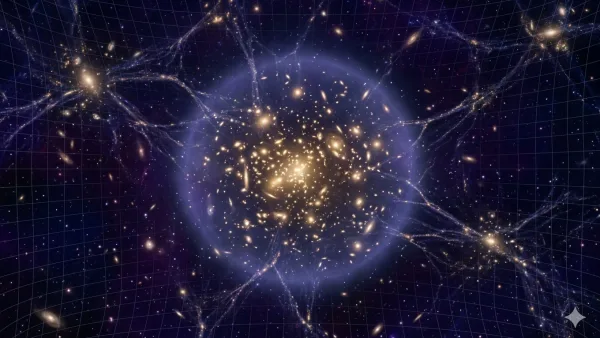
Webb’s most scientifically disruptive finding — the one that has generated the most debate within the astrophysics community and required the most substantial revision to established theory — is the systematic discovery of massive, well-structured galaxies in the universe’s first few hundred million years. The standard model of cosmic structure formation predicted that the earliest galaxies should be small, irregular, and composed primarily of the lightest elements — cosmic infants whose stars were just beginning to forge heavier elements through nuclear fusion. What Webb keeps finding is something dramatically different.
In mid-2025, Webb confirmed JADES-GS-z14-0 at a redshift of 14.32 — placing it approximately 290 million years after the Big Bang. This is not merely a distant galaxy. It is a galaxy that, under standard cosmological models, should not be able to exist in the form Webb observes at that age. It is bright, relatively massive, and appears to contain stars that require hundreds of millions of years of stellar evolution to produce — stars that, if the dating is correct, have been forming with extraordinary efficiency from almost the moment the universe began. Webb also revealed, in 2025, a system of at least five interacting galaxies just 800 million years after the Big Bang — showing that galaxy mergers and interactions, processes previously thought to characterise a much later cosmic era, were already occurring in the infant universe.
The astrophysics community has not reached consensus on what the impossible early galaxies mean. Multiple explanations compete. Some astrophysicists propose that early star formation was significantly more efficient than models predict — that the conditions of the early universe allowed gas to collapse and form stars faster than the standard model assumes. Others suggest that dark matter interactions in the early universe catalysed structure formation beyond what gravity alone could accomplish. A smaller group argues that the findings challenge the cosmological constant itself — that the standard timeline may require adjustment to account for what Webb is observing. What is agreed is that the data is too clean and too consistent across multiple independent observations to dismiss as calibration error. Webb has created a genuine crisis in early-universe cosmology that represents either a major refinement of the standard model or potentially something more radical.
Discovery Two: Exoplanet Atmospheres and the Search for Life
Webb’s capability for exoplanet atmospheric characterisation was anticipated as one of its most significant science themes, and the results have exceeded even optimistic pre-launch assessments. The technique — transmission spectroscopy, which analyses which wavelengths of a host star’s light are absorbed as a planet passes in front of it — allows Webb to determine the molecular composition of exoplanet atmospheres with unprecedented precision.
Webb’s first released science result was a transmission spectrum of the hot Jupiter WASP-39b that showed unambiguous carbon dioxide — the first definitive detection of CO₂ in an exoplanet atmosphere. This was followed by the detection of water vapour, sodium, potassium, and sulfur dioxide in the same planet’s atmosphere — the last of which was particularly significant because sulfur dioxide (SO₂) is a photochemical product, formed by chemical reactions driven by stellar light, providing direct observational evidence of photochemistry occurring in an exoplanet atmosphere. Webb had, within weeks of beginning science operations, demonstrated that it could detect molecules whose presence tells us about the physics and chemistry of distant worlds in ways that earlier instruments could not.
K2-18b — an exoplanet 8.6 times Earth’s mass and 120 light-years from Earth — produced the most astrobiologically significant Webb finding to date: the detection of methane and carbon dioxide in its atmosphere, along with a potential signal from dimethyl sulphide (DMS). On Earth, DMS is produced almost exclusively by biological organisms — marine phytoplankton are the primary natural source. The caveat that the Webb team was careful to articulate is that the DMS detection is tentative, that non-biological chemical pathways for DMS production in the conditions of K2-18b’s atmosphere cannot be ruled out, and that the detection requires confirmation with additional observations. K2-18b is a “Hycean world” candidate — a class of planet with liquid water oceans beneath a hydrogen-rich atmosphere — and while the tentative DMS detection is not a confirmed biosignature, it is the closest that any observation of a distant planet has come to suggesting the possibility of biological origin.
The TRAPPIST-1 system — seven Earth-sized planets orbiting an ultracool dwarf star 39 light-years away — has been a primary target for Webb’s habitable world characterisation programme. Early results from TRAPPIST-1b and 1c have ruled out thick hydrogen atmospheres on the innermost planets, suggesting they have thin or no atmospheres — a finding consistent with the intense radiation from TRAPPIST-1 stripping lighter atmospheres away. Observations of the outer TRAPPIST-1 planets, which orbit in or near the habitable zone, are ongoing. The results are challenging existing models of atmospheric retention around ultracool dwarf stars and informing estimates of which conditions are required for habitable worlds to maintain their atmospheres over geological timescales.
In a landmark first announced in April 2026, Webb directly studied an exoplanet’s surface for the first time — a rocky, airless world where the telescope detected the thermal emission from the surface itself rather than from an atmosphere. “We see a dark, hot, barren rock,” the research team described — a result that was simultaneously scientifically significant (confirming that Webb can characterise bare rocky surfaces) and a reminder that the search for habitable worlds requires finding the exceptions to the rule of hot, dark, airless rock that appears to characterise most terrestrial-class planets at accessible distances.
Discovery Three: The Life and Death of Stars
Webb’s infrared vision penetrates the dust clouds that shroud regions of active star formation, revealing for the first time the detailed structure of the environments where stars are being born. The Carina Nebula images — among the first released in July 2022 — showed hundreds of previously unseen protostars in the “Cosmic Cliffs” region: stars in their earliest formation stages, still embedded in collapsing gas clouds, completely invisible to optical telescopes including Hubble. Webb has since catalogued hundreds of additional protostars in multiple star-forming regions, providing an unprecedented census of stellar birth at every stage from initial gas collapse through protostellar disk formation.
The Pillars of Creation — one of astronomy’s most iconic images, first captured by Hubble in 1995 — was re-imaged by Webb in 2022 and 2023 in both near-infrared and mid-infrared, revealing protostellar jets, newly forming stars embedded in the pillars, and the detailed structure of the pillar gas that Hubble’s visible light images could not penetrate. Webb’s version shows stars being born inside structures that appear solid in Hubble images but are revealed as translucent and complex in infrared.
At the opposite end of stellar evolution, Webb has documented dying stars with unprecedented detail. The Helix Nebula — one of the closest and most studied planetary nebulae, the remnant cloud ejected by a dying Sun-like star — received what ESA Webb described as “the clearest infrared look at this familiar object,” revealing intricate filamentary structures in the ejected gas that previous telescopes could not resolve. Webb’s May 2026 image of the heart of galaxy M77 revealed the active galactic nucleus at its centre with extraordinary clarity, providing direct imaging of the feedback mechanisms through which supermassive black holes regulate star formation in their host galaxies.
January 2026 brought a discovery with significant implications for understanding how active galaxies work: scientists documented an enormous stream of super-hot gas erupting from a nearby galaxy, driven by the black hole at its centre and stretching farther than the galaxy itself. This kind of black hole feedback — which injects energy into the galaxy’s gas supply and can suppress or trigger star formation — had been predicted by models but never directly imaged at this scale and resolution before Webb.
Discovery Four: Our Solar System Through New Eyes
Webb’s capabilities extend to our own solar system, where it has produced the most detailed infrared observations ever made of Jupiter, Saturn, Uranus, and Neptune, along with observations of asteroids, comets, and trans-Neptunian objects that have informed models of solar system formation.
Webb discovered a never-before-seen high-speed jet stream in Jupiter’s atmosphere in 2023 — a feature spanning more than 4,800 kilometres that had not been identified by any previous instrument. Saturn observations in 2024 and 2026 revealed atmospheric dynamics and seasonal changes in the ring system with precision that the Webb-Hubble joint observing programme has extended further. The 2026 Uranus characterisation — in which Webb mapped the vertical structure of Uranus’s upper atmosphere for the first time, uncovering how temperature and charged particles vary with altitude — provided the most detailed portrait ever made of where Uranus’s auroras form and how they are influenced by the planet’s unusually tilted magnetic field.
The observation of 3I/ATLAS — the third interstellar object ever detected, a comet from another star system identified in 2025 passing through our solar system — was an unexpected Webb science opportunity that the observatory was uniquely positioned to exploit. Unlike 1I/’Oumuamua and 2I/Borisov, which were studied primarily by ground-based telescopes and Hubble, 3I/ATLAS was observed by Webb at its full infrared sensitivity, providing the most detailed compositional analysis of material from another stellar system ever achieved. The composition of an interstellar visitor encodes information about the chemical conditions in its home system, and Webb’s observations of 3I/ATLAS’s coma and tail chemistry have opened a direct window onto the protoplanetary chemistry of a star system that we can never visit.
The Hubble Tension and Cosmological Constant: Webb’s Contribution
The Hubble tension — the significant discrepancy between two independent measurements of the universe’s expansion rate — is one of the deepest unresolved problems in cosmology, and Webb has contributed to its investigation by providing the most precise measurements of the Cepheid variable stars used in the late-universe measurement. Webb’s observations of Cepheid stars in galaxies previously measured by Hubble have confirmed Hubble’s measurements of those stars’ distances with improved precision — ruling out the possibility that the tension was caused by systematic errors in Hubble’s Cepheid measurements. The tension is real, and its explanation must lie elsewhere than in the measurement methodology that Webb has now validated.
The cosmological implications are significant. A real, validated tension between early-universe and late-universe expansion rate measurements at the level Webb has now helped confirm — approximately six sigma — implies either a systematic error in the early-universe measurement, new physics beyond the standard model of cosmology (new particles, modified dark energy, or early dark energy that changed the expansion rate before recombination), or some combination of both. Webb’s contribution is to remove one possible explanation — Cepheid calibration error — and thereby narrow the space of viable resolutions to the most fundamental cosmological problem of the decade.
What Webb Cannot Do and What Comes Next
Webb’s extraordinary capabilities have specific limits that define what it can and cannot contribute to the scientific questions it is investigating. It can detect molecules in exoplanet atmospheres with unprecedented sensitivity — but it cannot detect the atmospheric signatures of a true Earth analogue orbiting a Sun-like star. Earth-like planets transiting Sun-like stars produce atmospheric signals approximately 100 times weaker than the signals Webb has successfully detected, and are observable only around much smaller stars like the ultracool dwarfs of the TRAPPIST-1 system. Direct detection of biosignatures on Earth-twins around Sun-like stars — the ultimate goal of the search for life — requires a future large space telescope with a coronagraph capable of blocking the star’s light and directly imaging the planet.
Webb’s operational lifetime is constrained by propellant — the fuel used for trajectory corrections and orbital maintenance. The initial estimate of a 10-year minimum operational lifetime has been extended; current estimates suggest Webb has sufficient propellant for more than 20 years of operations, potentially extending science into the early 2040s. The scientific programme being built on Webb’s observations — expanding datasets, improved analysis tools, and successor missions — will be the basis for astronomy for decades. The Nancy Grace Roman Space Telescope, targeting launch in late 2026 or 2027, will complement Webb with wide-field infrared surveys that map dark matter and dark energy across vast sky areas, while Webb continues its deep, targeted investigations of specific objects and regions that Roman’s wide-field approach cannot resolve in equivalent detail.
Four years into its science mission, Webb has already earned its place among the most scientifically productive instruments in the history of astronomy. Its discoveries have not merely added new facts to existing frameworks. They have challenged the frameworks themselves — producing a genuine crisis in early-universe cosmology, revealing exoplanet atmospheres with potential biosignatures that require explanation, and delivering images of such extraordinary quality that they have permanently altered the reference point for what space-based astronomy can achieve. The universe it has revealed is stranger, more complex, and more interesting than the universe its designers expected to find when they first turned its golden mirror to the sky.

0 Comments
No comments yet. Be the first to share your thoughts!