
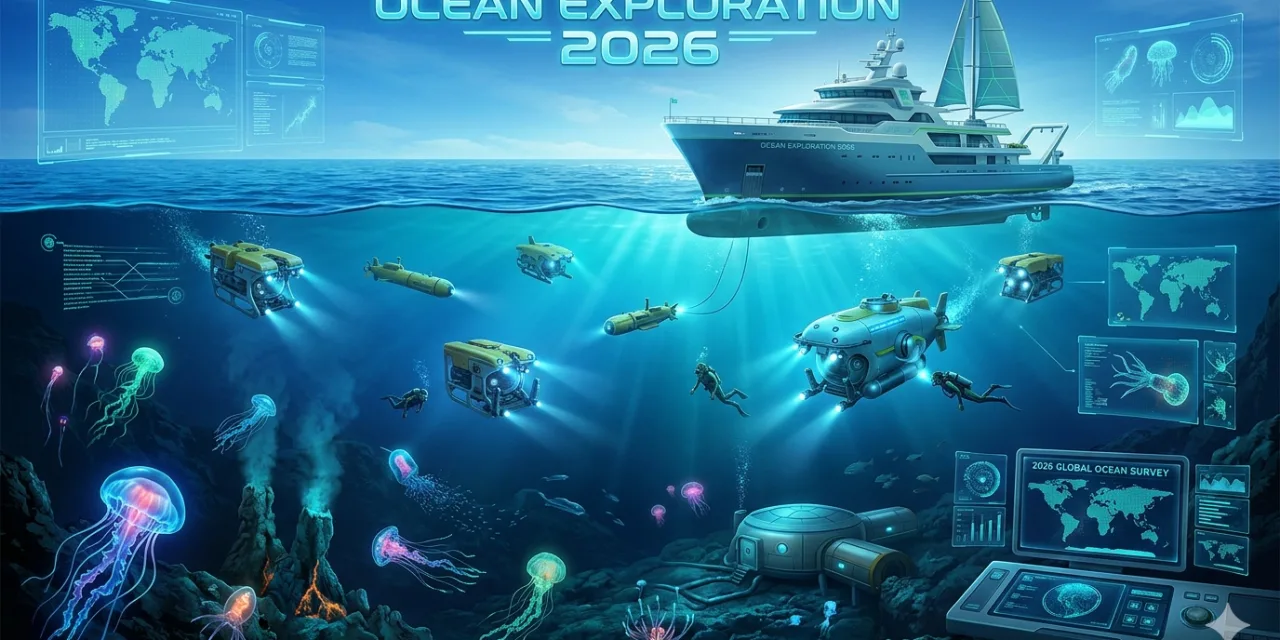
We have better maps of Mars than we have of the ocean floor. More than 80 percent of Earth’s oceans remain unmapped at the resolution needed to characterise their geology, chemistry, and biology — and only a small fraction of that mapped area has been directly observed by human eyes or cameras. The deep ocean, which constitutes the largest habitat on Earth by volume, is less explored than the near side of the Moon. Scientists estimate that the deep sea hosts between 500,000 and 10 million species — the range of uncertainty spanning an order of magnitude reflects how little we actually know. Every expedition to previously unvisited areas of the deep ocean returns with new species, new geological structures, and new ecological systems that revise our understanding of what life can do and where it can survive.
In 2026, the pace of ocean exploration is accelerating in ways that were not possible even five years ago. A landmark study published in Science Advances earlier this year announced the Global Deep Sea Exploration Goals — a coordinated international mission to visually explore 10,000 deep ocean locations, nearly doubling the total number of sites humans have ever directly observed in the deep sea. “Understanding the deep ocean is essential for informed decisions about biodiversity, climate, and the sustainable management of marine resources,” said the study’s lead author. “With the Global Deep Sea Exploration Goals, we now have a clear path toward seeing and understanding the deep ocean for the first time.” NOAA Ocean Exploration is conducting 2026 expeditions in the Pacific Ocean, Caribbean Sea, and Lake Michigan — including E/V Nautilus missions through the Mariana Islands, Wake Island, and the Hawaiian Archipelago. India’s Samudrayaan deep ocean mission has begun unmanned deep-sea tests. And the Schmidt Ocean Institute released new deep-sea imagery in February 2026 documenting 28 newly identified species from the South Atlantic — including glass squid captured by ROV SuBastian in the Colorado-Rawson submarine canyon off Argentina.
This guide covers what the deep ocean actually is, why so much of it remains unexplored, the technology that is finally making systematic exploration possible, the most significant discoveries of 2025 and 2026, the commercial and environmental stakes of deep-sea resource extraction, and why understanding the ocean floor may be as important for humanity’s future as anything happening beyond Earth’s atmosphere.
The Scale of the Unknown: Earth’s Most Alien Environment
The ocean covers 71 percent of Earth’s surface and averages approximately 3,688 metres in depth. Its total volume is approximately 1.335 billion cubic kilometres — a figure so large it resists intuitive grasp. The deep ocean — generally defined as water below 200 metres, where sunlight no longer penetrates sufficiently for photosynthesis — constitutes approximately 95 percent of the ocean’s total volume. The hadal zone, the deepest 1 to 2 percent of the ocean occupying trenches below 6,000 metres, is the most extreme and least explored of all environments on Earth.
The conditions in the deep ocean are, from the perspective of surface life, genuinely alien. Hydrostatic pressure increases by approximately one atmosphere for every 10 metres of depth — at the bottom of the Mariana Trench (approximately 11,000 metres), the pressure is approximately 1,100 times atmospheric pressure at the surface, equivalent to the weight of 50 jumbo jets. Temperatures hover just above freezing throughout most of the deep ocean, dropping to near 0°C in the hadal zone. There is no light — photons from the surface are completely absorbed within the first 200 metres, leaving the deep ocean in absolute darkness except for the bioluminescence produced by organisms themselves. These conditions — crushing pressure, near-freezing temperatures, complete darkness, and sparse nutrients drifting down from the sunlit surface zone — were once assumed to preclude complex life. What exploration has revealed instead is an extraordinary diversity of life that has adapted to every extreme the deep ocean offers, including the hydrothermal vents discovered in 1977 that host chemosynthetic ecosystems entirely independent of sunlight.
Only approximately 20 percent of the ocean floor has been mapped at the resolution that Google Maps provides for land surfaces. The rest remains characterised only by coarse satellite-derived gravity measurements that can identify major features like mid-ocean ridges and deep trenches but cannot resolve individual seamounts, hydrothermal vent fields, submarine canyons, or the geological details that determine where deep-sea ecosystems concentrate. As of 2026, only 38 percent of Alaska’s seafloor has been mapped — and Alaska represents one of the most economically important and most scientifically interesting ocean territories in the United States.
The Technology Revolution: How 2026 Exploration Is Different
The reason ocean exploration is accelerating in 2026 rather than having been systematically completed decades ago is primarily technological. The deep ocean presents engineering challenges that are fundamentally different from space exploration in some respects and similar in others: the crushing pressure of the deep ocean destroys conventional electronics without extraordinary engineering, the electromagnetic communication that enables real-time data transmission in space does not work through seawater, and the corrosive chemical environment of the deep ocean degrades materials that would survive in the vacuum of space. The tools that make systematic deep-sea exploration possible have been developing for decades but are achieving new capability levels in 2026 that are changing what is achievable per expedition.
Remotely Operated Vehicles (ROVs) are the primary tool of visual deep-sea exploration — tethered robotic systems that descend on a cable from a surface ship, carrying cameras, lights, manipulator arms, and sampling equipment. The tether provides continuous power from the ship and real-time video and data transmission — enabling scientists aboard the ship to observe and direct the ROV’s exploration in real time, and to livestream the entire dive to global audiences through platforms like Nautilus Live. ROV technology has improved substantially in capability and reliability, with modern systems like ROV Doc Ricketts (Schmidt Ocean Institute) and ROV Jason (WHOI) capable of routine operations to 6,500 metres. The livestreaming of ROV dives — which began as a public engagement initiative and has become a standard NOAA Ocean Exploration practice — has also created a global citizen science network: thousands of viewers simultaneously watch deep-sea dives in real time, and in documented cases have spotted significant features that the professional scientists aboard missed.
Autonomous Underwater Vehicles (AUVs) represent the newer and faster-growing complement to ROVs. Unlike ROVs, AUVs operate untethered — programmed with a mission plan, released from the ship, and recovered after completing their survey autonomously. This architecture allows AUVs to cover vastly more geographic area than tethered ROVs in a given time, making them ideal for large-scale seafloor mapping, water column characterisation, and systematic survey of wide areas before ROV dives investigate specific features of interest in detail. The combination of AUV surveys identifying the most promising targets with ROV dives conducting detailed visual investigation of those targets is the two-phase approach that maximises scientific return per expedition hour. A 2022 demonstration coordinated by NOAA successfully used uncrewed systems for long-range ocean exploration without a surface support ship — a milestone that points toward the future of autonomous ocean exploration in which support vessels are not required for every mission.
AI-powered image analysis is transforming the throughput of deep-sea biology. Deep-sea ROV dives generate hours of high-definition video footage that must be reviewed and annotated to extract biological and geological data. Human review is slow and expensive — annotating hours of video is a days-long process for trained marine biologists. AI image recognition systems trained on deep-sea biological imagery can now scan footage automatically, flagging frames containing species of interest for expert review and generating preliminary species counts and habitat characterisations. The NOAA project to automate collection and real-time analysis of large volumes of underwater visual data — making imagery available in a global database — directly addresses this bottleneck, enabling the kind of systematic deep-sea biological census that was previously impossible at scale.
The Major Discoveries of 2025 and 2026
Every systematic deep-sea expedition in 2026 has returned new species — a consistency that reflects how little of the deep ocean has been explored rather than an exceptional year for biological novelty. The Schmidt Ocean Institute’s February 2026 release documented 28 newly identified deep-sea species from the South Atlantic, including the glass squid filmed by ROV SuBastian in the Colorado-Rawson submarine canyon off Argentina’s coast. The Science Times March 2026 report documented over 20 newly identified species from twilight and hadal zones across the Pacific and South Atlantic — organisms thriving in darkness and crushing pressure that reshape understanding of how life survives in extreme environments.
The discovery category that has generated the most scientific impact in recent years is chemosynthetic ecosystem diversity. The hydrothermal vents discovered in 1977 were the first demonstration that ecosystems could be powered entirely by chemical energy rather than sunlight. Subsequent exploration has revealed multiple distinct chemosynthetic ecosystem types: hydrothermal vents (hot, mineral-rich fluids emerging from the seafloor at temperatures up to 400°C), cold seeps (slower emissions of methane and hydrogen sulphide at near-ambient temperatures), brine pools (ultra-salty, oxygen-free depressions in the seafloor that appear as “lakes within the ocean”), and serpentinite-hosted systems (where rock-water reactions produce hydrogen that fuels microbial communities). The Schmidt Ocean Institute’s January 2026 expedition specifically targeted cold seeps in the South Atlantic — “deep-sea areas where methane and other chemical emissions from the ocean floor sustain microbial life” — and the documentation of cold seep communities in previously unexplored areas of the South Atlantic extends the known range of these ecosystems significantly.
Geological discoveries in 2026 continue to revise models of seafloor structure. Seamounts — underwater mountains rising from the ocean floor — are now known to host some of the most diverse deep-sea communities on Earth, because their elevated position concentrates current flow and nutrient supply. Systematic seamount surveys have revealed that seamounts are vastly more numerous than previously estimated, with recent analyses suggesting tens of thousands of unmapped seamounts globally. Each seamount that receives detailed investigation reveals distinct community compositions — seamounts that are geographically isolated function as evolutionary islands, generating unique species assemblages that may have been evolving in isolation for millions of years.
The 10,000 Sites Mission: Ocean Exploration at Scale
The Global Deep Sea Exploration Goals published in Science Advances in April 2026 represent the most ambitious coordinated ocean exploration programme ever proposed — a framework for visually exploring 10,000 deep ocean locations that would nearly double the total number of sites humans have ever directly observed. The study’s lead author Dr. Bell described the scientific and policy stakes clearly: the deep ocean affects climate regulation, biodiversity, and marine resource management in ways that current policy decisions are making without adequate information about the systems they affect.
The 10,000 sites mission is achievable with current technology within a decade if exploration resources are coordinated effectively. The bottleneck is not technology — ROVs and AUVs are capable of operating at the required depths and returning the required data — but the limited number of research vessels with deep-sea exploration capability, the high cost of expedition operations, and the absence of a coordinated international framework that prioritises sites systematically. The Global Deep Sea Exploration Goals framework is specifically designed to address this coordination gap, providing a prioritised site list and a shared data repository that allows contributions from expeditions worldwide rather than requiring a single programme to conduct all missions.
NOAA’s 2026 field season — coordinated across NOAA Ship Okeanos Explorer, E/V Nautilus, and partner vessels — is one component of this broader global effort. E/V Nautilus’s five 2026 expeditions in the Central and Western Pacific are specifically co-developed with local community knowledge holders in the regions explored — a model of inclusive ocean science that integrates Indigenous and Pacific Island community knowledge with scientific exploration priorities, reflecting both ethical commitments and the practical value of local knowledge about ocean areas that outside scientists have limited prior context for.
Deep-Sea Mining: The Environmental Stakes of Ocean Resources
The commercial stakes of ocean exploration are concentrated in two categories: fisheries and resource extraction. The deep-sea resource extraction debate — specifically around polymetallic nodules, cobalt-rich crusts, and seafloor massive sulphides — has become one of the most contested environmental and economic policy questions in ocean governance.
Polymetallic nodules — potato-sized concretions of manganese, cobalt, nickel, and copper that litter the abyssal plains of the Pacific at densities of up to 75 kilograms per square metre in the richest zones — contain concentrations of metals essential for electric vehicle batteries and renewable energy infrastructure. The Clarion-Clipperton Zone, a 4.5-million-square-kilometre region of the equatorial Pacific, is estimated to contain more nickel and cobalt than all known terrestrial deposits combined. The International Seabed Authority (ISA), which governs mineral extraction in international waters, has issued 31 exploration contracts to government-sponsored organisations and commercial entities. Commercial-scale mining has not yet begun, but pressure from the battery metal demand surge has intensified commercial interest.
The environmental opposition to deep-sea mining is grounded in two arguments. First, the abyssal plain ecosystems that nodule mining would disturb are extraordinarily fragile and slow-recovering — the nodule fields are themselves the substrate on which unique deep-sea communities have evolved over millions of years, and disturbance experiments from the 1970s and 1980s show that the tracks of experimental mining equipment remain visible on the seafloor decades later with minimal ecological recovery. Second, the biological communities of the abyssal plains remain so incompletely characterised that mining at scale would inevitably destroy species that have not yet been described or studied — the permanent loss of biodiversity in systems that took millions of years to evolve. The counter-argument is that terrestrial metal mining for the same battery metals causes documented, comparable ecological damage, and that the urgency of the energy transition may justify deep-sea extraction if the comparative environmental impact is carefully assessed.
The ISA’s process for establishing environmental regulations for deep-sea mining — repeatedly delayed under pressure from mining advocates and environmental advocates — remained unresolved as of early 2026, creating regulatory uncertainty that has both slowed commercial development and prevented the environmental protections that critics argue are necessary before any commercial extraction proceeds.
Why Ocean Exploration Matters Beyond Science
The deep ocean is not merely a scientific curiosity. It performs functions that are essential to life on Earth’s surface in ways that are only beginning to be understood with sufficient detail to inform effective management.
The deep ocean is the largest carbon reservoir on Earth, storing carbon in forms ranging from dissolved organic matter to the calcium carbonate shells of organisms that sink from the surface and accumulate on the seafloor over geological timescales. Changes in deep ocean circulation — driven by climate change affecting the temperature and salinity of surface waters that drive the thermohaline circulation — could alter how efficiently the ocean sequesters carbon, with direct consequences for the rate of atmospheric CO₂ accumulation. Understanding how the deep ocean carbon cycle actually works — which requires direct observation of the biological and chemical processes at work in specific deep-sea environments — is a prerequisite for accurately predicting how ocean carbon storage will respond to continuing warming.
The pharmacological potential of deep-sea organisms is another practical dimension of exploration with substantial economic implications. Marine organisms — particularly those from chemosynthetic environments where they have evolved unique biochemistries to handle extreme conditions — are a source of novel compounds with potential medical applications. Multiple approved cancer drugs, antibiotics, and anti-inflammatory compounds have been derived from marine organisms. The deep-sea chemical space remains almost entirely unexplored as a source of pharmacological candidates, and the unique biochemistry of deep-sea organisms adapted to extreme pressure, temperature, and chemistry is generating compounds with properties that terrestrial or shallow-marine organisms do not produce.
The deep ocean in 2026 occupies the same position in human knowledge that the continents occupied in the 15th century: known to exist, understood in very general terms, and almost entirely unvisited. The technology that is making systematic exploration possible — advanced ROVs, autonomous vehicles, AI-powered image analysis, and the coordinating frameworks that focus those tools on the highest-priority unexplored locations — is converging in ways that make the next decade of ocean exploration potentially as transformative for our understanding of life on Earth as the first decade of space exploration was for our understanding of Earth’s place in the cosmos. The alien life forms we are most likely to discover in our lifetimes are not on distant planets. They are in the crushing darkness below the surface of the ocean that covers three quarters of the planet we live on.


0 Comments
No comments yet. Be the first to share your thoughts!