
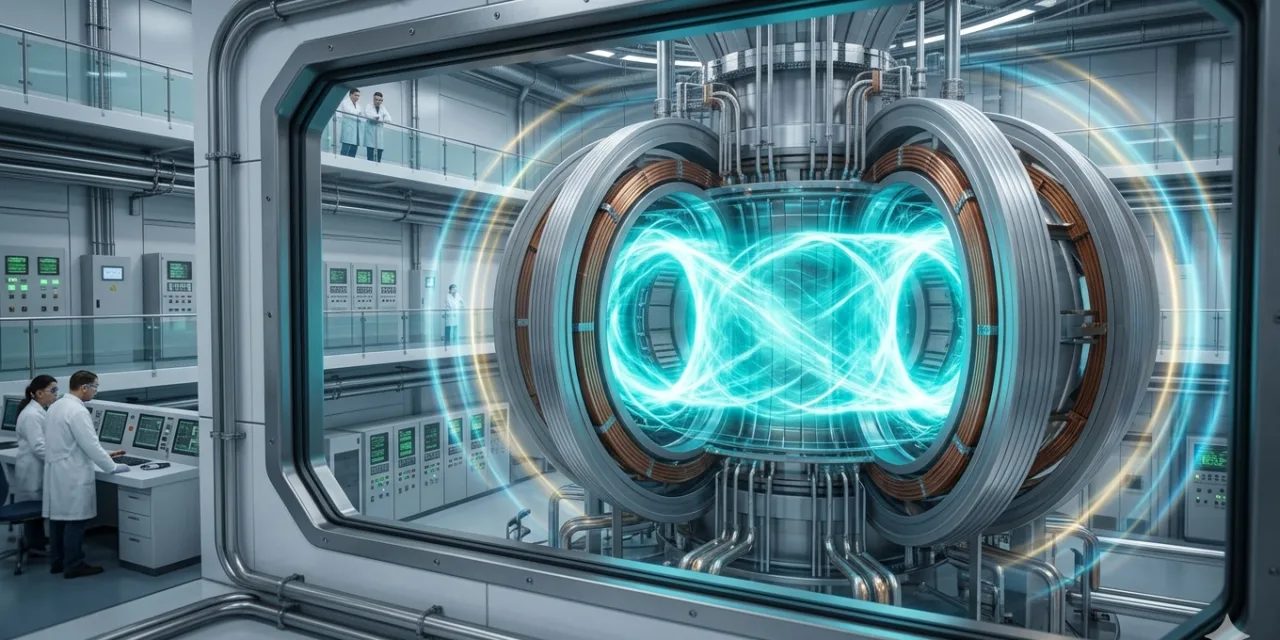
In January 2026, China’s Experimental Advanced Superconducting Tokamak — the EAST reactor, nicknamed the “artificial sun” — broke through what researchers had long considered a fundamental barrier of fusion plasma physics. For the first time, the reactor successfully maintained plasma stability at extreme densities in what theorists call the “density-free regime”: a plasma state where the fuel can remain confined and coherent even as density continues to increase, rather than becoming unstable and collapsing as had previously always happened above certain density thresholds. The Chinese team’s achievement, reported by the Chinese Academy of Sciences and described by Live Science, confirmed a theoretical prediction about plasma behaviour that had never before been experimentally demonstrated. Lead researcher Ping Zhu described the findings as suggesting “a practical and scalable pathway for extending density limits in tokamaks and next-generation burning plasma fusion devices.”
This milestone arrived just months after the National Ignition Facility at Lawrence Livermore National Laboratory in California delivered another landmark result: in April 2025, its laser fusion system produced 8.6 megajoules of fusion energy from 2.08 megajoules of laser energy input — more than four times as much energy out as went in from the lasers. The NIF had first achieved this net gain milestone in December 2022 with a 3.15 megajoule result; in the intervening years, the team has systematically improved and reproduced the result, demonstrating that laser-driven fusion ignition is a repeatable, controllable process rather than a one-time lucky shot.
The fusion energy story in 2026 is one of genuine, measurable, accelerating progress across multiple technical approaches simultaneously — and the most significant story it tells is that the fundamental physics questions that defined the field for seventy years are being answered one by one. The question is no longer whether nuclear fusion works. It does. The question is whether it can be scaled into a commercially viable power plant within a timeframe relevant to the energy transition. On that question, there is honest optimism tempered by honest caution, a rapidly growing private sector, and an international competition that is raising both investment and urgency. This guide covers the full picture.
What Nuclear Fusion Is — and Why It Is Different From Everything Else
Nuclear fusion is the process that powers the Sun and every other star in the universe. In the Sun’s core, immense gravitational pressure and temperatures exceeding 15 million degrees Celsius force hydrogen nuclei together with enough energy to overcome their mutual electromagnetic repulsion, causing them to fuse into helium. The helium nucleus has slightly less mass than the two hydrogen nuclei combined, and this mass difference — described by Einstein’s famous equation E = mc² — is released as energy. The Sun converts approximately 600 million tonnes of hydrogen into helium every second, releasing in the process the energy that sustains life on Earth at a distance of 150 million kilometres.
On Earth, the most accessible fusion reaction uses two isotopes of hydrogen: deuterium (hydrogen with one neutron) and tritium (hydrogen with two neutrons). When deuterium and tritium fuse, they produce a helium nucleus and a high-energy neutron, releasing approximately 17.6 megaelectronvolts of energy per reaction. The energy density of this process is extraordinary: per kilogram of fuel, fusion produces nearly four million times more energy than coal or oil, according to the International Atomic Energy Agency. A single glass of fusion fuel — deuterium extracted from seawater, which contains it at a concentration of roughly one part in 6,400 — carries the energy equivalent of one million gallons of oil, enough to power a home for more than 800 years.
The fuel supply considerations are equally remarkable. Deuterium is abundant in ordinary seawater at concentrations that make its extraction from the ocean essentially inexhaustible on any human-relevant timescale. Tritium is rarer — it occurs naturally in only tiny quantities — but can be produced by bombarding lithium with the neutrons that the fusion reaction itself generates. Lithium is found in ocean water at concentrations that are similarly practically inexhaustible. A fusion power civilisation would run on seawater and lithium, both globally distributed and geopolitically uncomplicated sources of fuel.
The environmental profile of fusion is fundamentally different from both fossil fuels and nuclear fission. Fusion produces no carbon dioxide or other greenhouse gases during operation. It produces no long-lived radioactive waste — the helium produced by the main fusion reaction is inert, and the activated structural materials of the reactor vessel become only mildly radioactive and decay to safe levels within decades rather than the millennia required for fission reactor waste. It cannot undergo a runaway chain reaction or melt down in the way fission reactors can — if plasma confinement fails, the fusion reaction simply stops. It is, by any objective measure, the cleanest and safest large-scale energy source that physics permits.
How Fusion Works: The Three Requirements
The challenge of fusion is not conceptual — the physics is well understood. The challenge is engineering: creating and sustaining on Earth the conditions that exist naturally in stellar interiors, using technology that can be built, maintained, and operated economically.
Fusion requires three conditions to be met simultaneously, and the product of these three quantities — temperature, density, and confinement time — must exceed a threshold called the Lawson criterion for the fusion reaction to be self-sustaining (ignited). This triple product requirement is the central engineering target of all fusion programmes.
Temperature is the first requirement. Deuterium and tritium nuclei must be moving fast enough for their collisions to overcome the Coulomb barrier — the electromagnetic repulsion between their positive charges — with enough energy to allow the strong nuclear force to take over and fuse them. This requires temperatures of approximately 100 to 150 million degrees Celsius — roughly five to ten times hotter than the centre of the Sun, because the Sun uses gravity to compress plasma to extremely high density, compensating for its relatively modest temperature. At these temperatures, the fuel is in a plasma state: the electrons have been stripped from the nuclei, leaving a hot, electrically conducting gas of charged particles.
Density is the second requirement. There must be enough fuel nuclei in a given volume for collisions to occur at a rate that sustains the reaction. Fusion plasma is much less dense than the Sun’s core — it is, counterintuitively, far less dense than air — but the density must be sufficient and uniform for the reaction to proceed.
Confinement time is the third requirement and the most practically challenging. The plasma at 100 million degrees cannot touch the walls of any physical container — it would instantly cool below fusion temperatures and contaminate the plasma with impurities. Plasma must be confined by some means other than physical contact for long enough for a significant fraction of the fuel to fuse and release energy. The two main approaches to confinement — magnetic confinement (used by tokamaks and stellarators) and inertial confinement (used by laser fusion systems like NIF) — address this challenge in fundamentally different ways.
Magnetic Confinement: Tokamaks and Stellarators
Magnetic confinement fusion uses powerful magnetic fields to hold the hot plasma in a configuration that keeps it away from the reactor walls. The most common design is the tokamak — a doughnut-shaped (toroidal) chamber in which plasma is confined by a combination of toroidal magnetic fields (running around the circumference of the doughnut) and poloidal magnetic fields (running through the hole of the doughnut). The combination creates a helical field geometry that keeps the plasma spiralling in a stable path without touching the walls.
Tokamaks are the dominant technology in both the public and private fusion programmes. The largest tokamak ever built was the Joint European Torus (JET) in the United Kingdom, which operated for 40 years from 1983 before entering decommissioning in October 2023. In its final experiment before decommissioning, JET set a world record for magnetic confinement fusion: 69 megajoules of energy from just 0.2 milligrams of fuel — a result that demonstrated the extraordinary energy density of fusion at a scale large enough to be unambiguously impressive. JET’s legacy is not only its scientific results but the 40 years of operational experience it provided in managing and understanding fusion plasma behaviour at scale.
JET’s successor — the project that has absorbed the most public investment in fusion in history — is ITER, the International Thermonuclear Experimental Reactor under construction in Cadarache, southern France. ITER is a collaboration between China, the European Union, India, Japan, Korea, Russia, and the United States, representing the largest international science project in the world and an investment estimated at over 20 billion euros. ITER is not designed to produce electricity — it is an experimental reactor intended to demonstrate that fusion can produce significantly more energy than is required to run it. Its target: 500 megawatts of fusion power output from 50 megawatts of heating power input, a gain factor (Q) of 10. ITER is expected to begin plasma operations in the early 2030s, with its full deuterium-tritium fusion experiments planned for the mid-to-late 2030s.
ITER’s scale is deliberately enormous — its plasma volume of 840 cubic metres is ten times larger than JET’s — because larger plasma volumes make confinement easier and energy gain more accessible. The engineering challenges of building a device that maintains 100-million-degree plasma in a superconducting magnetic confinement system operating at near-absolute zero temperature, surrounded by tritium-handling systems and activation radiation from the fusion neutrons, have made ITER one of the most technically complex construction projects in history. Its schedule has slipped significantly from original projections — a pattern in large fusion projects that private sector companies are specifically attempting to avoid with smaller, faster-to-build approaches.
The stellarator is an alternative magnetic confinement design that addresses one of the tokamak’s fundamental limitations. Unlike tokamaks, which require a current to flow through the plasma to generate their confinement field (creating a disruption risk when the current behaves unstably), stellarators use external coil geometries so complex that they must be designed by computer and manufactured with extraordinary precision, but which produce inherently steady-state plasma without the disruption risk. Germany’s Wendelstein 7-X stellarator has made consistent progress in recent years, demonstrating plasma temperatures and confinement times that show stellarators can match tokamak performance in key parameters while avoiding disruptive plasma instabilities. Proxima Fusion, a startup that emerged from the Wendelstein 7-X research programme, is pursuing a commercial stellarator path — one of several private companies that has concluded the tokamak’s disruption risk is a fundamental obstacle to commercial operation.
Laser Fusion: The NIF’s Ignition Breakthrough
Inertial confinement fusion takes a fundamentally different approach. Rather than holding plasma in magnetic fields for extended periods, it compresses a tiny pellet of deuterium-tritium fuel so rapidly and so intensely — using powerful lasers or other energy drivers — that the fusion reaction occurs before the plasma has time to expand and cool. The confinement time in inertial fusion is measured in billionths of a second; what inertial confinement lacks in duration it makes up for in density, compressing fuel to densities many times that of the Sun’s core.
The National Ignition Facility at Lawrence Livermore National Laboratory operates the world’s largest laser system — 192 powerful laser beams focusing 2 megajoules of ultraviolet light onto a fuel capsule roughly the size of a peppercorn. The December 2022 result, in which the NIF produced 3.15 megajoules of fusion energy from 2.05 megajoules of laser energy, was the first time in history that any fusion experiment produced more energy from the fuel than the energy used to initiate the reaction — the “ignition” milestone that the field had been pursuing since the 1960s. The April 2025 result of 8.6 megajoules output from 2.08 megajoules of laser input demonstrated that ignition is not merely achievable but improvable — the gain factor has increased fourfold in less than three years.
The honest caveat is essential: the energy gain achieved at NIF is measured against the energy delivered to the fuel by the lasers, not against the total energy consumed by the laser system. The lasers themselves are extremely inefficient — they consume approximately 300 to 400 megajoules of electrical energy to produce the 2 megajoules of laser energy that hits the fuel. So on a wall-plug efficiency basis, the NIF is still consuming vastly more energy than it produces. Converting laser fusion ignition science into a commercially viable power plant requires not just the energy gain physics demonstration (which is now established) but a complete reimagining of the driver technology — lasers or alternatives that are far more efficient, far cheaper, and capable of firing many times per second rather than once every few days.
China’s “Artificial Sun” and the Density Breakthrough
China’s EAST tokamak — the Experimental Advanced Superconducting Tokamak — has been breaking fusion records regularly for a decade. In 2021, it sustained plasma for 101 seconds at temperatures above 120 million degrees Celsius. In 2023, it maintained plasma for 403 seconds — nearly seven minutes — at temperatures exceeding 100 million degrees. These duration records matter because commercial fusion will require sustained, continuous plasma operation rather than brief pulses.
The January 2026 EAST breakthrough is different in kind from duration records: it addresses a fundamental plasma physics barrier. The density-free regime — the plasma state EAST has now experimentally confirmed — is significant because higher plasma density means more fusion reactions per unit volume and therefore more energy output from a given reactor size. The previous consensus was that density could not be increased beyond a certain threshold (the Greenwald density limit) without losing plasma stability. EAST has demonstrated that this limit is not absolute — that under the right conditions of plasma-wall interaction (what theorists call plasma-wall self-organisation), plasma can remain stable even as density continues to increase. The practical implication is that future fusion reactors may be able to operate at higher densities than existing designs assumed, potentially making them more compact and more energy-efficient than current ITER-class reactor concepts.
China’s investment in fusion reflects strategic intent well beyond scientific curiosity. Annual Chinese public investment in fusion is estimated at approximately $1.5 billion — nearly twice the US federal fusion budget — and China’s 15th Five-Year Plan (2026-2030) designates fusion energy a frontline priority of “great-power scientific competition,” promising “extraordinary measures” to secure breakthroughs. In July 2025, Beijing launched China Fusion Energy Co. Ltd. with $2.1 billion in registered capital — a single entity whose initial capitalisation is 2.5 times the entire annual US Department of Energy fusion budget. The geopolitical dimension of fusion — the first nation to achieve commercial fusion power will hold an energy advantage comparable to the industrial revolution’s coal advantage — is increasingly driving investment decisions in multiple countries.
The Private Fusion Race: 53 Companies and $10 Billion
The most remarkable structural change in the fusion landscape over the past five years is the emergence of a substantial private-sector ecosystem. The Fusion Industry Association’s membership has grown to 53 companies globally, more than double its founding membership of 24 in 2021. These companies have collectively attracted over $10 billion in private investment — from technology companies including Microsoft and Google, from billionaires including Bill Gates and Jeff Bezos, from energy companies including Chevron, and from venture capital firms that see fusion as a potential trillion-dollar market.
The private companies are not merely building versions of ITER at smaller scale. Many are pursuing genuinely different technical approaches, using materials advances and engineering innovations — particularly high-temperature superconducting magnets — that make smaller, faster-to-build, cheaper reactors technically feasible in ways they were not when ITER’s design was finalised. The FIA reports that a majority of its member companies expect to be producing electricity for the grid by the 2030s — a timeline significantly more aggressive than the public fusion programme’s projections, which generally envision first commercial power plants in the 2040s.
Commonwealth Fusion Systems (CFS), a spinout from MIT, is the most prominently funded of the private fusion companies, having raised over $2 billion. CFS’s approach centres on a technological bet: that high-temperature superconducting (HTS) tape, developed in the past decade, enables building magnets far more powerful than the superconducting magnets used in ITER, and that stronger magnets allow a much smaller tokamak to achieve the same plasma conditions as a much larger one using weaker magnets. CFS’s demonstration magnet, built and tested in 2021, achieved a magnetic field strength of 20 tesla — the strongest ever achieved in a large-bore magnet of its type, and roughly twice the field strength of ITER’s magnets. CFS’s SPARC reactor, currently under construction in Massachusetts, will be roughly 25 times smaller in plasma volume than ITER but aims to achieve similar plasma conditions because of its stronger magnetic confinement. If SPARC achieves net energy gain on a plasma timescale — which CFS targets in the late 2020s — it will validate the HTS magnet approach and pave the way for ARC, CFS’s planned commercial fusion power plant targeting first operations in the mid-2030s.
Google’s DeepMind AI research team has been collaborating with CFS and the École Polytechnique Fédérale de Lausanne (EPFL) to develop AI systems for real-time plasma control. Managing fusion plasma requires continuous adjustment of magnetic field configurations in response to plasma instabilities that develop and evolve on timescales of milliseconds — too fast for human operators to manage in real time. AI systems trained on tokamak plasma data can predict instability development and adjust field parameters proactively, reducing the frequency of disruptive plasma collapses. DeepMind’s work represents the application of the same AI capabilities that have advanced game-playing and protein-structure prediction to the plasma physics problem — a collaboration that reflects a broader trend of AI being deployed to accelerate progress in physical sciences.
Other private companies are pursuing alternative technical approaches. Helion Energy, backed by $2.2 billion including a commitment from Microsoft to purchase electricity from Helion’s first commercial plant, uses a field-reversed configuration rather than a tokamak, pulsing plasmas rather than sustaining them continuously. TAE Technologies is developing a compact tokamak using hydrogen-boron fuel (rather than deuterium-tritium) — a fuel combination that would produce essentially no neutrons and eliminate the activation radiation challenge, though it requires even higher temperatures than deuterium-tritium fusion. General Fusion uses a magnetised target fusion approach in which a metal piston compresses magnetised plasma rather than using laser drivers or magnetic coils. Each approach has different strengths and limitations, and the diversity of private sector approaches hedges against the risk of any single technical dead-end dominating the field.
The Honest Assessment: Where Fusion Actually Stands
The genuine progress in fusion in 2026 is real, measurable, and accelerating — and it must be reported honestly against the equally real gap between current demonstrations and a commercial power plant. Understanding the distinction between different types of “energy gain” claims is essential for evaluating fusion progress accurately.
The NIF’s laser energy gain (Q greater than 1 on the laser energy delivered to the fuel) is a genuine physics milestone. It proves that fusion ignition is achievable and reproducible in a laboratory setting. It does not mean a laser fusion power plant is close — the laser system consumes roughly 200 times as much energy as the fusion reaction produces when wall-plug efficiency is included, and no laser system of the efficiency required for a power plant exists or has a clear near-term development path. The NIF result is proof of physics, not proof of engineering.
The tokamak energy gain of ITER’s target (Q = 10 on heating power) similarly measures fusion power output against the energy used to heat the plasma, not against the total energy consumed by the machine including magnets, cooling systems, and building operations. “Engineering break-even” — producing more fusion energy than the total electricity consumed by the entire power plant — remains a milestone that no fusion device has yet achieved and that is the target of the first generation of commercial pilots in the early to mid-2030s.
The Fusion Energy Solutions analysis of 2026 puts it accurately: fusion deserves excitement but also scepticism. Schedule risk is endemic to fusion projects — almost every major milestone has taken longer than early roadmaps suggested. Cost overruns are likely — early fusion plants will resemble large custom infrastructure projects with cost profiles closer to first-of-a-kind nuclear than to modular renewables. And competition from falling renewable costs is real — by the 2030s, wind, solar, storage, and demand-side solutions may have already achieved deep decarbonisation in many grids, potentially shrinking the addressable market for expensive first-of-a-kind fusion plants in the regions that could afford them earliest. The FIA majority forecast of fusion on the grid by the 2030s likely reflects the most optimistic members’ projections; a more conservative median view is first grid-connected pilot plants in the early to mid-2030s and significant commercial capacity in the 2040s.
Why Fusion Matters Even If It Is Always Twenty Years Away
The old joke about fusion — that it has always been twenty years away for the past seventy years — contains genuine insight but misleads in its cynicism. Fusion has been twenty years away for seventy years not because no progress has been made but because the target was always moving: each discovery revealed new complexity that required additional research, and the original timelines were based on extrapolation from very early results that underestimated the plasma physics challenges. The progress since 2022 — multiple independent demonstrations of energy gain, the demonstration of high-temperature superconducting magnets enabling compact reactor designs, the commercial and government investment flooding into the field, and China’s 2026 density-barrier breakthrough — represents a genuine acceleration that is qualitatively different from the plateau of the preceding two decades.
Even with the caveats about timeline uncertainty, the case for fusion energy is strong enough to sustain the investment levels it is attracting. For the specific set of energy applications where fusion is most relevant — firm, baseload, zero-carbon power in densely populated regions where land for renewables is limited; process heat for heavy industry where electrification is challenging; energy supply for contexts (including potential future space habitats) where fuel delivery is impractical — fusion offers a unique combination of properties that no other energy source matches: practically inexhaustible fuel, zero carbon emissions, no long-lived radioactive waste, no meltdown risk, and energy density per unit of fuel that makes the logistics of fuel supply entirely trivial at any conceivable scale of deployment.
The geopolitical stakes have risen dramatically with the recognition that fusion, if achieved commercially, represents an energy independence inflection point comparable to the transition from wood to coal or from coal to oil — and that the first nation or bloc to commercialise it will hold an energy advantage of historic significance. China’s $2.1 billion fusion company launch, its $1.5 billion annual public fusion investment, and the designation of fusion as a great-power competition priority in its 15th Five-Year Plan reflect a strategic assessment that fusion is too important to treat as a long-shot scientific programme. The US private fusion ecosystem’s $10 billion in venture and strategic capital reflects the same assessment from a different direction.
Nuclear fusion has spent seventy years as a promise. What 2026 shows is that the promise is finally turning, piece by piece, into proof. The plasma physics is confirmed. The ignition is demonstrated and improving. The magnet technology is advancing faster than any previous decade. The private capital is flowing. The international competition is raising urgency. The path from here to a working commercial fusion power plant is still long and still uncertain — but it is, for the first time, a path rather than a horizon. The Sun’s power, contained on Earth, measured in megajoules delivered from milligrams of fuel, is no longer a metaphor for what might one day be possible. It is a result that has been measured, repeated, and improved. The question now is not whether fusion energy will arrive, but when.





0 Comments
No comments yet. Be the first to share your thoughts!