
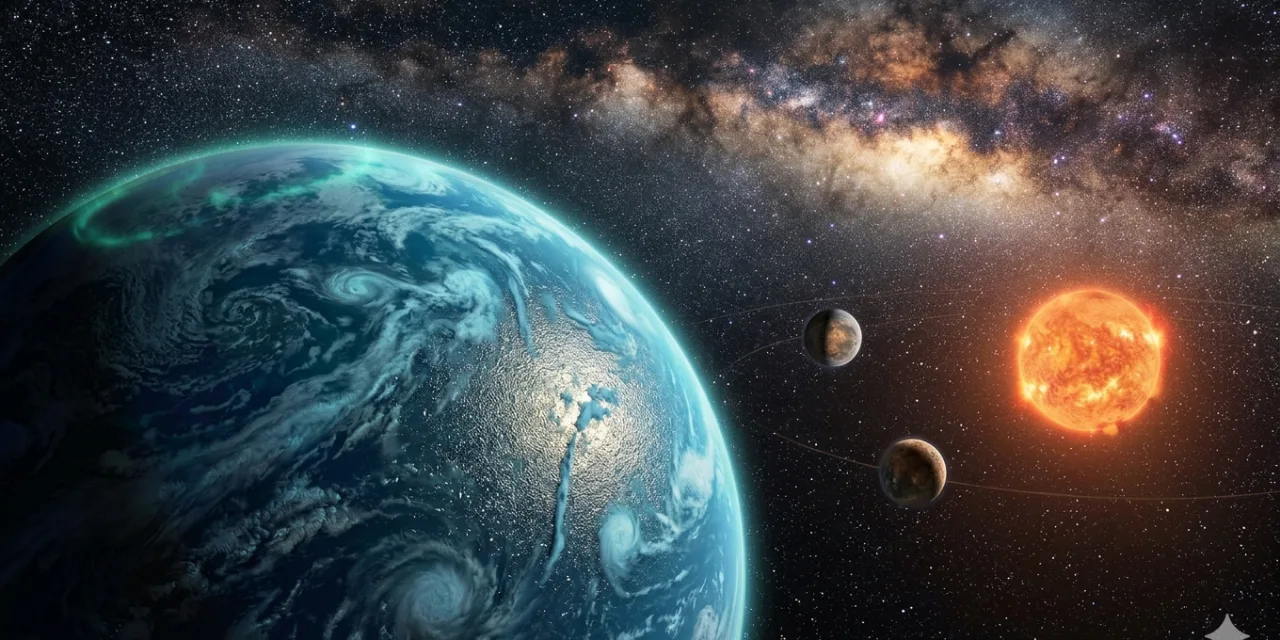
In April 2026, a paper published in the Monthly Notices of the Royal Astronomical Society did something that would have been impossible just a decade ago: it produced a shortlist. Not a catalogue, not an inventory, not a raw data dump of thousands of candidates — but a curated, prioritised list of 45 rocky exoplanets sitting within the habitable zones of their stars, specifically selected for their potential to host liquid water and their accessibility to current and near-future observational instruments. Of those 45, 24 sit in an even narrower range of conditions that make them the top candidates for immediate follow-up. This represents a fundamental shift in how astronomers are approaching the search for life beyond Earth — from the question “are there other planets?” which was answered definitively in the affirmative three decades ago, to the far more demanding and far more interesting question “which specific worlds should we actually investigate first?”
The context for that shift is extraordinary. In October 1995, astronomers Michel Mayor and Didier Queloz confirmed the existence of 51 Pegasi b — the first planet detected orbiting a Sun-like star, a discovery that earned them the Nobel Prize in Physics in 2019. In the three decades since that breakthrough, the confirmed exoplanet count has surpassed 6,000, with thousands more candidates awaiting confirmation. The Kepler Space Telescope alone, which operated from 2009 to 2018, detected more than 2,600 confirmed exoplanets by monitoring the minute dimming of starlight as planets passed in front of their stars. The TESS mission continues that work. The James Webb Space Telescope, operational since 2022, has gone further still — not merely detecting exoplanets but beginning to characterise their atmospheres, searching for the chemical signatures that might indicate conditions suitable for life or, in the most significant recent development, the biosignatures of life itself.
The question that opens this article — could any of these worlds support life? — is no longer purely theoretical. The answer, in 2026, is: possibly, and we have the tools to begin finding out.
What an Exoplanet Is — and Why There Are So Many
An exoplanet is any planet beyond our solar system. Most orbit other stars, though a category of “rogue planets” — free-floating objects of planetary mass — drift through the galaxy untethered to any star, ejected from their original planetary systems by gravitational interactions. We have confirmed more than 6,000 exoplanets, but astronomers believe the galaxy contains billions — the Milky Way alone is estimated to have more than 100 billion stars, and the Kepler mission’s statistical analysis of its survey region suggested that, on average, each star hosts at least one planet. Some estimates put the total number of planets in the Milky Way at over a trillion.
This abundance of planets was not what astronomers expected when the search began. The early theoretical expectation was that planetary systems would be relatively rare — that the specific conditions of our solar system’s formation were unusual enough that planets of the kind we see here would not be common. Thirty years of discovery has overturned that expectation completely. Planets appear to be the rule rather than the exception in stellar system formation. They come in astonishing variety: giant gas worlds larger than Jupiter orbiting closer to their stars than Mercury orbits our Sun (the “hot Jupiters” that were among the first exoplanets detected); sub-Neptunes in the size range between Earth and Neptune that have no equivalent in our solar system but appear to be the most common type of planet in the galaxy; rocky super-Earths with masses several times Earth’s; water worlds that may be entirely covered by liquid oceans; and planets orbiting pairs of stars or in the intense radiation environment near the galactic centre.
The variety matters for the search for life because it has forced astronomers to question which of these configurations might support biology. For much of the early exoplanet search, the default assumption was that life required something very much like Earth: a rocky planet of roughly Earth’s mass, orbiting a Sun-like star at roughly Earth’s distance, with liquid water on the surface, protected by a magnetic field, and sheltered within a stable solar system. Each of these requirements dramatically narrowed the candidate list. But recent discoveries — and especially the work being done with James Webb — have begun to complicate this picture, suggesting that life-friendly conditions might exist in configurations quite different from our own home world.
How We Find Them: The Detection Methods Explained
Finding a planet orbiting a distant star is an exercise in detecting extraordinarily subtle signals. Even the nearest exoplanets are so far away that direct optical observation — seeing them as point sources of light separate from their stars — is possible only in a handful of cases with current technology. The vast majority of confirmed exoplanets have been detected through indirect methods that infer the planet’s existence from its effect on the star it orbits.
The transit method is responsible for the majority of confirmed exoplanet discoveries. When a planet passes in front of its star from our line of sight — transiting — it blocks a tiny fraction of the star’s light. A Jupiter-sized planet blocks roughly 1 percent of a Sun-like star’s light during transit; an Earth-sized planet blocks approximately 0.01 percent. Detecting these minute, periodic dimmings requires precise photometric measurements sustained over months to years, which space telescopes are ideally suited to provide. The transit method is most effective at detecting large planets orbiting close to their stars — which is why hot Jupiters were so prevalent in early exoplanet catalogues. It also allows astronomers to determine the planet’s orbital period (from the time between transits), its size relative to the star (from the depth of the dimming), and with additional analysis, aspects of its atmospheric composition through transmission spectroscopy.
The radial velocity method — also called the Doppler method — detects the gravitational tug that a planet exerts on its star. As a planet orbits, it pulls the star slightly toward and away from Earth, causing the star’s light to undergo periodic Doppler shifts: blue-shifting as the star approaches and red-shifting as it recedes. By measuring these shifts with high-resolution spectrographs, astronomers can determine the planet’s minimum mass and orbital period. This was the method used to detect 51 Pegasi b in 1995. It is most sensitive to massive planets orbiting close to their stars, which produce the strongest gravitational pulls and the most detectable wobbles.
Direct imaging is exactly what it sounds like — actually photographing the planet as a separate point of light distinct from its star. This is technically extremely challenging because the star is typically billions of times brighter than the planet, making the planet invisible in the glare. It is currently only practical for young, massive planets orbiting far from their stars — conditions that don’t describe most potentially habitable worlds. But it is the method that the proposed Habitable Worlds Observatory (HWO) is being designed to advance, using coronagraphs and starshades that block the star’s light to reveal the dimmer planet alongside it. Direct imaging of an Earth-like planet around a Sun-like star, and spectroscopic analysis of its atmosphere, is the next frontier of exoplanet science.
Gravitational microlensing exploits the fact that massive objects bend light through gravitational effects predicted by general relativity. When a star with a planet passes in front of a more distant background star from our perspective, the foreground star’s gravity acts as a lens, amplifying the background star’s light in a characteristic pattern — and the planet produces a detectable additional signature in that amplification. Microlensing is capable of detecting planets at distances from their stars that other methods struggle to reach, including planets in the outer solar system analogues where rocky worlds might orbit in very different conditions from our own.
The Habitable Zone: Necessary But Not Sufficient
The concept of the habitable zone — colloquially the “Goldilocks zone” — defines the region around a star within which a planet could theoretically maintain liquid water on its surface. The inner edge of the habitable zone is set by the temperature at which a planet’s oceans would evaporate and its atmosphere would enter a runaway greenhouse effect like Venus. The outer edge is set by the temperature at which carbon dioxide condensation would remove the greenhouse effect needed to keep the surface above freezing. The habitable zone for our Sun encompasses the orbital range from approximately 0.95 to 1.67 astronomical units — Earth sits comfortably within it, while Mars sits near the outer boundary and Venus sits inward of the inner edge.
The habitable zone concept is genuinely useful as a first-pass filter for candidate worlds — a planet far inside the inner edge or far outside the outer edge is unlikely to host surface liquid water regardless of other conditions. But it is insufficient as a complete habitability criterion for several important reasons that more recent research has emphasised. First, atmospheric conditions can dramatically alter surface temperatures relative to what the habitable zone model predicts from stellar radiation alone. A thick carbon dioxide atmosphere can warm a planet well outside the classical habitable zone through the greenhouse effect. A reflective atmosphere or surface can cool a planet inside the habitable zone below freezing. Second, liquid water does not require surface conditions at all — as the subsurface oceans of Europa and Enceladus in our own solar system demonstrate, geological heating can maintain liquid water environments regardless of distance from the Sun. Third, life as we understand it requires more than liquid water — it requires a suite of chemical conditions, energy sources, and geological processes that the habitable zone concept does not capture.
The April 2026 shortlist of 45 habitable zone rocky exoplanets represents a more sophisticated approach than simple habitable zone classification. The researchers — Bohl, Lawrence, Lowry, and Kaltenegger — used a “practically grounded definition of habitability” that incorporated measurable planetary properties and specifically filtered for worlds accessible to current and near-future observational instruments. The result is not a list of definitely habitable worlds but a prioritised research agenda: these are the 45 planets that give astronomers the best combination of habitability potential and observational accessibility, ensuring that limited telescope time is allocated to the most informative targets.
The TRAPPIST-1 System: Seven Earth-Sized Worlds, Three in the Habitable Zone
No exoplanet system has captured more sustained scientific attention since its discovery in 2017 than TRAPPIST-1 — a system of seven Earth-sized planets orbiting an ultra-cool red dwarf star approximately 40 light-years from Earth. The system’s extraordinary feature is that three of its seven planets — TRAPPIST-1 e, f, and g — sit within the star’s habitable zone, with TRAPPIST-1 e standing out as the most Earth-like of all known exoplanets in terms of size, mass, and estimated temperature.
James Webb has been characterising the TRAPPIST-1 system in detail since beginning science operations. The results are a mixture of encouraging and sobering. TRAPPIST-1 b, the innermost planet, was found to have no significant atmosphere — its dayside temperature of roughly 450 degrees Fahrenheit suggests it is a bare rock baked by its proximity to the star. TRAPPIST-1 d was similarly found to apparently lack an atmosphere in preliminary data. These findings were concerning because they raised the question of whether red dwarf stars’ intense ultraviolet and X-ray flares during their early energetic phases strip the atmospheres from their close-orbiting planets before those atmospheres can stabilise.
But the story is not concluded. TRAPPIST-1 e, f, and g — the three habitable zone planets — are at greater distances from the star, potentially having experienced less atmospheric stripping. Scientists are continuing observations, and the analysis of atmospheric data for these three worlds is among the highest scientific priorities for the James Webb mission in 2026. TRAPPIST-1 e in particular has drawn intense interest: its orbital position within the habitable zone and its estimated size and mass make it the closest thing to an Earth analogue in a system close enough for Webb to begin probing atmospheric chemistry. As the India TV News reported in April 2026, in the latest screening of 6,000+ known exoplanets for Earth-like candidates, TRAPPIST-1 e stands out as especially compelling.
The TRAPPIST-1 system also represents a broader scientific question about red dwarf stars as hosts for habitable worlds. Red dwarfs — also called M dwarfs — are the most common type of star in the galaxy, comprising approximately 70 percent of all stars. If they can host habitable planets, the number of potentially life-bearing worlds in the Milky Way increases dramatically. But their habitability as hosts is complicated by their flare activity, the tidal locking of close-orbiting planets (which always present the same face to the star, creating extreme temperature differentials between the day and night sides), and the intense radiation environments that accompany their youth. The TRAPPIST-1 observations are helping answer whether any of these factors are definitively lethal for planetary atmospheres and surface habitability — and the results are more nuanced than either the optimistic or pessimistic positions predicted.
K2-18b and the Biosignature That Shocked Science
The most consequential exoplanet discovery of the past two years — and one of the most scientifically significant in the history of the field — centres on a planet called K2-18b, a “sub-Neptune” world approximately 120 light-years from Earth. K2-18b is between two and three times the width of Earth, with 8.6 times Earth’s mass, and it orbits within the habitable zone of its star, receiving almost the same amount of solar radiation as Earth receives from our Sun.
Using the James Webb Space Telescope’s MIRI spectrograph, Cambridge University astrophysicist Nikku Madhusudhan and his research team detected what they describe as the strongest evidence yet of possible life beyond our solar system: chemical signatures of dimethyl sulfide (DMS) and dimethyl disulfide (DMDS) in K2-18b’s atmosphere at concentrations more than 10 parts per million — thousands of times higher than their concentrations in Earth’s atmosphere. On Earth, both DMS and DMDS are produced by living organisms — primarily marine phytoplankton and microbial life. Webb found that one or both gases were present at a 99.7 percent confidence level, meaning there is a 0.3 percent chance the signal is a statistical artefact.
The detection caused a wave of headlines suggesting life had been found beyond Earth. Madhusudhan himself urged caution — the appropriate scientific response to a 99.7 percent confidence measurement that falls short of the 99.9999 percent (“five sigma”) standard required for a definitive discovery claim in physics. “We are either seeing the first signs of life beyond Earth — or uncovering an entirely new chemical process we’ve never seen before. Either way, it’s a breakthrough,” he said. The finding has since been subject to intense scrutiny, with alternative non-biological explanations proposed and evaluated. The team’s stated next step is to repeat the observations two to three times using the full MIRI instrument to increase detection significance and definitively establish whether the signal is robust or a measurement artefact.
K2-18b belongs to a newly recognised category of planet that Madhusudhan himself coined: a “hycean” world — a combination of “hydrogen” and “ocean.” Hycean worlds are theorised to have hydrogen-rich atmospheres overlying global liquid water oceans, with no equivalent in our solar system. They are, as Madhusudhan explains, particularly exciting from an astrobiological perspective precisely because their hydrogen-rich atmospheres make atmospheric characterisation with current instruments far more feasible than for thinner Earth-like atmospheres. Detecting biosignatures on a true Earth-twin around a Sun-like star remains approximately 20 years away in terms of instrumental capability. Hycean worlds have brought that frontier to the present — Webb can probe their atmospheres now, and what it is finding is creating genuine, evidence-based scientific excitement about the possibility of microbial life in liquid water oceans beneath hydrogen-rich skies.
What Biosignatures Are and Why Scientists Are Careful About Them
A biosignature is any measurable property of a planet’s atmosphere, surface, or broader environment that provides evidence of biological processes — past or present. The concept is straightforward in principle but profoundly challenging in practice, because every proposed biosignature gas can also be produced by non-biological processes, and distinguishing biological from abiological sources requires the kind of precision and contextual understanding that current technology is only beginning to achieve.
The most frequently discussed biosignature combination is oxygen and methane detected simultaneously in a planet’s atmosphere. On their own, neither gas is uniquely biological: oxygen can be produced by photolysis of water vapour, and methane can be produced by volcanic activity and serpentinisation reactions between water and rock. But oxygen and methane react with each other chemically and do not coexist in equilibrium — their simultaneous presence in an atmosphere requires a continuous source replenishing both, which on Earth is provided by photosynthetic life (producing oxygen) and methanogenic microbes (producing methane). A planet’s atmosphere showing both gases at significant concentrations would constitute strong — though not definitive — evidence for active biological processes.
The “red edge” is another biosignature that atmospheric characterisation programmes are searching for. On Earth, vegetation reflects infrared light in a characteristic pattern at the boundary between visible and near-infrared wavelengths — the chlorophyll reflection peak. If photosynthetic life exists on an exoplanet’s surface, its vegetation might produce a similar spectral signature. Detecting this in an exoplanet’s spectrum would require direct imaging spectroscopy of the planet’s surface rather than transmission spectroscopy of its atmosphere — a capability that the Habitable Worlds Observatory is being designed to provide for Earth-like planets around Sun-like stars.
The case of K2-18b illustrates why scientists treat biosignature claims carefully. DMS and DMDS are genuine biosignatures on Earth — they are produced in biologically significant quantities only by living organisms under Earth’s conditions. But K2-18b is not Earth: it is a hycean world with a hydrogen-rich atmosphere and, if the hypothesis is correct, a liquid water ocean under conditions of temperature and pressure quite different from Earth’s. Whether DMS and DMDS can be produced at the detected concentrations by non-biological chemistry in those specific conditions is a question that cannot yet be definitively answered. The scientific process — repeating observations, proposing and testing alternative explanations, seeking independent confirmation from different instruments — is exactly what is happening. The excitement is warranted; the conclusion is not yet.
The Numbers: How Many Habitable Worlds Might Exist?
A study published in 2025 and drawing on the full database of known exoplanets estimated that approximately 1 percent of all extrasolar planets are potentially habitable for life as we know it — meaning they meet the basic conditions of size, temperature, and composition that make liquid water surface conditions plausible. One percent of the Milky Way’s estimated 100 billion planets is one billion potentially habitable worlds. That number is likely a conservative estimate: it does not account for subsurface liquid water environments (as exist on Europa and Enceladus), hycean world ocean environments (which may be more common than rocky habitable zone planets), or exotic life forms that might thrive under conditions we do not classify as habitable based on our Earth-centric biology.
The question of how many habitable worlds exist is different from the question of how many inhabited worlds exist — and that distinction is where the profound uncertainty of astrobiology resides. Even accepting that billions of potentially habitable worlds exist in the galaxy, the probability that any given habitable world actually develops life depends on factors we do not understand: how often the chemistry required for the origin of life occurs, whether the origin of life is an inevitable outcome of chemistry given sufficient time, or whether it is a statistical fluke so improbable that even billions of habitable worlds contain only one example. The Fermi Paradox — the observation that if intelligent civilisations are common, we should have heard from them by now — adds another layer of uncertainty to the inhabited count even if the habitable count is high.
What 2026 has changed is not the answer to these questions but the methodology for approaching them. The shift from simply cataloguing planets to systematically prioritising the 45 most promising habitable zone rocky exoplanets for immediate observation — from collecting data to performing targeted atmospheric characterisation — represents the transition from the census phase of exoplanet science to the investigation phase. And for the first time, the investigation phase has produced a result that cannot be easily explained without considering biology: the DMS and DMDS signals at K2-18b. Whether that result survives confirmation observations will determine whether the investigation phase produces the most significant scientific discovery in human history within the next few years.
The Instruments That Are Changing Everything
The capacity to characterise exoplanet atmospheres at the level required to search for biosignatures has arrived principally through the James Webb Space Telescope. Webb’s primary mirrors, its sensitivity across near- and mid-infrared wavelengths, and its operation in the cold darkness of the L2 Lagrange point — 1.5 million kilometres from Earth, shielded from solar radiation — give it capabilities that the Hubble Space Telescope and ground-based observatories cannot match for this specific application. In its first 18 months of science operations, Webb characterised atmospheric water vapour in WASP-96 b with unprecedented precision, identified methane and carbon dioxide in K2-18b’s atmosphere (the first carbon-based molecules detected in a habitable zone exoplanet’s atmosphere), and determined that TRAPPIST-1 b lacks a significant atmosphere.
The forthcoming Extremely Large Telescope (ELT), currently under construction at the Atacama Desert site in Chile and expected to begin science operations in the late 2020s, will complement Webb with a 39-metre primary mirror — the largest optical telescope ever built — providing the resolving power and light-gathering capacity to perform high-resolution spectroscopy on exoplanet atmospheres that Webb cannot achieve. Together, Webb and ELT represent a generational leap in atmospheric characterisation capability.
Looking further ahead, NASA’s Habitable Worlds Observatory is the mission specifically designed for the most challenging goal in exoplanet science: direct imaging and spectral analysis of Earth-like planets orbiting Sun-like stars. Unlike Webb (which was not optimised for this application) or ground-based telescopes (which are limited by atmospheric distortion and scattered starlight), the HWO will use a coronagraph and possibly a separate starshade to block the star’s light and image the planet directly — enabling surface-level spectroscopy and the direct detection of vegetation red-edge signatures if they exist. The HWO is still in the planning and priority-setting phase as of 2026, but the scientific community’s 2020 decadal survey identified it as the highest-priority large mission for the coming decade, reflecting the consensus that direct imaging of potentially habitable Earth analogues is the next transformative step in the search for life.
AI and the Acceleration of Discovery
Artificial intelligence is playing an increasingly important role in exoplanet science at every stage of the discovery and characterisation pipeline. In January 2026 alone, AI-driven analysis of archival data identified a “super-Earth” that had been hidden in the glare of a binary star system for years — a discovery that manual analysis had not flagged despite the data being available. More broadly, AI algorithms trained on known exoplanet transit signatures are finding candidate planets in existing datasets at rates that human reviewers could not achieve manually, effectively mining the combined years of telescope observations accumulated by Kepler, TESS, and ground-based surveys for previously missed discoveries.
For atmospheric characterisation, AI is accelerating the process of extracting chemical fingerprints from noisy transmission spectra — identifying the absorption features of specific molecules against the background noise that plagues observations of objects as faint as exoplanet atmospheres in the light of their host stars. The SETI Institute has been integrating AI into its technosignature search programmes, allowing searches for anomalous signals across larger datasets and more diverse signal types than traditional approaches allow. As the SETI Institute’s March 2026 research programme notes, prioritised target lists like the new 45-planet catalogue allow technosignature searches to focus on planets already identified as potentially habitable — shrinking the vast search space in a field defined by extraordinarily low signal probabilities.
What Finding Life Would Actually Mean
NASA describes the question of whether life exists beyond Earth as “one of the most profound questions of all time” and notes that the answer — whatever it is — will change us forever. This is one of the rare cases in science communication where the grand claim is not an exaggeration. A confirmed detection of biosignatures in an exoplanet atmosphere, elevated to the scientific standard of discovery, would be the most significant discovery in the history of science — immediately transforming the question of whether life is a cosmic accident unique to Earth into a question of how common it is, what forms it takes, and what it means for our understanding of biology, chemistry, and the conditions that make complexity possible in the universe.
Even the absence of biosignatures on the most promising candidates would be scientifically transformative. If the 45 highest-priority habitable zone rocky exoplanets are characterised and none show evidence of biology, the implications for the frequency of life in the universe are significant — constraining the probability of abiogenesis (the origin of life from chemistry) in ways that decades of theoretical astrobiology have not been able to achieve.
The field of exoplanet science in 2026 is at an extraordinary moment. The census is largely complete: planets are everywhere, habitable zone candidates number in the billions across the galaxy, and specific priority targets have been identified and characterised to a degree that would have seemed impossible when 51 Pegasi b was announced in 1995. What began as the question of whether planets exist around other stars has become the investigation of whether specific chemical signatures of life can be detected in their atmospheres. The answer to that question — yes, possibly, at K2-18b — is preliminary, contested, and awaiting confirmation. But the fact that it is being asked with real evidence in hand, rather than purely theoretically, marks a turning point from which astronomy does not step back. The universe is speaking. We are, for the first time, close enough to being able to listen.


0 Comments
No comments yet. Be the first to share your thoughts!