
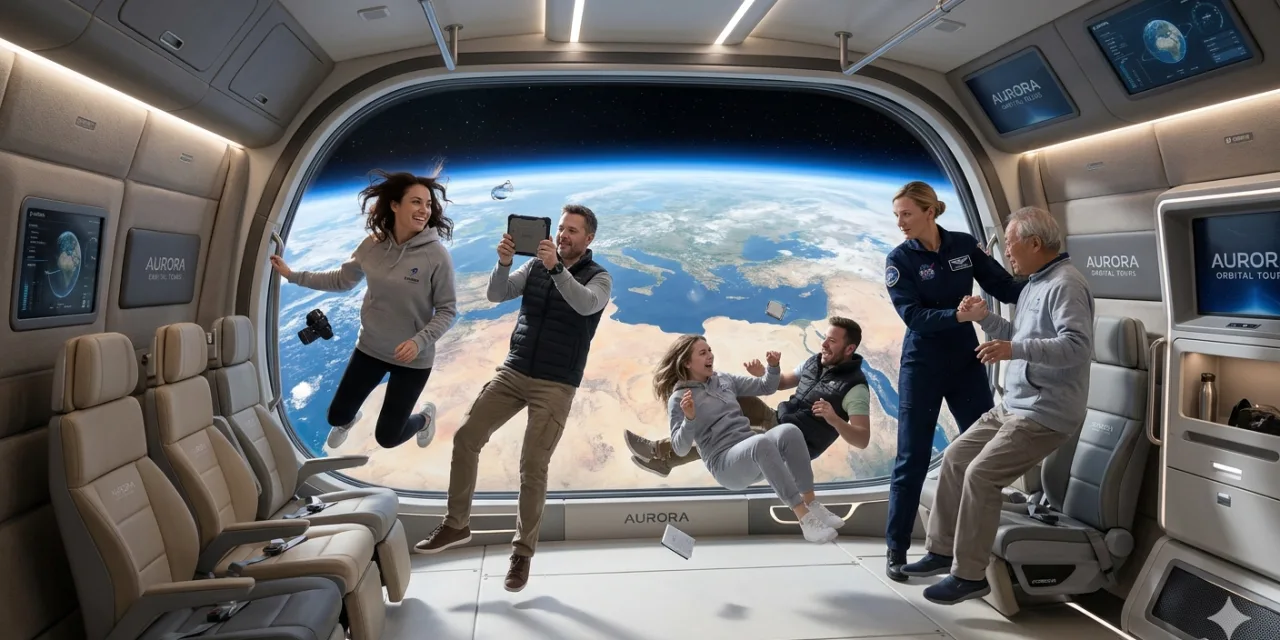
On January 22, 2026, a Blue Origin New Shepard rocket lifted off from West Texas carrying six passengers to the edge of space. Eight days later, Blue Origin announced it would not fly again — at least not for another two years. The company was grounding its entire suborbital tourism programme to redirect resources toward building a lunar lander for NASA. Just weeks earlier, Virgin Galactic had relaunched ticket sales for its next-generation Delta spacecraft at $750,000 a seat, but had no flights to offer until late 2026 at the earliest. SpaceX’s Starship — the vehicle that could, one day, transform the economics of space travel entirely — was completing its eleventh test flight and preparing for a twelfth.
This is where space tourism stands in 2026. Not in the future tense of breathless 2019 predictions, but in the complicated, expensive, stop-start, genuinely extraordinary present tense of an industry that has flown hundreds of paying passengers to space and is simultaneously fighting for its commercial survival, rethinking its business models, and building the infrastructure that could, within this decade, change what space travel means for humanity.
The global space tourism market is valued at approximately $8.9 billion in 2026 and is projected to reach $62.1 billion by 2036, growing at a compound annual rate of 21.8 percent. Those numbers tell one story. The real story — of who is actually flying, what it costs, why one of the industry’s founding companies just pulled its product from the market, and what Starship could mean for everyone who ever wanted to look down at Earth from above — is considerably more interesting.
The Road to Here: How Commercial Space Tourism Became Real
The idea of paying to travel to space is older than the internet, but the reality is younger than most smartphones. Dennis Tito, an American businessman, became the first space tourist in 2001 when he paid approximately $20 million to fly to the International Space Station aboard a Russian Soyuz spacecraft. Six more tourists followed through the same Roscosmos arrangement over the next decade — a trickle of extraordinarily wealthy individuals purchasing an experience that the technology of the time could deliver only expensively and infrequently.
The transformation of space tourism from a bespoke Soyuz arrangement to a nascent commercial industry required the development of purpose-built commercial spacecraft and the competitive pressure of multiple private companies pursuing the same market. Virgin Galactic, founded by Richard Branson in 2004, spent seventeen years and enormous capital developing SpaceShipTwo — an air-launched suborbital spaceplane designed to carry six paying passengers to the edge of space and back. Blue Origin, founded by Jeff Bezos in 2000, developed the New Shepard — a fully reusable suborbital rocket and capsule designed for brief ten-minute trips to the Kármán line and back. SpaceX, founded by Elon Musk in 2002 with the longer-range goal of making humanity multiplanetary, developed Crew Dragon as a fully capable orbital spacecraft that has since been adapted for commercial missions beyond its original NASA contract.
The years 2021 and 2023 were the industry’s most productive. Virgin Galactic’s VSS Unity flew Richard Branson and colleagues in July 2021, marking the first commercial flight for the company. Blue Origin’s New Shepard flew Jeff Bezos, his brother, aviator Wally Funk, and 18-year-old Oliver Daemen the following week — the youngest and oldest people to reach space — and proceeded to fly 98 people to the Kármán line across 38 missions over the following five years. SpaceX’s Inspiration4 mission in September 2021 carried four civilian passengers into orbit for three days, the first all-civilian orbital flight in history. By 2023, Virgin Galactic had logged seven commercial flights and the industry began to look, if briefly, like it was finding its operational rhythm. Then, in 2024, Virgin Galactic grounded its SpaceShipTwo fleet to transition to the next-generation Delta spacecraft. And in January 2026, Blue Origin followed with its own, more consequential pause.
The Blue Origin Pause: What It Means and Why It Happened
The announcement came on January 30, 2026 — eight days after New Shepard’s most recent tourism flight. Blue Origin stated it would pause all New Shepard missions for at least two years to “shift resources to further accelerate development of the company’s human lunar capabilities.” The decision reflected Blue Origin’s $3.6 billion NASA contract to develop the Blue Moon lunar lander, which holds a place in NASA’s Artemis programme to send astronauts Back to the lunar surface. A robotic demonstration of Blue Moon is scheduled to launch to the lunar surface in 2026, and the crewed Blue Moon Mark 2 is targeted to support the Artemis V mission, currently projected for 2029.
The pause is strategically rational for Blue Origin as a company with lunar ambitions — but it leaves a significant gap in the suborbital tourism market. New Shepard had carried 98 people to space across 38 flights. Those 98 passengers — including celebrities such as Katy Perry, Gayle King, William Shatner, and Michael Strahan alongside paying private customers — represented the only operational suborbital human spaceflight programme producing regular flights. Its suspension means that as of early 2026, there is no operational commercial suborbital human spaceflight product available for purchase and delivery anywhere in the world. “There really is no suborbital space tourism market right now,” Craig Curran, president of the DePrez Group of Travel Companies in Rochester, New York, told the Spokesman-Review in March 2026. “In terms of having an actual product, we’re in a wait-and-see for Virgin Galactic to become operational.”
The people who had purchased New Shepard tickets face an uncertain wait. Blue Origin has not disclosed how many future passengers held reservations, nor the timeline for any potential commercial resumption after the two-year minimum pause. For the market as a whole, the pause is a reminder that space tourism in 2026 remains a fragile product whose supply can disappear on short notice for reasons entirely unrelated to customer demand.
Virgin Galactic: The Return and the Delta Spacecraft
While Blue Origin was announcing its pause, Virgin Galactic was doing the opposite — relaunching ticket sales ahead of the expected resumption of commercial flights later in 2026. The company has officially restarted sales for its next-generation Delta class spacecraft at $750,000 per seat, an increase of approximately $100,000 over previous pricing that the company attributes to both increased demand signals and the improved capabilities of the new vehicle.
The Delta class spaceplane is a materially different product from the SpaceShipTwo vehicles that preceded it. Where SpaceShipTwo carried four passengers, the Delta carries six — improving the economics of each flight significantly. The vehicle is designed for higher operational tempo, with the goal of enabling more frequent and more reliable commercial operations than the SpaceShipTwo generation achieved. Virgin Galactic expects the first test flight for Delta to occur by the end of 2026, with commercial operations following once test milestones are achieved.
Virgin Galactic’s financial situation has been challenging. The company’s share price has fallen more than 98 percent since its October 2019 public debut. Revenue for 2025 was $2 million — down from $7 million in 2024 — reflecting the absence of commercial flights during the transition period. The bet the company is making is that the Delta class vehicle, if it delivers on its design specification, will provide the operational reliability and flight frequency that SpaceShipTwo never sustainably achieved. Richard Branson has publicly positioned the Delta launch as critical — particularly given Blue Origin’s withdrawal from the suborbital market, which in principle leaves Virgin Galactic as the only operational suborbital tourism option if it can resume flights. “The space launch later this year is going to be really important,” Branson said in March 2026, “particularly now that Blue Origin seems to have bowed out of putting people into space.”
The suborbital experience that Virgin Galactic offers is worth describing precisely, because it differs from orbital spaceflight in ways that matter for anyone evaluating the product. The Delta spaceplane is carried aloft by a mothership aircraft to an altitude of approximately 15 kilometres, where it is released and ignites its rocket motor, climbing to approximately 86 kilometres — above the US Air Force’s 80-kilometre definition of space, though below the internationally recognised Kármán line at 100 kilometres. Passengers experience approximately four to six minutes of weightlessness and views of the Earth’s curvature against the blackness of space before the vehicle glides back to a runway landing. The total experience from takeoff to landing is approximately 90 minutes. It is brief. It is also something that fewer than a thousand human beings have ever experienced.
SpaceX: The Orbital Option and the Starship Horizon
SpaceX occupies a different tier of the space tourism market — one defined by orbital duration, dramatically higher price, and an entirely different quality of experience. Through its Crew Dragon spacecraft, SpaceX has enabled multiple private astronaut missions that go far beyond the brief edge-of-space experience that suborbital providers offer.
The Inspiration4 mission of September 2021 carried four civilians into orbit for three days at an altitude of approximately 575 kilometres — higher than the International Space Station — where they conducted science experiments, raised money for St. Jude Children’s Research Hospital, and became the first all-civilian crew to orbit Earth. The Polaris programme, a series of increasingly ambitious private missions funded by technology entrepreneur Jared Isaacman, has continued this tradition. Polaris Dawn, flown in 2024, included the first commercial spacewalk in history — another milestone in the ongoing expansion of what private spaceflight can accomplish.
Axiom Space has built the most structured commercial orbital programme around access to the International Space Station, organising dedicated private astronaut missions in which paying customers spend eight to fourteen days aboard the ISS alongside professional astronauts — participating in scientific experiments, conducting commercial research, and experiencing life in low Earth orbit. These missions cost approximately $55 million per seat, plus additional costs for training, insurance, and preparation that push the total investment for a single passenger well above that figure. Despite the cost, Axiom has successfully flown multiple missions and has an active manifest, establishing a precedent for the kind of extended commercial presence in low Earth orbit that forms the foundation of its longer-term business model.
Axiom’s longer-term plan is not merely to be a tour operator for the ISS. The company is developing its own commercial modules — the Axiom Station — intended to attach to the ISS initially and then detach to operate as an independent private space station after the ISS is retired, currently planned for the early 2030s. This would represent the first commercial orbital habitat available for tourism, research, and commercial operations in history. The construction and operational timeline is ambitious, but the engineering work is underway and NASA has awarded Axiom the contracts to develop its first modules.
Starship is the variable that could change everything. SpaceX’s Starship — a fully reusable, 120-metre-tall launch system comprising the Super Heavy booster and the Starship upper stage — is the vehicle that could, if it achieves its design objectives, reduce the cost of reaching orbit by 90 percent or more. SpaceX completed its eleventh Starship test flight in early 2026, demonstrating full booster catch at the launch tower — the mechanical arm system that catches the returning booster rather than allowing it to land on legs — and is preparing for the twelfth test flight in late April 2026. Each flight adds capability and data. The trajectory from current testing to routine orbital flight is not straight, but it is advancing.
What Starship means for space tourism specifically is a matter of the cost curve. Today, reaching orbit costs approximately $55 million per seat. If Starship reduces the launch cost per person to $2 million, then $500,000, then potentially lower over time as launch cadence scales, the market for space tourism transforms from a product for the billionaire tier to one accessible to the merely very wealthy — and eventually, in the theoretical longer term, to a far broader population. SpaceX shattered its own rocket launch record in 2025, achieving 165 orbital Falcon 9 flights in a single year. If Starship achieves comparable reliability at its target cost, the economics of space access change fundamentally.
What Space Tourism Actually Costs in 2026: The Full Price Breakdown
The stated ticket price for a commercial spaceflight is rarely the full story. Understanding the actual cost of buying a space tourism experience in 2026 requires accounting for training, preparation, insurance, and the non-refundable deposit structures that characterise the market.
Suborbital flights are the most accessible tier, once available again. Virgin Galactic’s Delta class tickets are currently priced at $750,000 per seat for a 90-minute experience reaching approximately 86 kilometres. Previous New Shepard ticket prices were not publicly disclosed by Blue Origin, but industry estimates placed them at approximately $1.5 million to $2 million — significantly above Virgin Galactic’s pricing, reflecting the higher operational costs of a vertical-launch system. Both categories require pre-flight medical evaluations, several days of training and preparation at the launch site, and deposit structures that typically require a substantial upfront commitment before refund rights expire.
Orbital flights via Crew Dragon currently cost approximately $55 million per seat for a multi-day ISS mission through Axiom Space. The total package — including months of training at Johnson Space Center in Houston, medical certification, quarantine protocols, and the mission itself — represents an investment of time and commitment as well as cost. At this price point, the market is genuinely limited to individuals with both the financial resources of the ultra-wealthy and the physical profile to pass astronaut medical requirements.
High-altitude balloon experiences represent the accessible floor of the near-space tourism category. World View Enterprises offers flights in a pressurised capsule carried by a balloon to approximately 30 kilometres — well below the internationally recognised boundary of space but high enough to see the curvature of the Earth and the blackness of the atmosphere above. Pricing for these experiences begins at approximately $50,000, making them more accessible than rocket-powered options while delivering a meaningfully different (and longer) experience: flights last several hours rather than minutes.
The cost trajectory over the next decade, across all categories, is expected downward. The projection that suborbital prices could drop approximately 50 percent by 2030 to around $200,000 per seat reflects both the maturation of existing vehicle technologies and the potential impact of Starship on orbital economics. The UBS investment bank has projected that 50,000 people could be space tourists by 2030 — a number that would require a significant reduction in price from current levels to generate sufficient demand, but that is not implausible if Starship delivers on even a fraction of its cost-reduction potential.
The Companies Building Tomorrow’s Space Tourism Infrastructure
Beyond the three companies that have dominated space tourism headlines, a broader ecosystem of commercial space ventures is building the infrastructure that will define the industry over the next decade.
Vast Space is developing Haven-1, a commercial space station module intended to launch as early as 2025 and dock with the ISS before operating independently. Haven-1 is designed to host private visitors for stays of up to thirty days — a more extended orbital experience than any currently available commercial option. SpaceX is partnered with Vast for the Crew Dragon transportation that would ferry passengers to and from the station, creating a vertically integrated commercial orbital tourism product that combines launch and destination in a single commercial arrangement.
Orbital Assembly Corporation is pursuing the more ambitious vision of the Voyager Station — a rotating wheel-shaped space hotel that would generate artificial gravity through centripetal force, resembling a luxury cruise ship in concept if not in the engineering challenge of building it. The project’s timeline has shifted since its initial announcement, and the technical and financial challenges of constructing a rotating space habitat remain substantial. But the concept illustrates the direction that commercial space travel infrastructure could take over a longer timeframe if orbital launch costs fall sufficiently.
Chinese commercial space tourism is entering the competitive picture on a longer timeframe but with the weight of significant investment behind it. Beijing Interstellar Human Spaceflight Technology Co. has announced plans to fly tourists by 2028 at prices of approximately 3 million yuan (around $430,000 at current exchange rates). CAS Space Technology Co. is targeting crewed space tourism flights by 2029. These timelines are ambitious, but the Chinese commercial space sector has demonstrated the ability to execute at speed when adequately funded and politically supported. As Rachel Fu, professor in the department of tourism, hospitality and event management at the University of Florida, observed: Chinese companies are “signalling we’re going to compete.”
The Safety Picture: Where the Risks Actually Are
Space tourism’s safety record to date is considerably better than the early years of commercial aviation, but the comparison is imperfect because the number of flights is orders of magnitude smaller. The current estimated risk of fatality for orbital spaceflights is approximately 1 in 100 to 200 — dramatically higher than commercial aviation, which has driven its fatality rate below 1 in a million. Suborbital flights, which operate at lower velocities and altitudes, carry lower risk than orbital missions, though quantifying the exact figure is difficult given the still-small sample size.
The regulatory framework governing commercial human spaceflight in the United States is overseen by the Federal Aviation Administration, which licenses launches and re-entries. The FAA’s current approach to commercial human spaceflight regulation distinguishes between “informed consent” — in which passengers acknowledge and accept the risks of an experimental operation — and the certification standards that apply to commercial aviation. This framework has been debated as the industry matures: the argument that space tourism should eventually be held to standards more comparable to commercial aviation will grow stronger as the industry scales and the passenger population broadens beyond the ultra-wealthy adventure seekers of the current era.
Blue Origin’s New Shepard programme experienced its most significant safety incident in September 2022, when the NS-23 uncrewed flight suffered an engine nozzle failure that triggered the crew capsule escape system mid-flight. The capsule parachuted safely to the ground; no passengers were aboard. The FAA grounded New Shepard for several months pending investigation, and the programme eventually resumed with additional safety modifications. This incident underscores that even well-engineered commercial spaceflight systems operate in an environment where failure modes remain possible, and Where the rigour of safety margins is continuously being tested against the demands of operational tempo.
The Deeper Question: Is Space Tourism a Real Market?
The question that hangs over the industry in 2026 — asked explicitly in a March 2026 headline that declared the space tourism dream was “foundering as millionaire demand dries up” — is whether the current market represents a genuine commercial product or a subsidised adventure for a handful of ultra-wealthy individuals that cannot sustain a real industry at current price levels.
The honest answer is: both, simultaneously, and the distinction matters depending on the timeframe you are considering. At current prices — $750,000 for a suborbital trip, $55 million for an orbital week — the addressable market is genuinely tiny. There are not enough people in the world willing and able to spend those amounts on a space experience to sustain a high-cadence commercial operation at any of the existing providers. Recurring demand has been limited. The industry’s founding companies have struggled financially in ways that contradict the optimistic projections of their early business cases.
But this critique misunderstands the function of the current phase of space tourism development. As Rachel Fu of the University of Florida put it: “Space tourism was never meant to remain a niche luxury product. The small initial customer pool functions as a financial and technological bridge toward a longer-term goal: lowering the cost of access to space and expanding commercial activity beyond Earth.” The high prices of today are not the equilibrium state of a mature market. They are the cost structure of an industry that is paying for reusable rocket development, commercial spaceflight infrastructure, regulatory pathway establishment, and the operational experience that will eventually enable much lower costs.
The metric that matters most is not current revenue but current trajectory. SpaceX achieved 165 orbital launches in 2025. Starship is advancing through its test programme. Virgin Galactic is transitioning to a higher-frequency vehicle. Axiom is building the first commercial space station. The Chinese industry is entering the competitive field. Over 55 percent of American adults expect it will become common for people to travel to space for tourism within fifty years. These are the indicators of an industry in its genuinely early stages — capital-intensive, operationally immature, and structurally positioned to look entirely different a decade from now than it does today.
What the Future of Space Tourism Actually Looks Like
The space tourism of 2036 will be unrecognisable from the space tourism of 2026 if — and it is a significant if — the technology trajectory holds. Three developments in particular would transform the industry.
Starship operational maturity would do more than any other single development to reshape the economics of space access. If Starship achieves reliable operations at its target cost structure, the price of reaching orbit would fall by an order of magnitude or more. The cost of a seat on a Crew Dragon mission might fall from $55 million to $5 million, then lower. The market at $5 million is vastly larger than the market at $55 million. The market at $500,000 — which would still be aspirational for most people — would be orders of magnitude larger still. SpaceX’s long-term vision for Starship is not space tourism but interplanetary travel, with Mars as the stated destination. But the orbital economy that Starship enables along the way would be the most significant driver of space tourism growth this decade.
Commercial space stations would transform space from a destination you visit briefly into one you can inhabit for days or weeks. Axiom Station, Haven-1, and other commercial orbital habitats represent the transition from space tourism as a brief experience to space tourism as a stay. When people can spend a week in orbit aboard a commercial station — eating, sleeping, exercising, working, looking out the window at Earth below — the product becomes more comparable to an extraordinary expedition vacation than to a theme park ride. That comparison changes the market in ways that duration pricing, repeat visiting, and the development of destination-specific experiences would build over time.
Suborbital price reductions to the $100,000 to $200,000 range — achievable on a ten-to-fifteen-year horizon if the technology matures as projected — would push the addressable market from the billionaire tier into the upper-middle-high net worth tier, roughly comparable to today’s ultra-luxury travel market. Private jets, superyacht charters, and extreme expedition travel already attract a substantial global customer base at price points in that range. The market for space tourism at those prices would be meaningfully larger than anything the current industry can access.
The path to that future runs through the somewhat chaotic, operationally challenging, financially stressed, and genuinely extraordinary present — through grounded New Shepard rockets and delayed Delta spacecraft and Starship test flights and Axiom modules under construction. The industry is building its way toward a destination that was, not long ago, purely science fiction. Progress in that direction is not linear and is not guaranteed. But the direction itself has not changed.
For the minority of people who can afford the current price of admission, space is open now. For the rest of us, the question is not whether the price will eventually come down. The question is how soon.


0 Comments
No comments yet. Be the first to share your thoughts!