
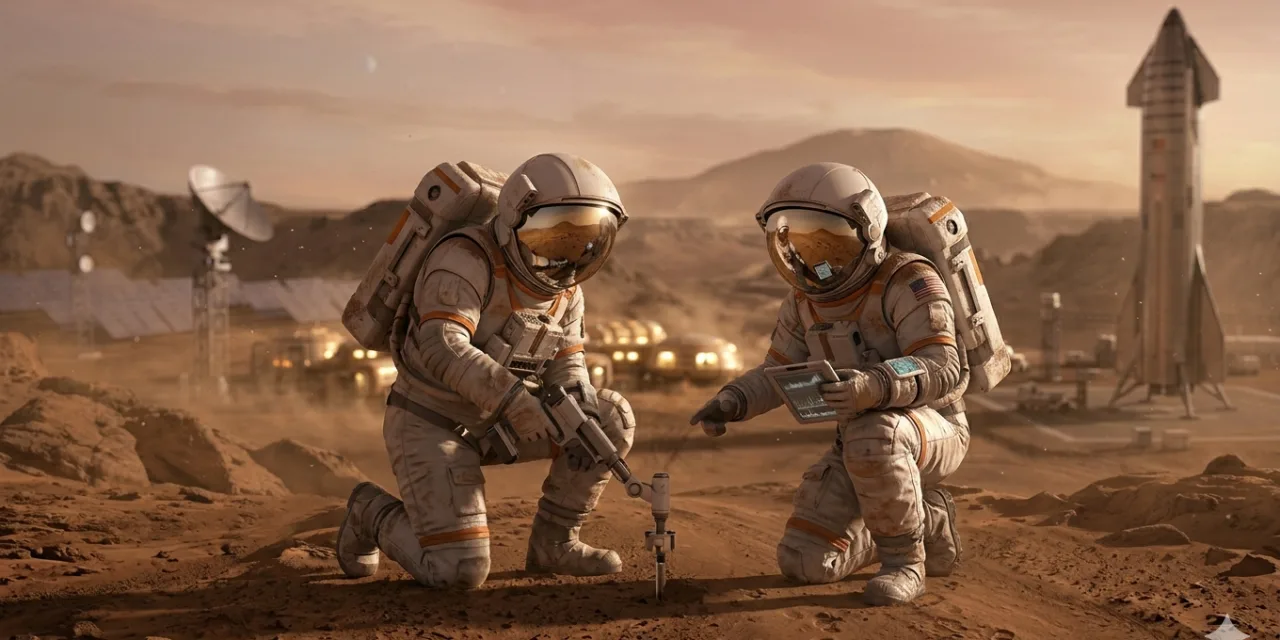
On 9 February 2026, Elon Musk announced that SpaceX was deprioritising its Mars ambitions for “about five to seven years” in order to focus on lunar missions — a significant recalibration from earlier timelines that had anticipated uncrewed Starship flights to Mars as early as the 2026 launch window. The announcement came after a May 2025 presentation in which Musk had given a 50 percent probability of meeting that window, contingent on the successful demonstration of orbital propellant transfer between two Starships in space — a manoeuvre that requires filling Starship’s tank with roughly 1,200 tonnes of cryogenic propellant transferred in batches of 100 tonnes per tanker flight. That demonstration has not yet been accomplished.
The February 2026 delay is, in one sense, a scheduling adjustment. In another sense, it is a useful lens through which to examine the enormous gap between the ambition of Mars colonisation — which Musk describes as insurance for the long-term survival of the human species — and the reality of what it would actually require to put humans on Mars and keep them alive there permanently. Because the question “could humans live on Mars?” is not primarily a question about rockets. Rockets are the most visible part of the challenge and the part that generates the most media attention. But getting to Mars is significantly easier than surviving there. Keeping people alive on a world with no breathable atmosphere, lethal radiation levels, toxic soil, temperatures that can drop to minus 70 degrees Celsius, and no possibility of rapid resupply from Earth is the hard problem — and it is a problem that the scientific and engineering communities have been studying seriously for decades, producing an increasingly detailed picture of both what would be required and how far current technology falls short.
This guide covers the science of Mars colonisation honestly and completely: what Mars is actually like, what the journey does to the human body, the five fundamental survival challenges on the Martian surface, what NASA’s Perseverance rover has already demonstrated about resource production, what the realistic timeline for a first crewed landing looks like, and what “self-sustaining colony” would actually require. The answer to whether humans could live on Mars is yes — the physics permits it, the chemistry works, the resources exist. The answer to whether humans will live on Mars anytime soon is considerably more complicated.
What Mars Is Actually Like: The Environment You Would Arrive In
Popular depictions of Mars — the red, dusty, rocky expanse that rovers have photographed — capture the visual reality of the planet but understate the hostility of its environment for biology. Understanding what Mars is actually like, in precise physical terms, is the starting point for understanding what colonisation requires.
Mars’s atmosphere is thin — approximately 0.6 percent of Earth’s atmospheric pressure at the surface, compared to 100 percent for Earth. It is composed of approximately 95.3 percent carbon dioxide, 2.7 percent nitrogen, and 1.6 percent argon, with trace amounts of oxygen and water vapour. It is entirely unbreathable. The thin atmosphere also provides minimal protection from solar and cosmic radiation — a critical survival issue discussed in detail below. It creates minimal aerodynamic braking during entry from space (making landing heavy payloads technically very challenging), and provides no thermal insulation comparable to Earth’s atmosphere. Wind speeds can be modest in normal conditions but during global dust storms — which occur periodically and can envelop the entire planet for months — winds accelerate to hundreds of kilometres per hour, though the thin air means the actual force they exert is much lower than equivalent wind speeds on Earth.
Surface temperatures are extreme and variable. At the Martian equator in summer, midday temperatures can approach 0 degrees Celsius — briefly and locally tolerable without special equipment. But nights at the equator drop to minus 70 degrees Celsius or colder, and polar regions reach minus 125 degrees Celsius in winter. The daily temperature swing of 70 to 100 degrees Celsius at most latitudes creates severe thermal stress on any surface infrastructure. Habitats, power systems, and equipment must be designed to withstand this cycling indefinitely without failure — a requirement that exceeds the thermal design envelope of most existing space hardware.
Mars’s gravity is approximately 38 percent of Earth’s — less than half. While stronger than the Moon’s gravity (16.5 percent of Earth’s), Martian gravity is still insufficient for normal human physiology. Long-duration studies on the International Space Station demonstrate that extended microgravity causes significant bone density loss, muscle atrophy, cardiovascular changes, and fluid redistribution in the body. Whether 38 percent gravity is sufficient to prevent these effects over multi-year Mars stays — or whether it merely slows them — is unknown, because no human has ever spent extended time in a partial gravity environment comparable to Mars. The ISS data, while invaluable, cannot be directly extrapolated to predict what a two-and-a-half-year Mars mission would do to human physiology.
Martian soil — regolith — is chemically hostile in ways that Earth soil is not. It contains significant concentrations of perchlorates: highly reactive salts at concentrations of approximately 0.5 percent that are toxic to human thyroid function and would prevent direct use of Martian soil for growing food without prior chemical processing. The fine particle size of Martian dust — similar to terrestrial talc — means it would penetrate seals, abrade equipment, and create serious respiratory hazards if it entered habitats. During global dust storms, dust accumulation on solar panels can reduce their power output by 90 percent or more — as the Mars Opportunity rover experienced, ultimately contributing to the end of its mission when it could not generate sufficient power to survive.
The Journey: What Six Months in Space Does to the Human Body
Before any of the surface challenges apply, the crew must survive the journey. A minimum-energy transit from Earth to Mars takes approximately 180 days — six months — during which the astronauts are exposed to the space environment in ways that Earth-bound experience, and even ISS experience, does not replicate.
The radiation environment beyond Earth’s protective magnetosphere is the most dangerous element of the transit. Galactic cosmic rays — high-energy particles originating outside the solar system — bombard the spacecraft continuously at flux levels that no shielding currently envisioned for Starship-class vehicles could completely block. Solar particle events — intense bursts of proton radiation from solar flares and coronal mass ejections — can deliver acute radiation doses within hours. A complete round-trip Mars mission — approximately 180 days in transit each way plus 600 days on the surface during the wait for the next Earth-Mars transfer window — would expose astronauts to approximately 1.01 to 1.1 sieverts of radiation. To put this in context: NASA’s current career radiation limit for astronauts is 1 sievert lifetime for women and slightly higher for men (with limits adjusted for age at exposure). A single Mars mission would consume or exceed a significant fraction of this lifetime limit, meaningfully increasing cancer risk.
Cosmic radiation’s danger goes beyond cancer risk. Heavy ions — helium nuclei, carbon nuclei, iron nuclei — penetrate shielding that stops most other radiation and interact directly with biological tissue, including the central nervous system. Studies on rodents exposed to simulated cosmic ray environments have shown cognitive impairment, increased anxiety, and neurological changes that have no equivalent in the ISS radiation environment (where Earth’s magnetosphere provides substantial protection). Whether these effects translate to human space travellers at Mars-mission radiation doses is not yet known — but the data is concerning enough that radiation protection is considered one of the unsolved fundamental problems of crewed Mars missions.
The transit also imposes six months of microgravity — zero gravity in a free-falling spacecraft. Unlike the 38 percent Martian gravity, in-transit microgravity is the same as ISS conditions, and the ISS data is relevant: bone density loss of approximately 1 to 2 percent per month in load-bearing bones without countermeasures, muscle atrophy requiring two hours of daily exercise to partially mitigate, cardiovascular deconditioning, and immune system changes. Arriving at Mars after six months of this exposure, a crew would need to immediately begin functioning in 38 percent gravity while potentially building and commissioning habitat systems before their Earth-adapted physiology had time to readapt.
Communication delays add a third layer of operational challenge during the transit and throughout the surface mission. At minimum Earth-Mars distance, radio signals take approximately 3 minutes each way. At maximum distance, the round-trip communication delay is 48 minutes. This means that Earth-based mission control cannot participate in real-time decisions — any medical emergency, system failure, or unexpected situation requires the crew to diagnose and resolve it autonomously, without the real-time support that every previous crewed space mission has relied on. Mars missions will require a level of crew medical competence and decision-making autonomy unprecedented in human spaceflight.
The Five Survival Challenges on the Martian Surface
Getting to Mars and surviving the journey is, in many respects, the easier part of the problem. The harder challenges begin when the crew arrives and must sustain themselves on a planet that provides none of the resources humans require in immediately accessible form.
Radiation shielding on the Martian surface is partly but not fully addressed by the atmosphere. Mars’s thin atmosphere and lack of a global magnetosphere mean that the surface radiation environment is approximately 100 times higher than Earth’s — roughly 0.23 millisieverts per day (compared to approximately 0.003 millisieverts per day on Earth’s surface). Over the 600-day surface stay of a round-trip mission, this alone represents approximately 0.14 sieverts of surface exposure, adding to the transit dose. Effective shielding requires either burying habitats beneath several metres of regolith — which provides excellent radiation protection through the simple physics of mass interposition — or building surface habitats with water walls, using the hydrogen content of water as a proton absorber. Subsurface construction requires excavation capability that no Mars surface mission has yet demonstrated at scale. The most practical near-term solution is a hybrid: pressurised surface modules for daytime activity, retreating to subsurface or heavily shielded sleeping quarters for the hours when biological radiation repair mechanisms are most active. Underground habitats also offer thermal stability advantages, with subsurface temperatures remaining relatively constant compared to the dramatic surface temperature cycling.
Atmospheric pressure and breathable air cannot be provided by Mars’s native environment. Habitats must be pressurised to comfortable human levels — approximately 60 to 100 kilopascals of pressure with a breathable oxygen-nitrogen mixture — and maintained at that pressure indefinitely without leaks. Pressure differentials between habitat interior and Mars exterior are substantial: the same differential that makes a puncture catastrophic on the ISS is present on Mars, and any breach in the pressure vessel rapidly becomes life-threatening. Air quality within the habitat must be continuously managed: CO2 produced by crew respiration must be scrubbed, oxygen must be replenished, trace contaminants from equipment, cooking, and biology must be controlled, and humidity must be maintained within comfortable ranges. The International Space Station’s Environmental Control and Life Support System (ECLSS) has developed significant expertise in all of these areas, but ISS operates with Earth as a backup — resupply missions can address consumables, spare parts, and even crew in emergency situations. Mars cannot rely on this backup at any timescale compatible with a survival emergency.
Water is available on Mars in substantial quantities — but not in immediately accessible liquid form. Mars has significant water ice deposits at both polar regions and, more significantly for settlement purposes, in the subsurface at mid-latitudes where temperatures would allow extraction without the extreme cold of the poles. The Perseverance and Curiosity rovers have confirmed water ice in multiple subsurface contexts, and orbital mapping suggests that a 1-metre depth of Martian soil at mid-latitudes contains sufficient water ice to sustain significant human activity if extracted and processed. Drilling and heating regolith to extract water vapour, then condensing and purifying it, is technically feasible — but it requires power (a significant constraint, addressed below), drilling equipment that must function reliably without repair from Earth, and purification systems that must remove the perchlorates and other chemical contaminants present in Martian soil water. A six-person crew requires approximately 11 litres of water per person per day for drinking and hygiene, plus significant additional quantities for food production and industrial processes. The total water requirement for a sustained colony is substantial, and the extraction systems have never been tested in actual Martian conditions.
Food production is the long-term sustainability challenge that most clearly distinguishes a short-duration exploration mission from a colony. Any Mars presence beyond the first few missions must produce food locally — the mass and energy cost of transporting all calories from Earth is prohibitive for sustained operations. Mars has the raw ingredients for agriculture: carbon dioxide, sunlight (though at roughly 43 percent of Earth’s intensity at the Martian surface), and water (if extracted from the subsurface). What it does not have is immediately fertile soil. Martian regolith must be remediated before it can support plant growth: perchlorates must be chemically broken down or biologically processed, microbial communities must be introduced to create biologically active soil, and nutrients must be supplemented. Hydroponics — growing crops in nutrient-enriched water rather than soil — avoids the regolith remediation problem but requires substantial infrastructure: sealed growing chambers with artificial lighting (since the thin atmosphere provides minimal UV protection for plants and Martian sunlight hours may not match optimal growing cycles), water recycling systems, and nutrient management. Caloric productivity per square metre of growing area must be ten times or more what typical Earth agriculture achieves to sustain a colony within a feasible physical footprint. No closed-loop agricultural system of the required performance has yet been demonstrated anywhere — Biosphere 2, the 1991-1993 Earth-based experimental closed ecological system, struggled to maintain adequate food production despite operating at full Earth atmospheric pressure and under ideal conditions.
Power generation is the resource that enables everything else — habitat pressurisation, water extraction, food production, manufacturing, communication, and life support are all power-hungry processes. Mars has two candidate power sources: solar and nuclear. Solar power on Mars is viable but challenged: Mars receives approximately 43 percent of Earth’s solar irradiance at the surface, and during global dust storms, insolation can drop to near zero for weeks to months. Any solar-dependent colony would require months of energy storage to survive dust storms — a storage requirement that adds enormous mass and complexity. Nuclear power — specifically compact fission reactors based on technologies like NASA’s Kilopower project — provides a steady, weather-independent power supply that is unaffected by dust storms and does not require large surface area. A 10-kilowatt Kilopower-class reactor has been successfully demonstrated in ground testing. Scaling to the power requirements of a sustained colony — which would be in the hundreds of kilowatts to megawatts range — is an engineering challenge that hasn’t yet been solved, but the physics is straightforward and the path is clearer than for some other Mars challenges.
The MOXIE Breakthrough: Proving Oxygen Can Be Made on Mars
NASA’s Perseverance rover carried an instrument that may represent the single most practically significant technology demonstration in the history of Mars exploration: MOXIE — the Mars Oxygen In-Situ Resource Utilisation Experiment. MOXIE produced oxygen from the Martian atmosphere through a process called solid oxide electrolysis, splitting carbon dioxide molecules into carbon monoxide and oxygen. In operational tests across multiple Martian seasons and conditions, MOXIE successfully produced oxygen at rates and purities that demonstrated the fundamental chemistry is viable in actual Martian atmospheric conditions.
The significance of this demonstration cannot be overstated. A crew of six on Mars for 600 days would require approximately one tonne of oxygen just for breathing. The methane propellant for a Mars ascent vehicle’s return flight to Earth requires approximately 31 tonnes of liquid oxygen as an oxidiser. The total oxygen requirement for even a small-scale early crewed mission is measured in tens of tonnes — quantities that would require either launching from Earth at prohibitive mass and cost, or producing locally. MOXIE proved that local production works in Martian conditions. What it did not demonstrate — and what represents one of the field’s major remaining challenges — is scaling. The MOXIE experiment operated at approximately 6 to 10 grams of oxygen per hour. A full-scale system capable of producing the 31 tonnes of liquid oxygen needed for ascent fuel would need to operate at roughly 2 kilograms per hour for 26 months continuously — a factor of roughly 200 times larger and at liquid rather than gaseous form. The scaling challenge is engineering, not physics — but engineering challenges on Mars, where repair and resupply from Earth take years, are qualitatively different from engineering challenges on Earth.
The SpaceX Timeline: Ambition, Delays, and What the Science Says
Elon Musk’s Mars colonisation roadmap has always been characterised by aggressive timelines that have consistently slipped. In 2016, he was discussing crewed Mars missions in the mid-2020s. In 2025, he was targeting uncrewed Starship flights in the 2026 window with a 50 percent confidence estimate. In February 2026, he announced a five-to-seven-year delay. The pattern is consistent enough that it has become a standing joke in the aerospace community — but the underlying serious question is whether the technical barriers are being underestimated, or whether iterative engineering will eventually close the gap.
A 2024 feasibility study published in the journal Nature was direct in its assessment: a crewed Mars mission using the Starship architecture as currently designed is not feasible, primarily because the mass model required for a return mission exceeds what Starship can deliver even with the planned orbital refuelling scheme. The study identified several fundamental engineering gaps — most critically the power supply for in-situ resource utilisation on the Martian surface, and the mass constraints imposed by the requirement to carry the return fuel or produce it locally. The study recommended stronger international collaboration to distribute the technology development burden and improve feasibility.
The orbital refuelling challenge is the most immediate technical barrier for Starship-based Mars missions. Starship requires approximately 1,200 tonnes of propellant to reach Mars, but can carry only about 100-150 tonnes of propellant per Earth launch — requiring 8-12 tanker flights to refuel a single Mars-bound Starship in Earth orbit. Coordinating this many flights before the fuel evaporates through boil-off losses, while maintaining precise orbital rendezvous for each transfer, is an unprecedented logistical challenge. SpaceX has transferred small amounts of propellant between internal Starship tanks in ground testing and planned a full-scale two-vehicle transfer demonstration in 2026 — as of the February delay announcement, the schedule for this demonstration is unclear.
ScienceInsights’s 2026 realistic timeline assessment concludes that SpaceX could land humans on Mars by the early 2030s if Starship development stays roughly on track — but that these would be exploration missions, not colonies. A permanent, self-sustaining settlement — one where people could survive without continuous resupply from Earth — requires all five survival challenges described above to be solved simultaneously at operational scale, plus a legal framework for governance and property rights on another world. No optimistic projection from any credible source places a self-sustaining Mars colony before the 2050s; conservative assessments suggest the 2060s or later.
China’s Mars Programme: A Different Approach
SpaceX is not the only organisation with Mars ambitions. China’s space programme has outlined a methodical, multi-decade approach to Mars exploration that builds incrementally from robotic missions through crewed orbit to eventual surface landing. China’s Tianwen-1 mission successfully delivered the Zhurong rover to the Martian surface in 2021 — making China only the second nation after the United States to successfully operate a rover on Mars. Chinese space officials have described plans for a crewed orbital Mars mission before 2050, with a crewed landing later in the 2040s or 2050s depending on technology development progress.
The Chinese approach — orbit first, then land, then build — is more conservative than SpaceX’s and is more consistent with the incremental technology development that Mars’s challenges require. Where SpaceX’s approach involves launching a large, complex system and testing it against Mars’s actual conditions iteratively, China’s roadmap builds verified capabilities in sequence, reducing the risk of catastrophic failure on any single critical mission. Both approaches have legitimate arguments in their favour, and both are encountering the same physical barriers: radiation, propulsion mass, ISRU scaling, and closed-loop life support.
The Psychological Challenge: What Living on Mars Would Do to the Mind
The physical challenges of Mars colonisation are well-studied and have at least theoretical solutions. The psychological and cognitive challenges receive less attention but are, in the assessment of many mission planners, the most likely cause of mission failure in practice.
The combination of extreme isolation (the closest humans would be hundreds of millions of kilometres away), communication delays making real-time conversation with Earth impossible, confinement in small pressurised volumes, the absence of natural environments, constant awareness of the environmental hazards surrounding the habitat, and the knowledge that any significant system failure could be fatal creates a psychological environment that has no precedent in human experience. Mars analogue studies — including NASA’s Hawaii Space Exploration Analog and Simulation (HI-SEAS) programme, which confined crews in isolated habitats on Mauna Loa for simulated Mars-mission durations — have documented significant psychological stress, interpersonal conflict, sleep disruption, and cognitive performance degradation under these conditions even without the actual danger of the Martian environment. Biosphere 2’s food shortages added nutritional stress on top of psychological stress, producing conflicts and cohesion breakdown that illustrate how quickly psychological resilience can be overwhelmed by resource scarcity.
Cognitive effects of radiation exposure add a biological dimension to the psychological challenge. Studies on rodents exposed to simulated cosmic ray environments at Mars-relevant doses have shown measurable changes in brain structure and cognitive function — increased anxiety, reduced performance on learning and memory tasks, and inflammation in the central nervous system. The Scott Kelly twin study, which compared the physiology and gene expression of astronaut Scott Kelly after a year on the ISS with his Earth-based twin Mark Kelly, documented significant gene expression changes including in genes associated with cognitive function, immune response, and telomere length. The Mars mission radiation environment is substantially harsher than the ISS environment, and the cognitive consequences of 18 months of cosmic ray exposure (six months in transit each way plus surface exposure) remain poorly characterised.
Why We Are Going Anyway: The Case for Mars
Given the extraordinary difficulty of the task, the honesty of the challenge, and the certainty of delays relative to any timeline announced today, it is worth stating clearly why Mars colonisation is nonetheless being seriously pursued by both public space agencies and private ventures — because the case is genuinely compelling even when stripped of hype.
The most fundamental argument is species survival. Earth faces existential risks — asteroid impact, pandemic, nuclear war, climate catastrophe — none of which are individually probable on any given century’s timescale but which collectively represent a finite probability of civilisational or species-level catastrophe over geological time. A self-sustaining Mars colony would represent a backup civilisation: a second copy of humanity that could survive events that destroyed Earth’s population. Musk has described this explicitly as the primary motivation for SpaceX’s Mars programme, and even critics of his specific approach tend to accept the underlying logic.
The scientific case is equally strong. Mars is the most Earth-like planet in the solar system with the possible exception of early Venus, and its geological history — including a past when it had liquid water, a thicker atmosphere, and possibly conditions hospitable to life — makes it the most scientifically productive planetary destination available for sustained human presence. Robotic missions have been extraordinarily valuable, but there are fundamental limitations to what remote-controlled instruments can accomplish on the Martian surface. Human scientists with the ability to traverse kilometres per day, make real-time observational decisions, use hand tools and field judgement, and drill at geologically selected sites would transform the pace and scope of Mars science in ways that no foreseeable robotic programme can match.
And then there is the human dimension that is harder to quantify but no less real: the drive to explore, to push the boundaries of where our species has been, to face an extreme challenge and solve it through ingenuity and courage. The generation that puts humans on Mars — whoever they are, whichever nation or company gets there first — will accomplish something comparable to the first humans to cross an ocean or stand on the Moon: a moment that expands what is understood as possible. The challenges are extraordinary. The timeline is uncertain. The history of ambitious space programmes suggests that delays will continue to accumulate. But the physics permits it, the engineering path is visible even if it is long, and the reasons to try are as compelling as any that humanity has ever acted on.


0 Comments
No comments yet. Be the first to share your thoughts!