
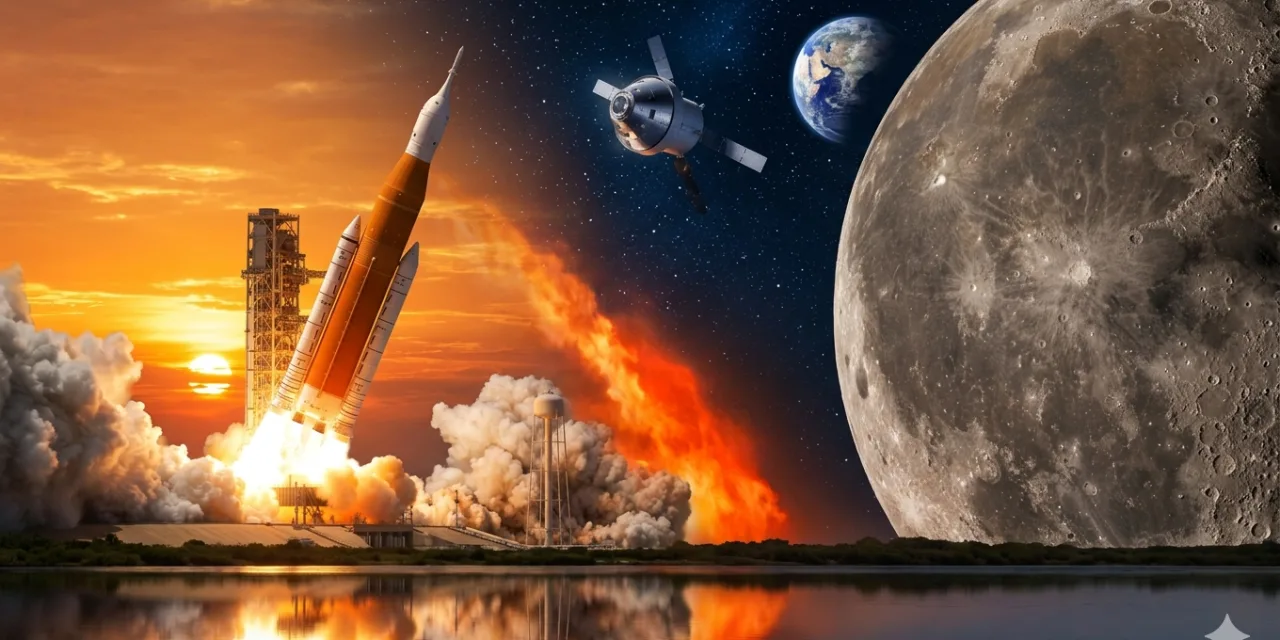
At 6:35 p.m. Eastern time on April 1, 2026, NASA’s Space Launch System rocket lifted off from Launch Pad 39B at Kennedy Space Center carrying four astronauts toward the Moon for the first time in 53 years. Commander Reid Wiseman, Pilot Victor Glover, and Mission Specialists Christina Koch and Canadian Space Agency astronaut Jeremy Hansen rode Orion — the spacecraft the crew named Integrity — away from Earth on 8.8 million pounds of thrust in what was, by any measure, one of the most significant moments in the history of human spaceflight. Nine days later, on April 10, the Orion spacecraft splashed down at 5:07 p.m. PDT in the Pacific Ocean off the coast of San Diego, completing a 694,481-mile journey that broke a record that had stood for 56 years. The crew reached a maximum distance of 252,756 miles from Earth — surpassing the Apollo 13 distance record of 248,655 miles, set in 1970, by more than 4,000 miles.
Artemis II was not a Moon landing. The crew did not step onto the lunar surface. But it was the most important step toward that landing since Apollo 17 ended human lunar exploration in December 1972, and it accomplished something that the last half-century of robotic missions, commercial launches, and international space station operations could not: it proved that the hardware, the team, and the institutional capability to send humans to the Moon and return them safely to Earth are operational and ready to support the missions that follow. Artemis III, which aims to return humans to the lunar surface — including the first woman and the first person of colour to walk on the Moon — is now targeted for 2027, with the first sustained lunar landing programme targeting early 2028.
This is the complete story of the Artemis programme: what it is, why it matters, what Artemis II achieved, how the broader mission architecture works, who is going, where they are going, and what comes after the Moon.
Why Go Back to the Moon? The Case for Artemis
The Apollo programme demonstrated that humans could reach the Moon. What it did not have time to establish — before the programme was cancelled after six successful landings and the near-tragedy of Apollo 13 — was a sustainable, permanent human presence in deep space. Artemis is fundamentally different from Apollo not just in its technical architecture but in its strategic objectives. Apollo was a sprint, driven by Cold War geopolitical competition, with the singular goal of reaching the Moon before the Soviet Union. Artemis is designed to be the beginning of a permanent expansion of human activity beyond low Earth orbit.
The scientific case for returning to the Moon in 2026 is substantially stronger than it was in the Apollo era, because we know vastly more about what is there. The confirmation in 2009 of water ice deposits in permanently shadowed craters near the lunar south pole — the region where Artemis landing missions are targeted — transformed the Moon from a scientifically interesting but relatively barren destination into a potentially resource-rich one. Water ice can be broken into hydrogen and oxygen, providing both breathable air and rocket propellant, which means the Moon could eventually serve as a refuelling depot for deeper space missions rather than being an endpoint that missions carry all their fuel to reach. Understanding the exact nature, extent, and accessibility of these ice deposits is one of the primary scientific objectives of the Artemis programme’s surface missions.
The Moon is also a scientifically extraordinary destination in its own right. Its surface preserves billions of years of solar system history — impact records, ancient volcanic activity, and the preserved signatures of early solar conditions that have been erased on Earth by plate tectonics, erosion, and the activity of life. The lunar south pole region, which has never been visited by any crewed mission, contains some of the oldest and least-disturbed geology in the inner solar system. The science that human explorers with field geology training can accomplish in hours exceeds what robotic missions can achieve in months.
Beyond science, Artemis serves the longer-term strategic objective of developing the technologies, operational experience, and human adaptation data required for eventual crewed missions to Mars. The Moon is a proving ground: close enough to Earth that missions can be aborted and crews recovered in days rather than the six to nine months a Mars transit would require, but far enough to genuinely test the deep space systems — radiation protection, life support for extended periods, communication over deep space distances, in-situ resource utilisation — that Mars missions will depend on. Going to the Moon is not a detour from Mars. In NASA’s framework, it is the necessary predecessor to it.
Artemis II: What Just Happened
The Artemis II mission that concluded on April 10, 2026, was a crewed free-return trajectory around the Moon — a figure-eight path that uses the Moon’s gravity to slingshot the spacecraft back toward Earth without requiring a burn to enter or exit lunar orbit. This trajectory choice was deliberate: Artemis II was a test flight, and the free-return path meant that even if the spacecraft’s propulsion system failed completely after the translunar injection burn, the laws of orbital mechanics would return the crew to Earth safely without requiring any additional propulsion. The priority was validating Orion’s systems with humans aboard, not maximising time near the Moon.
The mission accomplished its primary objectives comprehensively. With astronauts aboard for the first time, NASA engineers put Orion through a full in-flight evaluation that had not been possible during Artemis I’s uncrewed 2022 mission. The crew tested Orion’s life support systems in the deep space radiation environment — confirming the spacecraft can sustain humans in conditions beyond Earth’s magnetic field. Pilot Victor Glover and the crew conducted manual piloting demonstrations, taking direct control of Orion to validate its handling characteristics and collect data for future rendezvous and docking operations with commercial lunar landers. Emergency equipment and procedures, the Orion crew survival system spacesuits, and critical spacecraft systems were all evaluated in the environment they will actually be used.
During their April 6 lunar flyby, the crew — who named their spacecraft Integrity — photographed more than 7,000 images of the lunar surface from a vantage point no human had occupied in over half a century. Victor Glover’s words during the flyby captured the emotional weight of the moment: “There are stars… An unreal view… The Moon in the foreground is one of the darkest things we see out the window. And now, deep space behind it is kind of dark blue, like it looks from Earth, but we can also still see stars.” The imagery captured during the flyby includes earthset and earthrise photographs, impact craters, ancient lava flows, surface fractures, and views of the terminator — the boundary between lunar day and night — where low-angle sunlight creates the illumination conditions similar to those at the lunar south pole where future landers will set down.
The crew’s final distance record was confirmed after the translunar injection burn: 252,756 miles from Earth at their farthest point, surpassing Apollo 13’s record by over 4,000 miles. Commander Reid Wiseman’s words as the crew completed their translunar injection burn conveyed what the mission represented: “Sending four humans 250 thousand miles away is a herculean effort, and we are now just realising the gravity of that.” On April 10, after nearly ten days in deep space, Orion re-entered Earth’s atmosphere at 25,000 miles per hour and splashed down safely in the Pacific Ocean. The Artemis programme had its first human crew back on Earth, having demonstrated everything the programme needed to proceed to landing.
The Hardware: SLS, Orion, and the European Service Module
Understanding what makes the Artemis architecture work requires understanding its three primary components — the Space Launch System rocket that lifts everything off Earth, the Orion spacecraft that carries and sustains the crew, and the European Service Module that powers and propels Orion.
The Space Launch System is NASA’s heavy-lift rocket — the most powerful rocket ever flown, with 8.8 million pounds of thrust at liftoff that exceeds even the Saturn V rockets that powered the Apollo programme. SLS is the only rocket in the world currently capable of sending Orion, its crew, and the supplies needed for a lunar mission directly to the Moon in a single launch — a capability that no commercial rocket currently matches, though SpaceX’s Starship is designed with comparable capability in mind for future missions. The SLS rocket used for Artemis II is the Block 1 configuration, the baseline version. A more powerful Block 1B variant with an upgraded upper stage is planned for later Artemis missions to support the crew and cargo requirements of sustained lunar surface operations.
The Orion spacecraft is NASA’s deep space crew vehicle — designed from the ground up for the radiation environment, communication delays, and operational requirements of deep space missions rather than for the relatively benign low Earth orbit environment of the Space Shuttle and ISS. Orion’s crew module can support up to six astronauts for short-duration missions and four astronauts for the extended mission durations required for lunar surface operations. Its design incorporates radiation shielding, an advanced life support system, and an emergency launch abort system that can pull the crew to safety even in the first seconds of a launch anomaly. Orion’s heat shield — which protects the crew module during re-entry at the 25,000 mph speeds of a return from deep space — was a focus of significant engineering attention ahead of Artemis II, following anomalies observed during Artemis I’s re-entry. NASA completed additional analysis and testing and confirmed the heat shield design was safe for crewed flight, with design changes addressing identified issues planned for Artemis III.
The European Service Module, built by the European Space Agency using heritage from the ATV cargo vehicle that supplied the International Space Station, provides Orion with power (via four solar array wings that extend to a 63-foot wingspan), water and oxygen, thermal control, and the propulsion for mid-course corrections and trans-Earth injection. The ESA partnership on Orion’s service module — signed in 2013 as a cost-sharing arrangement — has provided NASA with a flight-proven propulsion system at significantly lower development cost than a fully in-house design, and has given ESA access to deep space exploration hardware and operational experience.
The Crew: Who Are the Artemis II Astronauts?
The four astronauts who flew Artemis II represent the specific combination of experience, background, and capability that NASA selected for the mission’s test flight objectives.
Commander Reid Wiseman is a US Navy test pilot and NASA astronaut who previously flew aboard the International Space Station on Expedition 41. His test pilot background was directly relevant to Artemis II’s piloting demonstration objectives, and as commander he was responsible for crew safety and mission execution decisions throughout the ten-day mission. Wiseman was selected as Artemis II commander in April 2023.
Pilot Victor Glover was the first Black astronaut selected for a crewed Moon mission and the first Black pilot of a spacecraft on a lunar trajectory — a milestone that carried significant historical resonance for a programme that has made crew diversity an explicit element of its mission design. Glover previously flew on the first operational Crew Dragon mission to the International Space Station (Crew-1) and served aboard the station for six months.
Mission Specialist Christina Koch held the record for the longest single spaceflight by a woman (328 days) before Artemis II and brought extensive microgravity operations experience to the mission’s science and systems evaluation objectives. Koch was among the first class of astronauts considered candidates for an Artemis lunar surface mission, making Artemis II direct preparation for a potential future Moon landing assignment.
Mission Specialist Jeremy Hansen is a Canadian Space Agency astronaut and the first Canadian selected for a lunar mission — a selection that fulfils a Canadian contribution to the Artemis programme enabled by Canada’s provision of the Canadarm3 robotic system for the Lunar Gateway space station, now cancelled. Hansen brought military pilot training and a background in space medicine to the mission. His selection as the first non-American on a lunar trajectory mission since the Apollo era was significant for the international character of the Artemis programme.
The Architecture: How Future Artemis Missions Get to the Surface
Artemis II was a flyby with no landing. The missions that follow will place humans on the surface of the Moon for the first time since December 1972, using an architecture that is more complex than Apollo’s — involving commercial lunar landers and, eventually, a lunar space station — but designed to support sustained presence rather than short visits.
Artemis III, targeted for 2027, will be the first crewed lunar landing of the programme. The mission architecture involves the SLS/Orion combination launching the crew toward the Moon as in Artemis II, but this time entering lunar orbit rather than flying a free-return trajectory. In lunar orbit, the crew will transfer from Orion to a commercial Human Landing System — a lunar lander provided by a commercial partner rather than developed in-house by NASA — for the descent to the lunar surface. After their surface activities, the crew returns to lunar orbit in the lander’s ascent stage, docks with Orion, and returns to Earth.
NASA selected SpaceX’s Starship as the Human Landing System for Artemis III in 2021, and Blue Origin’s Blue Moon lander was selected for subsequent missions in 2023. A 2027 demonstration mission in low Earth orbit will test one or both commercial landers ahead of Artemis III’s crewed lunar surface operations. The first Artemis lunar landing is now targeted for early 2028 — a date that NASA has maintained consistently since mid-2025 and that the successful completion of Artemis II substantially supports.
The Lunar Gateway — a small space station planned for lunar orbit that would have served as a staging point for surface missions and a platform for scientific research — was cancelled in March 2026 as a cost-reduction measure, with the decision reflecting a prioritisation of the crewed surface missions that are Artemis’s primary objective over the infrastructure station whose primary value was for later, more sustained operations. The cancellation does not affect Artemis III’s architecture, which does not require the Gateway.
The Artemis South Pole Targets: Where Humans Will Land
Every Apollo landing was in the lunar equatorial region — the approach that minimised fuel requirements and simplified mission geometry for the first-generation lunar missions of the 1960s and 1970s. Artemis landing missions are targeted for the lunar south pole region, a choice driven by the scientific and resource priorities of the modern programme.
The lunar south pole contains permanently shadowed craters — crater floors that have not received direct sunlight in billions of years because of the Moon’s minimal axial tilt. These permanently shadowed regions maintain temperatures as low as negative 250 degrees Celsius, cold enough to trap and preserve volatile compounds — including water ice — that would sublimate and escape if exposed to direct sunlight. The confirmed presence of water ice in these regions, demonstrated by multiple orbital and surface instruments, makes the south pole the most scientifically and commercially valuable area of the Moon for long-duration human operations.
NASA has identified thirteen candidate landing sites within six degrees of the south pole for Artemis III, each selected for proximity to permanently shadowed regions containing confirmed ice deposits, terrain accessibility for the lunar lander, adequate sunlight for solar power during surface operations, and scientific interest. The imagery and terrain data collected by the Artemis II crew during their April 6 flyby — specifically including documentation of surface conditions and illumination at the terminator in the south pole region — directly contributes to the final landing site selection process for Artemis III.
The International Dimension: Who Is Building Artemis Together
Unlike Apollo, which was a US national programme competing against Soviet space capability, Artemis is an explicitly international programme built around the Artemis Accords — a set of bilateral agreements between the United States and partner nations that establish norms for responsible space exploration, including transparency of operations, interoperability of systems, registration of space objects, and the peaceful use of the Moon’s resources. As of April 2026, over 40 nations have signed the Artemis Accords, representing the largest multinational framework for lunar exploration in history.
ESA’s contribution of the Orion Service Module is the most significant hardware partnership, but the Artemis programme involves contributions from partner agencies across multiple mission elements: the Canadian Space Agency’s Canadarm3 (originally planned for the Lunar Gateway, now being redesigned for surface and orbital applications following the Gateway cancellation), JAXA’s contributions to deep space human factors research, and contributions from commercial companies in multiple countries to the broader Artemis ecosystem. The presence of Canadian astronaut Jeremy Hansen on Artemis II is the most visible expression of this international character — the first time a non-American has flown on a crewed mission to the Moon.
After the Moon: Artemis as the Path to Mars
NASA’s official framing of the Artemis programme positions the Moon not as the final destination but as the necessary predecessor to human missions to Mars — the proving ground where the technologies, operational protocols, and human physiological data needed for interplanetary transit can be developed and validated in a location where the consequences of failure are recoverable in days rather than months.
The technologies that Artemis surface missions will test and develop — in-situ resource utilisation (extracting usable materials, including water for rocket propellant, from the lunar environment), closed-loop life support for long-duration surface habitation, surface mobility systems, communication and navigation architectures for operations beyond Earth’s magnetic field, and radiation medicine protocols for crews spending extended time in the deep space radiation environment — are exactly the technologies that a Mars mission will require, in more demanding forms, for a mission that cannot rely on Earth resupply within days.
The human data that Artemis missions will generate is equally valuable. The AVATAR investigation carried on Artemis II studies how human tissue responds to the deep space radiation environment — data that has not been available from the International Space Station, which orbits within Earth’s protective magnetic field. Understanding the biological effects of the galactic cosmic ray and solar particle radiation environment that exists beyond Earth’s magnetosphere is essential for setting safe exposure limits and developing countermeasures for crewed Mars missions, which will expose their crews to this environment for years rather than weeks.
Artemis II accomplished something that goes beyond its technical objectives. It demonstrated, in the most concrete way possible, that the programme built to return humanity to the Moon and carry human presence beyond it is real, operational, and working. Fifty-three years after humanity left the Moon, four people made the journey to its vicinity and came back safely. When Victor Glover looked at Earth from 250,000 miles away and described a species that accomplishes great things when it brings its differences together, he was describing not just the crew of Integrity but the programme that put them there — and the broader human aspiration that has always made space exploration something more than a technical achievement. The Moon is waiting. The next crew to get there will actually land.




0 Comments
No comments yet. Be the first to share your thoughts!