
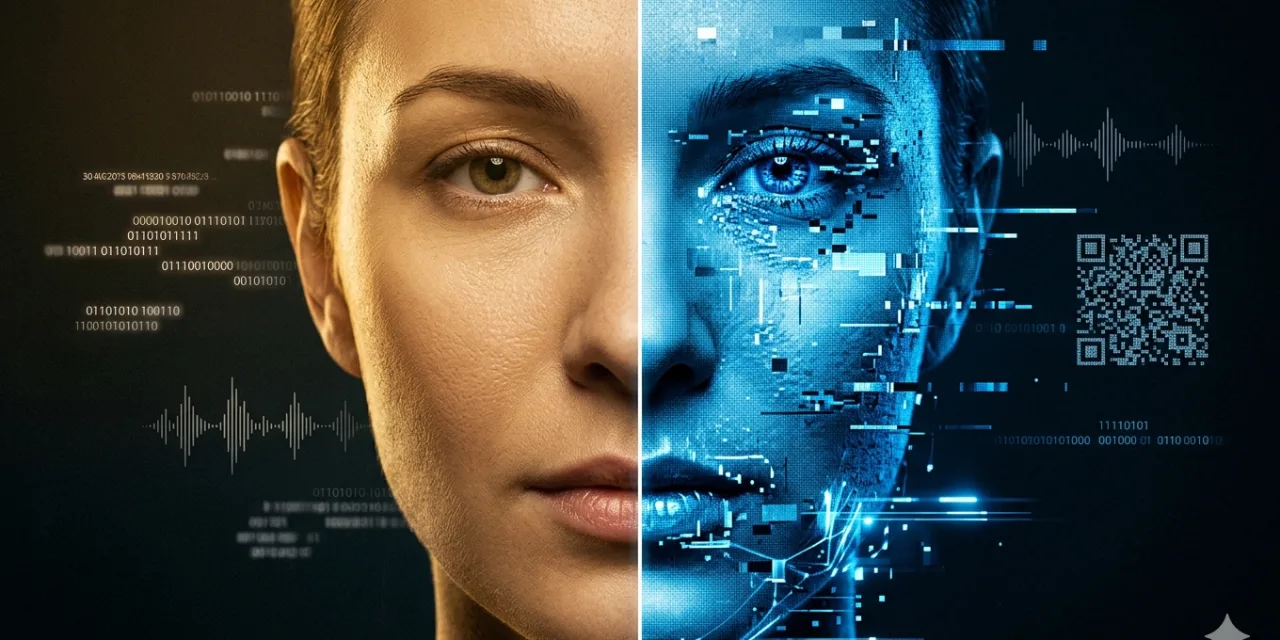
In February 2024, a finance worker at Arup — one of the world’s most respected global engineering firms — joined a video conference call with who he believed to be the company’s Chief Financial Officer and several senior colleagues. The CFO explained an urgent financial transaction that needed to be completed that day. The colleagues confirmed it. The worker transferred $25 million to accounts controlled by fraudsters. None of the people on that call were real. Every face, every voice, every participant was a deepfake — an AI-generated replica constructed from publicly available footage and audio of the actual executives, rendered convincingly enough in real time to deceive an experienced finance professional under entirely normal working conditions.
That attack is no longer an extraordinary edge case. It is an early and well-documented example of what has become a mainstream, rapidly growing category of financial fraud. Deepfake video scams surged 700 percent in 2025, with Gen Threat Labs detecting 159,378 unique deepfake scam instances in Q4 2025 alone. Instances of deepfake fraud overall surged by 3,000 percent in 2024 as powerful AI generation tools became freely available. A deepfake attempt occurred every five minutes in 2024 — and that frequency has continued to accelerate into 2026. Global financial losses attributed to AI-enabled fraud are projected to reach $40 billion by 2027, up from approximately $12 billion in 2023.
The technology enabling these attacks has crossed a threshold that makes traditional detection approaches obsolete. Voice cloning tools require as little as three seconds of audio to create a voice clone with 85 percent accuracy — audio trivially available from LinkedIn videos, YouTube content, corporate webinars, and podcast appearances. As Fortune reported in December 2025, voice cloning has crossed the “indistinguishable threshold,” meaning human listeners can no longer reliably distinguish cloned voices from authentic ones in controlled conditions. Deepfake video has evolved from the flickering, uncanny-valley artefacts that earlier detection methods relied on to real-time interactive avatars that maintain temporal consistency across a live conversation. 68 percent of deepfakes are now nearly indistinguishable from genuine media. A 2025 iProov study found that only 0.1 percent of participants correctly identified all fake and real media shown to them.
This guide explains how deepfake scams work in 2026 — the full technical attack chain, the specific fraud types, the real cases with real numbers, the detection signals that remain valid despite the technology’s improvement, and the procedural defences that genuinely reduce risk. Because the primary lesson of the deepfake era is this: the defences that reliably work are not primarily technological. They are procedural.
What Deepfakes Are and How They Work
A deepfake is AI-generated or AI-manipulated media — video, audio, or image — that depicts a real person saying or doing something they never actually said or did. The term combines “deep learning” (the underlying AI technique) with “fake” (the nature of the output). While the word implies technical complexity and Hollywood-grade production, the reality of deepfake creation in 2026 is that it requires no technical expertise, minimal time, and in many cases zero cost.
For video and image deepfakes, Generative Adversarial Networks (GANs) and newer diffusion model architectures train on examples of the target individual’s appearance — face, expressions, skin texture, lighting response — and learn to generate new images and video of that person in novel contexts. Face-swapping tools overlay a target’s face onto existing video footage. Avatar generation systems create fully synthetic video of a target speaking words they never spoke, with lip movements, facial expressions, and head movements generated to match synthesised audio. For voice deepfakes, cloning models train on short samples of the target’s voice — as little as three seconds is sufficient for current commercial tools — and generate new speech in that voice from any input text.
The 2024 International AI Safety Report found that the tools powering these attacks are free, require no technical expertise, and can be used anonymously. The Biden robocall that attempted to suppress voter turnout in New Hampshire’s 2024 primary election cost $1 to create and took less than 20 minutes to produce and deploy. In 2026, agentic AI systems can handle entire scam workflows autonomously — from data scraping and target profiling to real-time voice conversation and fund transfer coordination — without a human attacker present after the initial setup. The industrialisation of deepfake fraud mirrors the industrialisation of ransomware through RaaS: professional infrastructure, low skill requirements, scalable volume.
Multimodal deepfake attacks — coordinating video, audio, and supporting phishing simultaneously — represent the current leading edge. The Arup attack combined deepfake video of multiple senior executives with synthesised voice audio, across a live video conference platform, preceded by preparatory emails establishing the meeting context. Each layer of the attack reinforced the authenticity of the next. The email established the meeting was legitimate; the video call confirmed the participants were real; the voices confirmed the instructions were genuine. No single layer was individually conclusive — together, they produced a compounding illusion that a careful, experienced professional could not identify as fraud.
The Six Major Deepfake Scam Types in 2026
Deepfake fraud has diversified significantly beyond its early focus on celebrity impersonation and political disinformation. The financially motivated attacks of 2026 target specific scenarios where trust in identity is the basis for a consequential action — most commonly a financial transfer, credential disclosure, or access grant.
Executive impersonation and Business Email Compromise (BEC) is the highest-value category. Attackers clone the voice or video likeness of a company’s CEO, CFO, or senior executive and use it to instruct employees — typically in finance, accounts payable, or IT — to take urgent, confidential action. The instruction is almost always time-pressured: a wire transfer that must complete before close of business, a password reset needed immediately for a board call, a system access grant required before the executive’s flight departs. 25.9 percent of executives reported their organisations experienced one or more deepfake incidents targeting financial and accounting data in the prior 12 months. 53 percent of financial professionals had experienced attempted deepfake scams. The FBI records over $2.9 billion in annual BEC losses broadly — deepfake-enabled variants are the most sophisticated and hardest to detect subset of this category.
Voice cloning vishing (voice phishing) targets individuals and organisations through phone calls presenting a cloned voice of a trusted person — a family member in distress, a bank representative, a government official, an employer. AI voice cloning attacks exceed 1,000 scam calls per day at major retail and financial institutions. Of victims targeted by voice clones who confirmed financial loss, 77 percent lost money — the highest success rate of any Social Engineering attack type. The family emergency variant exploits a deeply human reflex: 40 percent of people reported they would take action to help if they received a voicemail from their spouse claiming to need assistance, according to McAfee research. This emotional override — the instinct to help a person you recognise — activates before rational evaluation of the call’s legitimacy can occur.
Identity verification bypass attacks the digital onboarding processes of financial services — the remote KYC and identity verification systems that banks, exchanges, and fintech platforms use to confirm a new customer is who they claim to be. These systems typically require a live video showing the applicant holding a government ID and performing a liveness check. Deepfake tools generate convincing synthetic video that passes liveness checks while presenting a fraudulent or synthetic identity. Deepfake attacks bypassing biometric authentication increased by 704 percent in 2023. Gartner predicts that by 2026, 30 percent of enterprises will no longer consider standalone identity verification and authentication reliable in isolation — a finding that reflects the current operational reality for financial services identity teams.
Celebrity deepfakes and investment scams exploit the trust and influence of public figures to promote fraudulent products, non-existent investments, and cryptocurrency scams. Deepfake videos of Elon Musk, Warren Buffett, and other prominent figures have been used extensively to promote fraudulent investment schemes on social media. The deepfake Taylor Swift Le Creuset cookware advertisements that appeared on Facebook represent the consumer-level version of a threat with much more serious manifestations in investment fraud contexts. The cryptocurrency sector accounted for 88 percent of all detected deepfake fraud cases in 2023, reflecting the combination of high transaction values, irreversibility of transfers, and the prevalence of celebrity association with crypto.
Romance scam deepfakes weaponise emotional connection as the primary attack vector. Scammers create convincing fake personas on dating platforms using AI-generated profile photos, deepfake video during calls, and cloned voices in messages — building apparent romantic relationships over weeks or months before requesting financial assistance. A Hong Kong deepfake romance scam network lured victims into giving more than $46 million to a coordinated group of fraudsters. The use of video calls specifically targets the most common protective advice given to online romance scam victims — “always ask to video call to verify they are real” — rendering that advice ineffective against anyone deploying real-time deepfake video.
Synthetic identity fraud combines genuine identifying information (a real Social Security or national ID number) with AI-generated fabricated details — a fake name, AI-generated face photograph, manufactured credit or identity history — to create entirely synthetic identities for financial account opening, loan applications, and government document acquisition. Deepfake-as-a-Service platforms offer synthetic identity packages as a commodity — AI-generated photos, supporting documents, and liveness-check-passing video — accessible to any fraudster seeking to onboard fake identities to financial platforms at scale.
Why Human Detection Is Failing
The reflexive response to deepfake fraud awareness is to train people to spot fakes. This is the right instinct, applied to an increasingly difficult problem. Understanding the limits of human detection capability is as important as understanding the signals that remain useful.
Around 60 percent of people believe they could successfully spot a deepfake video. Actual performance data tells a different story. Human accuracy in identifying deepfake images in controlled studies is 62 percent — meaning roughly four in ten deepfakes fool the average person even when they are specifically trying to detect them. A University of Florida study found participants claimed a 73 percent accuracy rate in identifying audio deepfakes but were consistently fooled in practice. Only 0.1 percent of participants in iProov’s 2025 study correctly identified all fake and real media shown to them. The effectiveness of dedicated detection tools drops by 45 to 50 percent when deployed against real-world deepfakes outside controlled laboratory conditions.
The attacks are also deliberately designed to suppress the psychological conditions under which detection is possible. The Arup finance worker was not trying to spot a deepfake — he was participating in what appeared to be a routine business meeting. The Social Engineering layers — urgency, authority, familiarity, confidentiality — create a psychological environment in which analytical scepticism is suppressed and action is motivated by compliance with apparent authority. The deepfake provides sensory confirmation that the person is real; the social engineering provides the framing that makes verification feel unnecessary or even disrespectful. Together, they exploit the gap between how human trust actually works and how we assume it should work under threat conditions.
Detection Signals That Still Work in 2026
Despite rapid quality improvement, specific detection signals remain useful — not as definitive proof of fakery, but as triggers for procedural verification. Multiple signals appearing together materially increase the probability that an interaction is synthetic.
In video deepfakes, watch for unnatural blinking patterns — too infrequent, too mechanical, or perfectly rhythmic in ways that reflect model training rather than natural neurology. Examine the boundary between the face and the hairline, ears, and neck: deepfakes frequently show subtle integration inconsistencies where the synthesised face meets real hair or clothing. Look for lighting anomalies — a face lit differently from the ambient environment, or shadows falling inconsistently with the apparent light source. The three-finger test remains a useful heuristic in many cases: asking a video call participant to place three spread fingers across their face can reveal distortion at the face-hand boundary caused by face-swap processing. Ask unexpected, personal questions the real person would answer easily but an attacker who has only scraped public information would not — a specific shared memory, a detail from a private conversation.
In voice deepfakes, listen for “too-perfect” consistency — voice clones often lack the natural breath pauses, micro-hesitations, and subtle tonal variations that characterise authentic speech under emotional or cognitive pressure. Current models frequently stumble on words with unusual pronunciation or names not represented in training data. A caller who cannot correctly pronounce a colleague’s name they should know, or who mispronounces industry terminology they use daily, warrants additional scrutiny. Background audio inconsistencies — a mismatch between the acoustic environment suggested by the audio quality and what the context implies — can indicate a studio-recorded voice clone rather than ambient real-world recording.
Context and pressure signals are often more reliable detection indicators than technical artefacts. Genuine senior executives rarely make direct, personal calls to individual employees to authorise time-sensitive financial transactions while asking for secrecy. Genuine family members in genuine emergencies rarely require immediate, unconventional payment methods. The combination of urgency, authority, and a request that bypasses normal process is the social engineering signature that accompanies deepfake attacks regardless of how convincing the synthetic media is — and it is a signal that does not require any technical detection capability to recognise.
The Defences That Actually Work: Procedures Over Technology
The most important practical insight in deepfake defence is that the reliably effective defences are procedural, not technological. A verification procedure that is independent of the potentially compromised communication channel cannot be defeated by any deepfake — however sophisticated — because it does not rely on the authenticity of the media to confirm identity.
Establish verbal codewords with family members and trusted colleagues. A pre-agreed word or phrase — known only to the two of you, never written down, never transmitted digitally — provides a verification mechanism that a deepfake attacker cannot replicate. Agree in person. Use it in any emergency or unusual financial request. If someone claiming to be your spouse calls in apparent distress and cannot produce the codeword, treat the call as suspicious regardless of how accurate the voice sounds. Multiple consumer protection agencies and cybersecurity firms now recommend this practice explicitly; McAfee has been among the most prominent advocates for family codeword adoption since 2023.
Verify any unusual request out-of-band, always. For any communication — email, video call, voice call, message — that requests a significant financial transaction, credential reset, system access change, or other consequential action: hang up, and call the person back on a number you already have on file. Not a number provided in the suspicious communication. Not a callback to the number that just called you. A number from your existing contacts that you would use in normal circumstances. This step is not paranoid for high-value decisions — it is the exact control the Arup attack was designed to circumvent, and it would have stopped the $25 million transfer entirely if it had been applied.
Implement dual-approval policies for financial transactions above defined thresholds. No single employee should have unilateral authority to execute a significant financial transaction based on a single communication from a single authorised individual, regardless of how senior that individual appears to be. Two-person approval requirements — where the second approver was not part of the original communication that initiated the request — create a verification redundancy that even a sophisticated multimodal deepfake attack targeting one person cannot easily overcome simultaneously across two independent conversations.
Reduce the publicly available voice and video material of high-value targets. Voice cloning quality correlates with training data quantity and quality. Executives, public figures, and high-net-worth individuals who are likely impersonation targets can meaningfully reduce their deepfake attackability by being deliberate about what voice and video content is published publicly. This does not require eliminating public presence — it means considering whether every podcast appearance, conference talk, and social media video is generating training data that benefits attackers, and applying privacy settings to audio and video content where practicable.
Train staff on the social engineering signature, not just the technical artefacts. Security awareness training focused on telling people to look for blurry faces and odd lighting is based on the threat of three years ago. In 2026, training must focus on the social engineering patterns that accompany deepfake attacks — urgency, authority, secrecy, unconventional channels, pressure to bypass normal processes. These patterns are consistent across deepfake attack types and are detectable without any technical deepfake-specific capability. The question “why is this request bypassing our normal verification process?” is more reliably protective than “does this face look slightly artificial?”
Detection Technology: What It Can and Cannot Do
Technological deepfake detection tools have a meaningful supporting role in enterprise defence but should not be treated as primary protection. Tools including Reality Defender, Microsoft Video Authenticator, and iProov’s liveness detection platform analyse content for manipulation signatures invisible to the human eye and can flag suspicious media for human review. Google’s SynthID watermarks AI-generated content at the generation stage, enabling platforms to trace synthetic media — though this only helps when the generating platform participates in the watermarking programme. The UK Government’s 2026 analysis of deepfake detection technology notes that detection providers actively partner with both AI developers and generative AI service providers to stay current — reflecting an arms race structure in which detection capability must continuously adapt to generation advances.
The limitation of these tools is consistent and important: laboratory detection accuracy does not translate directly to real-world attack conditions. Detection tools lose 45 to 50 percent effectiveness against real-world deepfakes outside controlled test environments. Attackers specifically design new generation techniques to evade known detection signatures. And detection tools that are integrated into enterprise workflows can create false confidence — a deepfake that passes automated detection is not confirmed authentic, it is simply undetected. Technological detection should be treated as an additional signal, not as a replacement for procedural controls.
If You Are Targeted: What to Do
If you suspect you have been targeted by a deepfake scam — whether or not you acted on it — the response follows a clear sequence. Stop all further action immediately. Do not transfer additional funds, share additional credentials, or continue engaging with the communication that triggered the suspicion. Preserve all evidence: save emails, call recordings if possible, chat logs, transaction records, and any other artefacts of the interaction. Report the incident to the relevant authorities: in the United States, the FTC at reportfraud.ftc.gov and the FBI’s Internet Crime Complaint Center at ic3.gov. Contact your financial institution immediately if any funds were transferred — the speed of reporting significantly affects recovery probability, though cryptocurrency transactions remain extremely difficult to reverse. Notify your organisation’s security team if the attack was work-related, and follow your incident response plan.
Documenting the specific AI techniques used — deepfake video, cloned voice, AI-generated phishing text — helps law enforcement track patterns, build cases, and develop the intelligence picture of active threat actors that enables eventual prosecution. Individual reports that seem too small to matter contribute to a collective intelligence base that is essential for addressing deepfake fraud at scale.
The Deeper Threat: Truth Decay and the Collapse of Digital Trust
Beyond the direct and measurable financial losses, the deepfake threat creates a systemic consequence that researchers at Vectra AI have described as “truth decay.” As deepfake video, cloned voices, and AI-generated text become indistinguishable from authentic communications at scale, the foundational assumption of digital interaction — that the person you are communicating with is who they appear to be, and that the media you are viewing represents something that actually happened — becomes untenable. Every video call becomes a potential deepfake. Every voice message from an authority figure becomes suspect. Every image shared on social media may be synthetic.
This erosion of digital trust does not affect only fraud victims. It introduces friction and uncertainty into every digital interaction — the friction of verification, the cognitive load of sustained scepticism, the institutional cost of building processes that do not assume channel authenticity. Gartner’s prediction that 30 percent of enterprises will no longer consider standalone identity verification reliable by 2026 describes not a future possibility but a present condition that enterprise Security and identity teams are already managing. The response is not technological fatalism but the deliberate construction of trust infrastructure that does not depend on the authenticity of the communication channel — verification procedures, codewords, multi-person approvals, out-of-band confirmation. None of these are expensive. None require advanced technical capability. All of them work even when the technology fails to detect the fake. In a world where seeing is no longer believing, the defence that works reliably is the one that does not require you to trust what you see.





0 Comments
No comments yet. Be the first to share your thoughts!