

In February 2025, the largest cryptocurrency theft in history was completed without a single line of malicious code exploiting a software vulnerability. The attacker did not crack an encryption key. They did not brute-force a password. They impersonated a trusted open-source software contributor, earned a developer’s confidence over time, and walked through the front door. The Bybit exchange lost $1.5 billion. The vulnerability that was exploited was not in the software. It was in the human being who trusted the wrong person.
In 2026, a finance employee at CarGurus joined what appeared to be a routine verification call. The voice on the other end was convincing, professional, and authoritative. It was also entirely synthetic — an AI-generated clone assembled from publicly available audio of an executive. Twelve and a half million customer records were stolen as a direct result of that single vishing call. The attacker never touched a server. They never needed to.
These are not edge cases or exotic attack scenarios reserved for high-value targets. They are illustrations of a category of threat that now accounts for thirty-six percent of all cybersecurity incidents globally, according to Unit 42’s 2025 Global Incident Response Report. Social engineering — the practice of manipulating people rather than systems to gain unauthorized access or information — is the most common, most damaging, and most rapidly evolving threat category in the 2026 cybersecurity landscape. And the integration of AI into social engineering attack infrastructure has made it genuinely more dangerous than at any previous point in its history.
This article is the complete guide to social engineering in 2026: what it is and why it works so effectively against human psychology, the full taxonomy of attack types with documented 2025-2026 examples of each, the specific ways AI has transformed the threat, the warning signs that identify attacks in progress, and the layered defence framework that reduces organisational vulnerability to the most common initial access vector in modern cybercrime.
Why Social Engineering Works: The Psychology of the Human Hack
Social engineering is not a technology problem. It is a human psychology problem — which is precisely why it is so difficult to solve with technical controls alone and why the organisations that reduce their vulnerability most effectively address both the technical and the human dimensions simultaneously.
The psychological mechanisms that social engineering attacks exploit are not obscure personality defects or unusual cognitive failures. They are the normal, functional features of human social cognition that allow people to operate effectively in complex social environments. Attackers exploit these features — trust, reciprocity, authority, urgency, fear, and social proof — because they are the features that evolution and culture have built into human decision-making for good reasons. The same cognitive shortcuts that allow you to navigate social environments efficiently are the ones that attackers manipulate to bypass your security judgment.
Authority bias is the most reliably exploited psychological trigger in social engineering. Humans are conditioned to comply with requests from perceived authorities — employers, government agencies, law enforcement, technical experts — with reduced critical scrutiny. An attacker who convincingly impersonates an IT administrator, a senior executive, a tax authority, or a law enforcement official does not need to construct a sophisticated technical attack. They need only to establish the appearance of authority sufficiently to trigger the compliance response that authority status reliably produces. Secureframe’s comprehensive social engineering statistics analysis found that authority exploitation remains the most effective social engineering trigger across all attack categories in 2025-2026.
Urgency and fear work by activating the cognitive shortcuts that evolution built for threat response — when something seems dangerous and time-sensitive, the brain prioritises rapid action over deliberate analysis. An attacker who creates urgency — “your account has been compromised and will be locked in fifteen minutes unless you verify immediately” — is not just providing a pretext. They are deliberately activating a cognitive mode that suppresses the verification behaviour that would otherwise catch the attack. Modern social engineering attacks, as the Vectra AI comprehensive analysis notes, use fabricated deadlines, fake security alerts, and time-limited offers to force targets into rapid action without verification.
Trust and social proof are exploited through the apparently credible relationship or shared context that attackers construct. An email that references the recipient’s actual name, their actual company, their actual job title, and a recent company event they actually attended creates a much stronger trust signal than a generic phishing template. Social proof — the sense that other people are doing what is being requested — amplifies this effect. An attacker who says “other finance team members have already verified their accounts as part of this security audit” is using social proof to make the request seem less exceptional and therefore less worthy of scrutiny.
Reciprocity is exploited in longer-duration social engineering campaigns where the attacker builds a relationship before making the harmful request. The attacker who spends weeks befriending a target on LinkedIn, sharing useful resources, offering to help with a professional problem, and establishing themselves as a valued connection — before eventually asking for something that the target’s goodwill disposes them to grant — is exploiting the reciprocity norm that makes cooperative social behaviour possible. The Bybit attack exemplified this: the attacker invested time building a credible contributor persona before making the request that enabled the theft.
Understanding these psychological mechanisms is not just intellectually interesting. It is the foundation for designing security awareness training that actually works — training that teaches people about the specific cognitive biases they are vulnerable to, rather than just teaching them to look for obvious signs of phishing that sophisticated attackers have already eliminated from their campaigns.
The Complete Attack Taxonomy: Every Major Social Engineering Type Explained
Social engineering encompasses a diverse family of attack techniques, each adapted to specific communication channels, target profiles, and objectives. Understanding the full taxonomy is essential because different attack types require different defences, and organisations that protect only against the most familiar types create gaps that sophisticated attackers actively exploit.
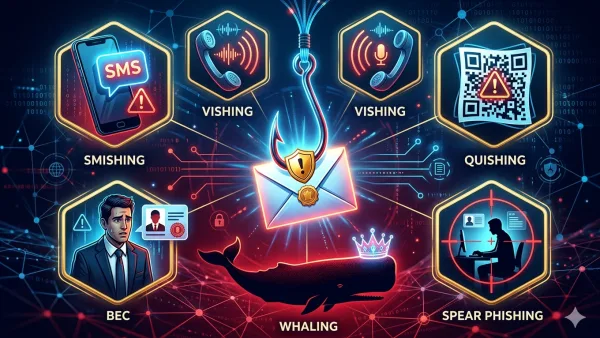
Phishing is the foundational social engineering attack and remains the most statistically prevalent. In 2024, phishing accounted for roughly sixteen percent of breaches with an average cost of $4.88 million per incident, according to IBM’s Cost of a Data Breach Report. The Anti-Phishing Working Group recorded over one million phishing attacks in Q1 2025 alone — a volume that reflects both the ease of launching phishing campaigns at scale and the ongoing effectiveness of the technique against inadequately trained targets. Modern phishing has undergone a qualitative transformation driven by AI. What Bitdefender’s cybersecurity predictions team called “the death of bad grammar” — the elimination of the spelling errors, awkward phrasing, and implausible scenarios that made earlier phishing easily identifiable — has produced campaigns where over eighty percent of phishing emails now use AI for at least one component: drafting text, personalising details, or generating convincing look-alike websites. The result is attacks that are linguistically flawless, contextually appropriate to the recipient’s actual role and recent activities, and essentially indistinguishable from legitimate communications without deliberate verification habits.
Spear phishing takes the personalisation of phishing to its logical extreme — highly targeted attacks against specific individuals, constructed using research into the target’s professional context, relationships, and recent activities. The RSA Security breach case, described in NuCamp’s 2026 social engineering analysis, illustrates the technique’s power: a phishing email with a subject line of “2011 Recruitment Plan” was sent to a small group of RSA employees. The email contained an Excel attachment with a zero-day exploit. The targeting was precise enough that the recipients found the subject plausible — and one opened the attachment. A single successful spear phish was sufficient to initiate a cascade that ultimately compromised RSA’s SecurID authentication tokens, affecting millions of downstream users. Modern spear phishing, enhanced by AI that can generate personalised pretexts at industrial scale, no longer requires the manual research investment that made it previously expensive and therefore selective. AI tools can now ingest a target’s LinkedIn profile, company website, recent press releases, and social media activity and generate a convincing personalised pretext in seconds.
Vishing (voice phishing) has experienced a dramatic resurgence in 2025 and 2026 driven specifically by AI voice cloning technology. Attackers no longer need to be gifted impersonators. With publicly available audio — from earnings calls, YouTube talks, podcasts, or even leaked voicemails — AI can clone a voice with accuracy that trained listeners cannot reliably distinguish from the genuine speaker. The $25 million deepfake CFO attack — where a finance employee was tricked into authorising a wire transfer after joining what appeared to be a legitimate video call with their CFO, whose likeness and voice were both deepfaked — is the most widely cited example. The 2026 CarGurus vishing breach, which involved twelve and a half million records stolen through a single AI-generated voice call, demonstrates that voice cloning attacks are not limited to extraordinarily sophisticated adversaries. The Vectra AI analysis noted that vishing has seen significant growth due to AI-powered voice cloning and professionalised vishing-as-a-service operations — criminal platforms that sell vishing attacks as a subscription service with no technical skill required from the purchaser.
Smishing (SMS phishing) exploits the higher open and response rates of SMS messages compared to email, combined with the reduced security scrutiny that most people apply to text messages. Package delivery notifications with fraudulent tracking links, bank verification requests, and urgent account alerts are the most common smishing templates. The mobile context creates additional vulnerability: people checking messages on phones are often multitasking, moving between applications, and operating with less cognitive attention than they apply to emails reviewed at a desk. The visual simplicity of SMS makes it harder to assess link legitimacy, and the brevity of the medium normalises the kind of short, urgent messages that phishing attacks depend on.
Pretexting is the construction of a fabricated scenario — a pretext — that provides the context and justification for a social engineering request. Business email compromise is one of the most financially damaging forms of pretexting: the attacker impersonates an executive, vendor, or business partner and uses the fabricated authority relationship to request wire transfers, credential disclosures, or sensitive data. BEC accounted for twenty-four to twenty-five percent of financially motivated attacks according to Verizon’s data, with approximately $2.9 billion in annual reported losses and a median monthly volume increase of fifty-four percent in the first half of 2025. The FBI estimates total exposed losses from BEC between 2013 and 2023 exceeded $55.4 billion globally — making it one of the most financially damaging cybercrime categories in existence.
Baiting uses the offer of something desirable — a free download, a prize, an interesting file, a physical USB drive labelled with something enticing — to lure targets into actions that compromise their security. The physical USB baiting attack, where an attacker drops USB drives in a target organisation’s car park or reception area in the hope that a curious employee will plug one in, is simple, inexpensive, and documented as effective in penetration testing exercises even at security-conscious organisations. The digital equivalent — malicious downloads disguised as desirable software, entertainment, or documents — is the mechanism behind many malware infections that begin with a social engineering lure rather than a technical exploit.
Quid pro quo and tech support scams offer a service — typically IT support or problem resolution — in exchange for information or access. The tech support scam, where an attacker calls posing as IT support and asks the target to provide credentials or install remote access software so the “technician” can resolve a fabricated problem, exploits both the authority of the technical expert role and the target’s desire to have their problem fixed. The help desk impersonation pattern has become increasingly sophisticated as AI tools make it trivial to gather convincing details and generate convincing scripts in advance, as NuCamp’s January 2026 social engineering analysis documents.
ClickFix campaigns represent one of the most significant new social engineering variants to emerge in 2025, surging five hundred and seventeen percent according to the Vectra AI analysis. ClickFix attacks present fake browser error messages, CAPTCHA verifications, or document viewing prompts that instruct users to execute commands in their own operating system — opening a command window and pasting what they believe is a verification or fix code, but which is actually malicious code that compromises their system. The technique is particularly effective because it makes the user an active participant in their own compromise, bypassing endpoint security controls that monitor for automated code execution. Users who follow the prompt believe they are performing a legitimate technical task.
Watering hole attacks compromise websites that the target population is known to visit, rather than approaching targets directly. An attacker who knows that employees at a defence contractor regularly visit a specific industry forum, trade publication, or professional association website can compromise that website and deliver malware to the contractors through their trusted regular browsing habit. The targeting is indirect but effective precisely because the trust relationship is genuine — the user is visiting a site they legitimately use, not one that arrived unsolicited in their inbox.
Insider threats and third-party recruitment represent the most difficult-to-detect social engineering variant because the attack originates from within the trusted perimeter. SecurityWeek’s January 2026 Cyber Insights analysis on social engineering identifies the insider threat as likely to worsen in 2026, noting that insiders exploit their privileged positions to steal data, disrupt systems, or facilitate external attacks. The outsider-recruited insider — an employee approached by an external attacker with an offer of payment for specific actions — is particularly challenging because from the system’s perspective, the insider’s actions look like legitimate authorised access.
How AI Has Transformed Social Engineering: The 2025-2026 Inflection Point
Artificial intelligence has not invented new social engineering techniques. It has amplified every existing technique by several orders of magnitude in speed, scale, personalization, and quality — while simultaneously lowering the skill threshold for executing sophisticated attacks to near zero. This combination has produced what SecurityWeek’s January 2026 Cyber Insights analysis describes as a genuinely different threat landscape: “We knew at the beginning of 2025 that social engineering would get AI wings. Now, at the beginning of 2026, we are learning just how high those wings can soar.”
The volume amplification effect is the most immediately quantifiable change. The Vectra AI analysis captures the core shift precisely: where a human attacker could craft a few dozen personalised pretexts per day, AI-powered tools generate thousands of contextually relevant, grammatically perfect messages in minutes. This shift from craft to industrial scale is the defining change in the 2025-2026 threat landscape. Over eighty percent of phishing campaigns now use AI for at least one step in their production process. A single threat actor operating AI-powered attack tools can reach a volume of targets that previously required large criminal organisations with dedicated human labour.
The quality improvement effect is equally significant and in some ways more dangerous. The social engineering attacks that previously provided reliable visual cues for identification — poor grammar, awkward phrasing, generic salutations, obviously suspicious sender addresses — have largely disappeared from sophisticated campaigns. Generative AI produces phishing content that is grammatically flawless, contextually appropriate to the target’s specific role and organisation, and calibrated to the writing style of whoever is being impersonated. Bojan Simic, CEO at HYPR, described the current state plainly in SecurityWeek’s analysis: “Deepfakes, synthetic backstories and real-time voice or video manipulation are no longer theoretical; they are active, sophisticated threats designed to bypass traditional defenses and exploit trust gaps… They’re happening right now, at scale and with devastating precision.”
The deepfake dimension deserves specific attention because of the specific defences it renders inadequate. Security practitioners have long advised users to verify suspicious requests by calling the requester on a known phone number. This defence was developed in an era when hearing someone’s voice was strong evidence that you were actually talking to that person. As Paul Nguyen, co-founder and co-CEO at Permiso, noted in SecurityWeek’s analysis: “Detection techniques continue evolving but will never keep pace with generation quality. By 2026, deepfake video and audio will be undetectable through technical analysis. Spectrograms will show no artifacts. Video frame analysis will reveal no rendering flaws. The only reliable defense is refusing to authenticate through channels that can be spoofed.” This is not pessimism — it is an accurate description of the technical reality that has made voice and video verification insufficient as standalone authentication methods for high-stakes requests.
AI-powered target research has eliminated one of the most time-consuming steps in social engineering attack preparation. Previously, constructing a convincing personalised pretext for a spear phishing campaign required manual research into the target — reviewing their social media, their company’s website, their professional history. AI tools can now perform this research automatically and at scale, processing a target’s digital footprint and generating a personalised, contextually plausible attack scenario in seconds. The result is that the level of personalisation previously reserved for highly targeted attacks on specific high-value individuals is now achievable against hundreds or thousands of targets simultaneously.
Synthetic identity creation — the construction of entirely fabricated digital personas complete with professional histories, social media presences, and authentic-seeming activity — has been made dramatically more accessible by AI-generated content and deepfake imagery. The Bybit attack demonstrates what a well-constructed synthetic persona can achieve: the attacker’s fabricated contributor identity was convincing enough to earn genuine developer trust over an extended period before making the request that enabled the $1.5 billion theft. Sumedh Barde, CPO at Simbian, noted in SecurityWeek’s analysis that deepfakes entered the workplace in 2025, with multiple incidents of fraud involving adversaries posing as interview candidates or business partners in video calls — a trend that is expected to accelerate in 2026.
The Anatomy of a Modern Social Engineering Attack: A Step-by-Step Walkthrough
Understanding how a sophisticated social engineering attack actually unfolds — from initial reconnaissance to successful compromise — provides the operational map for identifying where defences can most effectively interrupt the attack chain.
Stage One: Reconnaissance. Before any contact with the target, the attacker researches the organisation and the specific individuals they intend to approach. This includes mining LinkedIn for organisational structure, role details, and interpersonal relationships; reviewing the company website for executive names and bios; scraping social media for information about recent company events, projects, and personnel changes; monitoring job listings for information about which tools and systems the company uses; and searching public databases and previous breach data for credentials or personal information. AI tools have made this reconnaissance faster and more comprehensive than manual research could achieve — a fully detailed target profile can be assembled in minutes rather than hours.
Stage Two: Relationship or Pretext Establishment. The attacker uses the reconnaissance intelligence to establish either a credible pretext — the fabricated scenario that justifies the subsequent request — or a longer-duration relationship with the target. In a simple phishing attack, this stage is compressed into a single email designed around a plausible pretext. In more sophisticated attacks, the attacker may spend days or weeks in relationship-building before making the harmful request — connecting on LinkedIn, engaging with the target’s content, and establishing apparent credibility and trustworthiness before any harmful request is made.
Stage Three: Exploitation. Having established the pretext or relationship, the attacker makes the specific request that is the attack’s objective — whether that is a credential disclosure, a wire transfer, access to a system, the installation of software, or a physical action like letting someone into a secure area. The exploitation stage deploys the psychological triggers identified in the reconnaissance phase — authority, urgency, trust, fear, reciprocity — calibrated to the specific target’s likely response patterns. In AI-enhanced attacks, the exploitation content is often generated dynamically, customised to the specific conversational context in real time.
Stage Four: Execution and Concealment. The target complies with the request, often without realising that anything inappropriate has occurred. A finance employee who authorises a wire transfer to what appears to be a vendor’s updated bank account, or an IT worker who resets an account at a caller’s request, or an executive assistant who shares calendar information with someone they believe is a new colleague — each has been exploited without necessarily experiencing any of the discomfort or suspicion that a technically apparent attack would produce. The concealment begins as the attacker uses the access or information obtained to achieve their ultimate objective while maintaining the appearance of legitimate activity for as long as possible.
Real-World Cases That Define the 2026 Threat: What Actually Happened
The most useful preparation for social engineering defence comes not from abstract descriptions of attack types but from concrete case studies that illustrate how attacks actually unfold, what specific vulnerabilities they exploited, and what specific changes would have prevented them.
The Bybit exchange theft of $1.5 billion in February 2025 is the most financially consequential social engineering attack in history and represents the apex of what sophisticated long-duration social engineering can achieve. The attacker did not exploit a software vulnerability. They constructed a credible contributor persona, engaged authentically with the development community over time, and used the earned trust to introduce a malicious code modification that enabled the theft. The defence failure was not a technical one — it was a process failure. The verification protocols for code contributions did not include sufficient validation of contributor identity and intent when the stakes were at their highest.
The $25 million deepfake video call attack, described in multiple 2025 security reports, introduced a new category of social engineering risk: real-time video deepfake attacks that impersonate identifiable individuals in live video call contexts. A finance employee participated in what appeared to be a multi-party video call with company executives discussing a financial transaction. All participants were deepfaked. The employee, having no prior experience with synthetic video at this quality level, authorised the transfer. The defence gap was the absence of any out-of-band verification requirement for financial transactions of this magnitude — the organisation had not yet developed a process for verifying video call participants through an independent channel before executing significant financial actions.
The CarGurus vishing breach of 12.4 million records in 2026, described in the Vectra AI analysis, demonstrates that AI voice cloning attacks are now being used at scale against commercial targets rather than just high-profile individuals. A single vishing call, using a synthetic voice cloned from publicly available audio of a target executive, was sufficient to obtain the access credentials that enabled a massive data exfiltration. The defence gap was the absence of verification procedures specifically designed for voice-based requests for sensitive access — the organisation’s processes had not yet been updated to reflect the reality that hearing a familiar voice is no longer sufficient authentication.
The Scattered Spider retail attacks, which caused $300 million in losses across multiple retail organisations in 2025, illustrated the effectiveness of coordinated multi-channel social engineering at enterprise scale. The group specialised in help desk impersonation — calling IT support desks, impersonating employees, and convincing help desk staff to reset MFA and provide account access. The attack exploited the inherent tension in IT help desk work: the need to be helpful and to enable users to maintain access to their accounts, balanced against the need to verify identity before granting sensitive access. When these objectives are not explicitly balanced by documented verification requirements, the helpfulness instinct consistently wins — and attackers exploit it systematically.
The Red Flags That Signal a Social Engineering Attack in Progress
The most valuable skill for any employee to develop is the ability to recognise the warning signs of a social engineering attack while it is in progress — before the compliance response has been triggered and before any damaging action has been taken. The pattern recognition that experienced security professionals apply intuitively is learnable by anyone given the right framework.
Urgency without prior notice is the most reliable single warning sign. Legitimate processes that require urgent action almost always have some anticipatory communication — a meeting request, a prior discussion, a process that was set up in advance. A request that arrives unexpectedly and demands immediate action, citing a deadline that did not previously exist, should trigger verification before compliance rather than compliance before verification.
Authority combined with an unusual request is the second most reliable warning sign. An executive who routinely communicates through established channels and documented processes does not typically bypass those channels to make urgent one-off requests for financial transactions, credential sharing, or system access. When a request combines claimed high-level authority with a request that falls outside established procedures, the combination — not either element alone — is the signal to pause and verify.
Pressure to skip verification or keep the request secret is the clearest signal that something is wrong. Legitimate requests from legitimate principals do not come with instructions to bypass security procedures or to keep the communication confidential from colleagues or managers. An attacker who says “don’t mention this to your manager — it’s a sensitive matter” or “there isn’t time to go through the normal verification process” is specifically attempting to eliminate the verification steps that would expose the attack.
Contact through an unexpected channel or from an unexpected address is a structural warning sign that should always trigger channel-independent verification. An email from a known contact’s domain with a slightly different spelling, a call from an unfamiliar number claiming to be from a known organisation, a message from a new social media account claiming to be someone you know — each of these represents a channel anomaly that is worth verifying through a previously established direct contact before responding.
Requests for information or actions that feel slightly out of place for the stated context — even when the request is framed by an apparently credible authority — deserve the mental pause that NuCamp’s January 2026 social engineering analysis describes as the “commentary track” approach: “What stage of the script is this? What’s the ask? How do I break the scene safely?” The ability to step back from the immediate social pressure of a conversation and evaluate it analytically is the most valuable skill a potential social engineering target can develop.
The Five-Layer Defence Framework: How to Build Real Resistance
Defending against social engineering requires a layered approach that addresses the human element, the technical environment, and the process architecture simultaneously. No single control is sufficient. The organisations with the strongest social engineering resistance have built multiple complementary layers that each address different attack stages and different vulnerability dimensions.
Layer One: Security Awareness Training That Actually Works. The security awareness training that produces measurable behaviour change is not a once-a-year compliance video. It is continuous, scenario-specific, and evaluated against actual behaviour rather than quiz scores. Arctic Wolf’s analysis of security strategy found that only thirty-one percent of global respondents identified building a security awareness culture as a primary driver of their security strategy — which explains why so many organisations remain vulnerable to attacks that well-designed training would catch. Effective training presents realistic simulations of the specific attack types employees are likely to encounter — not generic phishing examples, but simulations calibrated to the specific roles, access privileges, and communication patterns of the employees being trained. It teaches the specific psychological mechanisms that attacks exploit, creating metacognitive awareness that helps employees recognise when those mechanisms are being activated. And it provides explicit, repeatable verification procedures to follow when warning signs appear — procedures that are practiced until they are automatic rather than theoretical.
Layer Two: Process Controls That Remove Single Points of Failure. The most powerful technical control against social engineering is a process design that requires multiple independent verification steps for high-consequence actions. Wire transfers above a threshold amount require verbal confirmation through a pre-registered number — not a number provided in the request itself — before execution. Privileged account resets require the requester to complete an identity verification process that cannot be bypassed over the phone. Access to sensitive systems requires a documented approval process that involves multiple named individuals, not just one who happens to be available. These process controls address the fundamental vulnerability that social engineering exploits: single points of authority that can be compromised through a single convincing interaction. Rachel Tobac, CEO of SocialProof Security, captured the required mindset in NuCamp’s analysis: “Be politely paranoid. If you receive a request for a sensitive action… verify who they say they are with a second verification.”
Layer Three: Technical Controls That Limit Blast Radius. Even with excellent training and strong process controls, some social engineering attacks will succeed against some targets some of the time. Technical controls that limit what a successfully deceived employee can actually do — least privilege access that restricts each user to the minimum permissions their role requires, network segmentation that prevents a compromised endpoint from accessing all systems, data loss prevention tools that monitor and restrict sensitive data transmission, and logging and alerting systems that detect anomalous behaviour — are the controls that prevent successful social engineering attacks from becoming catastrophic. The zero-trust principles described in TechVorta’s earlier cybersecurity coverage apply directly here: continuous verification at every access point, regardless of apparent legitimacy, ensures that even a fully compromised user account is constrained from causing unlimited damage.
Layer Four: Phishing-Resistant Authentication. MFA is necessary but not sufficient. The Vectra AI analysis makes a specific and important technical point: phishing-resistant authentication (FIDO2/passkeys) is the only effective defence against coordinated vishing and adversary-in-the-middle combinations. Traditional MFA — particularly SMS codes and one-time passwords — can be defeated by social engineering attacks that trick users into providing the code to the attacker in real time, or by adversary-in-the-middle attacks that intercept the code. FIDO2 hardware security keys and device-bound passkeys cannot be phished because the authentication is bound to the specific website or application being authenticated to — a fraudulent website cannot receive a FIDO2 authentication even if the user has been tricked into visiting it. For any account that has access to sensitive systems or financial functions, the upgrade from traditional MFA to phishing-resistant MFA is one of the highest-ROI security investments available.
Layer Five: Detection, Response, and Continuous Improvement. The assume-breach mindset that the Vectra AI analysis advocates for reflects the empirical reality that prevention alone is insufficient. Modern defence requires behavioural analytics that detect anomalous access patterns, identity monitoring that identifies account takeover indicators, and post-compromise detection that catches the lateral movement and data exfiltration that follow successful social engineering attacks before they complete. A simulated phishing exercise programme — ethically run, with no-blame reporting of results — provides ongoing measurement of actual employee susceptibility rates across different departments and roles, identifies the training gaps that are creating the highest exposure, and provides data to demonstrate security posture improvement over time. The loop between detection data, training content, process improvement, and technical control adjustment is what transforms social engineering defence from a static checklist into a continuously improving adaptive system.
Building a Verification Culture: The Behavioural Transformation That Matters Most
All of the technical controls and process frameworks described above are built on a behavioural foundation: a culture in which employees feel not just permitted but encouraged to pause, question, and verify before acting on any request that touches sensitive information, financial systems, or privileged access — regardless of how authoritative or urgent the request appears.
This culture does not exist by default. In most organisations, the default culture rewards helpfulness, compliance, and speed. An employee who pauses a call to verify a caller’s identity, or who declines to reset an account without a documented approval process, or who escalates a suspicious request rather than handling it themselves, is implicitly or explicitly going against the grain of the operational culture’s norm. Creating a security culture where verification is valued over helpfulness-at-any-cost requires deliberate and visible leadership commitment — senior leaders who model the verification behaviours they want employees to demonstrate, who publicly celebrate the employee who caught a social engineering attempt rather than complying with it, and who design escalation paths that make it easy to report suspicious requests without fear of criticism for being overly cautious.
The specific internal communications that support this culture include: pre-established code words for verifying high-stakes requests through a channel the attacker cannot intercept, explicit permission for any employee to refuse or delay a request while verification is completed regardless of the apparent seniority of the requester, and clear escalation paths for reporting suspicious interactions to security teams without bureaucratic friction. The Communications of the ACM analysis recommended specific internal controls for deepfake prevention that embody this principle: limiting executive audio and video exposure to reduce the material available for voice cloning; using internal keywords or signals as pre-agreed cues for high-risk approvals; and implementing callback verification for financial requests using pre-registered numbers rather than numbers provided in the request.
What AI-Powered Defence Looks Like: Catching AI With AI
The asymmetry in the AI-enhanced social engineering landscape — where AI dramatically amplifies attacker capability while defenders continue to rely primarily on human awareness — is not sustainable as the primary defence model. As Srini Tummalapenta, CTO of Security Services at IBM, stated plainly in the ACM analysis: “Given the increasing proliferation and methods used by cyber criminals, real-time detection that leverages AI to catch AI will be essential in protecting the financial and reputational interests of businesses.”
AI-powered email security platforms — moving beyond rule-based signature matching to behavioural analysis of communication patterns — can identify phishing attempts that no signature would catch: emails that are grammatically perfect and contextually plausible but that deviate from the established communication patterns of the purported sender in specific, detectable ways. Deepfake detection tools that analyse video and audio for statistical indicators of synthesis — indicators that are below the threshold of human perception but are detectable in signal analysis — provide a technical layer of authentication that supplements but does not replace the process controls described above. Behavioural biometrics platforms that model the normal patterns of how each user interacts with systems — typing rhythm, navigation patterns, session duration, access sequence — can detect when an account is being used by someone whose behaviour is inconsistent with the account owner’s established patterns, flagging potential account compromise without relying on the compromised user to notice and report.
The Mick Baccio, global security advisor at Cisco Foundation AI, captured the realistic expectation for AI-powered defence: “The best systems will need to combine signal analysis with behavioral context, cross-checking metadata, timing, and narrative consistency. Still, defenses will lag behind the offensive curve.” This honest acknowledgement that defenders will always be somewhat behind attackers in adapting to new social engineering techniques does not argue against investing in AI-powered defences. It argues for building adaptive systems that can learn and update quickly rather than static controls that are optimised for the attack patterns of the past.
Conclusion
Social engineering is not a technology problem. It is a human problem — one that happens to be dramatically amplified by technology in 2026 in ways that make it more dangerous, more scalable, and harder to detect than at any previous point in its history. The organisations that are most resistant to social engineering are not those with the most sophisticated technical controls. They are those that have invested equally in the human, process, and technical dimensions of defence — building a culture where verification is valued, processes where single points of authority do not exist, and technical controls that limit what a successfully deceived employee can do.
The $1.5 billion Bybit theft, the $25 million deepfake call, the 12.4 million records stolen through a single vishing interaction — these are not stories about technological failure. They are stories about the absence of the process controls and verification culture that would have caught these attacks before they caused harm. They are also stories about the specific capabilities that AI has added to the attacker’s toolkit — capabilities that require specific defensive responses, not just updated versions of defences that were designed for a different threat landscape.
Social engineering succeeds because human psychology is exploitable under the right conditions. No training programme, no process design, and no technical control eliminates that fundamental vulnerability entirely. The goal of social engineering defence is not perfection — it is the systematic reduction of the probability and the impact of successful attacks to levels that the organisation can absorb and recover from, combined with the continuous improvement that keeps pace with an evolving threat landscape.
In 2026, that goal requires treating the human element of security with the same systematic rigour that organisations apply to their technical controls. The weakest link in the security chain is a human being who has not been given the knowledge, the permission, and the process support to make the right decision when an attacker tries to manipulate them into making the wrong one.
TechVorta covers cybersecurity threats and defences with evidence-based analysis. Not with alarm. With clarity.



0 Comments
No comments yet. Be the first to share your thoughts!