
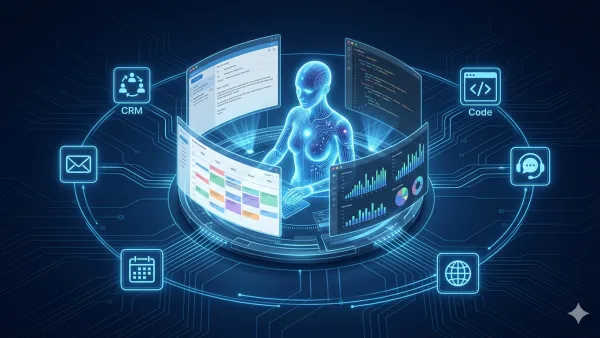
At 8:47 on a Tuesday morning, a sales operations manager at a mid-sized software company opens her laptop to find that something unusual has already happened. Overnight, an AI agent has scanned the company’s CRM for deals stalled at negotiation stage, drafted personalised follow-up emails calibrated to each prospect’s last interaction, cross-referenced the outreach against the calendar to avoid conflicting with scheduled calls, and queued everything for her review before the working day began. She approves, clicks send, and moves on. A task that would have occupied two hours of focused human attention happened autonomously, accurately, and before she arrived.
This is not a speculative scenario from a technology forecast. It is a description of what organisations using platforms like Salesforce Agentforce, Microsoft Copilot Studio, and Google’s Vertex AI Agent Builder are doing right now, in Q1 and Q2 of 2026. And it represents a shift in How Artificial Intelligence actually works that is more significant than anything that has happened since the launch of ChatGPT in late 2022 — because it is the shift from AI that talks to AI that acts.
For the past three years, the dominant experience of AI for most people has been conversational: you type a question, the AI responds. You ask it to write something, it writes. You ask it to explain something, it explains. These tools are genuinely useful. They are also fundamentally passive — they respond when prompted, stop when the prompt ends, and leave all the actual doing to the human on the other side of the conversation. AI agents change this at the root level. They do not wait to be prompted. They pursue goals. They use tools. They plan sequences of actions, execute them, check the results, and adjust when something does not work. The difference between a chatbot and an AI agent is roughly the difference between a reference book and an employee.
According to Gartner, 40 percent of enterprise applications will be integrated with task-specific AI agents by the end of 2026, up from less than 5 percent in early 2025. The dedicated market for autonomous AI and agent software has already crossed $11.79 billion in 2026, and AI spending velocity in this category is running approximately 340 percent higher than robotic process automation’s peak growth period. Salesforce research shows that full AI implementation across enterprises has increased 282 percent since 2024. These are not the numbers of a technology in early exploration. They are the numbers of a technology entering its production phase.
This guide explains what AI agents actually are, how they work under the hood, how they differ from the AI tools most people have already encountered, what they are being used for across real industries right now, what the genuine challenges of deploying them are, and what the rise of agentic AI means for the people whose work is most directly in its path.
What an AI Agent Actually Is
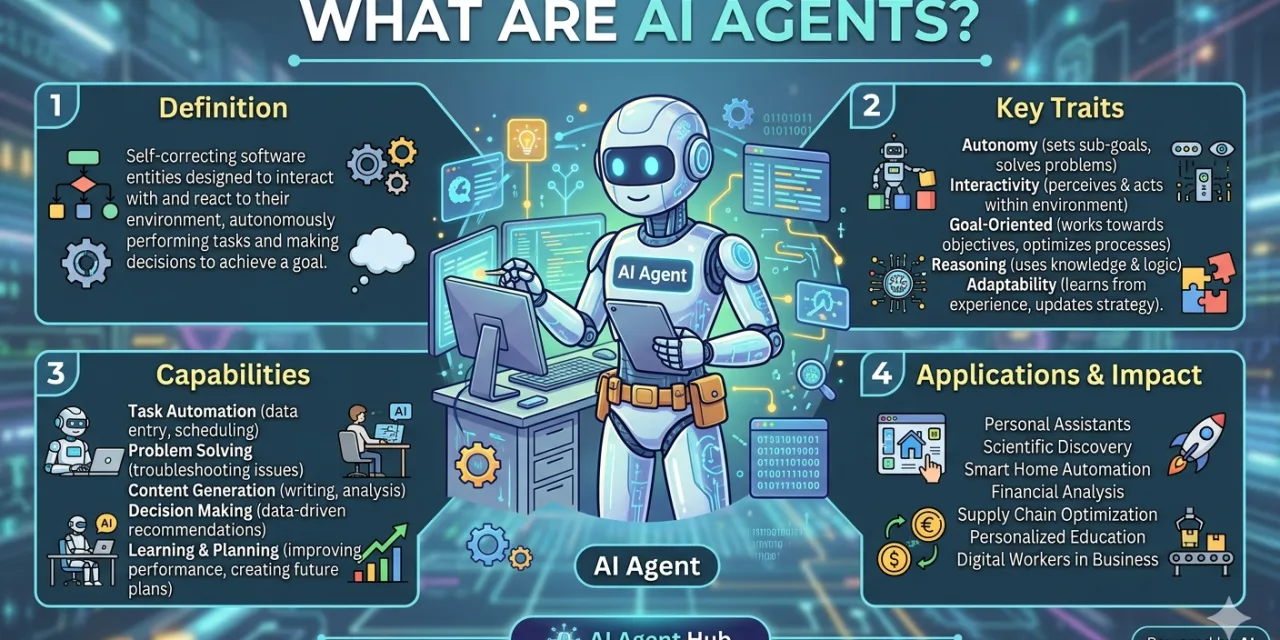
An AI agent is an autonomous software system that perceives its environment, reasons toward a defined goal, takes action, and learns from the outcomes — with minimal human intervention along the way. Google Cloud defines them as software systems that use AI to pursue goals and complete tasks on behalf of users, showing reasoning, planning, and memory with a level of autonomy to make decisions, learn, and adapt. IBM describes the core distinction precisely: while traditional LLMs produce responses based on training data, agentic technology uses tool calling to obtain current information, optimise workflows, and create subtasks autonomously to achieve complex goals.
The easiest way to understand what separates an AI agent from every AI tool that came before it is through a concrete contrast. You give a chatbot a task and it completes one response. You give an AI agent a goal and it determines the path, breaks the goal into sub-tasks, executes each sub-task using whatever tools are available, evaluates the results, and adjusts its approach if something goes wrong. A chatbot may explain how to research competitors. An AI agent may actually collect competitor pages, summarise them, compare pricing, identify positioning gaps, and deliver a structured report — without you specifying a single step along the way.
The concept has deeper roots than the current hype suggests. AI agents have been traced back to research from the 1990s, when the definition was equally contested. What has changed is capability: the emergence of large language models powerful enough to serve as the reasoning core of an agent, combined with the tool infrastructure (APIs, web access, database connections, code execution environments) that gives agents something to act with. Without an LLM at its centre, an agent would lack the reasoning flexibility to handle unstructured tasks. Without tools, it would be a sophisticated reasoner with nothing to do.
Three characteristics distinguish a genuine AI agent from a workflow automation tool or a sophisticated chatbot. First, AI agents reason: rather than matching inputs to preset outputs, an agent evaluates a situation, weighs options, and selects the most logical course of action — the same way a human analyst thinks through a problem before acting. Second, they adapt: when new information arrives mid-task (a form returns an error, a database is unavailable, a customer changes their request), an agent revises its plan rather than failing or stopping. Third, they course-correct: after every action, the agent checks whether it moved closer to the goal, and if it did not, it tries a different path. A static program simply does not have this capability.
How AI Agents Work: The Architecture Under the Hood
Understanding how an AI agent functions requires examining its components — because unlike a chatbot, which is essentially a single model responding to a prompt, an AI agent is an architecture of cooperating systems working together toward a goal.
The reasoning core: At the centre of most modern AI agents is a large language model — the same technology behind ChatGPT, Claude, and Gemini. The LLM serves as the agent’s brain: it interprets the goal, plans the sequence of steps required to achieve it, generates the outputs for each step, and evaluates whether each step succeeded. What makes the LLM useful as an agent’s core, rather than as a standalone tool, is that it can handle ambiguous, unstructured goals in natural language and produce flexible reasoning rather than rigid rule-following.
Memory: AI agents need to remember what they have done, what they know about the current task, and what they have learned from past interactions. Short-term memory keeps the context of the current task: what steps have been completed, what the results were, what remains to be done. Long-term memory allows agents to accumulate knowledge across sessions — user preferences, past successful approaches, domain-specific information relevant to recurring tasks. The agent’s ability to store past interactions in memory and plan future actions is what enables personalised, context-aware behaviour rather than the blank-slate experience of a traditional chatbot.
Tools: Tools are what give an agent its ability to act in the world rather than merely talk about it. An AI agent’s tool suite might include web search (to gather current information its training data does not contain), code execution (to perform calculations, manipulate data, or automate software interactions), API access (to interact with external services like CRMs, databases, email platforms, or calendar systems), file operations (to read, write, and modify documents), and communication capabilities (to send emails, create tickets, or post updates). The agent selects which tool to use for each sub-task based on what the task requires — web search for current information, a code interpreter for data analysis, an API call for CRM updates.
Planning and task decomposition: For complex goals, the agent cannot simply start executing — it must first plan. Task decomposition is the process by which an agent breaks a high-level goal into a sequence of manageable sub-tasks, each with a clear input and expected output. The plan is not fixed: an agent continuously re-evaluates its plan as sub-tasks are completed or fail, adjusting the sequence of remaining steps based on what has been learned.
Self-evaluation and course correction: After each action, a well-designed AI agent checks whether the result moved closer to the goal. If a web search returned irrelevant results, the agent reformulates the query. If an API call returned an error, the agent identifies the cause and tries an alternative approach. This self-correction loop is what separates agents from traditional automation: a script fails at an unexpected input; an agent reasons through the problem and finds a workaround.
Multi-agent orchestration: The most sophisticated agentic architectures involve not one agent but many — specialised agents coordinated by an orchestrator. Microsoft’s AutoGen platform, IBM’s watsonx Orchestrate, and Google Cloud’s Agent Builder all support multi-agent architectures in which a conductor agent breaks down a complex goal, delegates sub-tasks to specialised agents (one for data retrieval, one for analysis, one for communication), collects their results, and synthesises them into a coherent outcome. This architecture allows capabilities to be composed rather than replicated in a single monolithic system.
AI Agents vs Chatbots vs RPA: The Differences That Matter
The market around AI agents has generated significant terminology confusion, with “AI agent,” “AI assistant,” “chatbot,” and “automation” used interchangeably in ways that obscure meaningful differences. The distinctions matter because they determine what a tool can actually do for your organisation.
A traditional chatbot operates on a reactive, turn-by-turn model: you send a message, it sends a response, the interaction ends. Even the most sophisticated conversational AI tools — including the base experience of ChatGPT without its agents functionality — operate within this constraint. They can produce impressive outputs within a single response, but they do not initiate, plan sequences of actions, use external tools, or persist across a task that unfolds over time. They are, in AWS’s framing, reactive systems: they respond only when triggered and follow predefined interactions.
Robotic Process Automation (RPA) is closer to an agent in that it takes automated action in software systems, but it does so through rigid, predefined scripts. An RPA tool can log into a system, navigate to a specific screen, extract specific data, and paste it into another system — but only if each step unfolds exactly as scripted. If the UI changes, if an unexpected error appears, if the data format shifts, the RPA script fails. There is no reasoning, no adaptation, and no course correction. AI agents are fundamentally different in that they reason through exceptions, interpret unstructured inputs, and adapt their approach based on what they encounter.
The distinction that matters most in practice is autonomy and scope. A chatbot completes a single interaction. An RPA tool completes a predefined script. An AI agent pursues a goal across as many steps, tool uses, and decisions as the goal requires — adapting at each step based on what it finds. This is why organisations are not choosing between chatbots and AI agents, or between RPA and AI agents: they are layering agents on top of existing automation and conversational tools to handle the unstructured, multi-step work that neither could handle alone.
Types of AI Agents: From Simple to Fully Autonomous
AI agents are not a single technology — they span a range of capability levels that mirror, as Salesmate’s analysis notes, the levels of autonomy in self-driving vehicles. Understanding where a specific agent sits on this spectrum is essential for setting realistic expectations and designing appropriate governance.
At the simplest end are rule-based agents — systems that follow fixed decision trees or conditional logic. They can automate routine tasks reliably and quickly, but cannot handle situations their rules do not anticipate. Most early chatbot systems and basic automation scripts fall into this category. They are predictable and auditable, but limited.
Workflow agents are more flexible: they determine the sequence of actions dynamically based on the specific inputs they receive, using an LLM to interpret the task and route it appropriately. They handle a broader range of inputs than rule-based systems but still operate within a relatively constrained set of possible actions.
Partially autonomous agents — Level 3 in the self-driving analogy — can plan, execute, and adapt with minimal oversight. They can handle genuinely novel tasks within their domain, course-correct when something goes wrong, and pursue goals over extended periods without constant human guidance. Most of the enterprise AI agent deployments receiving significant attention in 2026 operate at this level.
Fully autonomous agents — systems that set their own goals, learn from outcomes, and operate with little to no human oversight — remain largely aspirational for high-stakes business contexts. The technical capabilities are advancing rapidly, but the governance frameworks, trust mechanisms, and liability structures required to deploy fully autonomous agents in consequential business decisions are not yet mature enough for most enterprise environments. Gartner warns that over 40 percent of agentic AI projects are at risk of cancellation by 2027 if governance, observability, and ROI clarity are not established — a finding that reflects the practical difficulty of scaling autonomous systems without the organisational infrastructure to manage them safely.
Where AI Agents Are Being Deployed Right Now
The adoption data for 2026 tells a clear story about which functions are leading the deployment of AI agents and why. Zapier’s 2026 enterprise survey found that Customer Support leads at 49 percent adoption, followed by Operations at 47 percent, Engineering at 35 percent, Marketing at 31 percent, Sales at 26 percent, and Finance at 24 percent. These percentages reflect the practical logic of agent deployment: start where the tasks are most structured, most repetitive, and most measurable.
Customer service and support is the most advanced deployment area because the value case is straightforward: high ticket volumes, predictable intent categories, and clearly measurable KPIs (resolution rate, handle time, customer satisfaction score). Contact centres deploying autonomous agents are reducing cost-per-contact by 20 to 40 percent as Tier-1 resolution becomes automated. Salesforce’s Agentforce usage data shows that the average number of customer service conversations led by an AI agent grew 22 times in the first half of 2025 alone. Adobe Population Health deployed Agentforce and reported saving more than $1 million annually in staff time, returning thousands of hours to clinical care teams.
Financial services is seeing some of the most dramatic productivity gains from agentic deployment. McKinsey reports that banks implementing agentic AI for Know Your Customer (KYC) and Anti-Money Laundering (AML) workflows are realising productivity improvements of between 200 and 2,000 percent — a range that reflects the enormous variation in task complexity and prior manual burden. Bradesco, an 82-year-old Latin American bank, deployed AI agent initiatives that boosted efficiency, freed up 17 percent of employee capacity, and cut lead times by 22 percent. The KYC compliance case is particularly compelling because the underlying task — collecting, verifying, and cross-referencing identity documents and regulatory flags — is both time-intensive and structurally well-defined enough for agents to execute reliably.
Legal research and document review is emerging as a high-ROI domain for AI agents because the underlying tasks are both cognitively demanding and structurally repetitive — research a legal question, find relevant precedents, summarise findings, flag relevant exceptions. BakerHostetler, an American law firm, adopted an AI-powered legal research agent that cut research-related hours by 60 percent, reduced time spent on case searches, and improved accuracy — enabling attorneys to redirect their attention to client-facing and strategic work where human judgement is genuinely irreplaceable.
Software development is experiencing some of the fastest agent adoption, driven by the availability of specialised coding agents. The coding and software development segment of the AI agents market is projected at a compound annual growth rate of 52.4 percent from 2025 to 2030 — the fastest-growing agent role segment. Demand for AI fluency in job postings has jumped nearly sevenfold in two years, with software engineers among the most actively affected roles. Modern coding agents do not merely autocomplete lines of code: they interpret entire codebases, identify bugs, write tests, refactor implementations, and execute multi-step development workflows with guidance rather than step-by-step instruction.
Supply chain and operations offers strong early ROI because the underlying workflows — monitoring inventory, tracking shipments, coordinating supplier communications, forecasting demand — are both data-intensive and time-sensitive in ways that make human-paced management increasingly inadequate. Logistics teams have reported cutting operational delays by up to 40 percent by deploying agents to coordinate forecasting, procurement, and tracking systems. An agentic system monitoring inventory levels, tracking weather conditions, anticipating shipping delays, and proactively rerouting shipments can compress the response time from hours to minutes — the difference between a disruption that cascades and one that is contained.
The Government Adopting AI Agents: A Signal Worth Noting
The deployment of AI agents by government institutions in 2025 and early 2026 is a meaningful signal about the technology’s maturation that deserves specific attention, because governments adopt new technology slowly and only after sufficient confidence in its reliability and accountability. The city of Kyle, Texas deployed a Salesforce AI agent for 311 customer service calls in March 2025. The Internal Revenue Service announced in November 2025 that it would deploy Agentforce agents across its Office of Chief Counsel, Taxpayer Advocate Services, and Office of Appeals. Staffordshire Police in the United Kingdom announced a trial of AI agents for handling non-emergency 101 calls beginning in 2026. The Detroit Department of Neighbourhoods deployed an AI agent for customer service calls in December 2025.
These are not technology companies experimenting with new tools. They are public institutions, subject to significant accountability and oversight requirements, deploying AI agents in direct public-facing roles. The fact that they are doing so reflects both the practical maturity of the technology and the scale of the operational pressure that drove these decisions — pressure from call volume, staffing constraints, and citizen expectation for responsive service that human-only operations struggle to meet. It also reflects the emergence of deployment patterns that are accountable enough for public-sector risk tolerance: defined scope, human oversight for exceptions, clear escalation paths, and measurable outcome standards.
The GenAI Paradox and Why Agents Are the Answer
Before examining the challenges of agent deployment, it is worth understanding the problem that AI agents are specifically designed to solve — a problem that the past three years of generative AI adoption have made increasingly visible. Kore.ai’s analysis gives it a name: the GenAI Paradox. McKinsey research shows that 78 percent of enterprises have deployed generative AI in at least one function. Yet 80 percent of those same enterprises say it has not improved productivity, cost, or revenue in any meaningful way.
This paradox is not primarily a technology failure. The tools work. The problem is that they work in a way that keeps humans in the loop for every single step of every single task — which means that all the time savings from generating content faster or searching knowledge bases more efficiently are consumed by the coordination overhead of having a human initiate, review, and act on every AI output. The AI is fast; the human is the bottleneck. Agents break this pattern by allowing the AI to complete multi-step tasks autonomously, only surfacing human attention where it is genuinely needed for judgment, oversight, or exception handling. The productivity gains become real when the human’s role shifts from executing every step to directing the overall goal and reviewing the outputs — and that shift is exactly what agents enable.
The Real Challenges: What Makes Agentic AI Hard
The adoption data and case study results are genuinely compelling. So is the warning embedded in the same research: despite the strong momentum, over 40 percent of agentic AI projects are at risk of cancellation by 2027. Only about 11 percent of pilot projects make it into full production. Understanding why projects fail is at least as important as understanding what success looks like.
Interoperability is the most cited technical challenge. A UiPath study of over 500 IT executives found that 87 percent rated interoperability as “very important” or “crucial” to successful agentic AI adoption. AI agents do not operate in isolation — they need to coordinate across CRMs, ERPs, email systems, databases, and third-party platforms. Without solid integration architecture, even the most sophisticated agent is isolated from the data and systems it needs to act on. Building the integration layer is often more complex and time-consuming than building the agent itself.
Governance is the most cited organisational challenge. Gartner, Deloitte, and IBM all flag governance as the primary constraint on scaling agentic AI in the enterprise. Deloitte’s 2026 report finds that only one in five companies has a mature governance model for autonomous AI agents — meaning that 80 percent of organisations deploying agents are doing so without the governance infrastructure to manage them safely at scale. Governance includes not only the technical questions of how to monitor agent behaviour and detect errors, but the organisational questions of who is accountable for agent actions, how agents should be restricted from taking consequential irreversible actions without human approval, and how to handle the liability questions that arise when an agent makes a costly mistake.
Hallucination and accuracy remain meaningful constraints. MIT Sloan’s February 2026 analysis of agentic AI is direct about the risk: various experiments by vendor and university researchers — including Anthropic and Carnegie Mellon — have found that AI agents make too many mistakes for businesses to rely on them for any process involving large financial consequences without meaningful human oversight. Agents inherit the hallucination tendencies of the LLMs at their core, and those tendencies compound across multi-step tasks: a wrong assumption in step two leads to a wrong action in step three, which leads to a compounding error in step four. Designing agents with self-verification, output checking, and clear human escalation paths for low-confidence decisions is essential rather than optional.
Workforce impact requires explicit management. A 66 percent decline in entry-level hiring has been reported by organisations that are leaning more heavily on AI agents for junior-level tasks — a finding that reflects a genuine structural shift in what kinds of work organisations expect humans to do. This shift is not painless: it creates real displacement risk for people in roles that agents are well-suited to automate, and it creates an expectation gap for new graduates entering organisations where the traditional entry-level work is no longer available for building foundational skills. Managing this transition — with honest communication, retraining investment, and genuine attention to the human dimensions of automation — is a leadership responsibility, not a technology problem.
How to Think About AI Agents if You Are Not a Technical Decision-Maker
Most of the people whose work will be most directly affected by AI agents are not technical decision-makers, and the technology’s complexity can make it feel like something that happens to you rather than something you have any agency over. This framing is both understandable and incorrect, because the decisions that most determine how AI agents affect any individual’s work are not primarily technical — they are choices about which tasks to automate, what oversight to maintain, and what to do with the human attention that automation frees up.
The most useful mental model is not the dystopian one (AI replacing humans) or the utopian one (AI making everyone superhuman). It is the management one: AI agents are a new kind of delegate. You define the goal, you establish the constraints, you review the output, and you retain responsibility for the outcomes. The agent handles the execution. Like any delegate, an AI agent is more useful when the task is well-defined, more reliable in domains where the rules are clear, and more likely to surprise you in novel or edge-case situations that require genuine judgment.
PwC research shows that nearly three-quarters of senior executives believe adopting AI agents could give their company a significant competitive advantage in the near term. Capgemini’s Rise of Agentic AI report found that 93 percent of leaders believe those who successfully scale AI agents in the next 12 months will gain an edge over industry peers. These are not just technology predictions — they are descriptions of a window of competitive advantage that, like most technology windows, is open for a limited time before early advantage becomes table stakes.
The Road Ahead: From Tools to Teammates
Gartner’s projection is the clearest single statement of where this trajectory leads: by 2028, 33 percent of enterprise software applications will include agentic AI, and 15 percent of day-to-day work decisions will be made autonomously by AI agents. By 2035, agentic AI could drive approximately 30 percent of enterprise application software revenue, surpassing $450 billion in a best-case scenario. The AI agent market’s overall trajectory points toward $1.3 trillion in AI-related investment by 2029 as IDC projects year-over-year growth of 31.9 percent between 2025 and 2029.
The deeper question is not whether agents will become ubiquitous in enterprise software — that trajectory is sufficiently clear that the question is already answered. It is what the arrival of genuinely capable agentic systems means for the nature of work itself. MIT Sloan’s framing is instructive here: if recent years were about AI answering questions and reasoning through problems, the next wave will be about true collaboration. Microsoft’s chief product officer for AI experiences, Aparna Chennapragada, describes 2026 as a new era for alliances between technology and people — where AI agents become digital coworkers helping individuals and small teams achieve what previously required entire departments.
The distinction between AI as tool and AI as colleague is not merely semantic. A tool enhances what you can do within the scope of what you already do. A colleague changes what you can attempt — because you can now delegate, coordinate, and scale in ways that were previously limited by the number of human hours available. The sales operations manager who arrived at her desk to find her outreach already drafted and queued was not more efficient at a task she would have done anyway. She was freed from a task entirely — and the time that returned to her was genuinely hers to direct toward work that required her specific knowledge, relationships, and judgment in a way that no agent can replicate.
That is the real promise of agentic AI in 2026: not that humans will be replaced, but that the range of work available to human attention will become significantly narrower in scope and significantly higher in stakes. Getting there requires building the governance, the integration infrastructure, and the organisational capability to manage autonomous systems responsibly — and it requires making the human decisions about which work to delegate, which to retain, and how to ensure that the agents acting in your name are doing so in ways you would actually endorse if you reviewed every step. The technology is ready. The organisational work is what 2026 is actually about.




0 Comments
No comments yet. Be the first to share your thoughts!