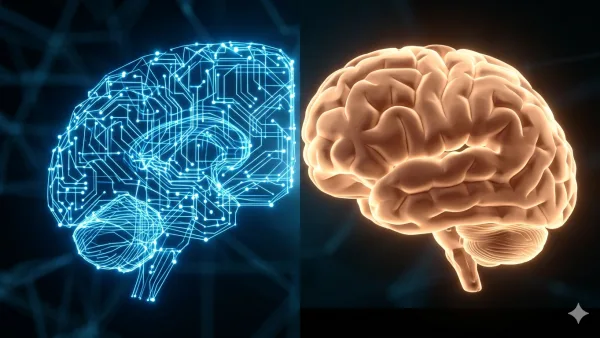
Type a sentence. A few seconds later, an image appears that did not exist thirty seconds ago — a photorealistic portrait, a baroque painting, a product photo, an architectural render, a fantasy landscape rendered with the detail of a master illustrator. Not found somewhere on the internet. Generated from nothing but your words and a very large amount of mathematics happening very fast inside a data centre somewhere.
This capability — which went from science fiction to freely available in roughly three years — is one of the most disorienting technological developments of the current decade. Not because it is the most powerful AI capability available. But because it is immediately, viscerally legible to anyone who tries it. You type words. An image appears. You can see the result with your own eyes. And what you see is often genuinely beautiful, or useful, or indistinguishable from something a skilled human would have spent hours creating.
Most people who use AI image generators regularly have no idea how they actually work. They know roughly what they do — translate text prompts into images — but the mechanism underneath, the specific mathematical process that converts a description into pixels, remains a mystery. That mystery is worth resolving, for several reasons. Understanding how these systems work explains why they produce the specific failure modes they do — the anatomically impossible hands, the garbled text within images, the occasional surreal inconsistencies. It explains why different tools have genuinely different strengths and produce genuinely different aesthetics. It explains why prompting skill matters so much and specifically what kind of guidance helps. And it provides the conceptual foundation for understanding where this technology is heading and why its 2026 iteration is qualitatively different from what existed even eighteen months ago.
This article covers all of it. The science of how AI image generation actually works, explained without requiring a mathematics or computer science background. The specific technologies that dominate the current landscape — diffusion models, transformers, latent space — described precisely enough to be genuinely illuminating rather than hand-wavy. The current platform landscape in 2026, with an honest assessment of which tools excel at which tasks. The practical guidance that makes the difference between frustrating outputs and genuinely useful ones. And the ethical and legal questions that the technology has raised — questions that remain actively contested and that anyone using these tools professionally needs to understand.
A Quick History: From Impossible Dream to Everyday Tool in Five Years
To appreciate how remarkable the current capability is, it helps to understand how recently its emergence was considered implausible. As recently as 2020, the consensus among computer vision researchers was that generating photorealistic images from arbitrary text descriptions was a goal years or decades away. The visual complexity of real-world images — the infinite variation in lighting, texture, spatial relationships, material properties, and contextual coherence that makes a photograph look real — was considered too high-dimensional a problem for then-current generative models to address convincingly.
The timeline of what actually happened compressed those projections dramatically. In January 2021, OpenAI announced DALL-E — the first public demonstration of a model capable of generating images from text descriptions at a quality level that surprised even the researchers who built it. In April 2022, DALL-E 2 pushed quality dramatically further. In August 2022, Stable Diffusion was released as open source, democratising access to image generation capability and triggering an explosion of community development that has accelerated the technology’s evolution ever since. Midjourney launched its public beta in July 2022 and rapidly established itself as the aesthetic leader for artistic image generation.
By 2026, the landscape has matured into something considerably more sophisticated. As aiwiner.com’s January 2026 comprehensive guide captures, what makes 2026’s models particularly impressive is their scale and sophistication. Stable Diffusion 3.5 Large utilises 8.1 billion parameters with Multimodal Diffusion Transformer architecture. Midjourney V7 was released in April 2025 with significant improvements in prompt understanding and image quality. These are not just bigger models — they are smarter about how they process information. The technology has moved from impressive demonstration to production infrastructure that creators, designers, marketers, and businesses use daily at commercial scale.
The Foundational Concept: What Diffusion Actually Means
Almost every major AI image generation system in use in 2026 is built on a technology called a diffusion model. Understanding this technology at a conceptual level — not the mathematics, but the underlying logic — makes everything else about how these systems work fall into place.
The name “diffusion” is borrowed from physics, specifically from the thermodynamic process by which a substance spreads through a medium. The University of Toronto’s AI Image Research guide offers the most intuitive explanation: diffusion models are inspired by the process by which a drop of food colouring spreads in water to eventually create a uniform colour. The food colouring starts structured and concentrated — it has a visible shape and a defined location. As it diffuses through the water, it gradually loses that structure, spreading into increasingly random, uniform distribution. Eventually all the colour information that defined the original drop has been distributed into chaos — the water is uniformly tinged and the original shape is completely gone.
A diffusion model takes this process and applies it to images. The training process works as follows: you start with a real image — a photograph, an illustration, any visual content — and you systematically add random noise to it, step by step, until what remains is pure statistical noise with no visual information. At each step, the model observes what the image looked like before and after the noise was added. Over millions of iterations with millions of training images, the model learns the statistical relationship between structured visual content and its noisy versions at every stage of the corruption process.
Then comes the key insight. Once the model has learned how to go from image to noise, it has also, implicitly, learned how to go from noise back to image. The ArchiVinci diffusion models guide describes this as the reverse process: starting from random noise — what the University of Toronto’s guide evocatively calls “TV static” — and applying the learned reverse of the corruption process, step by step, until coherent visual structure emerges. Each step of the reverse process refines the image slightly: noise becomes vague shapes, vague shapes become recognisable objects, recognisable objects develop detail, detail is refined into the final image.
This denoising process is why AI-generated images look the way they do and why they are different from photographs. They are not photographs of anything. They are the result of a mathematical process starting from randomness and converging toward visual coherence. As Tandfonline’s academic analysis of AI image generation notes, step by step, mere entropy turns into recognisable bodies, things, and spaces. The results may seem like concrete solids; they may resemble photographs or some other products of traditional image production. But they are not images captured from reality. They are images synthesised from learned statistical patterns about what visual coherence looks like.
How Text Connects to Image: The Conditioning Mechanism
A diffusion model that starts from random noise and generates random images is not very useful. What makes AI image generators practically valuable is the ability to guide the denoising process with a text description — to steer the convergence from noise toward images that match the content described by the prompt. This is called text conditioning, and understanding how it works explains both the power and the limitations of prompt engineering.
The text conditioning process begins before any image generation happens. The prompt you type — “a photorealistic portrait of an elderly woman in dramatic side lighting” — is processed by a text encoder, typically a model called CLIP (Contrastive Language-Image Pre-training) or a similar system. CLIP was trained on hundreds of millions of paired image-text examples from the internet, learning to represent both images and text descriptions in a shared mathematical space — what researchers call an embedding space or latent space. In this shared space, images and text descriptions that are semantically related are mathematically close to each other.
KDNuggets’ explanation of the mechanism captures the next step precisely: this embedding is then fed into the diffusion model architecture through a mechanism called cross-attention. Cross-attention is a type of attention mechanism that enables the model to focus on specific parts of the text and align the image generation process with the text. At each step of the reverse denoising process, the model examines both the current partially-denoised image state and the text embedding, and uses cross-attention to ensure that the next denoising step moves toward visual content that matches the description rather than just toward any coherent image.
The practical implication of this mechanism is that prompting is fundamentally about providing clear, specific guidance for the conditioning process. When you write a vague prompt — “a nice scene” — you give the conditioning mechanism very little to work with, and the model fills the ambiguity with whatever the training data most associated with that vague description. When you write a specific prompt — “a sunlit coastal Mediterranean village at golden hour, stone buildings with terracotta roofs, bougainvillea in the foreground, deep blue sea in the background, wide angle, hyperrealistic photography style” — you provide rich conditioning information that steers the generation process through multiple specific visual attributes simultaneously.
The University of Toronto’s guide makes an important observation about the stochastic nature of this process: since diffusion models always start image synthesis from random noise, the produced image is different each time. This means that with the same prompt, different images will be produced each time — because no single image properly represents all the information presented in a vector. This is why generating multiple variations of a prompt is standard practice and why seed values matter for reproducibility. A seed value — a numerical input that initialises the random number generator — allows the same combination of prompt and model to produce the same image consistently, enabling iteration and refinement rather than starting from scratch each time.
Latent Diffusion: The Technical Innovation That Made It Practical
The diffusion process as described — starting from noise in pixel space and denoising step by step toward a full-resolution image — is conceptually elegant but computationally expensive. A 1024×1024 pixel image has over one million individual pixels, and running the full denoising process in that space requires enormous computational resources for every generation.
The innovation that made diffusion models practical at scale was latent diffusion — performing the diffusion process in a compressed representation of the image rather than in pixel space directly. The ArchiVinci guide explains this clearly: Stable Diffusion, developed by Stability AI in collaboration with CompVis and Runway in 2022, introduced latent diffusion, where denoising occurs in a compressed feature space rather than pixel space, allowing efficient high-resolution generation. Wikipedia’s text-to-image model article describes the mechanism: an autoencoder, often a variational autoencoder (VAE), is used to convert between pixel space and a compressed latent representation. The diffusion process happens in this compressed latent space, which might represent a 1024×1024 image in a space that is eight or sixteen times smaller in each dimension — dramatically reducing computational requirements. Only at the very end of generation is the latent representation decoded back into pixel space to produce the final visible image.
This is why the architecture is called a latent diffusion model (LDM) — the diffusion and denoising happen in the “latent” compressed space, not in the raw image space. The practical consequence of this architectural choice is what made tools like Stable Diffusion accessible to ordinary consumer hardware — the reduced computational requirement means that a model capable of generating high-quality images can run on a graphics card that a consumer can purchase, rather than requiring data centre-scale computation for every image.
The 2026 Platform Landscape: Which Tool Wins at What
The AI image generation market in 2026 has matured into a multi-platform ecosystem where different tools genuinely excel at different tasks, and the “best” tool depends entirely on what you are trying to produce and in what context. The February 2026 analysis from Cliprise — a platform that operates eleven image generation models in production and therefore has direct comparative data from thousands of real creator workflows — provides the most practically grounded assessment of the current landscape available.
Midjourney V7 — The Aesthetic Leader
Midjourney retains its position as the model with the strongest aesthetic sense. Not necessarily the most photorealistic, the most flexible, or the most technically precise — but the model that most consistently produces output with visual appeal and artistic intentionality that the other models struggle to match. The platform focuses on artistic expression and stylistic control rather than strict realism, producing visually striking, design-oriented results. Midjourney V7, released in April 2025, brought significant improvements in prompt understanding — reducing the gap between what a user describes and what the model produces — and in image quality for complex scenes. The Cliprise analysis places Midjourney in the top tier for artistic style and in the strong tier for photorealism and people and faces. It is the go-to tool for creative professionals who prioritise visual impact over technical accuracy. The notable operational quirk — access through Discord rather than a conventional web interface — remains distinctive and continues to attract criticism from users who find it non-intuitive, though Midjourney’s web interface has improved considerably through 2025.
DALL-E 4o (via ChatGPT) — The Accessible Generalist
OpenAI’s image generation, now integrated as DALL-E 4o within the ChatGPT interface, prioritises accessibility and safety over raw quality metrics. The Cliprise analysis captures its position accurately: it produces good images reliably, handles a very wide range of prompts without refusal, and integrates seamlessly into conversational AI workflows. What it does best is broad accessibility, consistent quality floor — rarely producing completely failed generations — and natural language prompt interpretation that is more forgiving of imprecise descriptions. Where it lags is maximum photorealistic fidelity, which is behind Flux 2 and Imagen 4, and stylistic range, which is behind Midjourney. For the user who wants adequate quality across a wide range of tasks without learning model-specific prompting techniques, and who already uses ChatGPT for other work, DALL-E 4o is the natural choice. It sits in the strong tier for photorealism and capable tier for artistic style in the Cliprise comparison — competent across all dimensions without leading in any specific one.
Flux 2 Pro — The Photorealism Champion
Flux 2, developed by Black Forest Labs, has emerged as the top tier leader for photorealism and product accuracy in the Cliprise framework — surpassing Midjourney and DALL-E at the highest fidelity end of image generation. For commercial applications requiring photographic accuracy — product photography, architectural visualisation, documentary-style images — Flux 2 Pro’s ability to generate output that approaches the quality of real photography at high resolution makes it the professional choice. Its Kontext variant leads in character consistency — the ability to maintain the same character’s appearance across multiple generated images — which is critical for commercial storytelling and brand asset creation. The tradeoff is cost: Flux 2 Pro sits in the strong tier for cost efficiency in the Cliprise analysis, meaning it is not the cheapest option for high-volume production.
Google Imagen 4 — The Technical Precision Specialist
Google’s Imagen 4 leads alongside Flux 2 in photorealism and tops the ranking for people and faces — the historically most difficult category for AI image generation, where the uncanny valley effects of earlier models were most pronounced. Google’s advantage in this specific dimension reflects both the scale of Google’s training data infrastructure and the specific research investment in realistic human face generation. Imagen 4 is the appropriate choice for content requiring accurate human representation — professional headshots, brand imagery featuring people, lifestyle photography. Access is through Google’s Gemini and Vertex AI platforms rather than a standalone application, which shapes its user base toward developers and enterprise customers rather than individual creators.
Ideogram V3 — The Text-in-Image Leader
Ideogram has solved one of the most persistent and practically significant failures of AI image generation: the inability to render readable text within images. Previous generations of image generation models consistently produced garbled, illegible, or nonexistent text when prompts requested images containing words — a limitation that made them unusable for many commercial design applications where typography is essential. Ideogram V3 tops the Cliprise ranking for text in images and strong tier for character consistency — making it the tool of choice for any application where readable text must appear within the generated image: social media graphics with captions, poster designs, book covers, advertising with headlines, UI mockups, and infographics. For these specific use cases, Ideogram is not just the best option available — it is the only option that reliably delivers the required capability.
Stable Diffusion — The Open-Source Powerhouse
Stable Diffusion occupies a unique position in the landscape: it is the only major image generation system that is fully open source, downloadable, and runnable on consumer hardware without any API calls or subscription fees. This makes it the platform of choice for users who prioritise control, customisation, volume, and ownership over convenience — users who generate images at a scale where commercial API costs would be prohibitive, who want to fine-tune the model on their own specific visual style, or who have privacy requirements that preclude sending their prompts to third-party servers. The community of developers building on Stable Diffusion has created an extraordinary ecosystem of model variants, fine-tuned checkpoints, extensions, and workflows that extend the base model’s capabilities far beyond what any single commercial platform offers. The tradeoff is the steeper learning curve — running Stable Diffusion effectively requires more technical engagement than using a commercial platform through a web interface.
Seedream — The Volume Production Value Play
ByteDance’s Seedream models (4.5, 4.0, 3.0) represent a different kind of leadership: competitive image quality at significantly lower credit costs than the premium models. The Cliprise analysis notes that Seedream 4.5 in particular produces output that, for many use cases, is difficult to distinguish from Midjourney or Flux in casual viewing. The value proposition is real: for high-volume social content production where generating fifty or more images per day is the workflow, the cost difference between Seedream and Midjourney compounds quickly. The quality gap exists but may not matter for every application. For businesses producing content at scale where cost per image is a meaningful operational variable, Seedream represents a genuine strategic choice rather than a compromise.
Why AI Images Look the Way They Do: The Specific Failure Modes Explained
Every experienced user of AI image generation tools has encountered its characteristic failure modes — the outputs that are almost right but wrong in specific, recurring ways. Understanding the technical reasons for these failures is not just intellectually satisfying. It is practically useful because it explains how to structure prompts and workflows to avoid them.
The hand problem — the tendency of AI-generated images to produce anatomically incorrect, extra-fingered, malformed, or otherwise wrong human hands — was the most notorious limitation of early image generation systems and remains present, to a lesser degree, in 2026’s best models. The technical reason is rooted in training data and the nature of the diffusion process. Human hands are among the most variable and complex visual structures in natural imagery — they appear in countless orientations, states of motion, lighting conditions, and spatial relationships with other elements. The statistical patterns that represent “hand” in the model’s learned representation are correspondingly complex and variable. The denoising process converges toward a hand-shaped region without necessarily converging toward an anatomically specific number of fingers and joints in precisely correct relationships. Modern models have improved substantially on this dimension — Imagen 4’s strong performance on people and faces includes better hand generation than previous generations — but the failure mode persists for complex hand configurations that are less common in training data.
Text rendering failures — the garbled, misshapen, or nonexistent text that previous models produced when prompted to include words within images — have a similar explanation. Language as written text is a highly structured, rule-governed visual system where small deviations from the correct forms produce unreadable output. The letter “a” looks like an “a” within very narrow visual tolerances. The statistical learning process of diffusion models, which excels at capturing the distributed, probabilistic visual qualities of natural imagery, struggles with the strict rule-following required for accurate text rendering. Ideogram V3’s breakthrough in this dimension represents genuine architectural and training innovation specifically targeted at this failure mode.
Spatial consistency issues — where elements in a scene violate the physical laws of perspective, lighting, or object relationships — reflect the fact that diffusion models learn statistical patterns in image space without explicit physical simulation. The model has learned that certain visual arrangements are common, not that objects must obey specific spatial rules. For most commercial applications, spatial consistency is good enough that this limitation does not affect usability. For technical visualisation, architectural rendering, or any application requiring precise physical accuracy, it remains a meaningful constraint.
Prompt drift in multi-element compositions — where a prompt requesting multiple specific elements produces an image where some elements are present, some are absent, and some are mutated versions of what was requested — reflects the attention mechanism’s difficulty in simultaneously conditioning on many distinct elements without some being underweighted. The practical solution is prompt decomposition: generating images with fewer simultaneously specified elements and compositing them, or using the inpainting and regional prompting capabilities that have been developed specifically to address this limitation.
Prompt Engineering That Actually Works: Practical Guidance
Prompting for image generation is genuinely learnable, and the difference in output quality between an inexperienced and an experienced prompter is substantial. The core principles are consistent across platforms, though the specific syntax and emphasis that different models respond to best varies.
Be specific about visual attributes, not just subjects. A prompt that says “a dog” produces an image of some dog. A prompt that says “a golden retriever puppy, wet from rain, sitting on a wooden dock, golden hour backlighting, shallow depth of field, 85mm lens, photorealistic” produces an image with controlled aesthetic choices that match a specific visual intent. Every attribute you want to control — lighting, perspective, style, mood, medium, colour palette, compositional elements — should be explicitly included rather than left to the model’s defaults.
Specify the medium and style clearly. AI models have strong associations between style descriptors and visual aesthetics. “Photorealistic”, “oil painting”, “watercolour”, “digital illustration”, “pencil sketch”, “cinematic”, “editorial photography” — each of these style descriptors activates very different regions of the model’s learned visual distribution and produces meaningfully different aesthetic outcomes. Combining multiple style descriptors — “cinematic photography in the style of a 1970s National Geographic magazine spread” — can produce more specific aesthetic targeting than any single descriptor alone.
Use negative prompts to exclude unwanted elements. Most image generation platforms allow you to specify negative prompts — descriptions of what you do not want in the image. “Blurry, low resolution, oversaturated, extra fingers, watermark, text, signature” are common negative prompt elements that suppress the specific failure modes most users want to avoid. For Stable Diffusion workflows in particular, negative prompt engineering has become an art form in its own right, with community-developed negative prompt templates for specific use cases that improve output quality measurably.
Iterate with seed values. When a generation produces an image that is close to but not quite what you want, preserve the seed value and modify the prompt incrementally rather than starting from scratch with a new random seed. This allows progressive refinement toward the target output without losing the compositional elements that were already working.
Use reference images where available. Most 2026 image generation platforms accept image inputs as well as text prompts, allowing you to provide visual references — a specific style, a specific composition, a specific colour palette — that the model uses as additional conditioning alongside the text description. This dramatically increases the specificity of control over aesthetic output and is particularly valuable for brand asset creation where consistency with existing visual identity is required.
The Business Applications: Where AI Image Generation Is Delivering Commercial Value
The practical applications of AI image generation that are delivering verifiable commercial value in 2026 are more diverse and more specific than the generic “marketing content” framing that often dominates coverage of the technology. Understanding the specific use cases that have proven out helps calibrate where the technology is genuinely ready for commercial deployment versus where it still requires significant human intervention and judgment.
Marketing and content production has been, as aiwiner.com’s comprehensive guide confirms, probably the most widespread commercial application. Creating visual assets for blogs, social media, ads, and marketing materials used to require either design skills, expensive stock photo subscriptions, or hiring photographers and designers. AI image generation has made it possible for a single-person marketing operation to produce professional-quality visual assets at a volume that would have required a team of designers, at a fraction of the cost. For small and medium businesses where visual content quality directly influences customer acquisition but design budgets are limited, this is a direct and measurable economic benefit.
Product visualisation and e-commerce has become another high-value commercial application — particularly for businesses that want to show products in multiple contexts, lifestyle environments, or aesthetic treatments without photoshooting each variation. Flux 2 Pro’s strength in product accuracy makes it particularly well-suited for this application. A furniture brand that needs to show its sofa in twenty different room aesthetic settings no longer needs to either photograph it in twenty rooms or hire a 3D rendering firm. It generates the variations using a consistent product image as a reference and AI image generation to create the contextual environments.
Concept visualisation for design and architecture has transformed early-stage creative work in these fields. An architect presenting preliminary concepts to a client can generate photorealistic renders of proposed spaces in hours rather than the days or weeks that traditional 3D rendering required. An interior designer can show clients multiple aesthetic directions for a room quickly enough to iterate in a client meeting. The images are not construction drawings — they are evocative visualisations of intent that communicate design direction more efficiently than any previous medium at this stage of the process.
Custom illustration and editorial imagery has become one of the most interesting applications for independent creators and publishers who need high volumes of custom imagery that reflects their specific aesthetic vision. A newsletter publisher who previously used stock photography — generic, recognisable as stock, aesthetically mismatched with the publication’s voice — can now generate custom illustration that precisely matches the editorial aesthetic and the specific subject matter of each article. The AI-native publication aesthetic — distinctive, coherent, visually interesting — is increasingly a signal of editorial investment rather than a mark of compromise.
The Copyright and Ethics Debates: The Questions That Remain Open
Any honest account of AI image generation in 2026 must engage seriously with the copyright and ethics debates that the technology has generated — not to relitigate settled questions, but to accurately represent the state of genuinely open issues that anyone using these tools professionally needs to understand.
The copyright question at the heart of most litigation is whether training AI image models on copyrighted images constitutes infringement. Several major lawsuits are working through US courts in 2026, brought by visual artists, stock photography companies, and publishers who argue that the scraping of their work without consent or compensation to train commercial image generation models violates their intellectual property rights. The defendants — primarily Stability AI, Midjourney, and their investors — argue that training on publicly available images constitutes transformative fair use and that the models do not store or reproduce the training images directly. As of March 2026, no major US court has issued a final judgment that definitively resolves this question, and the legal landscape remains genuinely uncertain.
The artist displacement question is related but distinct. Whether or not training on an artist’s work constitutes legal infringement, the ability of AI models to generate images in a specific artist’s style — capturing their distinctive aesthetic, compositional choices, and technical approach — and to do so at speeds and costs that massively undercut the commercial market for human-created work in that style, has real economic consequences for working illustrators, concept artists, and commercial designers. The communities most affected are engaged in active advocacy, legal action, and technical countermeasures including Glaze and Nightshade — tools that add imperceptible modifications to images that disrupt AI training without affecting their visible appearance to human viewers.
Disclosure and synthetic media transparency is the ethics question with the most immediate regulatory traction. The EU AI Act’s limited-risk transparency requirements mandate disclosure of AI-generated content that could be mistaken for real imagery. Several major platform providers have implemented Content Credentials — technical metadata standards that embed information about how an image was created into the image file itself — allowing verification tools to identify AI-generated images even when visual inspection does not distinguish them from real photographs. Whether and how broadly these standards are adopted, and whether regulatory frameworks will mandate them for specific categories of high-stakes imagery, will be significant developments in the AI image generation space over the next two to three years.
The deepfake and disinformation potential of photorealistic AI image generation is the ethics concern that has attracted the most regulatory attention. The ability to generate photorealistic images of real people in situations that never occurred — public figures, private individuals — creates a disinformation risk that previous image manipulation technology could not achieve at scale. Current regulatory responses focus on mandatory labelling of synthetic imagery and criminal prohibitions on specific categories of deepfake content, particularly synthetic intimate imagery created without consent. These regulations are in various stages of development and enforcement across different jurisdictions.
Where AI Image Generation Is Going: The Next Eighteen Months
The trajectory of AI image generation over the next twelve to eighteen months is visible in current development patterns and emerging capabilities that have been demonstrated in research but not yet fully deployed commercially.
Video generation from text is the most significant frontier. As the Cliprise analysis notes explicitly, image generation and video generation are converging. The models that generate the best starting frames for video, and the video models that generate still frames as a step in their pipeline, are increasingly part of the same technical ecosystem. Tools like Runway, Sora, and Kling can already generate short video sequences from text prompts — not at the quality level of professional video production, but at a quality level that is commercially useful for specific applications. The gap between “this is clearly AI-generated video” and “this is indistinguishable from real video” is closing on a timeline measured in months rather than years.
Consistent character generation — the ability to generate the same character reliably across multiple images without it being the same image — has been identified as one of the most commercially valuable unsolved problems in AI image generation. Ideogram V3 and Flux Kontext are leading in this dimension, but the problem remains substantially unsolved for complex characters in diverse situations. The commercial applications that consistent character generation would unlock — AI-generated comics, illustrated narratives, brand mascot deployment across diverse contexts — represent a large untapped commercial opportunity that will drive significant research investment in this direction.
Real-time generation with interactive feedback is moving from research to early commercial deployment. Current systems generate images after a delay of seconds to tens of seconds, depending on the model and resolution. Systems that generate images at sufficient speed to respond to real-time interactive input — where you move a slider and the image updates instantly — would transform image generation from a prompt-response tool into an interactive creative environment. Adobe Firefly and several research labs are actively developing in this direction.
Integration with 3D generation and physical simulation is the frontier that would make AI image generation genuinely useful for the applications where photographic consistency and physical accuracy are required. When AI image generation can generate coherent 3D representations that maintain spatial and physical consistency across multiple viewpoints and lighting conditions, the architectural, industrial, and scientific visualisation applications that currently require photorealistic 3D rendering will become accessible to a far wider range of creators and use cases.
Conclusion
The technology that converts a text description into an image — that takes the food colouring of your description and diffuses it backward through mathematical noise into a coherent, beautiful, specific visual reality — is one of the most genuinely remarkable things that computation has produced. Not because it is the most intellectually profound AI capability. But because it makes visible, in a way that anyone can directly perceive and evaluate, the extraordinary distance that generative AI has travelled from the science fiction of five years ago to the production infrastructure of 2026.
Understanding how it works — the diffusion process, the latent space, the text conditioning through cross-attention, the specific architectural choices that determine each platform’s distinctive strengths and failure modes — transforms you from a passive user of a mysterious tool into an informed practitioner who can deploy the right tool for the right task, structure prompts that produce the outputs you actually need, and evaluate the results with appropriate critical judgment.
The platforms that lead in 2026 — Midjourney for aesthetic quality, Flux 2 for photorealism, Imagen 4 for human faces, Ideogram for text rendering, Stable Diffusion for customisation and open-source flexibility — each reflect specific technical and design choices that produce genuinely different outputs. Knowing which to reach for, and why, is the craft knowledge that separates the professional practitioner from the casual experimenter.
The questions that remain open — copyright, artist displacement, deepfake risk, synthetic media transparency — are not questions that the technology answers. They are questions that the people who develop, deploy, and regulate it must answer. The technology is indifferent to those answers. Its capabilities continue to develop regardless of whether the surrounding normative framework has caught up. Which makes the work of developing that framework both urgent and important — and makes understanding the technology, at the level this article has tried to provide, the prerequisite for engaging intelligently with those debates.
TechVorta covers artificial intelligence, emerging technology, and the developments shaping the digital creative landscape. Not with hype. With evidence.