
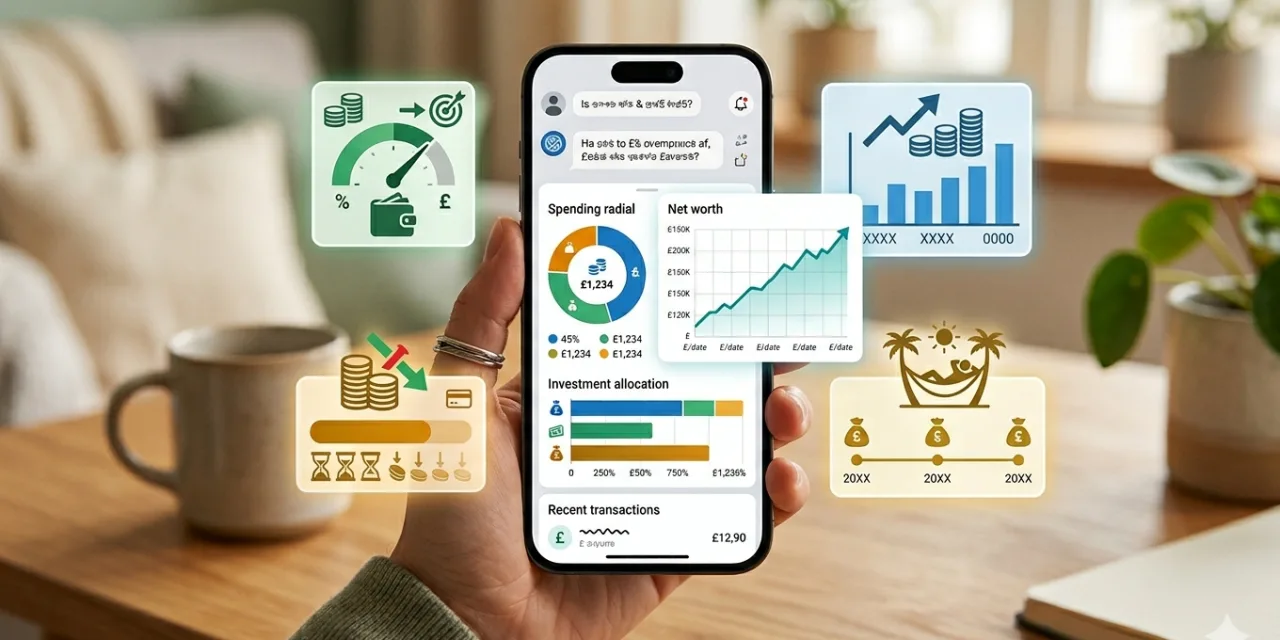
More than a third of consumers now consult AI tools before meeting their human financial advisor. The average user of an AI budgeting app saves between $300 and $600 more per year compared to manual budgeting, according to a 2025 NerdWallet study. Robo-advisors — AI-powered investment managers — charge as little as 0.25 percent of assets under management annually, compared to the 1 to 2 percent that human financial advisers typically charge. The global AI in fintech market was valued at approximately $44.08 billion in 2025 and is projected to grow at 16.5 percent CAGR through 2030. In 2026, AI financial tools have crossed a tipping point: they are not gimmicks or novelties — they are genuinely useful, increasingly free or low-cost, and demonstrably improving real financial outcomes for people who use them.
But 84 percent of consumers still have concerns about AI in banking, and those concerns are not baseless. AI financial tools vary enormously in what they actually do — from genuinely intelligent systems that reason across your complete financial picture to apps that do basic categorisation dressed up in “AI” marketing language. The tools that should be trusted with your financial data and your financial decisions are not the ones with the most impressive marketing. They are the ones that have regulatory backing, proven accuracy, genuine personalisation, and clear limits on what they claim to be able to do. Distinguishing between the two requires understanding what AI actually adds at each stage of personal finance management — budgeting, investing, debt management, and retirement planning — and which specific tools deliver genuine value versus surface-level intelligence that adds friction without improving outcomes.
This guide is written as practical financial education rather than financial advice. The specific tools reviewed here are assessed on their capabilities, accuracy, cost, and appropriate use cases — not ranked by affiliate revenue or promotional relationships. For decisions about your specific tax situation, investment strategy, estate planning, or complex financial circumstances, a licensed financial professional remains irreplaceable. For the majority of everyday financial management decisions — tracking spending, setting budgets, automating investments, identifying waste, planning debt payoff — AI tools in 2026 are capable, accessible, and worth using.
What AI Actually Does in Personal Finance
The most important distinction in evaluating AI financial tools is between tools that display data intelligently and tools that reason about it. Many applications labelled as AI financial tools in 2026 do the former: they categorise transactions more accurately than older rule-based systems, surface spending trends in clearer visualisations, and send alerts when balances reach thresholds. These are genuinely useful capabilities that improve on manual spreadsheet tracking — but they are not AI in the sense of reasoning, prediction, or personalised recommendation. They are smart software with better branding.
Genuinely AI-powered financial tools do something qualitatively different: they reason across your complete financial picture — spending, savings, investments, debts, goals, and timeline — to answer questions and generate recommendations that are personalised to your actual situation rather than generic. “Can I afford a $500 holiday if I maintain my current savings rate?” is a question that requires reasoning across your income, current savings rate, upcoming fixed expenses, and goal timeline simultaneously. A categorisation tool that shows you a pie chart of last month’s spending cannot answer it. An AI system with full financial context can — and the quality of that answer depends entirely on the quality and completeness of the data the system has access to.
Cash flow forecasting is the AI capability with the most immediate practical value for most users. A month can look fine on paper in aggregate while still producing individual days with dangerously low balances if payroll timing and bill due dates are misaligned. AI cash flow prediction — which models your expected income dates, fixed bill timing, and historical variable spending patterns — converts the unpredictability of monthly cash flow into a navigable calendar that shows where the low-balance risks are before they occur. This specific capability prevents the specific outcome that costs people most in avoidable fees: overdrafts, missed payments, and the credit damage that follows.
Anomaly detection is the AI capability that most consistently produces immediate financial benefit: identifying charges that do not fit your established patterns — subscription renewals you forgot you had, duplicate charges, unusual amounts at familiar merchants, and fraud indicators. Rocket Money’s AI scans every transaction and surfaces recurring charges; users report finding and cancelling an average of $512 per year in unwanted subscriptions. The value of this capability grows with transaction volume — the more financial accounts and cards a tool can see, the better its anomaly detection.
AI Budgeting Tools: The Most Mature Category
AI budgeting is where the tools are most mature, most accessible, and most consistently useful across different user types and financial situations. The four tools that produce the strongest real-world outcomes cover different philosophical approaches to budgeting — choosing between them is primarily a question of how you want to engage with your financial management rather than which one is objectively better.
Copilot Money (iOS only, $13/month or $100/year) is consistently rated the best overall AI-powered budgeting experience by independent reviewers in 2026. Its transaction categorisation accuracy — which Toolradar’s April 2026 analysis identifies as the foundation of every useful summary and trend report — is among the highest in the category, and its AI insights go beyond showing spending patterns to explaining their causes and projecting their impact on financial goals. The limitation is platform exclusivity: Copilot is iOS-only, with no Android equivalent. For iPhone users who want the most polished AI budgeting experience, it is the clearest recommendation.
Cleo (Free / Cleo Plus $5.99/month) uses a conversational AI chatbot interface that makes budgeting approachable for younger users who find traditional dashboard-based financial apps anxiety-inducing or intimidating. Cleo’s personality — irreverent, slightly sarcastic, genuinely funny at times — deliberately subverts the judgmental tone that personal finance tools often inadvertently adopt. The underlying financial analysis is solid; the conversational layer makes it accessible to users who would not engage with an equivalent analysis presented as a pie chart and a data table. The $250 cash advance feature — useful for genuine emergencies — should be treated as emergency infrastructure rather than a regular income supplement, which is where some users get into difficulty with the product.
Monarch Money ($14.99/month or $99/year) occupies the premium end of the category — more expensive than competitors but providing the most comprehensive tracking capability including investment portfolio monitoring alongside spending and budgeting. Its AI categorisation and joint financial management features make it the strongest option for couples and families managing shared finances across multiple accounts and asset types. The combination of spending tracking and investment visibility in a single coherent interface addresses the fragmentation problem that has made comprehensive personal financial management difficult — spending in one app, investments in another, retirement accounts somewhere else, with no unified picture of the whole.
YNAB — You Need a Budget ($14.99/month or $99/year) is less AI-powered than the others — it has added AI features including spending pattern analysis and a GPT-4 powered assistant — but its zero-based budgeting methodology (every dollar allocated to a specific purpose before it is spent) remains the most effective framework for users who need genuine behavioural change rather than better tracking. YNAB users who commit to the methodology consistently report the most dramatic improvements in financial outcomes, but the methodology requires active engagement that passive-tracking users will not provide. Choose YNAB if you want a system that builds financial discipline. Choose Copilot or Monarch if you want AI to surface insights from your natural behaviour without requiring you to change it.
Robo-Advisors: AI-Powered Investing for Everyone
Robo-advisors — platforms that use AI to build, manage, and rebalance investment portfolios automatically — have been the most consequential AI application in personal finance for the broadest population. Before robo-advisors, low-cost diversified investing required either significant financial knowledge to execute independently or the expense of a human financial adviser. Robo-advisors deliver the core of what a financial adviser does for investment management — asset allocation, diversification, periodic rebalancing, goal-based portfolio construction — at a fraction of the cost, with no minimum investment requirements, and with 24/7 availability.
The cost difference is material and compounding. A human financial adviser typically charges 1 to 2 percent of assets under management annually. On a $100,000 portfolio, that is $1,000 to $2,000 per year in advisory fees — every year, compounding against the growth that those fees could have generated if left invested. A robo-advisor at 0.25 percent annual fee on the same portfolio costs $250 per year — a difference of $750 to $1,750 annually that stays invested and compounds over decades. The long-term wealth difference from this fee differential alone is significant enough to justify robo-advisors for straightforward investment management even for users who have access to human advisers.
Betterment is the most established robo-advisor and the strongest choice for users focused primarily on long-term wealth building and retirement planning. Its AI-driven portfolio management includes automatic rebalancing when allocations drift from targets, tax-loss harvesting (selling underperforming assets to offset capital gains tax), and goal-based portfolio construction that adjusts risk level based on investment timeline. The platform’s Premium tier adds access to human certified financial planners for specific advice questions — a hybrid model that provides the efficiency of robo-management with human judgement available for complex situations.
Wealthfront competes directly with Betterment at the same 0.25 percent fee, with particular strengths in tax-loss harvesting sophistication and direct indexing (which allows higher-value accounts to hold individual stocks comprising an index rather than a fund, enabling more precise tax optimisation). Wealthfront’s Path financial planning tool provides detailed retirement and major purchase projections that go beyond simple portfolio management into broader financial planning territory.
Schwab Intelligent Portfolios has no advisory fee — charging 0.00 percent — which appears to be the strongest value proposition in the market until you examine the portfolio construction: Schwab holds a portion of every portfolio in cash, which generates revenue for Schwab rather than returns for the investor. For larger portfolios where the cash drag is a meaningful cost, the effective fee is not zero. For smaller accounts where the explicit 0.25 percent fees of Betterment and Wealthfront would represent a larger portion of returns, the cash drag is a more acceptable trade-off. Schwab Intelligent Portfolios Premium adds unlimited human advisor access at $30 per month — making it one of the most affordable hybrid human-AI advisory models available.
Fidelity Go offers robo-advisory services with no advisory fee for accounts under $25,000, making it the most accessible option for new investors starting with smaller amounts. Its integration with Fidelity’s broader platform — including zero-expense-ratio index funds available only to Fidelity customers — creates a cost-efficient ecosystem for users who are also consolidating their broader financial accounts with Fidelity.
AI for Debt Management: The Avalanche vs Snowball Decision
AI has made one of personal finance’s most impactful and most ignored disciplines significantly more accessible: systematic debt payoff planning. The two established methodologies — the avalanche method (paying off highest-interest debt first, minimising total interest paid) and the snowball method (paying off smallest-balance debt first, maximising the psychological momentum of quick wins) — are both well-documented and both effective for the users they suit. The AI contribution is not choosing between them but making the mathematical projection of each approach specific to your actual debt portfolio — showing exactly how many months until each debt is eliminated, exactly how much interest you will pay under each scenario, and exactly what extra monthly payment would accelerate the timeline.
For most people with significant high-interest debt — credit cards averaging 22 to 24 percent APR in 2026 — the avalanche method produces meaningfully better financial outcomes in total interest paid over the payoff period. The snowball method’s psychological advantage is real and valuable for users who have historically abandoned debt payoff plans before completion — the quick wins of eliminating smaller debts first provide motivation that the mathematically superior avalanche method, which can involve paying the highest-balance card for years before visible progress, does not. Knowing which approach suits your psychology is a self-knowledge question that no AI can answer better than you can.
Where AI genuinely accelerates debt payoff is in subscription identification and elimination — freeing cash flow for additional debt payments by surfacing recurring charges that have accumulated without active management. Rocket Money’s subscription scanning consistently identifies $300 to $600 per year in charges that users have forgotten about or stopped using. Redirecting that cash flow to additional debt payments accelerates payoff in ways that feel painless because the money was already being spent without conscious decision.
AI and Tax Optimisation: Assistance Without Advice
Tax is the area of personal finance where the boundary between AI assistance and regulated tax advice is most important to maintain — and where most consumer AI tools are most careful to stay on the right side of it. General-purpose AI tools including ChatGPT and Claude can explain tax concepts, help you understand what documentation you need for specific deductions, and help you organise the information required for tax preparation. They should not be used as the source of specific tax advice for your personal situation — tax rules are jurisdiction-specific, frequently changing, and consequential enough that errors are costly in ways that extend beyond the immediate financial impact to penalties and audit exposure.
TurboTax’s AI-powered interview process — which uses LLMs to guide users through complex tax situations through conversational questions rather than static forms — has achieved genuine accessibility improvements for users whose tax situations include self-employment income, rental properties, or investment transactions that previous versions of TurboTax’s guided interview handled less fluently. The AI interview approach reduces the intimidation of complex tax situations by converting form completion into a conversation, while maintaining the underlying accuracy of a tax preparation system whose logic has been validated by certified public accountants.
The most valuable tax-related AI capability available to most investors is tax-loss harvesting through robo-advisors — automatically selling underperforming investments to offset capital gains taxes. Betterment and Wealthfront both implement this automatically for taxable accounts. Across a portfolio managed for 20-plus years, the cumulative value of systematic tax-loss harvesting — which reduces the tax drag on investment returns each year — can be equivalent to a meaningful additional contribution to the portfolio’s final value. This is genuine AI-driven financial optimisation that individual investors cannot replicate manually with the same systematic consistency.
The AI vs Human Adviser Question: The Honest Answer
More than a third of consumers now consult AI tools before meeting their human financial advisor — a figure that reflects both AI’s improving capability and the desire to arrive at adviser meetings better informed. The appropriate relationship between AI tools and human advisers in personal finance is not AI replacing human advisers but AI handling the aspects of financial management that are systematic, rule-based, and data-intensive — freeing human advisers to focus on the aspects that genuinely require human judgment, emotional intelligence, and life context.
The specific capabilities that human financial advisers provide that AI tools cannot replace are: licensed advice on specific investment decisions for your specific situation, estate planning and complex tax planning that requires professional judgment and professional liability, emotional coaching during market volatility when the financial plan is rational but the human executing it is panicking, and the nuanced understanding of life context — family dynamics, health considerations, career trajectory, risk tolerance beyond stated preferences — that a sustained professional relationship develops over time. A human adviser who knows that a client’s stated “moderate risk tolerance” reflects their disposition during a bull market rather than their actual behaviour during a 30 percent market decline is providing something that no AI with 18 months of transaction history can replicate.
The 84 percent of consumers who retain concerns about AI in banking are not being irrational — they are appropriately cautious about an emerging technology whose accuracy, privacy practices, and regulatory oversight are still developing. The right response to those concerns is not avoiding AI financial tools but using them for the specific purposes where their capabilities are established and their limitations are manageable, while maintaining human oversight and professional advice for the decisions where the consequences of AI error would be most harmful. AI is not here to replace financial wisdom. It is here to handle the administrative and analytical work that has historically consumed the time and cognitive capacity that financial wisdom requires.
Getting Started: The Practical First Steps
The most common mistake in adopting AI financial tools is trying to implement everything simultaneously — downloading multiple apps, connecting all accounts, and then feeling overwhelmed by the information and abandoning the tools within a few weeks. The approach that produces lasting benefit is sequential adoption: one tool, for one purpose, deployed consistently for at least 30 days before evaluating whether it is working and whether to add a second.
For most people, the right starting point is a budgeting and tracking tool that handles the administrative work of categorising transactions and surfacing spending patterns automatically. Connect your primary bank account and main credit card first. Verify that the tool’s transaction pulling and categorisation is working accurately before adding more accounts. Correct miscategorised transactions immediately — each correction teaches the AI, and after approximately 50 corrections the categorisation becomes nearly automatic for your specific merchants and spending patterns. Focus on the single biggest insight the AI surfaces in the first 30 days — not the full dashboard, not the complete picture, just the one pattern that most clearly indicates where your money is going in ways you did not previously see clearly. Act on that one insight before adding complexity.
For investing, the starting point is simpler than most people expect: if you are not already investing in a tax-advantaged retirement account (401k, IRA, Roth IRA), starting there — with automated regular contributions and a robo-managed target-date fund — is the highest-impact single action available to most people for long-term wealth building. Automation is the AI’s most durable contribution to investing: automatic contributions, automatic rebalancing, and automatic tax optimisation remove the decisions that most individual investors make incorrectly when markets are volatile and emotions are high. The best investment strategy is the one that continues through market downturns without requiring courage that most investors do not actually have when prices are falling. AI automation provides that consistency without requiring willpower.
The gap between people who actively use AI financial tools and those who do not is already showing up in measurable outcomes — better savings rates, smarter tax management, fewer costly surprises. The tools are accessible, increasingly free, and genuinely improving. The barrier to entry is not cost or technical complexity. It is the initial friction of setting up an account, connecting a bank, and spending 15 minutes learning what the dashboard is telling you. The return on that investment — measured in dollars saved, interest avoided, and time reclaimed from financial administration — makes it one of the highest-ROI 15-minute commitments available to most people in 2026.




0 Comments
No comments yet. Be the first to share your thoughts!