
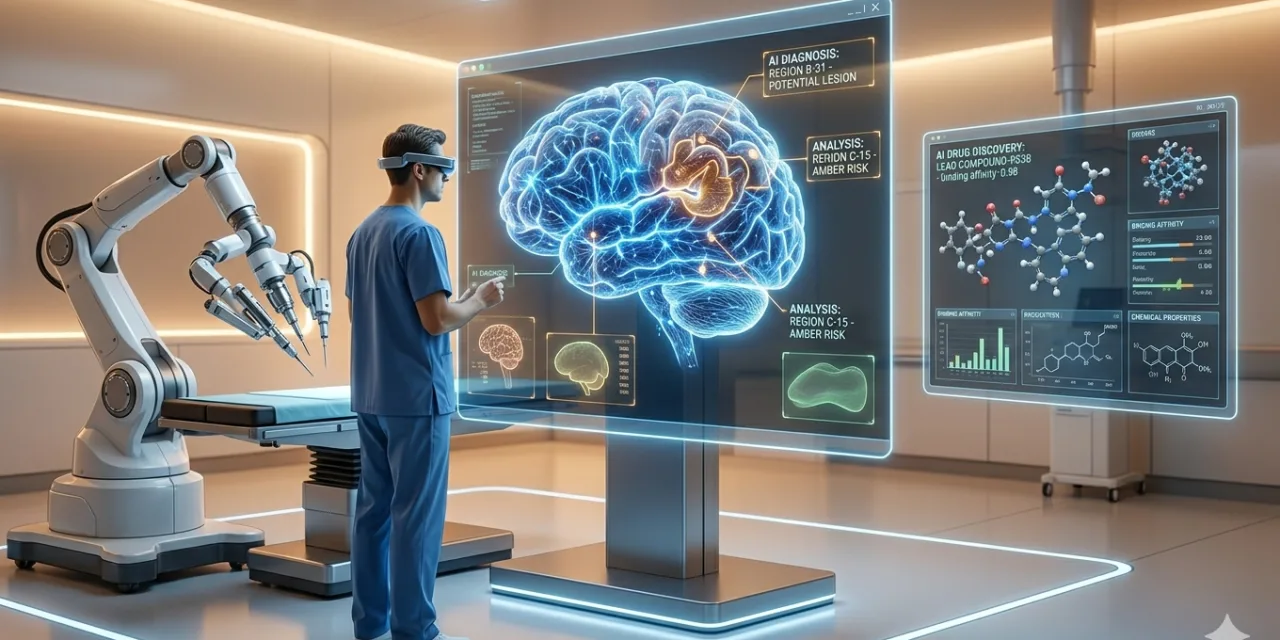
In 2020, the AI in healthcare market was worth approximately $5 billion. By 2026, it has crossed $45 billion. That is a ninefold increase in six years — a rate of growth that reflects not just investor enthusiasm but measurable clinical results that are now substantial enough to generate sustained institutional commitment. The NVIDIA State of AI in Healthcare and Life Sciences 2026 survey found that 44 percent of healthcare management respondents say AI has helped increase annual revenue by more than 10 percent. Among smaller healthcare companies, that figure rises to 56 percent. The same survey found that 35 percent of organisations report AI has reduced annual costs by 10 percent or more. AI in healthcare is no longer experimental. It has crossed the threshold into operational dependency — the point at which removing it would measurably impair performance rather than merely reverting to a prior state.
The transformation is happening across every layer of healthcare simultaneously. In radiology departments, AI algorithms achieve up to 94 percent accuracy in tumour detection, exceeding human performance in controlled settings. Across an 11-hospital network at Northwestern Medicine, AI boosted radiology report completion efficiency by an average of 15.5 percent, with some radiologists achieving gains as high as 40 percent — without compromising diagnostic accuracy. In pharmaceutical research, AI is identifying novel drug candidates in weeks rather than years, compressing timelines that previously stretched across decades. In hospital operations, AI is projected to reduce administrative costs by $20 billion annually in the US alone. And for the physicians at the centre of it all, AI-assisted documentation tools have reduced clinician burnout rates from 51.9 percent to 38.8 percent in facilities that have deployed them.
This guide covers the full picture of AI in healthcare in 2026: The specific applications transforming clinical practice, the measurable outcomes being achieved, the areas where the technology’s limitations remain important, and the structural questions about privacy, ethics, and equity that healthcare organisations deploying AI must address. Medicine is changing faster than most patients know and faster than most physicians anticipated. Understanding what AI is actually doing — and what it cannot yet do — matters for anyone who receives healthcare, provides it, or pays for it.
AI in Diagnostic Imaging: The Clearest Wins So Far
Radiology is the domain in which AI’s impact on healthcare is most advanced, most thoroughly validated, and most consequential for patient outcomes. The numbers explain why radiology accounts for 76 percent of all AI-enabled medical device authorisations by the FDA through end of 2025: the underlying task — identifying abnormalities in visual data — is precisely the kind of pattern recognition task at which deep learning systems excel when trained on sufficient labelled examples, and the consequences of both missed diagnoses and false positives are severe enough to make any accuracy improvement clinically significant.
The scale of the diagnostic imaging challenge makes AI’s role not merely beneficial but increasingly necessary. Hospitals globally conduct around 3.6 billion imaging procedures every year, according to WHO data. Radiologists in some facilities interpret up to 1,000 exams daily. The global AI in medical imaging sector is expected to address a 30 to 40 percent workforce gap among radiologists — a gap that reflects both the shortage of trained radiologists in many health systems and the pace at which imaging volume is growing relative to the supply of professionals to read it. AI does not replace the radiologist; it enables the radiologist to work at a scale and speed that would otherwise require significantly more personnel.
The accuracy data is compelling. AI reduces the time to interpret chest X-rays by 35.81 percent and significantly increases specificity. AI reduces false negatives per radiology case by 67 percent in trauma X-ray applications. AI-supported hospitals report a 42 percent reduction in diagnostic errors compared to non-AI facilities. For the specific task of tumour detection — where a false negative can mean a cancer missed at a treatable stage — AI algorithms achieving 94 percent accuracy in controlled settings represent a genuine advance over the human baseline in fatigue conditions, which is when the majority of high-volume diagnostic interpretation occurs.
The practical implementation of AI imaging tools has moved well beyond academic research. Major hospital systems are running AI triage tools that flag high-priority cases — suspected strokes, pneumothorax, pulmonary embolism — for immediate review, ensuring that the most urgent diagnoses reach radiologists first regardless of queue position. Dermatology AI tools are enabling primary care physicians and even patients to screen for melanoma at a level of accuracy that previously required specialist referral. Ophthalmology AI is detecting diabetic retinopathy in fundus photographs with sufficient accuracy that it is being deployed at population scale in countries including Thailand, the UK, and Singapore to screen the millions of diabetic patients who currently have no access to ophthalmologist review.
AI in Drug Discovery: Compressing the Timeline from Decades to Years
Traditional pharmaceutical drug discovery is one of the most expensive and least efficient processes in any industry. Taking a new drug from initial discovery to market approval costs on average $2.6 billion and takes between ten and fifteen years, with failure rates above 90 percent in clinical trials. The inefficiency is structural: identifying among billions of possible molecular structures those that are likely to bind effectively to a specific disease target, have acceptable safety profiles, and can be manufactured and delivered reliably requires testing enormous numbers of candidates through progressively more expensive and time-consuming stages.
AI changes this equation at every stage. In virtual screening — the initial identification of candidate molecules — AI enables pharmaceutical companies to analyse millions of molecular structures computationally, identifying candidates with favourable binding characteristics far faster than any physical screening process. AI identifies novel drug candidates within weeks rather than the years that conventional methods require for the same scope of search. AI models predict molecular interactions and optimise chemical synthesis, evaluate candidates against safety and pharmacokinetic parameters, and generate novel drug-like molecules by learning from compound databases and experimental outcomes — expanding the chemical space available for discovery beyond what human chemists could explore through intuition and manual analysis.
The drug repurposing application is particularly compelling from a health economics perspective. By identifying new therapeutic applications for approved medications — drugs whose safety profiles are already established and whose manufacturing processes already exist — AI dramatically reduces the time and regulatory burden required to bring the new indication to market. AI accelerates drug repurposing by uncovering new therapeutic applications for existing compounds, reducing both development risk and time to market.
BCG’s analysis of AI in healthcare in 2026 identifies Agentic AI as the next major inflection point in drug development: autonomous AI agents capable of generating new molecules, simulating how they will interact and behave in the body, and iterating on candidate structures in ways that compress the development timeline from years to months. The drug discovery technologies market is projected to reach $77.6 billion in 2026 — nearly double by 2032 — fuelled by AI-native platforms that are restructuring the economics of pharmaceutical R&D. Generative AI alone is estimated to deliver $60 to $110 billion annually in value for the pharma industry by some projections, primarily through the acceleration of the discovery and development pipeline.
The regulatory environment is adapting alongside the technology. The FDA released its first draft guidance on the use of AI in drug and biologic development as of January 2026, noting that AI use in regulatory submissions has increased exponentially since 2016. The first approvals of fully AI-discovered drugs are expected in the coming years based on current clinical trial timelines, representing a milestone that will mark the definitive arrival of AI as a drug-creating technology rather than merely a drug-finding tool.
AI and Clinical Documentation: Giving Time Back to Clinicians
One of the most practically significant — and most underreported — applications of AI in healthcare is the automation of clinical documentation. The average physician spends two to three hours on documentation for every hour of patient care. Emergency physicians often complete charts for eight to twelve hours after their clinical shifts end. Healthcare workers across disciplines spend up to 70 percent of their time on administrative tasks. This documentation burden is cited consistently as the primary driver of physician burnout, early retirement, and the growing workforce crisis in medicine. AI-assisted documentation is addressing this directly.
The technology at the core of AI clinical documentation is ambient clinical intelligence — systems that listen to physician-patient conversations in real time, extract the clinically relevant information, and generate draft clinical notes in the physician’s voice and in the format required by the electronic health record system. The physician reviews and approves the note rather than dictating or typing it from scratch. The result is a dramatic reduction in documentation time for the physician and, frequently, an improvement in documentation quality and completeness — because the AI captures the full clinical encounter rather than relying on the physician’s post-encounter recall.
Microsoft’s Nuance DAX Copilot, Epic’s ambient AI documentation tools, and several competing systems from specialist health IT companies are now deployed across thousands of hospital systems in the US, UK, and Australia. The clinical results are measurable: clinician burnout declined from 51.9 percent to 38.8 percent after short-term use of AI-assisted documentation tools in facilities that have deployed them — a reduction in one of the most expensive and most human-cost-intensive problems in healthcare. Adobe Population Health’s deployment of Salesforce Agentforce reported saving more than $1 million annually in clinical staff time through AI-assisted workflow automation — time that was returned to direct patient care.
The EHR integration trajectory for 2026 is significant. Major EHR vendors including Epic and Oracle’s Cerner have released AI documentation tools for widespread use. AI-generated progress notes are accepted by CMS and major insurance providers for billing purposes. By late 2026, AI is expected to be integrated with specialty-specific templates and guidelines, meaning that a cardiology note will automatically include relevant cardiac risk factors and guideline recommendations drawn from the patient’s record without requiring the physician to manually cross-reference. The practical consequence of this trajectory is that the physician’s interaction with the EHR — historically one of the most despised dimensions of modern clinical practice — is being restructured from a data-entry burden into a review and approval function.
Precision Medicine: AI Tailoring Treatment to the Individual
The standard model of medicine treats similar patients similarly — the same diagnosis receives the same treatment protocol, adjusted for broad demographic factors like age and weight. This approach is limited by the fact that patients with the same diagnosis often respond very differently to the same treatment, for reasons rooted in their genetic makeup, microbiome, metabolic profile, lifestyle, and the specific molecular characteristics of their disease. Precision medicine is the approach that attempts to account for these differences by tailoring diagnosis and treatment to the individual. AI is the technology that makes this approach scalable beyond the most specialised academic medical centres.
In oncology — the domain where precision medicine has advanced furthest — AI analyses tumour genomics to identify which molecular subtype of a cancer a specific patient has, which pathways are driving tumour growth, which targeted therapies those pathways are susceptible to, and which patients are likely to respond to immunotherapy. This molecular characterisation has transformed cancer treatment in the past decade: cancers that were previously treated as single diseases are now understood to be dozens of molecularly distinct conditions requiring different therapeutic approaches. AI makes the computational analysis of the genomic, proteomic, and imaging data required for this characterisation practical at clinical scale rather than only at research scale.
In pharmacogenomics — the study of how genetic variation affects individual responses to drugs — AI enables treatment selection based on the patient’s specific genetic variants affecting drug metabolism rather than on population-average efficacy data. In depression treatment, for example, rather than the current trial-and-error approach to antidepressant selection (in which the right drug is often identified only after several failed trials over months), AI analyses genetic variants affecting metabolic pathways, patient history, and symptom profile to recommend the antidepressant most likely to be effective with minimal side effects for that specific patient. BCG identifies AI-supported precision medicine tailored to individual genetics, environment, and lifestyle as one of the most transformative near-term opportunities — enabling providers to predict conditions like Alzheimer’s or kidney disease years before symptoms appear and intervene preventively rather than reactively.
Wearable health technologies are expanding the precision medicine data foundation into continuous real-time monitoring. The Roche Accu-Chek SmartGuide, which received CE-mark approval in September 2025, integrates with predictive AI algorithms that forecast glucose levels up to two hours ahead and overnight for up to seven hours — enabling diabetic patients and their care teams to intervene proactively rather than responding to hypoglycaemic events after they occur. The integration of continuously collected biosensor data with AI clinical decision support creates a monitoring infrastructure of unprecedented precision for chronic disease management, enabling treatment adjustments based on real-time patient-specific data rather than periodic clinic measurements.
AI in Surgery and Robotic Systems
Surgical robotics represents the physical frontier of AI in healthcare — the point at which the technology leaves the screen and operates on the patient directly. The da Vinci Surgical System, now in its fifth generation, has performed millions of minimally invasive procedures globally, with AI integration enabling unprecedented precision in the execution of planned surgical movements and real-time guidance from intraoperative imaging. AI-assisted surgeries could shorten hospital stays by over 20 percent, with potential annual savings of $40 billion in reduced post-operative care costs.
The AI dimension of surgical robotics is evolving beyond instrument control assistance into surgical planning, intraoperative guidance, and outcome prediction. AI analyses preoperative imaging to generate patient-specific surgical plans that account for individual anatomy, identifies optimal entry points and instrument trajectories that minimise tissue disruption, and provides real-time overlay guidance during the procedure based on continuous correlation of the surgical field with the preoperative plan. In neurosurgery, where the margin between successful tumour resection and permanent neurological damage can be measured in millimetres, AI-guided navigation that maintains real-time correlation between the planned resection and the actual intraoperative anatomy is clinically significant.
Robotic systems are also advancing in rehabilitation and physical therapy. AI-powered exoskeletons assist patients recovering from strokes or spinal cord injuries by providing movement support calibrated to the patient’s current capability and adjusting in real time based on electromyographic signals. These systems not only provide physical assistance but actively promote neuroplasticity — the brain’s ability to rewire connections — by providing immediate proprioceptive and sensory feedback during assisted movement.
Predictive Analytics and Preventive Care
One of the most significant structural shifts that AI is enabling in healthcare is the transition from reactive sick care to proactive predictive care. Traditional healthcare waits for patients to become sick and then treats their illness. AI-powered predictive analytics identifies which patients are at elevated risk of specific conditions before those conditions develop, enabling preventive interventions that are both cheaper and more effective than late-stage treatment.
Across 71 percent of US acute-care hospitals that have integrated predictive AI into their electronic health record systems — up from 66 percent the previous year — AI models are continuously analysing patient data to identify early warning signals for sepsis, falls, hospital-acquired infections, readmission risk, and deterioration requiring intensive care. Sepsis is one of the most time-critical conditions in hospital medicine: early identification enables antibiotic intervention before the systemic inflammatory cascade reaches a threshold from which recovery is significantly less likely. AI sepsis prediction tools that analyse vital signs, lab values, medication orders, and nursing documentation are reducing sepsis mortality in facilities that have deployed them.
At a population health level, AI prediction models are enabling health systems to identify which patients in their registered populations are at highest risk of hospitalisation, emergency department visits, or specific chronic disease progression — and to direct preventive care resources toward those patients proactively. The cost economics of this approach are compelling: preventing a hospitalisation saves dramatically more than the cost of the preventive intervention, and AI-guided targeting of preventive resources concentrates them on the patients where the return on investment is greatest.
The Challenges That Must Be Addressed
The advances above are real, measurable, and substantial. They are also incomplete — and the gaps in AI healthcare performance are clinically significant enough that honest assessment of them is as important as enthusiasm about the results.
Algorithmic bias and health equity is the most serious structural concern about AI in healthcare at scale. AI systems trained on historical medical data inherit the inequities embedded in that data — diagnostic tools trained primarily on imaging from lighter-skinned patients may perform worse on darker skin tones, clinical risk models trained on data from populations with better healthcare access may perform poorly on underserved populations, and language models fine-tuned on the medical literature of wealthy countries may not generalise well to disease presentations that are more common in lower-income settings. Identifying and correcting these biases requires deliberate attention to dataset composition, disaggregated performance evaluation across demographic groups, and post-deployment monitoring that specifically looks for performance disparities.
Data privacy and security are foundational concerns for any healthcare AI application, because the underlying data is among the most sensitive that exists and because healthcare organisations are consistent high-value targets for cybersecurity attacks. AI systems require access to large amounts of patient data to train and operate effectively, and each expansion of data access creates additional exposure for the patients whose data is involved. Federated learning — a technical approach that allows AI models to be trained on data distributed across multiple institutions without the data leaving those institutions — is one of the most promising approaches to enabling AI training without the centralisation of sensitive data that creates the largest privacy risks.
Regulatory adaptation is lagging behind technical capability. The FDA has approved AI-enabled medical devices at an accelerating pace — radiology tools, clinical decision support systems, surgical planning software — but the framework for ongoing monitoring of AI system performance after approval remains less developed than the framework for initial approval. An AI system that performs well on the distribution of cases present at the time of approval may perform differently as patient populations, disease patterns, and clinical practices change. Developing the post-market surveillance mechanisms that ensure AI systems remain safe and effective as deployed conditions evolve is an active area of regulatory development in the US, EU, and UK.
The human-AI interface in clinical practice requires sustained attention. Clinicians interacting with AI diagnostic or decision support tools need to understand enough about how the tool works to use it appropriately — to know when to trust its output and when to override it, to recognise when a case falls outside the distribution on which the tool was trained, and to maintain the clinical reasoning skills that are essential when AI tools fail or produce outputs requiring critical evaluation. Alert fatigue — the desensitisation that occurs when clinicians are exposed to too many AI-generated alerts, most of which are not actionable — is a real and growing problem that degrades the value of otherwise useful AI tools. Designing AI clinical tools that surface the right information to the right clinician at the right moment, rather than maximising the volume of alerts generated, is as much a human factors challenge as a technical one.
Where AI in Healthcare Goes Next
The trajectory of AI in healthcare over the next three to five years is defined by three converging forces: expanding capability, improving evidence, and deepening integration.
Expanding capability is driven by the continuing improvement of foundation models, the accumulation of healthcare-specific training data at scale, and the emergence of agentic AI systems that can autonomously manage complex multi-step clinical workflows. BCG identifies agentic AI in healthcare as the next major wave — autonomous agents that manage prior authorisation processes, coordinate care across multiple providers, monitor patients remotely and escalate based on predefined clinical thresholds, and run the administrative infrastructure of healthcare organisations with minimal human involvement for routine processes. The compression of drug development timelines from decades to years to — eventually — months through agentic AI systems capable of autonomous molecular design and biological simulation represents potentially the most consequential change to medicine since the development of randomised clinical trials.
Improving evidence is accumulating as AI tools deployed at scale generate the longitudinal outcome data that early adopters lacked. The shift from controlled research settings to real-world deployment across millions of patients and hundreds of millions of clinical encounters is generating the evidence base that regulators, payers, and cautious clinicians require before wide-scale adoption. The facilities and health systems that are deploying AI tools now are building the institutional capability — the data infrastructure, the workflow integration, the clinical expertise in AI use — that will define competitive position in healthcare as the technology matures.
Deepening integration — the embedding of AI into the workflows and infrastructure of healthcare rather than its operation as a parallel system that clinicians consult when prompted — is the organisational transformation that most determines whether AI’s clinical potential is realised or remains a set of impressive demonstrations. The physician who does not need to log into a separate AI system to benefit from it, because the AI is embedded invisibly into the EHR workflow they already use, will derive more value and introduce fewer errors than the physician who uses AI as an adjunct tool. The hospital that has integrated AI triage, documentation, and decision support into a coherent operational architecture will outperform one that has deployed a collection of isolated AI tools. Getting this integration right — technically, organisationally, and culturally — is the work that healthcare leaders are doing right now and that will define the patient experience of medicine for decades to come.




0 Comments
No comments yet. Be the first to share your thoughts!