
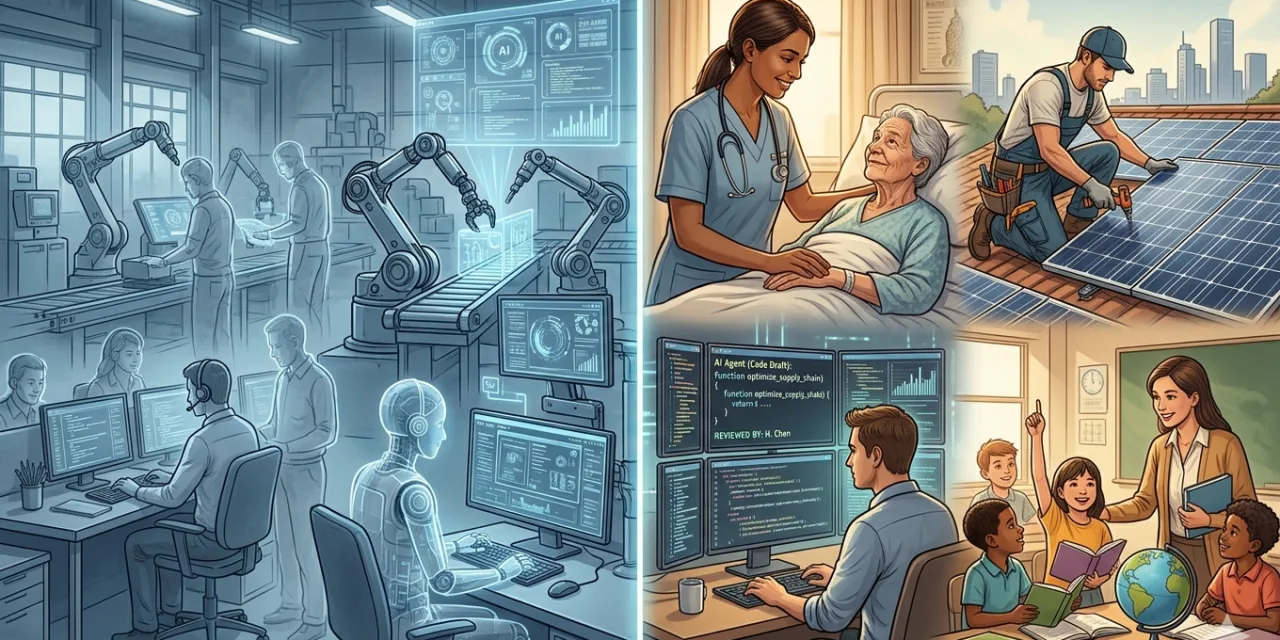
Between January and June 2025, companies reported 77,999 tech job cuts directly connected to AI adoption — hundreds of people losing jobs every working day. In the same period, demand for roles requiring AI literacy, analytical reasoning, and human judgment grew by 20 percent in job posting data covering nearly all US employers. Both of these things are true simultaneously, and both matter for understanding what is actually happening to work as Artificial Intelligence matures from experiment to infrastructure.
The public conversation about AI and employment tends to flatten into a binary that neither the data nor the lived experience of most workers supports. On one side: the displacement narrative, in which AI is a job-destroying force marching through industry after industry, leaving unemployment in its wake. On the other: the utopian counter-narrative, in which every job lost to automation is cleanly replaced by a better one, just as happened after previous waves of technological disruption, and everyone who adapts will be fine. Both narratives are too simple. The reality is that AI is disrupting employment in specific, structurally predictable ways — automating tasks that are codifiable, repetitive, and rule-bound while leaving or expanding roles that require emotional intelligence, physical dexterity in unstructured environments, genuine creativity, or complex contextual judgment that current AI systems cannot replicate.
This guide covers the full, evidence-based picture. The scale of displacement that is already measurable and the scale of what is still projected. The specific job categories facing the highest risk. The specific jobs and career domains that are most resilient and why. The skills that provide durable protection against automation. The new roles that AI is actively creating. And the wage and opportunity data that reveals where the real advantage currently lies for workers who engage with AI rather than resist it.
The Scale of What Is Already Happening
The statistics on AI’s impact on employment vary significantly depending on the time horizon and methodology, but the near-term data is now concrete enough to provide clear directional signals. AI contributed to 4.5 percent of total reported job losses in 2025 — a number that sounds small in isolation but represents a measurable and growing share of overall displacement, distinct from the cyclical and structural job losses that occur in any given year. About one in six employers surveyed expects AI to reduce headcount in 2026. Approximately 30 percent of US companies report having already replaced workers with AI tools, and nearly 40 percent of companies that adopt AI choose automation rather than using AI to support and augment their existing workforce.
For the tech sector specifically, the pattern is particularly visible. Employment in computer systems design and other AI-exposed sectors is trailing the broader economy’s employment growth, even as wage growth in those same sectors significantly outpaces national averages. The Federal Reserve Bank of Dallas’s February 2026 analysis of this apparent contradiction offers a precise explanation: AI is simultaneously automating the codifiable, knowledge-based tasks that entry-level workers perform and augmenting the experienced, tacit-knowledge-heavy work that senior workers do. The result is a labour market in which experienced professionals in AI-exposed fields are seeing strong wage growth, while new graduates entering those same fields are finding a dramatically tougher job market — not because they are being laid off, but because the entry points are disappearing.
A Harvard Business Review analysis published in March 2026, reviewing US job postings from 2019 through early 2025, captures this dynamic with particular clarity. After ChatGPT’s public debut, job openings for routine, automation-prone roles fell 13 percent. Demand for more analytical, technical, and creative jobs grew 20 percent over the same period. The jobs market is not uniformly contracting or uniformly expanding — it is restructuring, shifting its demand upward in skill complexity and toward tasks where human comparative advantage over AI remains meaningful.
The projections for the medium term — the next five to ten years — are considerably more dramatic. Goldman Sachs estimates that generative AI could replace the equivalent of 25 million full-time jobs by the end of 2026 and up to 270 million by 2030, while noting that roughly two-thirds of current jobs are exposed to some degree of AI automation. The World Economic Forum’s Future of Jobs Report 2025 projects that around 92 million jobs worldwide could be replaced or substantially transformed by 2030 — approximately 8 percent of today’s total global workforce. MIT and Boston University research estimates that AI-driven robotics will have replaced approximately 2 million manufacturing workers globally by 2026. These projections vary widely in their methodology and assumptions, but they converge on a central finding: the scale of disruption, already measurable and real in 2026, will accelerate through the end of the decade.
The Jobs Facing the Highest Risk
AI disruption is not distributed evenly across the labour market. It concentrates in roles where the work is primarily composed of codifiable, rule-bound tasks — activities that can be described as precise instructions, follow predictable decision trees, and produce outputs whose quality can be measured against a defined standard. The harder those criteria are to meet for a specific role, the more resilient that role is to automation. The more completely a role’s work can be described as a set of instructions for processing information inputs into information outputs, the more exposed it is.
Data entry and administrative support roles face the most acute near-term risk. Manual data entry clerks face a 95 percent automation risk, as AI systems can process over 1,000 documents per hour with an error rate below 0.1 percent, compared to a 2 to 5 percent error rate for humans. AI automation could eliminate 7.5 million data entry and administrative jobs by 2027. Bank tellers are projected to see employment decline 15 percent from 2023 to 2033, eliminating approximately 51,400 positions, as digital banking expands. Cashier employment is projected to decline 11 percent over the same period — a reduction of 353,100 jobs — as self-checkout and automated payment systems reach saturation in retail environments.
Customer service and call centre roles are undergoing rapid structural change. Around 80 percent of customer service roles are projected to be automatable as AI agents become capable of resolving complex customer queries independently. Telemarketers and call centre agents are already being displaced at scale by AI-driven systems that can handle inbound queries, process complaints, update account information, and escalate edge cases to human agents. The adoption of AI chatbots is expected to save businesses $8 billion annually in operational costs — savings that come primarily from reduced headcount requirements in customer-facing support functions.
Legal support and paralegal work faces significant near-term disruption. Paralegals face an 80 percent risk of automation as AI systems become capable of conducting legal research, drafting routine legal documents, reviewing contracts for standard clauses, and flagging anomalies in large document sets. Legal researchers face a 65 percent automation risk by 2027. The underlying tasks of legal support work — searching case law, summarising precedent, cross-referencing documents, checking for consistency — are structurally well-suited to the document processing and pattern recognition capabilities of large language models. The implication is not that lawyers will be replaced, but that the ratio of lawyers to legal support staff will shift dramatically as AI handles the work that previously required a team.
Healthcare administrative and transcription roles are also significantly exposed. Medical transcription is already 99 percent automated. Medical coding — translating clinical documentation into standardised billing codes — is projected to be 40 percent automated by 2025, with further acceleration expected. The Bureau of Labor Statistics projects medical transcriptionist employment to decline 4.7 percent from 2023 to 2033. The pattern in healthcare is characteristic of AI disruption more broadly: the clinical and human-facing roles are expanding while the administrative infrastructure roles are contracting.
Content creation roles that depend on routine production — standardised article formats, basic marketing copy, product descriptions, templated reports — are facing sustained pressure from generative AI tools that can produce equivalent quality output at a fraction of the time and cost. Digital marketing content writers are projected to see a 50 percent decline in roles by 2030. Reporter and writer positions are expected to shrink by 30 percent over the same period. In both cases, the risk is concentrated at the commodity end of the market — the volume-based, format-driven content that was never particularly differentiated. Original reporting, distinctive voice, deep domain expertise, and genuinely creative writing face considerably lower automation risk, because these require the kind of contextual judgment and original thought that AI consistently underperforms on relative to its performance on well-defined generation tasks.
What AI Cannot Replicate: The Durable Human Advantages
Understanding which jobs are most resilient to automation requires understanding what makes human labour difficult for AI to replace — and the answer is not, as the simplest version of the story suggests, merely “creativity” or “emotion.” The genuine human advantages that make roles resilient are more specific and more structural than this framing suggests.
Tacit knowledge and experiential judgment: The Federal Reserve Bank of Dallas research identifies this as the most consequential distinction in the labour market. Tacit knowledge — understanding gained through experience, developed through years of practice in complex, variable environments — is qualitatively different from codifiable knowledge that can be extracted from text and encoded in a model’s parameters. An experienced emergency room physician’s ability to recognise a deteriorating patient before the vital signs formally flag a problem is tacit knowledge. A master electrician’s ability to diagnose a fault in an unusual installation is tacit knowledge. A skilled negotiator’s ability to read the emotional dynamics of a room and adjust in real time is tacit knowledge. AI systems trained on text can describe these capabilities in detail but cannot perform them reliably in the unpredictable, high-stakes, physically embedded environments where they actually matter.
Genuine emotional intelligence and human relationship: There is a meaningful difference between performing emotional intelligence — producing text that seems empathetic, generating responses that mirror emotional signals — and experiencing and responding to the full richness of human emotional interaction in real time. Therapists, counsellors, and social workers provide care that depends not merely on saying the right thing but on genuinely perceiving, processing, and responding to complex emotional states in another human being. The US Bureau of Labor Statistics projects strong growth for mental health counsellors and social workers through 2032, precisely because the demand for human emotional support is growing at the same time that AI capability in clinical emotional contexts is plateauing. Patients can detect — and will not accept as equivalent — care that substitutes AI-generated language for genuine human presence.
Physical dexterity in unstructured environments: Robotics and physical AI are advancing rapidly, but the gap between AI capability in controlled, structured physical environments (manufacturing assembly lines, warehouse sorting) and its capability in variable, unstructured physical environments (a typical residential plumbing job, a complex electrical installation, a rooftop solar panel deployment) remains significant. Skilled tradespeople — electricians, plumbers, HVAC technicians, carpenters, mechanics — work in environments that are unique in their physical particulars every single time. A 42 percent share of Gen Z workers are either already in or planning to enter blue-collar or skilled trade jobs, including 37 percent of those with bachelor’s degrees — a trend that reflects both the resilience of these roles and the growing awareness among young workers that the credential-to-office-job pipeline is considerably less reliable than it was a decade ago.
Accountability, liability, and professional responsibility: Many of the roles most resistant to automation are resistant not because the underlying cognitive tasks are beyond AI capability, but because the accountability structures surrounding those tasks require a licensed, responsible human to be present. A doctor who uses AI to assist with diagnosis remains the legally and ethically responsible party for the diagnosis. A lawyer who uses AI to draft a contract remains the professionally responsible party for its contents. An architect who uses AI to generate structural designs remains the licensed professional responsible for the building’s safety. The accountability requirement — the human whose professional reputation, legal liability, and ethical responsibility is on the line — creates a structural floor beneath which automation cannot go in any regulated professional domain.
The Careers Most Resilient to AI Disruption
Drawing on the structural analysis above and the most current research from WEF, PwC, McKinsey, and the Bureau of Labor Statistics, the following career domains have the strongest combination of resilience factors in 2026.
Healthcare — clinical and direct patient care: Nursing, medicine, physical therapy, occupational therapy, and direct care work all combine tacit clinical knowledge, physical patient interaction, emotional intelligence, and regulatory accountability in proportions that make comprehensive automation implausible within the foreseeable time horizon. The WEF explicitly calls out aging populations as a structural driver of healthcare employment growth that will sustain demand for human clinical roles regardless of AI capability. Healthcare and social work professions are projected to add millions of new roles by 2030. Indeed’s 2025 analysis lists nursing among the roles least touched by automation — not because AI cannot assist with clinical tasks, but because AI assistance in healthcare is additive (handling documentation, monitoring vitals, flagging anomalies) rather than substitutive for the human clinical relationship.
Skilled trades — electrical, plumbing, HVAC, construction: The physical variability of trade work, the combination of spatial reasoning and manual dexterity required, and the consistently strong demand from aging housing stock and the infrastructure build-out required by the energy transition create a labour market picture for skilled trades that is substantially better than for most knowledge work categories facing AI disruption. Electricians supporting the solar, EV charging, and battery storage build-outs of the energy transition are in active shortage in most major markets. HVAC technicians servicing an expanding fleet of heat pumps replacing gas heating systems are similarly constrained. These roles also cannot be offshored — they must be performed on-site, in the physical location where the work is needed.
Mental health and social services: The demand for mental health support is growing faster than trained professionals can supply it, a situation that AI cannot resolve because AI-delivered mental health support is not equivalent to human-delivered support for the people who need it most. Therapists, counsellors, psychologists, and social workers possess capabilities — genuine human understanding, the ability to hold space for distress, the ethical presence that makes therapeutic trust possible — that current AI systems can approximate linguistically but not deliver substantively. Social work specifically, with its requirement for navigating complex human systems (family dynamics, institutional barriers, housing instability, substance use) in real-world environments, is among the roles most dependent on tacit judgment developed through field experience that AI cannot replicate.
Teaching and education: While AI is transforming some dimensions of education — providing personalised content, automating assessment of structured assignments, generating practice materials — the human teacher’s role as mentor, motivator, and moral authority in a young person’s development is not replicable by an AI system. The relationship between a teacher and a student is not a transaction in which information is transferred: it is a developmental relationship in which the student’s sense of capability, curiosity, and identity as a learner is shaped by the presence of a human who genuinely knows them and cares about their growth. The aspects of teaching that AI assists with (content generation, grading) are the least important dimensions of the role. The aspects that matter most remain stubbornly human.
Leadership, strategy, and complex decision-making: Senior leadership roles that require integrating ambiguous information across multiple domains, making consequential decisions under uncertainty, managing the human dynamics of large organisations, and being accountable for outcomes that affect many stakeholders are among the most resilient to automation — because the value of leadership is inseparable from the accountability, judgment, and human relationship that leadership requires. AI can be a powerful tool for leaders: synthesising data, surfacing options, stress-testing assumptions. It cannot replace the leader who must make the call and stand behind it.
The 56 Percent Wage Premium: Why AI Fluency Is the Most Valuable Skill of 2026
The most important single statistic for individual workers navigating the AI labour market is this: PwC’s AI Jobs Barometer shows a 56 percent wage premium for workers who use AI effectively. This is not a premium for AI engineers or data scientists — it is a premium for workers across a wide range of occupations who have developed the ability to leverage AI tools to deliver better outcomes in their existing domain. The nurse who uses AI to manage documentation more efficiently and focuses her reclaimed time on patient care is not at risk of being replaced by AI — she is making herself more valuable by using it. The accountant who uses AI to handle routine reconciliation and redirects his attention to complex advisory work is not being displaced — he is delivering more senior-level value without requiring senior-level support staff.
PwC’s research adds a complementary finding: skills in the most AI-exposed occupations are changing 66 percent faster than in the least exposed ones. This acceleration creates both urgency and opportunity. Workers who update their skill stack — learning to prompt effectively, to evaluate AI output critically, to identify where AI tools genuinely accelerate their work and where they introduce errors — compound their advantage over peers who resist engagement with the technology. Workers who wait for the technology to stabilise before adapting will find themselves in an increasingly difficult position in a market where the pace of skill demand change is already significant and accelerating.
The WEF projects that by 2030, 59 out of every 100 workers will need some form of retraining related to the changing skill demands of their role. Employers plan to upskill significant proportions of their existing workforce, hire for new skills where gaps exist, and reduce headcount where AI automates tasks that previously required human labour. The net projection from WEF’s Future of Jobs Report is actually net positive: while approximately 92 million jobs may be displaced by 2030, approximately 170 million new roles are expected to emerge in the same period. The challenge is that the displaced roles and the created roles are not the same roles in the same places for the same people — the displaced data entry clerk and the created AI trainer are different people with different skills in different locations, and the transition between them requires investment, time, and institutional support that does not happen automatically.
The New Jobs That AI Is Creating
The job creation side of the AI equation receives considerably less attention than the displacement side, partly because displacement is more visible (a specific person loses a specific job) and partly because new job categories are harder to describe before they are common. But the pattern of technology-driven job creation in previous waves of disruption is consistent: every major technology that automates a category of work creates new demand for workers who can build, maintain, govern, and work alongside the new technology. AI is no different.
AI training and fine-tuning specialists — people who understand how to shape the behaviour of AI models for specific domains and use cases — are among the fastest-growing roles in the technology labour market. Prompt engineers, who understand how to formulate instructions to AI systems to produce optimal outputs for specific tasks, are in demand across industries ranging from legal services to financial analysis to content production. AI safety and alignment researchers, who work on ensuring that AI systems behave reliably, transparently, and in accordance with human values, are among the most highly compensated roles in technology. AI governance specialists, who help organisations navigate the regulatory and ethical landscape of AI deployment, are in active shortage as the EU AI Act and its global equivalents create compliance requirements that most organisations are not yet prepared to meet.
More broadly, every organisation that deploys AI agents and automation tools needs people who can manage the interface between AI systems and human workflows — identifying where AI is adding value, where it is making errors, how to escalate edge cases, and how to continuously improve the system’s performance in the specific context of the organisation’s operations. These roles do not require deep technical AI expertise; they require domain expertise, critical evaluation skills, and the ability to communicate clearly between technical and non-technical stakeholders. They are, in other words, roles that reward the same combination of human judgment, domain knowledge, and communication skill that has always characterised high-performing knowledge workers — with AI fluency added as the new essential layer.
How to Future-Proof Your Career in the Age of AI
The strategic imperatives for individual workers navigating the AI labour market are not complicated, even if they require sustained effort. The workers who will be best positioned in 2030 share a set of behaviours that are visible and learnable right now.
Develop AI fluency, not just AI awareness. There is a significant difference between knowing that AI tools exist and knowing how to use them effectively in your specific domain. The worker who can identify which tasks in their existing role are best accelerated by AI tools, who has developed intuition for when AI output is reliable and when it requires verification, and who can articulate the productivity gains they generate through AI use is delivering measurable additional value to their employer. This is the skill set that produces the 56 percent wage premium PwC identifies — and it requires practice, not just exposure.
Build moat skills: the capabilities that are both high-value and resistant to automation. For most workers, this means deepening expertise in the dimensions of their role that require tacit knowledge, human judgment, or genuine emotional intelligence — the dimensions that AI assists with rather than replaces. A lawyer who is the world’s best at document review is in a vulnerable position. A lawyer who is excellent at client relationship management, strategic judgment on complex disputes, and cross-functional leadership of cases is in a durable position regardless of how capable AI document review becomes. Identify the moat tasks in your role and invest disproportionately in them.
Maintain the ability and willingness to learn. PwC’s finding that skill demands in AI-exposed occupations are changing 66 percent faster than in non-exposed ones is not a temporary feature of the current moment — it is the structural condition of work in a period of rapid technological change. Workers who treat their skills as a fixed stock — accumulated through education and hardened into a stable identity — are at structural disadvantage relative to workers who treat their skills as a continuous investment portfolio, subject to regular reassessment and reallocation. The specific skill mix that is optimal in 2026 will be different from the optimal mix in 2028. Maintaining the habit of learning is more important than the specific content of what is being learned at any moment.
The honest summary of AI’s impact on jobs in 2026 is that it is real, it is structurally predictable, it is creating winners and losers in ways that are already visible in wage and employment data, and it is not an apocalypse. Workers who engage with AI, develop the fluency to use it effectively, invest in the human capabilities it cannot replicate, and maintain the learning habit that allows them to adapt as the technology continues to evolve are positioned well in a labour market that rewards exactly these qualities. Workers who wait, resist, or assume that the disruption will not reach their specific role are making a bet that the evidence of 2026 makes increasingly difficult to justify.





0 Comments
No comments yet. Be the first to share your thoughts!