

Seventy percent of startups fail because they build products nobody wants. Not because the founders were not smart enough, or did not work hard enough, or failed to raise enough money, or hired the wrong people. Because they built something that they believed deeply in — and that the market, when given the opportunity to vote with its wallet, rejected quietly and completely.
This is the most preventable form of startup failure there is. And in 2026, it has no excuse.
The era of “build it and they will come” is definitively over. It was always a bad strategy, but it was at least an understandable one when building software required months of expensive engineering time, making the cost of iterating based on market feedback prohibitively slow. That constraint is gone. The cost of building software has plummeted because of AI-assisted engineering, no-code tools, and cloud infrastructure priced for experimentation. The cost of attention — of acquiring customers, of getting someone to notice your product in a saturated digital landscape — has skyrocketed. This inversion of the startup economy means that the scarce resource is not your ability to build. It is your ability to know what to build before you spend a single dollar building it.
Startup validation is not a preliminary step you do before the real work begins. In 2026, it is the most critical discipline a founder can develop — the systematic process of determining whether a business idea has genuine commercial merit before committing the time, money, and reputational capital that building a company requires. Companies that conduct thorough idea and market validation are two and a half times more likely to succeed than those that do not. That is not a marginal advantage. It is a structural one.
This guide covers every dimension of startup idea validation that matters in 2026 — from the foundational question of whether you have found a real problem worth solving, through the customer discovery process that separates genuine insight from comfortable delusion, to the AI-enhanced validation toolkit that compresses months of traditional research into weeks, to the specific signals that tell you whether to persist, pivot, or walk away. It is written for founders at the very beginning of their journey and for those who have been building for six months and feel the nagging suspicion that something is not quite right.
The goal is not to validate your idea. The goal is to find out whether your idea deserves to be built — and to find out as fast and as cheaply as possible.
The Validation Mindset: Why Most Founders Get This Wrong From the Start
The most common and most destructive mistake in startup validation is not a tactical error. It is a mindset error — the confusion between validation and confirmation.
Confirmation is what most founders are unconsciously doing when they describe their process as validation. They have an idea they believe in deeply. They feel excited about it. They want to believe it is good. And so when they “validate,” they look for evidence that confirms what they already believe — they ask friends who tell them it sounds great, they read market research reports that describe the broad industry their idea sits in, they point to successful companies in adjacent spaces as proof of the concept, and they interpret every piece of encouraging signal as validation while filing away the discouraging signals as not representative or missing the point.
True validation is precisely the opposite of this. It is a scientific process of seeking disproof, not proof. The hypothesis you are testing when you validate a startup idea is not “is my idea good?” — a question that has no falsifiable answer. The hypothesis is “is this specific problem real, frequent, and painful enough for this specific group of people that they will pay money for a solution?” — a question that has clear, testable criteria and that can be definitively falsified by evidence from the people you are hypothesising about.
This distinction matters practically because it changes how you conduct every part of the validation process. Confirmation-seeking founders ask: “Would you use this product?” True validation founders ask: “Tell me about the last time you experienced this problem and what you did about it.” The first question invites a polite yes. The second question produces actual evidence about whether the problem is real in the person’s life, how serious it is, and what solutions they have already tried — information that no amount of favorable nodding can replicate.
Validation velocity is the concept that captures the right operational orientation: success in 2026 is measured by how fast you can invalidate bad ideas, not just validate good ones. The founder who kills three bad ideas in three months and pivots to a fourth that shows genuine traction has spent their time infinitely better than the founder who spent the same three months building the first idea because they were too invested in it to test it honestly. Speed of disproof is the competitive advantage that separates founders who build companies from those who build monuments to their own assumptions.
Step One: Validate the Problem Before You Touch the Solution
The single most important rule in startup validation — the one that, if internalized and followed rigorously, would eliminate the majority of first-time founder failures — is this: validate the problem before you validate the solution.
It sounds obvious. In practice, almost no first-time founders do it. They arrive at the validation process with a solution in mind — an app, a platform, a service, a device — and they test whether people like the solution. What they should be testing, first, is whether the problem the solution addresses is one that people actually have, care about sufficiently, and are currently solving in unsatisfying ways.
The distinction matters enormously. A solution to a problem that is not painful enough to motivate behaviour change will fail regardless of how elegant the solution is. A solution to a real, acute, frequent problem will succeed even if it is imperfect, expensive, and technically basic — because people who have their hair on fire will use the imperfect bucket of water gratefully. The problem’s acuteness determines whether there is a market. The solution’s quality determines market share within that market. Founders who skip problem validation and go straight to solution validation are optimizing the wrong variable.
The framework for evaluating problem quality comes from thinking about two dimensions: magnitude (how much pain does this problem cause when it occurs?) and frequency (how often does it occur?). Problems that are high in both — problems that are severely painful and occur frequently — sit in what experienced investors call the “unicorn zone.” Uber solved a problem — the unreliability and unavailability of taxis — that was high magnitude (you are late, you are stranded, you are at the mercy of a driver who may or may not appear) and high frequency (people need transport constantly). Slack solved a problem — the fragmentation and noise of workplace communication — that was high magnitude and high frequency for professional knowledge workers. These are the categories that produce generational companies.
Problems that are high magnitude but low frequency sit in the enterprise zone — they are painful enough to justify significant investment in a solution when they occur, but they do not occur often enough to drive consumer-level adoption. Palantir and Workday live here — expensive, infrequently purchased, high-value solutions to serious problems that only manifest in specific contexts. Problems that are low magnitude and high frequency are the vitamin zone — people encounter them constantly but are not in enough pain to pay meaningfully for relief. Most habit trackers, most wellness apps, most productivity tools live here. They get downloaded and abandoned. Problems that are low in both dimensions are simply not the basis for a business.
Before you test any aspect of your solution, determine honestly which quadrant your target problem occupies. Be rigorous. Do not assume your problem is in the unicorn zone because you personally find it painful — you may be in a minority. The customer discovery process that follows is precisely designed to tell you what quadrant the market places your problem in, not which one you believe it deserves.
Step Two: Define Your Hypotheses With Precision
Every startup idea is a bundle of assumptions. The assumptions cover who the customer is, what problem they have, how severe that problem is, what solutions they currently use, why those solutions are inadequate, and whether they would pay for the alternative you are proposing. Most of these assumptions are never made explicit — they sit in the founder’s head as beliefs that feel so obvious they do not need questioning. The validation process requires making them explicit, because assumptions you cannot state clearly are assumptions you cannot test.
The Lean Canvas and Value Proposition Canvas are the two most widely used frameworks for making startup assumptions explicit and structured. The Lean Canvas, developed by Ash Maurya as a one-page adaptation of the Business Model Canvas for startups, captures the core assumptions of a business model on a single sheet: the problem you are solving, the customer segment experiencing it, the unique value proposition you are offering, your solution, your channels, your revenue streams, your cost structure, your key metrics, and your unfair advantage. Filling one out rigorously — and being honest about which cells are validated facts versus untested assumptions — is the starting point for systematic validation.
The most important hypotheses to identify and test are not the ones you are most confident about. They are the ones whose failure would kill the business — the riskiest assumptions. In most early-stage startups, the riskiest assumption is not “can we build this?” It is “does anyone care enough about this problem to pay for a solution?” Start with the assumption whose failure is most lethal. If you are wrong about that one, nothing else matters. If you are right about it, you can test the next most dangerous assumption with the confidence that you are building on solid ground.
A well-formed hypothesis in the startup context looks like this: “We believe that [customer segment] experiences [specific problem] with [specified frequency and magnitude], and that they are currently solving it using [existing solutions] which are inadequate because [specific failure modes of existing solutions]. We believe they would pay [price point] for a solution that [core value proposition]. We will know this hypothesis is validated when [specific measurable evidence]: [quantity] interviews confirm the problem without prompting, or [quantity] people pay [amount] for access before we have fully built the product.”
The final clause — the falsification criterion — is what transforms a belief into a testable hypothesis. Without it, you will find ways to interpret ambiguous evidence as confirming your belief. With it, you have a clear standard against which the evidence either qualifies or does not. This standard is not arbitrary. It is derived from the specific evidence that would genuinely convince a thoughtful, sceptical investor that the opportunity is real.
Step Three: Customer Discovery — The Art of Listening Without Selling
Customer discovery is the process of learning about your target customers — their problems, their behaviours, their current solutions, their language, their priorities — through direct conversations and observation, before you have built anything to sell them. It is the most valuable and most widely mishandled activity in early startup development.
The distinction between customer discovery and customer validation is important to maintain. Customer discovery is the first phase: understanding whether the problem you are hypothesising exists in the form and at the intensity you believe. Customer validation is the second phase: testing whether the solution you have designed addresses the problem effectively enough that people will pay for it. Discovery comes first. Many founders skip to validation — they want to show people their idea and get a reaction — before they have completed discovery, and in doing so they miss the unbiased information about the problem that discovery is designed to surface.
The practical mechanics of customer discovery begin with who you talk to. The natural impulse is to start with the most accessible people — friends, family, colleagues, the contacts you know will be supportive. This is precisely the wrong starting point. Friends and family will tell you the idea sounds great because they want to be supportive. They will tell you what they think you want to hear rather than what they actually experience. The signal you need comes from genuine strangers who fit your target customer profile — people who have no relationship with you to protect and no incentive to be kind at the expense of honesty.
Finding these strangers requires deliberate effort. Online communities — Reddit forums, Facebook groups, LinkedIn communities, Discord servers, Slack workspaces — organized around the problem domain you are exploring are among the richest and most accessible sources of target customers. Product Hunt, Indie Hackers, and niche community forums often host concentrated populations of the exact people you need to talk to. Cold outreach on LinkedIn, targeted to the specific job titles or industry roles you believe experience your target problem, has become more manageable with AI-assisted personalization tools. The goal at this stage is not to get many responses. It is to get twenty to thirty genuinely candid conversations.
The interview itself requires discipline in two directions simultaneously: asking the questions that surface real behaviour and real pain, and avoiding the questions that produce polite responses or theoretical commitments. Rob Fitzpatrick’s “The Mom Test” articulates the core principle most clearly: ask about people’s lives, not about your idea. The best customer discovery interviews never mention the solution you are planning. They explore the domain of the problem — how the interviewee currently handles the issue, how often it comes up, what they have tried to fix it, what those attempts cost in time and money, what happens when the current approach fails.
The specific questions that produce genuine insight include: “Tell me about the last time you experienced [problem].” “What did you do about it?” “How long did that take?” “How much did that cost?” “What was the most frustrating part?” “What have you already tried to fix this?” “Why didn’t those solutions work?” “If you could wave a magic wand and change one thing about how you handle this today, what would it be?” Notice that none of these questions mention your idea. They are all questions about the person’s experience. The answers — what they have already done, how much they have already spent, how often the problem surfaces, how frustrated they sound when they describe it — are the evidence that determines whether your problem hypothesis is valid.
After fifteen to twenty interviews, patterns emerge. You hear the same language. The same failure points surface across different conversations. The same workarounds appear repeatedly. If you do not hear patterns after twenty interviews, your target customer segment is too broad — narrow it until the patterns become visible. Patterns are the signal. Isolated anecdotes are noise.
One counterintuitive instruction from experienced customer discovery practitioners deserves emphasis: do not ask people if they would use your product or what they would pay for it. Hypothetical willingness is not evidence of actual willingness. The question “would you pay for something that solved this problem?” reliably produces optimistic responses from people who feel the problem is real. The same people often do not pay when the product is actually available. The evidence that matters is what people have already paid for attempted solutions to the problem — past behaviour is a far more reliable predictor of future behaviour than hypothetical intent.
Step Four: The 2026 AI-Enhanced Validation Toolkit
The validation toolkit available to founders in 2026 is significantly more powerful than what existed even two years ago — AI has compressed what previously took weeks of research into days, and what took days into hours. Knowing how to use these tools effectively is a genuine competitive advantage for early-stage founders operating with limited resources.
AI-assisted secondary research is the logical starting point before any primary customer discovery. Before you invest time in scheduling and conducting interviews, you should have a thorough picture of the landscape: who your potential customers are and where they congregate online, what language they use to describe the problem, what existing solutions exist and what their reviews reveal about their failure modes, what the market size estimates suggest about the opportunity, and whether there are adjacent businesses that have already validated the problem you are addressing. Large language models can synthesize industry reports, analyse Reddit and forum data for problem sentiment, map the competitive landscape, and surface the questions you should be asking in interviews — in an afternoon rather than a week.
The landing page experiment is the fastest and most widely applicable validation test available in 2026. Build a landing page — using Framer, Webflow, or Carrd — that describes your value proposition as if the product exists, includes a clear call to action (waitlist signup, pre-order, or a request to book a demo), and drives a small amount of targeted paid traffic to it. The conversion rate on the call to action is the market’s unbiased response to your value proposition, expressed in behaviour rather than stated preference. A page that converts at five percent or above with cold traffic is typically a signal worth pursuing. One that converts at less than one percent, despite multiple headline and copy variations, is telling you something important about either the problem’s urgency or the clarity of your value proposition.
The fake door test is a specific variant of the landing page experiment designed to test whether people will commit to paying before you have built the product. It places a “Buy Now,” “Get Early Access,” or “Pre-Order” button on your landing page. When clicked, rather than processing a payment, it either adds the user to a waitlist with a message like “you are on the list — we will reach out when we are ready for you” or, in the strongest version, takes them to a payment page and collects a refundable deposit or pre-order payment. Getting people to provide their email is a modest commitment signal. Getting people to hand over money — even a small amount, even with a clear refund promise — is a far stronger signal of genuine willingness to pay, as opposed to theoretical interest.
AI-powered outreach automation allows founders to conduct customer discovery at a scale that would have required an operations team five years ago. LinkedIn Sales Navigator, combined with AI-assisted message personalization, can target hundreds of people matching a specific job title, industry, and company size with personalized introductions that reference their specific context — in hours rather than days. A simple message like: “Hi [Name], I’m researching [specific problem] in [industry]. Would you spare 15 minutes to share your experience? No pitch — just research,” has a response rate that meaningfully exceeds generic outreach, and AI tools can generate and send these personalised messages at a scale no human team could sustain manually.
Concierge MVPs — where you deliver the core value proposition manually, without any underlying technology — are one of the most effective and most underused validation approaches available. Rather than building a platform that algorithmically matches service providers with clients, you manually make the matches yourself for the first ten users. Rather than building an AI tool that analyses financial statements, you analyse them manually for the first clients and deliver the results as if the tool existed. The concierge MVP tells you whether people value the outcome you are promising — independent of whether the technology you plan to build to deliver it at scale is the right approach. Many of the most successful SaaS companies began as concierge services — manual delivery of a value proposition that only later became software when the value was validated and the delivery economics justified engineering investment.
Smoke tests via pre-sales are the gold standard of validation evidence. If people will pay you money before the product is fully built — not a token deposit, but real pre-order revenue — you have the strongest possible market signal available without actually launching. Kickstarter and Indiegogo campaigns work on this principle for consumer products. Enterprise pre-sales, where you close Letters of Intent before writing code, work the same way for B2B software. A Letter of Intent from a business customer that says “if you build X features by Y date, we intend to purchase Z licenses at this price” is not legally binding, but it is evidence that a real buyer with a real budget has evaluated your value proposition and found it compelling. Three to five Letters of Intent from credible businesses with genuine budgets is more powerful validation evidence than any amount of positive interview feedback or landing page conversion data.
Step Five: The Four-Question Framework That Tells You Whether to Build, Pivot, or Walk Away
After completing customer discovery — after the interviews, the experiments, the landing page tests, and the pre-sales conversations — you need a structured way to evaluate what you have learned and decide what to do next. The following four questions provide that structure.
Question One: Is the problem real? This is the most fundamental question and the one that discovery interviews are primarily designed to answer. “Real” means that the people you interviewed consistently described encountering this problem without you prompting them with it, that they described it in consistent language reflecting genuine experience rather than theoretical reaction, and that their behaviour — what they have already tried, what they have already spent — reflects genuine motivation to solve it. If you had to work hard to convince people that the problem you described was real, or if their reactions were polite agreement rather than recognition and frustration, the problem is not real enough.
Question Two: Is the problem painful enough? Problem reality and problem severity are distinct. A real problem that causes mild inconvenience does not motivate purchasing behaviour. The evidence that a problem is painful enough includes: people have already spent time and money trying to solve it; they describe it with emotional intensity when discussing it; existing solutions, however imperfect, have genuine adoption because people are motivated enough to use them despite their flaws; and the cost of the problem — in time, money, missed opportunities, or stress — is clearly quantifiable and significant. The benchmark that experienced investors use is whether the problem is a “hair on fire” pain point — one where even an imperfect solution at a premium price would be gratefully adopted because the alternative is sufficiently bad.
Question Three: Is there willingness to pay at your price point? Willingness to use a free solution and willingness to pay for one are very different things, and confusion between them is one of the most common sources of false validation. The evidence that matters here is not what people say they would pay in interviews — it is what they have paid for existing solutions, what they have put on a waiting list for, what they have pre-ordered, and what they have said in Letters of Intent. If you have found genuine evidence of willingness to pay — pre-orders, deposits, LOIs, or active payment for inferior existing solutions — you have the foundation of a business. If you have found enthusiastic interest in a free version but no evidence that people would pay, you have a marketing problem, not a product opportunity.
Question Four: Can you reach enough of these customers cost-effectively? A real, painful problem that people will pay to solve is still not a viable business if you cannot reach the customers who have it at a customer acquisition cost that your business model can sustain. The addressable market question — how many people have this problem and can afford the solution — is part of this. The distribution question — how will you reach them, what channels will you use, what will it cost to acquire each customer — is equally important. A problem experienced only by a tiny, highly fragmented population that is difficult to reach efficiently may be genuinely real and genuinely painful while still not supporting the economics of a scalable business.
If the answers to all four questions are yes — the problem is real, sufficiently painful, monetizable, and addressable at viable economics — you have a validated basis for building. If one or more answers are no, you face a specific type of pivot: a customer pivot (different customer segment with the same problem), a problem pivot (different problem for the same customer), a solution pivot (different solution to the same validated problem), or an exit decision (this specific opportunity is not viable and your time is better spent elsewhere). Each type of “no” points toward a specific type of pivot, and identifying which question is failing helps you iterate precisely rather than changing everything at once in the hope that something improves.
The MVP in 2026: What It Is, What It Is Not, and How to Build One Right
The Minimum Viable Product concept — the simplest version of a product that allows you to test your most important hypothesis with real users — is one of the most widely cited and most widely misunderstood ideas in startup thinking. In 2026, the way MVPs are built has changed significantly from the era that produced the concept, and the common misconceptions about what an MVP should be have become more consequential as the cost of building has fallen and the temptation to over-build has accordingly increased.
The most important and most persistently violated principle of MVP design is that the M stands for Minimum in terms of features, not in terms of quality of the core experience. An MVP that delivers one thing — the core value proposition — with enough quality that users can genuinely evaluate whether it solves their problem is the right design. An MVP that delivers ten things badly, none of which works well enough for a user to assess the core value, is not an MVP. It is a prototype that produces confused feedback and inconclusive evidence.
The process for designing the right MVP begins with the MoSCoW prioritisation framework — categorising every potential feature as Must-Have (essential to the core value proposition and without which the MVP cannot be tested), Should-Have (valuable but deferrable), Could-Have (nice-to-have but explicitly excluded from the launch to protect the schedule), and Won’t-Have (explicitly excluded, giving the team permission to stop worrying about it). The Must-Haves are the MVP. Everything else is roadmap.
In 2026, the cost and timeline for building a quality MVP has compressed dramatically. AI-assisted development tools — Cursor, GitHub Copilot, Replit — reduce the engineering time required for a well-scoped MVP by roughly fifty to seventy percent compared to traditional development. No-code and low-code platforms enable founders with limited technical backgrounds to build functional MVPs that would have required substantial engineering investment two years ago. The practical implication is that a focused, well-specified MVP for a SaaS product can be built in weeks by a small team, and that the investment required — typically thirty thousand to seventy-five thousand dollars for a high-quality MVP with product discovery and UX design included, according to 2026 industry benchmarks — is meaningfully lower than it was even in 2023.
The validation metrics for an MVP should be defined before it is built, not after the results are in. Defining success criteria retrospectively is another form of confirmation bias — you will find ways to interpret the data as validating your approach. Defining them prospectively forces clarity about what evidence would actually convince you that you are on the right track, and what evidence would constitute a clear signal to change direction. Typical MVP success metrics include: the number of users who complete the core value-delivering workflow at least twice (indicating genuine repeated value rather than curiosity-driven exploration), the retention rate at thirty and sixty days (indicating sustained value rather than one-time use), and the willingness to pay a specific price (indicated by pre-order conversion rates or paid tier conversion in a freemium model).
What Good Validation Evidence Actually Looks Like: The Signal Hierarchy
Not all validation evidence is equally meaningful, and one of the most common ways that founders deceive themselves about the strength of their validation is by treating weak signals as strong ones. Understanding the hierarchy of validation evidence — from the weakest to the strongest — provides a calibrated view of how confident you should be after any given validation activity.
At the weakest end of the hierarchy sits verbal encouragement from people you know. “That sounds like a great idea” from a friend, a family member, or a supportive colleague is not validation evidence. It is social warmth. It tells you nothing about whether strangers with the problem will pay for a solution.
Slightly stronger — but still weak — is verbal encouragement from strangers who fit your customer profile. If twenty people you do not know, who work in your target industry, tell you the problem you described sounds like a real problem they experience, that is genuine signal. But it is still only stated agreement, not demonstrated behaviour.
Meaningfully stronger is demonstrated problem behaviour — evidence that people are already spending time and money working around the problem. If your discovery interviews consistently reveal that target customers are paying for inferior existing solutions, building custom internal tools to address the problem, or hiring consultants to do manually what you are proposing to automate, you have strong evidence that the problem is both real and motivating actual purchasing behaviour.
Stronger still is landing page conversion. A cold traffic conversion rate of five percent or above on a well-designed landing page with a waitlist CTA indicates that a meaningful fraction of your target market finds the value proposition compelling enough to take a small action based on a description alone.
Stronger than that is pre-order or deposit payment — actual money from real strangers who have decided, without building a complete product, that the value proposition is worth a financial commitment.
The strongest evidence of all is repeat paying customers — people who have used your MVP, experienced the value, and paid for continued access. If you have this, you are not validating anymore. You are executing.
The most common validation trap is accumulating many instances of weak evidence and treating the pile as equivalent to fewer instances of strong evidence. A hundred people telling you the idea sounds great is not more valuable than three people paying for the solution before it is built. The strength of the evidence type matters more than the volume of evidence gathered at a weaker level.
AI-Specific Validation Considerations: Building AI Products in 2026
A significant and growing proportion of startups being founded in 2026 are AI-native products — applications built on top of large language models, computer vision systems, or other AI capabilities. These products face a specific validation challenge that deserves explicit attention: the AI capability threshold problem.
Many AI product failures occur not because the market problem is wrong but because the AI capability that the product depends on is not yet good enough to solve the problem reliably at the level users require. An AI-powered legal document review tool that misses twenty percent of critical clauses is not a slightly imperfect product — it is a product that creates more liability for users than it removes. An AI customer service agent that handles eighty percent of tickets but infuriates customers on the other twenty percent may create more reputational damage than the cost savings of the resolved eighty percent justify.
Validating an AI product therefore requires testing not just whether the market problem is real and the willingness to pay is genuine, but also whether current AI capability is sufficient to deliver the promised value reliably enough to generate positive ROI. This is a technical validation step that sits alongside the market validation steps and that many AI founders skip — they validate the market and build the product before thoroughly evaluating whether the AI can actually deliver what the market expects.
The practical implication is that AI product validation should include a concierge phase — manually delivering the AI-powered value proposition using human intelligence before building the AI layer — specifically to verify that the value proposition, as delivered, is sufficiently compelling to justify the engineering investment in automating it. If the manually delivered version does not generate enthusiastic adoption and clear willingness to pay, the AI-automated version will not either. If the manually delivered version does generate strong adoption, you have both validated the market and established the quality bar that the AI must meet.
Knowing When to Pivot Versus When to Persist
One of the hardest judgement calls in early-stage startup development is distinguishing between evidence that you need to change direction and evidence that you simply need more time, more iterations, or better execution. Both can look similar in the short term — declining engagement, slow growth, unconvincing conversion rates — but they require entirely different responses.
The signals that indicate a pivot is warranted — rather than more iteration — are: the customers who tried your product and churned cannot articulate clearly what would make them stay (indicating that the core value proposition is unclear or insufficient, not that the execution is imperfect); the people you most expected to be enthusiastic early adopters are not using the product (indicating that your customer model is wrong, not that your marketing is insufficient); and your most engaged users are using the product for a purpose you did not design for (indicating that a different value proposition than the one you built for may be the genuine market opportunity).
The signals that indicate persistence and iteration rather than pivot: users who churned can articulate specifically what would make them stay and it is buildable; the conversion funnel shows strong interest at the top (discovery) with drop-off at a specific step that can be improved; your best customers are getting genuine value and referring others, but you have not yet found the channel that reaches more of them efficiently. These are execution problems, not hypothesis failures.
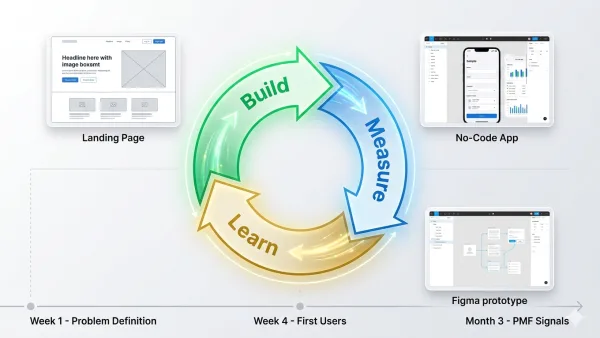
The lean startup methodology’s build-measure-learn feedback loop is the operational framework that governs this decision-making: you form a hypothesis, build the minimum to test it, measure the results honestly against pre-defined success criteria, learn whether the hypothesis was confirmed or denied, and use that learning to inform the next hypothesis. The key word in this loop is not “build” — it is “learn.” Each cycle should produce genuine learning that reduces uncertainty about whether and how the business can work. If a cycle produces no clear learning — if you cannot say clearly what you now believe that you did not believe before — the cycle was not designed well enough to answer the question you needed to answer.
The Validation to Investment Pipeline: What Investors Actually Want to See
Understanding what strong validation evidence looks like from an investor’s perspective — even if you are not planning to raise capital immediately — is useful because investors have seen enough startup validation processes to have calibrated views about which evidence is credible and which is not.
The current investment environment, shaped by several years of declining venture capital deployment and tighter investor scrutiny following the 2021-2022 peak, has made “traction before checks” the dominant investor posture in 2026. Investors who previously funded ideas based on founder quality and market opportunity alone now want to see evidence that the market hypothesis is validated before committing capital. The validation work that founders used to do after raising a seed round is increasingly the work they need to do to raise it.
The specific evidence that moves investors from skeptical to interested includes: customer interview recordings or detailed write-ups from at least twenty interviews with genuine target customers (not friends or people connected to the founder), showing consistent problem recognition without prompting; landing page data showing meaningful conversion rates on cold traffic; pre-order or LOI revenue that demonstrates willingness to pay before the product is fully built; and for post-MVP companies, cohort retention data showing that a meaningful percentage of users who try the core product come back and pay for continued access.
The narrative that this evidence supports — “I identified a specific problem experienced by a specific group of people, I verified that it is real and painful enough to motivate purchasing behaviour, I tested willingness to pay at a specific price point, and I got X pre-orders/LOIs/paying users before asking anyone for money” — is the narrative that sophisticated investors in 2026 respond to. It demonstrates that the founder has the discipline to test assumptions before spending, the intellectual honesty to update beliefs based on evidence rather than attachment to the original idea, and the execution capability to generate traction with limited resources. These are the qualities that predict startup success more reliably than any other observable characteristic — and strong validation evidence is the most compelling way to demonstrate them before you have a track record to point to.
The Validation Checklist: A Practical Self-Assessment
Use this checklist to evaluate the strength of your current validation before committing significant resources to building:
Problem Validation: Have you conducted at least twenty customer discovery interviews with genuine strangers who fit your target customer profile, without mentioning your solution? Do the majority of them describe the problem you are targeting without you prompting them? Can you quantify the cost of the problem — in time, money, or missed opportunity — based on what interviewees describe? Does the problem occur with sufficient frequency and severity to motivate purchasing behaviour (are people already spending money on imperfect solutions)?
Customer Definition: Can you describe your target customer in specific enough terms that you could find ten of them this week without difficulty? Have you segmented your customer base enough that the patterns in your discovery interviews are consistent rather than contradictory? Have you identified the specific role, industry, company size, or life situation that determines who most acutely experiences the problem?
Solution Validation: Have you tested the core value proposition with a landing page, smoke test, or concierge MVP before committing to engineering? Have you received genuine pre-orders, deposits, or Letters of Intent from real prospective customers? Have you run the concierge version of your product and confirmed that the manually delivered value generates the enthusiasm that justifies automating it?
Willingness to Pay: Do you have evidence of willingness to pay at your target price point from people who are not connected to you? Have you confirmed that the willingness to pay is for the outcome you deliver, not just for the novelty of the technology or the niceness of the interface?
Market Viability: Can you estimate the number of customers who fit your validated customer profile in your initial target market? Is the addressable market large enough to support the business model you are planning at the customer acquisition cost you expect? Have you identified at least one distribution channel that can reach these customers at viable economics?
If you can answer yes to the majority of these questions with genuine evidence — not theoretical assumptions — you have the validation foundation that supports committing serious resources to building. If you cannot, the work of validation is not complete, and the cost of completing it is a fraction of the cost of building in the wrong direction.
Conclusion
Startup validation in 2026 is not a nice-to-have preamble before the real work of building begins. It is itself the most important work that founders do in the early stages of a company — the activity whose quality determines whether the building that follows is an investment or an expense.
The tools available for validation in 2026 are the best they have ever been. AI compresses research timelines. No-code tools compress MVP development timelines. Cloud infrastructure makes experimenting cheap. The combination of lower build costs and higher attention costs means that the return on validation effort — the reduction in the probability of building something the market does not want — has never been higher.
What has not changed is the mindset required to do validation well. The willingness to be wrong about your initial hypothesis. The discipline to seek disproof rather than confirmation. The intellectual honesty to look at evidence that contradicts your beliefs and update accordingly. The patience to talk to twenty strangers before writing a line of code. These are not technical skills. They are cognitive disciplines — the disciplines that separate the founders who build companies from those who build cautionary tales.
Seventy percent of startups fail because they build products nobody wants. The founders of those startups were not less intelligent, less motivated, or less resourceful than the founders who succeeded. They were less honest with themselves about whether their beliefs about the market were actually true. The validation framework in this guide is a system for producing that honesty systematically — for replacing the comfortable certainty of untested assumptions with the grounded confidence of genuine market evidence.
That confidence — the kind that comes from knowing your problem is real, your customers exist, and your solution addresses genuine pain — is the most valuable thing a founder can possess as they begin to build. Everything else can be figured out along the way. This cannot.
TechVorta covers startup strategy, funding, and the technology trends shaping tomorrow’s companies. Not with hype. With evidence.




0 Comments
No comments yet. Be the first to share your thoughts!