
Fifteen percent of startups fail specifically because of pricing and cost issues — that is nearly one in five companies dying not because their product was bad but because their math was wrong. The average startup spends just six hours on their pricing strategy — not six hours a week or a month, but six hours total, ever, to define, test, and optimise a decision that determines whether the business model actually works. And pricing is the fastest lever in any business: a 1 percent improvement in price realisation — actually charging the price you intend to charge — has a larger impact on profitability than equivalent improvements in customer volume, cost of goods sold, or fixed costs, because it flows directly to the bottom line with no additional cost. Yet it is among the most neglected strategic decisions in most startups.
The landscape has shifted dramatically in 2026. The “growth at all costs” era, which tolerated bad pricing hygiene because revenue growth masked the underlying unit economics, is over. Eighty-five percent of SaaS companies surveyed have now adopted some form of usage-based pricing, reflecting a fundamental rethink of what pricing structure best aligns with value delivery. The average software price increased by 11.4 percent in the last year alone — evidence that the market is repricing software upward as AI capabilities raise product value. And the traditional models that dominated a decade ago — flat-rate pricing, per-seat subscriptions, freemium funnels — are being challenged by hybrid structures that better capture the value AI-powered products create at variable usage levels.
This guide covers the complete startup pricing playbook for 2026: how to research the right price before you set it, the five pricing models and when each one is appropriate, the three strategic goals your pricing can serve, the critical decision between per-seat and usage-based structures, freemium versus free trial (and what the data says), the psychological tactics that measurably improve conversion, how to raise prices without destroying customer relationships, and the most common pricing mistakes to avoid. If you are building a product and you have spent fewer than six hours on your pricing, this guide is where that changes.
Why Most Founders Get Pricing Wrong
The most common pricing error is not charging too much — it is charging too little. Most startup founders underprice because they are uncertain about the product’s value, anxious about rejection, and operating on the assumption that a lower price will reduce friction and accelerate adoption. This assumption is wrong in several compounding ways.
Underpricing creates a lower-quality customer base. Price-sensitive customers — the ones most easily attracted by a low price — are the ones most likely to churn when a cheaper competitor emerges, most likely to complain, most demanding of support relative to their revenue contribution, and least likely to expand. The customers you want — who are deeply committed to solving the problem your product addresses, who will stay through price increases, who will refer other customers — are not primarily shopping on price. They are evaluating whether your product solves a real problem reliably. Low pricing signals low quality to exactly these customers.
Underpricing also makes the unit economics of customer acquisition structurally harder. If your price is too low relative to the value you deliver, your LTV is compressed, which means your LTV:CAC ratio is worse, which means you can afford to spend less on acquisition, which limits your growth. Every dollar of underpricing is a dollar subtracted from the ceiling on what you can invest in acquiring the next customer. And once a price is established, raising it is significantly harder than setting it correctly from the start — you face customer resistance, churn risk, and the operational complexity of managing different prices for different cohorts.
The second most common error is competitor-based pricing — setting your price by looking at what competitors charge and positioning slightly below. This approach is appropriate for commodity products in established categories where customers are primarily comparing on price. It is not appropriate for differentiated software, where the relevant question is not “what does the competition charge?” but “what is the outcome my customer achieves with my product worth to them?” Those two questions produce very different answers. The competitor’s price tells you what they have decided to charge for their value delivery. It tells you nothing about what your value delivery is worth to your customer — which may be significantly higher or lower than the competitor’s, depending on what your product actually does.
The Three Goals Your Pricing Can Serve
Before choosing a pricing model or setting a price point, the most important decision is which strategic goal your pricing is intended to serve. Different goals lead to very different pricing structures, and clarity about the goal prevents the common failure mode of optimising for one metric (like conversion rate) while sacrificing another (like revenue per customer or LTV).
Revenue maximisation optimises for the highest possible revenue from each customer, negotiating for the maximum price each segment will pay and differentiating pricing by segment to capture different willingness-to-pay levels. This is the right approach when customer segments have meaningfully different ability to pay and when the sales process involves direct negotiation. Most mid-market and enterprise software companies price this way. The limitation is that revenue maximisation requires a sales process to negotiate each deal, which does not scale for self-serve products.
Market penetration prices low to minimise adoption friction, grow quickly, and establish a dominant user base — then monetises more aggressively once adoption and switching costs are established. Slack, Expensify, and New Relic all used penetration pricing. The land-and-expand tactic is its natural complement: get into accounts at low initial cost, prove value, then expand usage and upgrade customers to higher-value plans as the relationship matures. Penetration pricing prioritises market share over short-term revenue, which makes it appropriate when network effects, data advantages, or switching costs will create durable competitive advantages once scale is achieved. It is not appropriate when there is no clear mechanism for monetising the installed base more aggressively over time.
Profit maximisation (skimming) starts with a high price targeting the most sophisticated customers who will pay the most for a new capability, then broadens the product offering and lowers prices over time to address more of the market. Apple’s iPhone pricing history is the classic example. In software, skimming is less common because few startups have a product at launch that will be accepted by the most sophisticated customers at premium prices — but it is the right approach for products with genuine technological advantages (Palantir, Workday, Oracle’s database) that justify premium positioning and enable the kind of enterprise sales cycles where price is not the primary purchase criterion.
The Five Pricing Models: Structure and When to Use Each
A pricing model is how you charge — the structure of the revenue relationship. A pricing strategy is why and how much. Most founders conflate the two, but they are distinct decisions that combine to produce an overall pricing design. The five primary SaaS pricing model structures each have distinct advantages, limitations, and appropriate use cases.
Flat-rate pricing offers one product at one price with all features included. Basecamp is the canonical example. The advantage is radical simplicity: one offer, one decision, one clear value proposition. The limitation is that it leaves money on the table with large customers who would pay significantly more for expanded usage, while simultaneously pricing out small customers who need less. Flat-rate pricing works when your product has a very consistent value proposition across customer sizes and segments. It fails when the customer base is diverse enough that a single price is either too expensive for smaller customers or too cheap for larger ones.
Per-seat (per-user) pricing charges a fixed amount per user per month, scaling revenue directly with team size. It is predictable for both vendor and customer, simple to understand, and creates an expansion mechanic as customers add users. Salesforce, HubSpot, and most enterprise software historically used this model. The limitation is the seat-sharing incentive: customers constrain licensed seats to reduce cost, which caps revenue per account and creates friction around adoption. Per-seat pricing also misaligns with value when the product’s value scales with usage rather than user count — a single power user who generates enormous value pays the same as an occasional user who generates very little.
Usage-based pricing — also called consumption pricing or pay-as-you-go — charges customers based on what they consume: API calls, messages sent, storage used, transactions processed, data processed. It directly aligns cost with value and lowers the barrier to entry, allowing customers to start small and scale spending as their usage grows. AWS, Twilio, Stripe, and Snowflake all use usage-based models. Eighty-five percent of SaaS companies now incorporate some usage-based element. The limitation is revenue unpredictability: usage-based revenue fluctuates with customer activity, making forecasting harder and creating revenue volatility that can concern investors. The hybrid model — a subscription base fee plus usage charges above a threshold — provides the predictability of subscription revenue while capturing upside from high-usage customers.
Tiered pricing offers multiple packages at different price points, each with increasing features, capacity, or usage limits. It is the most common SaaS model because it allows one product to serve multiple customer segments with different willingness to pay. The design principle for tiered pricing is clarity about what the tiers are actually differentiating on — features, usage limits, support level, number of users — rather than creating arbitrary differences. The standard is three tiers: more than four creates decision paralysis. The middle tier should be clearly the best value for the target customer, designed so that the starter tier feels insufficient for most use cases and the premium tier exceeds what most customers need.
Freemium offers a free tier with limited features plus paid tiers for expanded capability. It is an acquisition strategy with pricing attached rather than a pure pricing model — the free tier is a growth mechanism for building a user base from which a fraction converts to paid. The conversion economics must work: the average freemium-to-paid conversion rate is 2 to 5 percent, which means you need a large free user base to generate meaningful paid revenue. Supporting large numbers of free users has real costs in infrastructure, support, and engineering time. And the “penny gap” — the psychological barrier between paying nothing and paying something — makes the freemium-to-paid conversion dramatically harder than moving a paid customer from one tier to another. The right question before adopting freemium is: “Can we support 100,000 free users to get 3,000 paying customers, and is that a better economics than an alternative acquisition model?”
The Value Metric: The Most Overlooked Pricing Decision
The value metric — what you charge per unit of — is arguably the most consequential pricing decision and the most consistently underanalysed. Choosing the wrong value metric is the silent killer of growth: if your product helps teams be more efficient but you charge per seat, you are effectively punishing customers for growing their team by using your product. If your product saves companies money based on transaction volume but you charge a flat monthly fee, you are undercharging high-volume customers who derive enormous value while overcharging low-volume customers who find the price hard to justify.
The ideal value metric scales directly with the value the customer receives from the product. For a payroll software company, the right metric is probably number of employees paid — because value scales directly with workforce size. For an email marketing platform, it might be number of subscribers — because the value of email marketing scales with list size. For an AI-powered writing tool, it might be words generated or documents produced. For a data analytics platform, it might be data volume processed or queries run.
The test of whether you have the right value metric is whether customers who get more value from your product pay more, automatically, without requiring a sales conversation. If your highest-value customers are paying the same as your lowest-value customers, you have either the wrong value metric or the wrong tier structure. Fixing the value metric is often the highest-leverage pricing improvement available — higher than changing the price point, higher than adding tiers, and higher than any psychological tactic.
How to Research the Right Price
Setting a price without customer research is a guess. The research process that replaces guessing with data involves both qualitative and quantitative components, and the results consistently reveal that founders are undercharging — often by a factor of two or more.
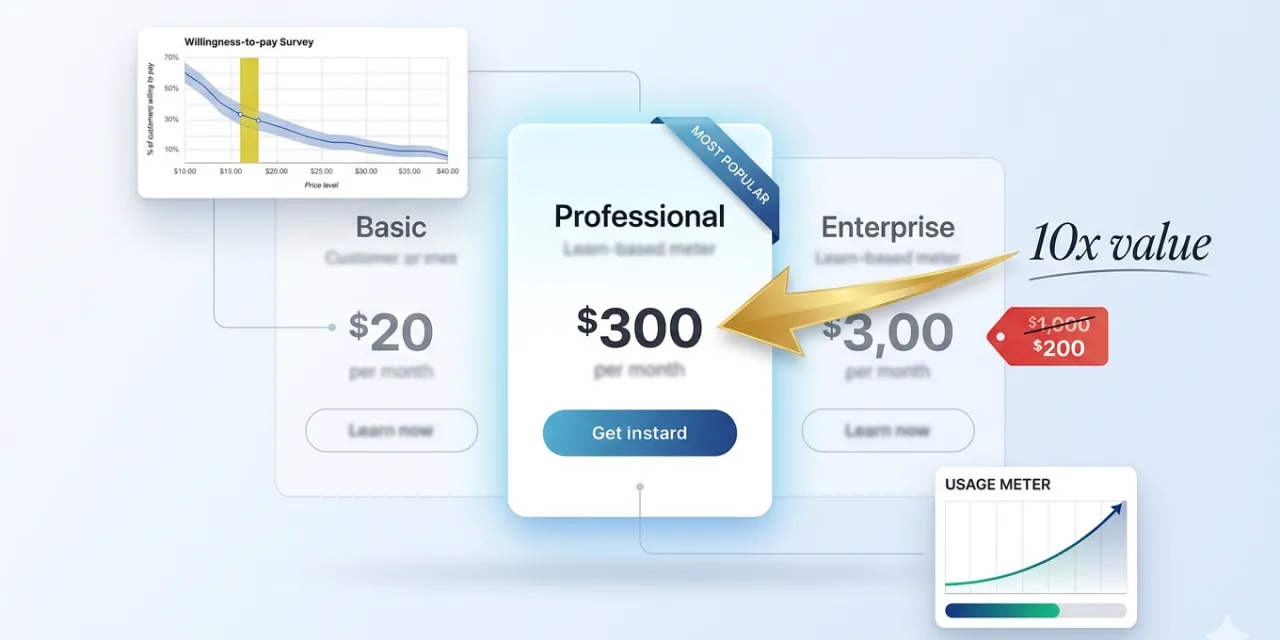
The Value Quantification method starts with customer interviews that establish the economic value your product delivers: How much time does this save your team per week? What would you have to spend on alternatives if this product did not exist? How much additional revenue do you generate or cost do you avoid because of this product? Once you have quantified the value in dollar terms, the 10x rule provides a starting price point: price at approximately 10 percent of the value you deliver. A product that saves a team $5,000 per month should be priced around $500 per month — delivering 10 times more value than it costs. This rule prevents both underpricing (charging too little relative to value) and overpricing (charging more than the customer perceives the value to be worth).
The Price Sensitivity Meter (Van Westendorp method) is the most widely used quantitative pricing research tool for early-stage products. It asks target customers four questions: At what price is this product so cheap you would question its quality? At what price is it a good deal? At what price is it starting to get expensive but you would still consider it? At what price is it so expensive you would not consider it? The intersection of the acceptable price range across a sufficient customer sample produces a price corridor — the range within which most customers consider the product reasonably priced — and identifies the optimal price point within that corridor.
Willingness-to-pay surveys are the faster alternative to full Van Westendorp research: simply asking potential customers “what would this be worth to you?” in a structured way, across a sample large enough to identify patterns by segment, produces directionally useful data for initial price setting even if the statistical precision is lower than formal research methods. Combining this with competitive price research — not to copy competitor prices, but to understand the range of prices the market has established for solving related problems — and with direct sales conversations where price objections are explicitly tested provides the research foundation for a confident initial price setting.
Freemium vs Free Trial: What the Data Says
One of the most practically important decisions in SaaS pricing is whether to offer a freemium model (a permanently free tier with limited capability) or an opt-in free trial (full product access for a defined period, then requiring payment to continue). The data in 2026 is clear enough to be directional: opt-in free trials convert at 18.5 percent, with top performers reaching 25 percent. Freemium converts at 2 to 5 percent.
The difference is not marginal — it is a factor of four to ten times. A free trial creates urgency (the free access ends) and demonstrates the full product value (customers experience the complete offering, not a hobbled free version). Freemium lacks both: there is no deadline that creates urgency to convert, and the limited free tier may never adequately demonstrate the value of paid features. The customers who stay on the freemium tier indefinitely are often the noisiest users — generating the most support requests and the most product feedback — while providing zero revenue.
Freemium is the right model when the free tier is genuinely useful as a standalone product (Dropbox, Notion, Slack’s free tier), when viral growth through the free user base creates compounding network effects that justify the economics, and when the free users produce a direct revenue benefit (through referrals, through data that improves the product, or through brand awareness that reduces paid acquisition costs). It is not the right model for most B2B SaaS products, where the free-tier economics rarely work and where opt-in trials with clear conversion mechanics consistently outperform.
The Psychological Pricing Toolkit
Once the value metric, model structure, and price point are set through research, psychological pricing tactics can improve conversion and revenue capture at the margin. These are not substitutes for a well-designed pricing structure — they are fine-tuning tools applied on top of a sound foundation.
Price anchoring is the most powerful psychological pricing tactic in SaaS: presenting a high-price option first makes subsequent options feel more affordable by comparison. When a customer sees a $399 per month enterprise plan before seeing a $99 per month professional plan, the $99 plan feels reasonable relative to the anchor. Without the anchor, $99 might feel expensive. A three-tier pricing page where the highest price is shown first creates the anchor that makes the target middle tier feel like value. The centre-stage effect — customers’ tendency to choose the middle option when presented with three — reinforces this: placing the preferred tier in the middle of three options consistently increases selection of that tier.
Annual billing incentives are one of the highest-leverage tactics for improving both cash flow and retention. Offering annual plans at a discount (two months free, equivalent to approximately 17 percent off the monthly rate, is the market standard) removes the monthly renewal decision, dramatically reduces churn, and provides upfront cash that improves working capital. The framing matters: “Pay $39 per month billed annually” converts better than “$470 per year billed annually” — the monthly equivalent feels more affordable even though the actual commitment is the same.
Charm pricing — prices ending in 9, 7, or other “non-round” numbers — works because the brain anchors on the left-most digit. $79 feels materially cheaper than $80 even though the actual difference is one dollar, because the left-digit anchoring effect causes the brain to process the price as “70-something” rather than “80.” For software at higher price points ($299, $499, $999), the charm pricing effect is present but smaller relative to the total price — it is most impactful at lower price points where the difference between $29 and $30 is perceived as larger than it actually is.
Decoy pricing adds a third option specifically designed to make another option look more attractive by comparison — typically an option with a slightly worse value proposition at a similar price to the target option, making the target option appear clearly superior. Used carefully, decoy pricing steers customers toward the tier that generates the most value for the vendor without the customer feeling manipulated.
Raising Prices Without Losing Customers
Every SaaS company eventually needs to raise prices — because the product has improved, because costs have increased, because the initial price was set too low, or because the market’s willingness to pay has increased as the category has matured. The average software price increased 11.4 percent in the past year across the SaaS market. Raising prices is normal, expected, and manageable if done correctly.
The most common mistake is permanent grandfathering — letting existing customers keep the old price indefinitely. Grandfathering creates a “debt” on the revenue base: the oldest, most loyal customers are being supported at a loss because they are paying 2020 prices for a 2026 product, and the revenue gap between their price and the market price widens with every new feature released. The alternative is a time-limited legacy discount: communicating clearly that prices are increasing, offering existing customers a grace period at their current rate (typically 6 to 12 months), and then transitioning them to the new pricing with adequate notice. Most customers who genuinely value the product will stay through a well-communicated price increase. The customers who leave over a justified price increase were typically the ones with the lowest LTV and highest support cost ratio — often a net improvement to the customer base quality.
Price increase communication should be direct, specific, and framed around value: explain what has improved in the product, acknowledge the increase transparently, and provide adequate notice — a minimum of 30 days for monthly customers, 90 days for annual. Frame the new price in terms of value delivered rather than apologising for the increase. A price increase is not a betrayal of loyal customers — it is an acknowledgment that the product has become more valuable. Treating it as such, rather than as an awkward imposition requiring excessive apology, produces better customer outcomes and better retention through the transition.
The Most Important Pricing Principle for 2026
The single most important principle for startup pricing in 2026 is that pricing is not a one-time decision made at launch and then left unchanged. It is an ongoing experiment that should be revisited at least annually, informed by customer research, churn data, expansion revenue patterns, competitive dynamics, and the evolution of the product’s value. A price set at launch rarely reflects the product’s value two to three years later, when features have been added, customer outcomes have been documented, and market position has strengthened. Founders who treat pricing as settled — as something decided once and never revisited — consistently leave significant revenue on the table and operate their businesses at lower margins than the product’s value could support.
The 2026 SaaS pricing environment rewards founders who have built pricing structures that scale with value delivery: usage-based components that capture revenue from high-value customers automatically, tier structures that align product access with customer needs, and annual billing incentives that lock in the customers who are most committed to the product. These are not complicated structures — they are systematic applications of the principle that price should reflect value, and that the mechanics of charging should reward customers who get more value and capture that value for the business rather than letting it accumulate untaxed on the customers’ side of the ledger. In a market where efficiency is the primary investor priority and pricing power is the clearest evidence of business quality, getting pricing right is no longer optional. It is the test.





0 Comments
No comments yet. Be the first to share your thoughts!