

The average SaaS company spends a total of eight hours thinking about pricing over the entire life of the business. Eight hours — for a decision that McKinsey research shows has more impact on profitability than any other single business variable: a one percent improvement in pricing yields an eleven percent improvement in profit, compared to a seven percent improvement from a one percent improvement in volume and a three percent improvement from a one percent reduction in costs. More than either acquisition or operational efficiency, pricing is the highest-leverage growth lever available to a SaaS company. And most founders treat it as an afterthought, set it once during the first week of the business, and revisit it only when something is clearly broken.
The consequences are predictable and expensive. Data from Price Intelligently shows that underpricing is two times more common than overpricing among SaaS companies, and significantly harder to correct — because repricing upward requires overcoming anchored customer expectations, while repricing downward only requires a decision. A SaaS Capital 2026 survey found that companies that actively optimise their pricing increased Annual Run Rate by an average of 25 percent without adding a single new customer — purely through better monetisation of the customers they already had. That is 25 percent revenue growth at zero additional acquisition cost, from an investment of strategic attention rather than capital.
At the same time, 2026 is a year of genuine pricing disruption. SaaS pricing increased 11.4 percent in 2025 compared to 2024 — four times the G7 inflation rate. The per-seat pricing model that defined twenty years of SaaS has come under systematic pressure from AI agents that perform work previously requiring multiple human users, making seat count an increasingly poor proxy for the value delivered. Usage-based pricing has gone from niche to mainstream, with 38 percent of SaaS companies now using some form of it. Outcome-based pricing — charging for results achieved rather than software accessed — has moved from theoretical possibility to commercial reality, with Intercom’s Fin product charging $0.99 per resolved support conversation and Salesforce’s Agentforce charging $2 per AI conversation.
The fundamental question of SaaS pricing has shifted from “how much do we charge?” to “what unit of value do we charge for?” This guide covers every dimension of that question: how to identify your value metric, the models available and when each applies, the specific frameworks for setting initial prices, how pricing evolves through each growth stage, the 2026 pricing revolution driven by AI, and the metrics that tell you whether your pricing is working.
The Strategic Foundation: What Pricing Actually Does
Before examining models and frameworks, it is worth being precise about what pricing actually does in a SaaS business — because most pricing mistakes come from treating it as a finance decision when it is simultaneously a product decision, a marketing decision, a competitive positioning decision, and a customer relationship decision.
Pricing communicates value before a customer has experienced the product. A pricing page is often the highest-traffic page on a SaaS website after the homepage, and 73 percent of SaaS buyers research pricing before contacting sales. The price point, the tier structure, the naming of plans, and the features gated at each level all communicate what kind of company you are and who your product is for. A $9 per month starting price says “this is for individuals and small teams experimenting.” A $500 per month minimum says “this is a serious tool for serious teams that will get serious value.” Both can be correct — but they attract entirely different buying audiences and set entirely different expectations about the onboarding, support, and account management experience the customer will receive.
Pricing also determines the trajectory of customer relationships. A pricing model that grows with customer success — where customers naturally spend more as they get more value — creates the expansion revenue that is the most durable and most capital-efficient form of SaaS growth. Net revenue retention above 100 percent means the existing customer base grows in revenue even without any new customer acquisition — every percentage point of NRR improvement adds directly to revenue without requiring additional CAC. Forrester Research found that for established SaaS companies, 70 to 80 percent of revenue growth comes from existing customers through upsells, cross-sells, and renewals. A pricing model that does not support natural expansion is leaving the majority of its potential revenue on the table.
The single most important pricing principle is value alignment: charge for what customers actually care about maximising. If you sell a sales acceleration tool, pricing on the number of meetings booked aligns perfectly with what sales teams care about — their spend grows in direct proportion to the value they receive. If you sell a data warehouse, pricing on queries run aligns with the value of faster insights. If you sell a customer support AI, pricing on resolved conversations aligns with the outcome the customer is paying for. When the pricing metric is the same thing the customer is trying to maximise, the billing relationship reinforces the customer success relationship rather than creating tension with it.
The Pricing Models: Every Option and When It Applies
There are six primary SaaS pricing models, each with distinct economics, strengths, and failure modes. Understanding all six — and the specific conditions under which each is appropriate — is the prerequisite for making an informed model choice rather than defaulting to whatever the most visible competitor happens to be using.
Flat rate pricing charges every customer a single price for access to the product, regardless of usage, team size, or feature consumption. It is maximally simple to communicate and predict — the customer always knows what they will pay, and the company always knows what they will receive. The canonical modern example is Basecamp, which charges a flat $99 per month for unlimited users, a model that has been both its competitive positioning (“not like those per-seat tools”) and a genuine product advantage for growing teams. Flat rate pricing is most appropriate at the very earliest stage — when simplicity of the buying decision matters more than revenue optimisation — and for products where usage patterns are genuinely uniform across the customer base. Its fundamental weakness is that it treats a customer using the product for 10 minutes per week identically to one whose entire operation depends on it, which leaves enormous value uncaptured from high-intensity users and may overprice the product for low-intensity ones.
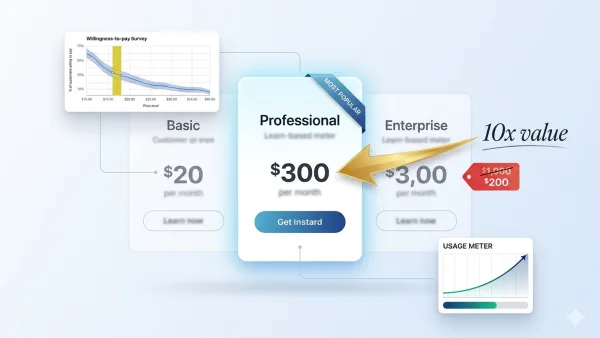
Tiered pricing — the “Good, Better, Best” model — is the most widely deployed SaaS pricing structure. Multiple plans at increasing price points, with expanding features, usage limits, or service levels at each tier, allow a single product to serve multiple customer segments without requiring separate products. HubSpot, Slack, and Notion all use tiered structures that span from free or very low-cost entry tiers designed to maximise top-of-funnel adoption to enterprise tiers with custom contracts, dedicated support, and security features priced for large organisations. The power of a well-designed tiered structure is that it creates a natural upgrade path: customers enter at the tier appropriate for their current needs and graduate to higher tiers as those needs expand. Tomasz Tunguz of Redpoint Ventures describes the strategic logic precisely: “Having three tiers enables you to bracket your target customer” — the middle tier becomes the obvious choice for the intended buyer, the bottom tier creates reference pricing that makes the middle seem reasonable, and the top tier creates an anchor that makes the middle seem accessible.
The critical design discipline in tiered pricing is making the middle tier — the Hero tier, in Kalungi’s framework — genuinely compelling rather than merely mediocre. Many tiered pricing structures fail because the middle tier was designed by committee rather than by customer insight: it contains features that were easy to add rather than features that customers actually value enough to upgrade for. The test of a well-designed Hero tier is that customers on the entry tier who have experienced real value from the product find the upgrade to the Hero tier an obvious decision rather than a reluctant necessity.
Per-user pricing ties revenue directly to team adoption, creating a natural expansion mechanism in collaboration and productivity tools where more users means more value. Slack, Zoom, Asana, and Notion all built their initial growth engines around per-seat expansion: one person adopts the product, brings their team, and the monthly bill grows with each person who joins. For products where the value genuinely increases as more team members participate — where network effects within the customer organisation are real — per-seat pricing elegantly aligns revenue with usage and value simultaneously. Its weakness, which has become dramatically more visible in 2026, is that AI agents do not have seats. As AI systems replace the human workflows that previously required multiple users, the seat count that once served as a proxy for value delivered no longer accurately reflects what the product is providing.
Usage-based pricing charges customers for what they actually consume: API calls, data processed, messages sent, tokens generated, storage used, or whatever unit of consumption most directly correlates with the value the product delivers. Adoption of usage-based pricing among SaaS companies rose from 30 percent in 2019 to approximately 85 percent by 2024, driven both by the economics of cloud infrastructure (where the vendor’s costs scale with usage) and by the recognition that usage-based models align incentives more precisely than access-based models. Twilio’s usage-based model — charging per API call, per SMS, per voice minute — let developers start at essentially zero cost and scale their spend directly with their application’s growth, generating NRR well above 130 percent as successful developers grew into large customers. The fundamental challenge of usage-based pricing is revenue unpredictability: both for vendors trying to forecast revenue and for enterprise customers trying to budget technology spend. A 2026 survey found that 78 percent of IT leaders report unexpected charges from consumption-based pricing, and 90 percent of CIOs cite cost forecasting as their top challenge in AI deployment.
Outcome-based pricing is the most significant pricing frontier of 2025 and 2026, moving rapidly from theoretical appeal to commercial deployment. Rather than charging for access or consumption, outcome-based models charge for measurable results achieved. Intercom’s Fin AI charges $0.99 only when the AI fully resolves a customer support conversation — no charge for failed attempts, no charge for conversations the AI handled poorly. Salesforce’s Agentforce charges $2 per AI-handled conversation, framed explicitly as a fraction of the $30 to $50 cost of a human agent interaction. Zendesk adopted the most aggressive form — customers are charged only when a ticket is fully resolved by AI, with zero charge for unresolved interactions. These models solve the AI adoption paradox directly: if an AI support tool eventually requires 80 percent fewer human support agents, per-seat pricing would penalise the vendor’s own success. Outcome-based pricing grows revenue in direct proportion to the outcomes delivered — which is the ideal alignment between vendor incentives and customer interests. The model’s practical challenge is attribution: when outcomes depend on multiple factors, customers will dispute charges for outcomes they attribute to other causes.
Hybrid pricing — combining a predictable base subscription with usage-based components — has emerged as the dominant structure for mature SaaS products and is rapidly becoming the default for AI-native products. Golden Door Asset’s analysis of the highest-performing SaaS pricing models found that hybrid models combining a platform fee with usage-based components deliver the highest net dollar retention, at 140 percent median. The logic is intuitive: a base subscription provides revenue predictability for the vendor and cost predictability for the customer, while usage-based components capture expansion revenue from customers who derive increasing value. Snowflake’s model — pay per query plus optional committed capacity contracts — combines the flexibility of pure consumption with the predictability of committed spend. Many AI SaaS companies in 2026 use “base + consumption” as their default: a monthly subscription covers core access, and AI-intensive workloads like generation, analysis, or inference are billed separately at a per-use rate.
The 2026 Pricing Revolution: What AI Is Doing to Every Model
Artificial intelligence is not merely adding a new product category to SaaS pricing discussions. It is structurally challenging the economic assumptions on which twenty years of SaaS pricing was built — and the implications extend to every category of software, not just products explicitly marketed as AI tools.
The per-seat model rested on a simple and for decades valid assumption: the value delivered by software scales with the number of humans using it, because humans are the unit of work. When an AI agent can draft contracts, reconcile invoices, generate marketing copy, and triage support tickets without tying its activity to a named employee account, the link between headcount and software value breaks. As PYMNTS’ February 2026 analysis of the SaaS pricing shift reports: the per-seat model is not vanishing overnight — many enterprises still value its simplicity and predictability — but the economic centre of gravity is moving from access to output. The SaaS era was built on selling licences to people. The AI era is being built on pricing for work done.
For vendors building AI products, pricing carries an additional complexity that purely software-based products did not face: real marginal costs. Every AI inference call, every model generation, every token processed has a non-zero compute cost. The old SaaS playbook of “generous free tier forever” fails when free users burn GPU compute and API costs that the vendor is paying for. ProductLed’s 2026 analysis of PLG trends identified this specifically: free models are shifting away from indefinite generous access toward time-boxed trials, usage caps, and value-based gating — because the economics of AI products make unlimited free access financially unsustainable.
There is also a paradox developing in 2026 that the Monetizely analysis identifies with particular clarity. Just as the industry converged on usage-based pricing as the logical response to AI’s high infrastructure costs, the rapid decline in AI inference costs — some categories dropping 50 to 90 percent in a single year — may make simpler pricing structures economically viable again. When the marginal cost of providing AI capabilities falls to near zero, a flat subscription that bundles AI features within a tiered package can undercut competitors with complex usage-based structures — not because the pricing model is better, but because the economics now support it. The pendulum that swung from seat-based to usage-based may swing back toward simplicity in categories where AI COGS have collapsed.
Setting Your Initial Price: The Frameworks That Actually Work
Most SaaS founders set their initial price by one of two methods: looking at competitors and averaging their prices, or calculating their costs and adding a margin. Both methods are systematically wrong and consistently produce underpricing.
Competitor benchmarking fails because your product is not your competitor’s product, and the price your competitor charges reflects their cost structure, their customer base, their brand perception, and their strategic objectives — none of which are necessarily relevant to your situation. Clay built a $1.25 billion valuation on usage-based pricing specifically calibrated to the variable consumption patterns of its data enrichment product — not because usage-based pricing was trendy, but because it was the right model for their specific product and customer. Copying it without understanding why it works for Clay will produce a pricing structure optimised for a different business.
Cost-plus pricing fails in SaaS because the marginal cost of delivering software to one more customer approaches zero — there is no natural relationship between cost structure and appropriate price for a product whose cost does not scale with sales volume. Setting price at cost-plus-margin ensures you are not losing money on each customer, but tells you nothing about how much value you are actually creating, which is the correct basis for pricing.
The framework that consistently produces better pricing outcomes is value-based pricing, anchored in structured research about customer willingness to pay. The Van Westendorp Price Sensitivity Meter is the most practical research tool for this: ask a representative sample of your target customers four questions — at what price would this product seem too expensive to consider? At what price would it start to seem expensive but still worth considering? At what price would it start to seem like a bargain? At what price would it seem so cheap that you would question its quality? The intersection of the “too cheap” and “too expensive” curves defines your acceptable price range. The intersection of the “starting to get expensive” and “starting to be a bargain” curves identifies your optimal price point — the one that maximises revenue without generating significant resistance.
First Round Review research found that SaaS startups that conduct formal pricing research before launch are 65 percent more likely to achieve or exceed their first-year revenue goals compared to those that use intuition alone. The research does not need to be expensive or methodologically elaborate. Five to ten structured conversations with potential customers in your target segment, asking directly about value, alternatives they currently use, and price sensitivity, will produce more useful pricing intelligence than any amount of competitive benchmarking.
A consistent and important finding in pricing research is that founders systematically underestimate customer willingness to pay. The typical founder, having spent months immersed in the technical details of building their product, has lost the perspective of someone encountering the product for the first time and experiencing the value it creates immediately. Price Intelligently’s research confirms that underpricing is twice as common as overpricing. Starting at a higher price point — even if it requires offering early customers a negotiated discount — is strategically sounder than starting low, because anchoring customer expectations at a low price is extraordinarily difficult to reverse as the product matures and its value increases.
How Pricing Evolves: The Three Growth Stages
No pricing model should be treated as permanent. The companies that reach $100 million ARR almost never do so on the same pricing model they launched with. The analysis of how 28 SaaS companies evolved their pricing on the path to centaur status, published by Monetizely in January 2026, reveals a clear pattern across three stages.
Early stage — seeking product-market fit: the priority is minimising friction and proving value. Successful centaurs consistently used simple, accessible pricing at this stage — free tiers, low-cost starter plans, or simple per-seat models — that traded short-term revenue per customer for maximum reach and rapid product-market fit validation. Slack’s per-user freemium, Atlassian’s ultra-low entry price, Zoom’s 40-minute meeting limit combined with modest Pro pricing — all of these prioritised adoption over monetisation. The risk of complexity at this stage is that pricing friction obscures what the market is actually telling you about the product. Keep pricing simple at the early stage: one or two plans, clear value alignment, low-enough entry cost to minimise the decision overhead for a potential customer who has not yet experienced the product.
Mid stage — scaling revenue, capturing more value: roughly from $5 million to $50 million ARR, pricing strategy shifts from acquisition-focused to value-capture-focused. This is the stage at which tiered structures are introduced or refined, value metrics are adjusted to better align with customer outcomes, and enterprise pricing begins to emerge alongside self-serve pricing. Intercom’s packaging redesign, New Relic’s shift to consumption-based pricing to reignite expansion revenue, Gainsight’s introduction of modular pricing to unlock larger contracts — these pivots happened at mid-stage, when the company had enough customer data to understand which features drove retention and expansion and enough customer volume to segment meaningfully by willingness to pay. Mid-stage is also when the decision about per-seat versus usage-based versus hybrid has the most consequence: the model chosen at this point determines the expansion economics of the next several years.
Late stage — optimising for scale and longevity: at scale, pricing becomes a tool for deepening competitive moats and maximising LTV across an increasingly diverse customer base. Multi-product bundles — Salesforce 360, Zoom One, Adobe Creative Cloud — encourage customers to consolidate spend with a single vendor rather than purchasing point solutions from multiple providers. Volume discounts, committed capacity contracts, and custom enterprise pricing create switching costs that increase retention from the highest-value customer segments. Price increases — historically avoided for fear of customer revolt — become viable when executed against products that have demonstrated strong retention and clear ROI. OpenView Partners research shows that strategic price increases in well-positioned SaaS products produce a 95 percent customer retention rate. The fear of repricing is usually worse than the reality.
The Pricing Page: Where Strategy Becomes Conversion
The pricing page is the most consequential page on most SaaS websites, and it is consistently under-invested in relative to its impact on revenue. Every element of a pricing page — tier names, price anchors, feature lists, call-to-action language, recommended tier highlighting — influences conversion and tier selection in ways that are measurable and testable.
The psychological architecture of a three-tier pricing page follows a specific logic. The lowest tier exists primarily as a reference point that makes the middle tier seem reasonable. The highest tier exists primarily as an anchor that makes the middle tier seem accessible and attractively priced. The middle tier is the one most customers should choose, and the page should be designed to make that obvious — through strategic highlighting (“Most Popular”), feature lists that make the Hero tier’s additional value apparent, and pricing anchors that make the jump from lowest to middle feel justified while the jump from middle to highest feels like a meaningful upgrade for specific needs. Most customers should not be buying the highest tier, and the page design should reflect that — the enterprise tier is for prospects who will call you, not for prospects who should self-serve their way to checkout.
Annual pricing versus monthly pricing deserves explicit treatment on most pricing pages. Annual pricing — typically offered at a 15 to 20 percent discount relative to monthly — improves cash flow, reduces churn risk, and simplifies customer relationship management. Many SaaS companies default to showing monthly pricing because it looks lower, but the strategic error is that monthly pricing trains customers to evaluate the cost on a monthly basis, making each renewal a re-purchase decision. Annual pricing frames the cost as an annual investment in a tool that the customer has committed to using, which both improves retention and increases the cohort’s LTV. The best practice in 2026 is to show both monthly and annual options, prominently display the annual savings, and default the toggle to annual while making the monthly option clearly available for customers who prefer flexibility.
NRR: The Metric That Tells You Whether Your Pricing Is Working
Net Revenue Retention is the single metric that most directly measures whether a pricing model is generating the expansion revenue that durable SaaS growth requires. NRR measures the percentage of revenue retained from the existing customer base after accounting for expansion (upsells and cross-sells), contraction (plan downgrades), and churn (customer cancellations). An NRR of 100 percent means the existing customer base generates exactly as much revenue this period as last period. An NRR above 100 percent means the existing base is growing — customers are collectively spending more than they were, without any new customer acquisition. An NRR below 100 percent means the existing base is shrinking — churn and contraction are exceeding expansion.
The benchmarks matter: 95 to 100 percent NRR is acceptable for SMB-focused SaaS, where higher churn from small businesses is a structural feature of the market. 100 to 105 percent is the expectation for mid-market SaaS. 105 to 110 percent characterises strong enterprise SaaS. 110 to 120 percent represents best-in-class performance across most categories. Infrastructure and developer tools — Snowflake, Datadog, Twilio — can sustain 130 percent NRR or above because their usage-based models grow naturally with customer success. A 10-point NRR improvement adds 20 to 30 percent to company valuation for a growth-stage SaaS company: for a $50 million ARR company, that represents $50 to $100 million in enterprise value created through pricing optimisation alone.
The diagnostic questions that NRR answers are precise. If NRR is below 100 percent, the pricing model is failing to retain and grow the existing customer base — either because it is not creating sufficient expansion mechanisms, because the product is not delivering sufficient value to justify renewals, or both. If NRR is between 100 and 110 percent, the expansion mechanisms exist but are underperforming relative to best-in-class benchmarks — an opportunity to introduce additional upsell triggers, feature gating, or usage-based expansion components. If NRR is above 110 percent, the expansion engine is working and the growth priority shifts to acquiring more customers at the top of the funnel who will then expand through the existing mechanisms.
The Common Pricing Mistakes and How to Avoid Them
The pricing errors that consistently damage SaaS revenue fall into a small number of predictable patterns, each with a specific cause and a specific remedy.
Copying competitors without understanding why their pricing works. Every SaaS market has a dominant pricing model that most participants copy without interrogating. Per-seat pricing dominates collaboration tools because collaboration tools genuinely generate more value with more users — but copying per-seat pricing for a tool that does not have this property creates a pricing model that does not fit the product’s value delivery. Before adopting any pricing model observed in your market, ask specifically: why does this model work for that product? Does the same logic apply to mine?
Anchoring to a low price too early and failing to raise it. The most common single pricing error in early-stage SaaS is launching at a price designed to minimise resistance rather than to reflect value delivered. Underpricing attracts price-sensitive customers who are the most likely to churn when you eventually raise prices, signals insufficient value to customers who associate price with quality, and creates an anchor that makes subsequent price increases feel punitive rather than reasonable. Starting higher — even at a price that produces some friction — is almost always the correct long-term choice.
Building a pricing model you cannot operationally support. Usage-based and hybrid pricing models require usage instrumentation, real-time metering, accurate billing systems, and customer communication workflows for when usage approaches limits or overages occur. Building a complex usage-based pricing model before the engineering and billing infrastructure exists to support it cleanly creates customer disputes, billing errors, and trust erosion that damage the customer relationship regardless of how well-designed the pricing model itself is. The best pricing model is the one your organisation can operate reliably — not the theoretically optimal model that your billing system cannot support.
Treating pricing as a one-time decision. Bessemer Venture Partners recommends revisiting pricing at least every six months — not necessarily changing the price, but auditing whether the model, the tiers, the feature gating, and the price points still reflect the current product, the current customer base, and the current competitive environment. Customer willingness to pay is dynamic: it increases as markets mature, as the product improves, and as the value delivered becomes more demonstrable. A company that priced its product in 2022 at what was then appropriate and has not revisited that decision since 2022 is almost certainly leaving significant revenue on the table.
The Pricing System in Practice
Effective SaaS pricing in 2026 is a system, not a decision. It requires ongoing research into customer willingness to pay, continuous monitoring of NRR and expansion revenue metrics, regular competitive intelligence, structured experimentation with packaging and feature gating, and deliberate cross-functional alignment between product, marketing, sales, and finance around a shared pricing strategy. The companies that invest in this system consistently outperform those that treat pricing as a finance exercise conducted annually.
The specific actions that constitute this system are not complex. A biannual pricing review — auditing tiers against customer WTP, reviewing NRR by tier and segment, assessing competitive positioning, and identifying features that customers in lower tiers are already using in ways that suggest they are deriving value warranting a higher tier — takes a day of structured work and consistently produces insights that improve revenue without requiring product changes. Quarterly competitive pricing reviews, which 60 percent of high-growth SaaS companies conduct, ensure that the pricing strategy remains calibrated to the competitive environment rather than becoming static while the market moves around it. A structured system for capturing customer pricing feedback — through sales conversations, NPS surveys, churn interviews, and upgrade and downgrade data — provides the continuous signal that ensures pricing decisions are grounded in market reality rather than internal assumption.
Pricing is not a number. It is a message about what you believe your product is worth, a mechanism for capturing the value you create, a signal to potential customers about what kind of company you are, and a system for growing revenue from the customers you already have. Getting it right is worth far more than the eight hours the average SaaS company invests in it. Getting it right, and keeping it right as the company and the market evolve, is one of the highest-leverage investments a SaaS founder can make.




0 Comments
No comments yet. Be the first to share your thoughts!