
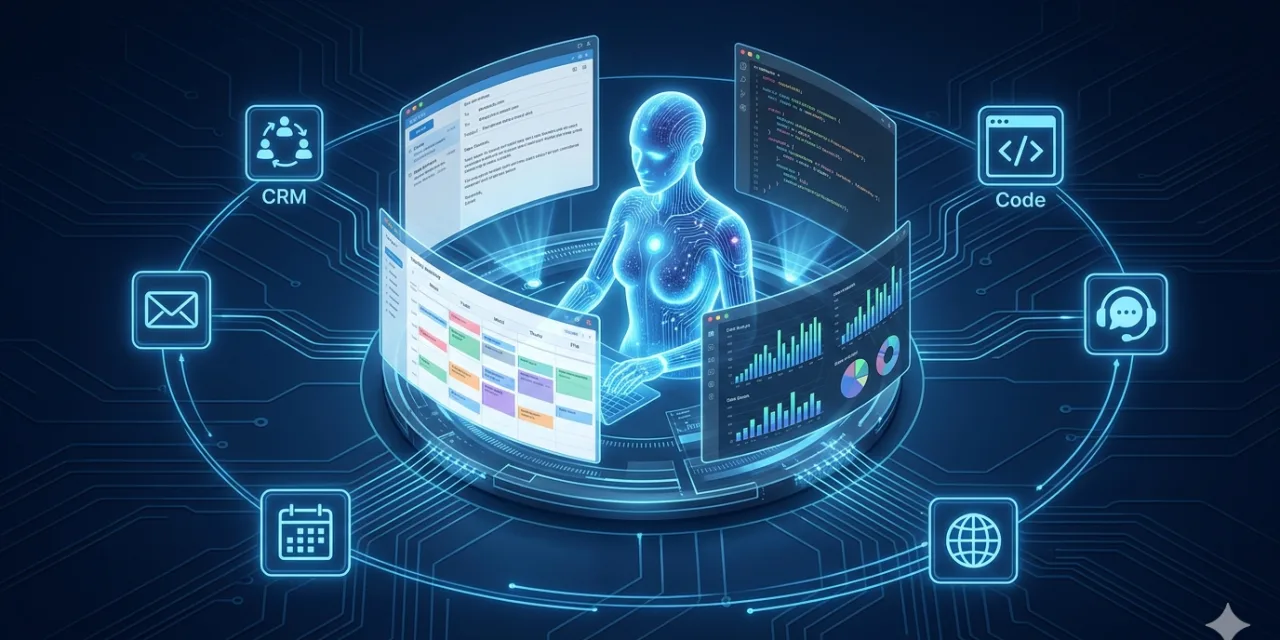
Salesforce’s Agentforce handled over 380,000 customer support interactions and resolved 84 percent of them entirely on its own — no human required. A leading telecom company deployed AI agents to manage 80 percent of its routine customer inquiries autonomously, freeing human teams for complex issues only. Enterprises are now using an average of 12 AI agents across their operations, a figure Salesforce projects will grow by 67 percent within two years. And the global AI agents market — which hit $10.91 billion in 2026, up 43 percent from $7.63 billion in 2025 — is on a trajectory that Grand View Research projects will reach $50.31 billion by 2030. That is a 45.8 percent compound annual growth rate, making AI agents the fastest-growing segment in enterprise software since the cloud computing boom.
Something has genuinely changed in 2026. The AI tools that most people encountered in 2022 and 2023 were reactive: you typed a prompt, the tool responded, and you decided what to do with the response. Every action required human initiation. Every output required human evaluation and implementation. The model was, fundamentally, a very sophisticated search and text generation engine — impressive, useful, but not autonomous. What 2025 and 2026 have delivered is the transition from that reactive model to something qualitatively different: AI agents that accept a goal, plan the steps required to achieve it, execute those steps across multiple tools and applications, evaluate the results, and iterate — all without requiring a human to prompt every stage. The shift is from “prompt-and-respond” to “delegate-and-supervise.”
This guide explains what AI agents actually are, how they work, what distinguishes a genuine agent from a chatbot with extra features, which specific agents are delivering real results in 2026, what use cases they are best suited for, and the honest limitations and risks that any serious evaluation needs to account for. Whether you are an individual professional looking to reclaim hours lost to repetitive tasks or a business leader evaluating which AI agent platform will actually deliver ROI, this is the complete picture.
What an AI Agent Actually Is — and How It Differs from a Chatbot
The term “AI agent” has been applied so broadly by marketing teams in 2025 and 2026 that it has started to lose meaning. Every chatbot update, every automation tool with a new AI layer, every virtual assistant with web browsing capability has been relabelled an “agent.” Understanding the precise technical distinction between an AI agent and an AI assistant — or an AI-powered automation — is essential for evaluating which tools are actually worth your time.
An AI assistant (the chatbot model) is reactive. It waits for a prompt, processes it, generates a response, and stops. Each interaction is essentially independent. The assistant has no persistent goals, no ability to initiate actions on its own, and no mechanism for executing multi-step plans across external tools without a human prompt at each step. ChatGPT in its standard conversational mode, Claude in a basic API integration, and most consumer AI tools function this way.
An AI agent is goal-directed. Given a high-level objective — “research our three main competitors and produce a report comparing their pricing, features, and customer reviews” or “manage my email inbox, draft responses to anything requiring a reply, flag anything urgent, and unsubscribe me from newsletters I haven’t opened in 30 days” — an agent breaks the goal into subtasks, determines which tools to use for each subtask, executes those tools, evaluates the outputs, and iterates until the goal is achieved. Crucially, the agent does this without requiring a human prompt at each step. It reasons about what to do next based on what it has learned from previous steps.
The technical architecture that makes this possible involves several components working together: a large language model that serves as the reasoning core (planning what to do, evaluating outputs, deciding what to do next), a memory system that maintains context across the execution of multi-step tasks, a tool-calling capability that allows the model to invoke external APIs and applications (search engines, email clients, calendars, databases, code interpreters), and an orchestration layer that manages the flow between these components. When these components work well together, the result is a system that can handle genuinely complex, multi-step workflows with minimal human intervention. When they do not — when the reasoning fails, the tools return unexpected outputs, or the memory is insufficient — agents make errors that can be difficult to detect and correct.
Gartner’s assessment for 2026 is that 40 percent of enterprise applications will feature task-specific AI agents by the end of the year, up from less than 5 percent in 2025. That trajectory — from virtually zero to nearly half of enterprise software in a single year — reflects both genuine technical advancement and the commercial pressure on every enterprise software vendor to add AI agent capabilities to their products, regardless of whether those capabilities are genuinely mature. The quality of what is being shipped under the “agent” label varies enormously, which makes honest evaluation more important than ever.
The Best AI Agents of 2026: A Category-by-Category Breakdown
Rather than a simple ranked list, understanding which agent is best for which use case produces more useful guidance. The 2026 landscape is characterised by specialisation: the agent that excels at customer support is different from the one that excels at coding, which is different from the one that excels at email management. Matching the agent to the use case is the most important decision in evaluating this market.
For Business Automation and Customer Support: Salesforce Agentforce
Salesforce Agentforce is the most production-proven enterprise AI agent platform in 2026, with Salesforce’s own Help site having handled 1.7 million-plus conversations at a 76 percent autonomous resolution rate. For organisations already on Salesforce, it represents the most deeply integrated option: Agentforce operates directly inside CRM workflows, with role-based agents for service (resolving support cases), sales (qualifying leads, updating records), and custom business processes. Its Atlas Reasoning Engine uses a ReAct (Reason-Act-Observe) cycle for multi-step autonomous execution, and its Einstein Trust Layer grounds responses in verified CRM data to reduce hallucination risk. A Forrester study showed 396 percent three-year ROI from Agentforce deployments, driven primarily by reduced agent headcount and faster case resolution.
The honest assessment: Agentforce is powerful within the Salesforce ecosystem and genuinely autonomous in the workflows it is designed for. Teams not already on Salesforce face steep onboarding costs. Pricing — $2 per conversation or approximately $0.10 per agent action with Flex Credits — can climb quickly at scale. For organisations already invested in Salesforce whose primary use case is customer service automation or sales workflow management, it is the category leader. For everyone else, the switching cost is substantial.
For General-Purpose Autonomous Task Execution: Manus
Manus — acquired by Meta for $2 billion in December 2025 but continuing to operate as a standalone service — is the most capable general-purpose autonomous agent available to individual professionals and small teams in 2026. Given a complex, open-ended task in plain language (“research our competitors in the EMEA SaaS market and produce a 2,000-word report with specific pricing, feature, and customer sentiment comparisons”), Manus breaks it into subtasks, builds an execution plan, and works through each step using 29 different tools for web navigation, code execution, data analysis, and media creation. It produces a finished output rather than a draft that requires substantial human editing. Manus is powered by Anthropic’s Claude as its primary LLM, giving it strong reasoning capabilities for complex multi-step tasks.
The honest assessment: Manus excels at bounded, well-defined projects where the expected output is clear even if the execution path is complex. It is less reliable on tasks that require nuanced human judgment at intermediate steps. The Meta acquisition has raised questions about long-term data privacy implications that enterprise users in particular should evaluate carefully.
For Coding and Software Development: Claude Code
Claude Code, Anthropic’s coding-focused agent, represents the evolution of AI coding assistants into genuinely autonomous development tools. Unlike GitHub Copilot’s autocomplete model or ChatGPT’s conversational coding assistance, Claude Code operates in the terminal with full shell and file system access — it runs tests, makes multi-file changes, navigates the entire repository, and iterates on tasks autonomously based on test results. Its large context windows allow it to hold significantly more of a codebase in scope during a session than competing tools. Model Context Protocol (MCP) server integration allows connections to common engineering systems including GitHub, databases, and CI/CD pipelines. For engineering teams automating development pipelines, code review workflows, or repetitive implementation tasks, Claude Code represents the current state of the art in coding agents.
For Microsoft 365 Users: Microsoft Copilot
Microsoft Copilot has matured significantly through 2025 and into 2026, with its Researcher and Analyst agents capable of operating autonomously within Office applications — generating reports, analysing datasets, and synthesising insights without step-by-step prompting. Copilot Studio agents can trigger automated workflows across the Microsoft ecosystem. For organisations already on Microsoft 365, the integration depth is substantial: Copilot works across email, Word documents, Excel spreadsheets, PowerPoint presentations, and Teams meetings simultaneously. Copilot Business pricing runs from $18 per user per month (promotional through mid-2026) rising to $21 after that, on top of an existing Microsoft 365 subscription. For Microsoft-committed organisations, this is the embedded agent option that requires the least additional tooling.
For Email and Personal Productivity: Lindy AI
Lindy AI occupies a specific and valuable niche: personal productivity automation that operates through familiar interfaces rather than requiring adoption of a new application. Lindy manages email through learning the user’s communication style and drafting replies that match it, organises inboxes, schedules meetings, updates CRM records, and coordinates internal workflows — all controllable through a text message interface as if texting a human colleague. For founders, operators, and SMB teams who want genuine email automation without enterprise software investment, Lindy delivers a high-autonomy experience at accessible pricing. Its limitation is the same as its strength: it is individual-focused and not designed for coordinated multi-agent deployment across an organisation.
For Research and Information Synthesis: ChatGPT Deep Research
OpenAI’s Deep Research capability — available on ChatGPT Plus, Team, and Pro plans — represents the most widely accessible research agent for individual users. Given a research question, it autonomously searches the web across multiple sources, synthesises information, evaluates source quality, and produces structured research outputs significantly more comprehensive than a standard ChatGPT response. For knowledge workers who need rigorous research on competitive landscapes, market analysis, technical domains, or policy questions, Deep Research is the fastest entry point into agentic AI capability without enterprise procurement. Its limitation is that it is single-agent (not designed for multi-agent orchestration) and its write actions require user confirmation at each step — making it less autonomous than dedicated agent platforms for tasks that require taking action rather than generating information.
How AI Agents Actually Work: The Technical Architecture
Understanding the technical architecture of AI agents is useful not just for engineers evaluating platforms but for any user who wants to understand why agents sometimes produce excellent results and sometimes fail in ways that seem surprising. The failure modes of AI agents are predictable from their architecture — and knowing them allows you to design the human oversight that catches failures before they compound.
The reasoning core of an AI agent is a large language model — in most current implementations, one of the frontier models from Anthropic, OpenAI, or Google. The LLM is responsible for taking the current state of the task (what has been done, what the results were, what remains to be done) and deciding what action to take next. This decision-making process happens through a reasoning cycle — most commonly the ReAct pattern (Reason-Act-Observe): the model reasons about the current state, decides on an action, observes the result of that action, and reasons about what to do next based on the observation.
Memory is the component that makes multi-step tasks possible. An agent working on a complex task needs to remember what it has already done, what results it obtained, and what constraints it is operating under. Current agent architectures use a combination of in-context memory (maintaining the full task history in the model’s context window), external memory stores (databases that the agent can query for information accumulated across previous sessions), and episodic memory (records of specific past interactions that can be retrieved). The size of the model’s context window directly limits how complex a task it can hold in mind simultaneously — which is why Claude Code’s large context window is a meaningful advantage for large-codebase tasks.
Tool use is the capability that allows agents to take action in the world rather than just generating text. Modern AI agents can call external APIs, browse the web, execute code, read and write files, query databases, send emails, update calendar entries, and interact with software interfaces — essentially any digital action that can be described programmatically. The range and reliability of an agent’s tool library directly determines what kinds of tasks it can execute autonomously.
Orchestration manages the flow between these components and is where the quality differences between agent platforms become most apparent. A well-designed orchestration layer handles tool failures gracefully, detects when the agent has gone down an unproductive path and corrects course, enforces constraints that prevent the agent from taking actions outside its permitted scope, and provides the human oversight checkpoints that allow users to review and approve actions before they are irreversible. A poorly designed orchestration layer produces agents that fail silently, take irreversible actions without appropriate confirmation, and compound errors across multiple steps before a human is able to intervene.
What AI Agents Are Genuinely Good At in 2026
The gap between what AI agents are claimed to be capable of and what they reliably deliver in production is significant, and navigating that gap requires understanding specifically where current agents excel and where they consistently fall short.
AI agents are genuinely excellent at well-defined, repetitive tasks that involve accessing, processing, and organising digital information at scale. Customer support query resolution, lead data enrichment, appointment scheduling, email triage and drafting, report generation from structured data, code refactoring and test writing, document classification and extraction, and routine CRM updates all represent categories where agents are producing measurable, reliable results in 2026. Conversational AI is on pace to save $80 billion in contact-centre labour costs by 2026, according to market analysis — and that figure reflects genuine operational savings from agents that handle a large percentage of routine interactions without human involvement.
AI agents are significantly less reliable at tasks that require nuanced human judgment, creative synthesis across ambiguous inputs, or physical-world reasoning. Open-ended computer use benchmarks — tests of agents’ ability to navigate arbitrary software interfaces — still produce scores in the single digits for most platforms. Tasks that require subjective evaluation (is this marketing copy good?), ethical judgment (should I send this email to this person in this context?), or real-world physical coordination remain firmly in the human domain.
The trust gap is the most significant commercial barrier to broader adoption. According to consumer research, only 17 percent of consumers trust AI enough to complete a purchase on their behalf, though 30 percent are now willing to let an agent complete a purchase — up sharply from 2024. Seventy-nine percent of Americans still prefer human customer service over AI for support interactions. The gap between what AI agents can technically do and what consumers trust them to do is real and consequential for businesses building agent-forward customer experiences.
The Risk Landscape: What Can Go Wrong
Gartner projects that over 40 percent of enterprise agentic AI projects will be cancelled by end of 2027 due to costs, unclear value, and weak governance. Only 21 percent of companies have a mature agent governance model, according to Deloitte. Fifty-one percent of service leaders say security concerns have delayed or limited AI agent initiatives. These statistics reflect genuine risks that any serious evaluation must address.
The most significant risk category for AI agents is action irreversibility. An agent that sends an email, deletes a file, updates a customer record, or initiates a financial transaction has taken an action that may be difficult or impossible to reverse. Unlike a chatbot whose worst outcome is an unhelpful or inaccurate text response, an agent that executes actions incorrectly can create real operational damage. The governance frameworks that mitigate this risk — human approval checkpoints for high-stakes actions, audit logs of all agent actions, rollback capabilities for reversible actions, hard constraints that prevent agents from taking certain categories of action without explicit authorisation — are not optional for enterprise deployments.
Prompt injection — attacks where malicious content in data the agent processes (an email, a web page, a document) contains instructions that redirect the agent’s behaviour — is a security vulnerability specific to AI agents that has no direct equivalent in traditional software security. An agent instructed to read and summarise emails could be redirected by a malicious email to exfiltrate data, send unauthorised messages, or take other unintended actions. Security frameworks for agent deployments need to address this threat specifically, not as an afterthought.
Cost unpredictability is a practical concern that is frequently underestimated. Sixty-two percent of service leaders cite unpredictable AI costs as a concern. Agent platforms typically charge per action, per conversation, or per token consumed — and the costs of a production agent handling high volumes of complex tasks can exceed initial estimates significantly. Careful monitoring of agent usage and cost, with automatic limits that prevent runaway spending, is essential from the first day of deployment.
How to Get Started with AI Agents: A Practical Framework
For individuals and small teams approaching AI agents for the first time, the most effective starting strategy is narrow scope and high oversight: begin with a single, well-defined, low-stakes workflow that you understand completely, deploy an agent to assist with it (not fully replace it), and monitor the results carefully before expanding scope or reducing oversight. The founders, operators, and professionals who have extracted the most value from AI agents in 2026 consistently describe the same learning curve: start small, measure carefully, expand what works, and maintain human review of agent outputs until you have enough operational experience to know which categories of output are reliably correct.
For enterprises evaluating agent platforms, the governance question should come before the capability question. What actions will the agent be permitted to take? Who can authorise the agent to take higher-stakes actions? How will agent actions be logged and audited? What human review process applies to which categories of output? Answering these questions before selecting a platform ensures that the platform you choose has the governance capabilities your risk profile requires — and prevents the common pattern of deploying a capable agent without the oversight structure that makes it safe to operate at scale.
The most important shift in mindset for organisations adopting AI agents is from “task automation” to “workforce augmentation.” The organisations that are extracting the most value from AI agents in 2026 are not the ones that have automated the most human positions — they are the ones that have eliminated the most repetitive, low-judgment work from their human workforce, freeing human attention for the relationship-building, creative synthesis, strategic judgment, and complex problem-solving that agents cannot do. AI agents that resolve 84 percent of customer support cases autonomously are not eliminating customer support teams — they are enabling those teams to focus entirely on the 16 percent of cases that genuinely require human expertise, empathy, and relationship context. That reallocation of human attention — away from routine and toward complex — is where the real productivity advantage of the agentic AI era is being realised.
The global AI agents market will reach $50 billion by 2030. The enterprises that build the governance frameworks, tool integrations, and human-AI collaboration models that make agents genuinely productive — rather than just deploying agents and hoping — will capture the advantage. The technology is ready. The question, as always with transformative technology, is whether the organisations using it are.




0 Comments
No comments yet. Be the first to share your thoughts!