
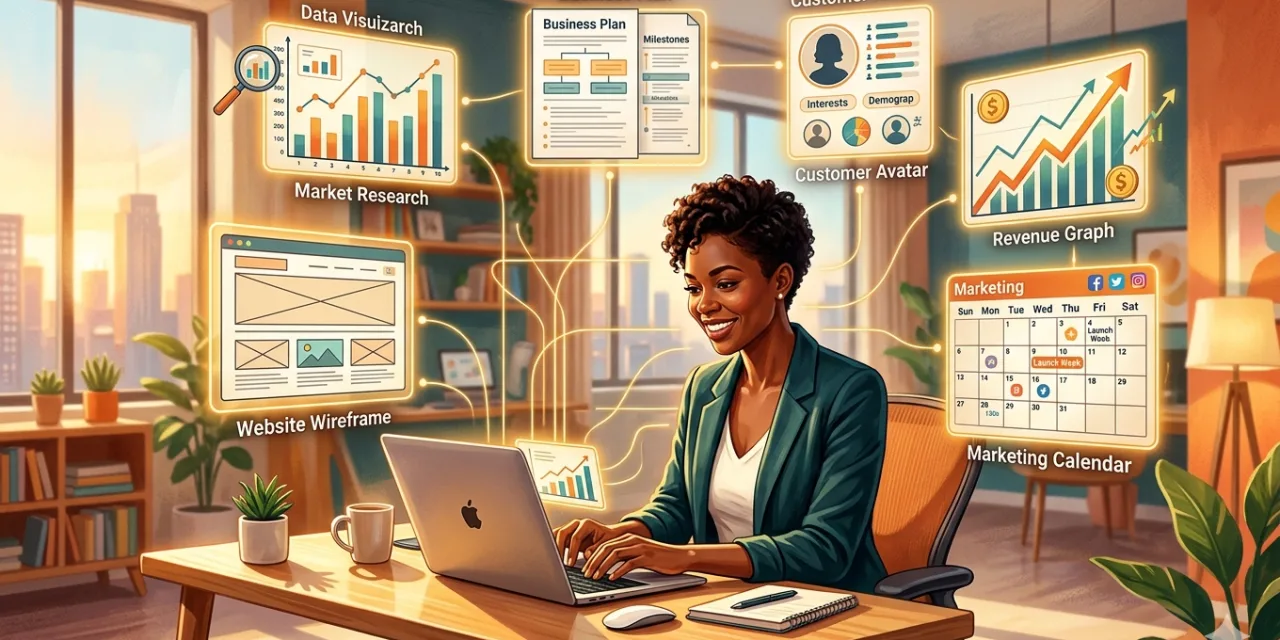
Marketing and customer acquisition are the biggest hurdles entrepreneurs face in their first year — 37 percent and 36 percent respectively, according to Shopify’s Merchant Survey. Those are not problems of ambition or effort. They are problems of resources: the time, money, expertise, and manpower that most early-stage founders simply do not have. In 2026, AI is changing what it means to have those resources. The top two AI benefits reported by entrepreneurs are improved efficiency on repetitive tasks (55 percent) and help with brainstorming and creativity (55 percent) — and the implications of those two benefits, stacked across every stage of building a business, are compounding in ways that are making it genuinely possible to start and grow a business in 2026 with less capital, less team, and less prior domain expertise than at any previous point in entrepreneurial history.
This is not hype. It is a structural shift in the cost of starting something. Tasks that previously required hiring specialists — market research, financial modelling, website development, brand design, content creation, legal document drafting, customer support automation — are now accessible to any founder willing to invest time in learning to use the right tools. The AI sector is projected to reach $1.339 trillion in value by 2030. The question is not whether AI will be part of how businesses are built in this decade — it already is. The question is whether you are using it strategically enough to actually compete.
This guide covers the complete AI-powered business launch playbook for 2026: how to use AI at every stage from idea validation through launch and early growth, which specific tools to use for which tasks, the “tool stacking” strategy that multiplies the value of individual AI applications, the AI-native business models that are generating real revenue in 2026, and the honest limitations that require human judgment rather than AI delegation. If you are planning to start a business — as a solo founder, a small team, or a side project you want to turn into something real — this is the playbook.
Stage One: Idea Generation and Validation
The first place AI provides leverage in starting a business is before you have committed to anything — in the generation and stress-testing of the business idea itself. Most founders approach this stage with a single idea they are attached to and a confirmation bias toward information that supports pursuing it. AI disrupts this pattern by generating genuinely diverse alternative ideas and providing systematic challenge to the assumptions underlying any given concept.
The most effective AI-assisted ideation approach is not to ask “what business should I start?” in a single prompt but to have a sustained conversation that provides the AI with specific context and constraints. Telling a model like Claude or ChatGPT your skills, your available time commitment, your financial runway, the markets you understand, the problems you have personally experienced, and the kind of lifestyle you want to build around the business — and then asking it to generate 10 business ideas that specifically fit those parameters — produces dramatically more useful output than a generic prompt. The follow-up conversation matters as much as the initial generation: pushing back on ideas, asking for specific challenges to each concept, requesting alternative formats for the same core idea, and exploring what would need to be true for each idea to work produces the kind of structured thinking that most solo founders struggle to achieve in isolation.
For market validation, AI tools can compress what previously required weeks of manual research into hours of structured analysis. AI market research tools can analyse consumer behaviour patterns from public data sources, social media discussions, review site data, search trend analysis, and competitor positioning to produce a coherent picture of market demand, customer sentiment, and competitive dynamics. One entrepreneur in the eco-friendly product sector used AI-driven market analysis to uncover critical consumer insights that led to a strategic pivot in product focus before spending any money on development or inventory. Another founder used AI simulations to optimise a service offering, adjusting pricing and delivery schedules based on local demographic data before launching.
The validation stage is also where AI can help you identify what you do not know. Asking a model to analyse your business idea and produce a list of the 20 assumptions you are making that could be wrong — ranked by the potential damage to the business if they turn out to be false — is one of the most valuable inputs available to a founder before making significant commitments. This kind of structured scepticism is difficult to generate in isolation, where optimism bias tends to dominate, but comes naturally to AI models trained to identify logical inconsistencies and knowledge gaps.
Stage Two: Market Research That Used to Cost Thousands
Before AI, comprehensive market research required either significant personal time (reading hundreds of industry reports, customer interviews, competitor analyses, and academic papers) or significant budget (hiring a market research firm or a data analyst). In 2026, the same quality of market intelligence is available to any founder with access to a frontier AI model, for a fraction of either cost.
The AI market research workflow that produces the most useful output for early-stage founders involves several distinct tasks applied in sequence. Begin with landscape analysis: asking the AI to describe the current state of your target market — the major players, the recent trend lines, the customer segments, the pricing norms, and the areas where current solutions are consistently falling short. For markets with significant public data, this analysis can be quite precise; for niche or rapidly evolving markets, the AI’s knowledge may be dated enough to require supplementation with real-time search.
Customer persona development with AI involves providing the model with your target customer hypothesis — the specific job title, life stage, problem, and context of the person you are trying to serve — and asking it to stress-test the persona: who else might have this problem? What assumptions are you making about the customer that may not hold? What competing solutions does this customer already use, and what would make them switch? The AI’s ability to roleplay as the target customer — responding to your product description as that customer would, raising objections that customer might raise, describing what would and would not be compelling about your offering — is one of the most underused validation tools available.
Competitor analysis with AI can produce a structured comparison of every direct competitor’s features, pricing, positioning, customer reviews, and apparent strengths and weaknesses — synthesised from public information in minutes rather than days. The output is not perfect — the AI does not have access to private competitive intelligence, and its knowledge of rapidly evolving markets may lag the current reality — but it provides a strong foundation that human research can supplement efficiently.
Search trend analysis, sentiment analysis from review sites and social media, and gap analysis (identifying what customers want that no existing product provides) are all tasks that AI handles significantly faster than manual research. The founder who invests two to three days in AI-assisted market research before building anything has a substantially more grounded understanding of what they are getting into than the founder who proceeds primarily on intuition and personal conviction.
Stage Three: The Business Plan in Hours, Not Weeks
A business plan serves two distinct purposes: it helps you think clearly about the business, and it communicates the business to external stakeholders (investors, lenders, partners). AI excels at the first purpose and provides strong assistance with the second, though human judgment and domain knowledge are still required to produce something genuinely accurate and compelling rather than generic.
AI business plan generators — available as features within ChatGPT, Claude, and dedicated tools like LivePlan and Bizplan — can produce a structured, professionally formatted business plan from your market research inputs and business concept in hours rather than the weeks that writing one from scratch typically requires. These plans cover executive summary, company description, market analysis, competitive landscape, products and services, marketing and sales strategy, financial projections, and operational plan — the standard sections that investors and lenders expect. The plans these tools generate are not finished documents that should be submitted as-is: they are excellent first drafts that require founder customisation, domain expertise input, and real-world validation of the financial assumptions. But they accelerate the process dramatically and structure the thinking in ways that are genuinely useful for founders who have never built a business before.
Financial modelling is the part of business planning that most non-financial founders find most intimidating, and it is an area where AI provides genuine leverage. Asking an AI to help build a financial model for a specific business type — providing the revenue model, the key cost categories, the expected growth trajectory, and the target market size — produces a working spreadsheet structure that the founder can then populate with real numbers. More valuably, asking the AI to identify the three financial assumptions that most significantly affect whether the business is viable — and to model what happens if each of those assumptions is wrong by 50 percent in the pessimistic direction — produces the kind of stress-testing that founders typically do not apply to their own financial models.
Stage Four: Brand Identity and Website Without an Agency
Brand identity and website development were historically among the largest early startup costs: professional brand design from a good agency typically runs $5,000 to $20,000, and custom website development from $10,000 to $50,000 for a relatively simple site. In 2026, AI-powered tools have largely eliminated these costs for early-stage founders who are willing to invest time rather than money.
AI-powered logo makers and brand identity tools — Looka, Canva’s AI brand kit, Adobe Express, and Ideogram for custom image generation — allow founders with no graphic design training to produce professional-quality visual identity systems: logos, colour palettes, typography systems, and brand guideline documents. The output is not what a top creative agency would produce for a Fortune 500 company — it lacks the strategic depth, cultural nuance, and originality of world-class brand design. For an early-stage startup that needs a credible, professional-looking identity to acquire first customers and test product-market fit, these tools are more than sufficient and infinitely superior to the alternative of launching with an obviously DIY visual identity.
Website development has been similarly transformed. No-code website builders — Webflow, Framer, Squarespace, and Wix — combined with AI content generation have made it possible for a non-technical founder to launch a professional, conversion-optimised website in a single day. AI generates the copywriting (headlines, value propositions, feature descriptions, testimonial frameworks, FAQ content), the site structure (which pages to include, how to organise the navigation), and the SEO meta descriptions that help the site rank in search — leaving only the configuration and brand application to the founder. For SaaS and software products, tools like Bubble, Glide, and Adalo have extended no-code development from websites into functional application development, allowing founders to build working MVPs without writing a line of code.
Stage Five: Content Marketing and Customer Acquisition
Content marketing has become the primary customer acquisition channel for startups without large paid advertising budgets, and AI has made it possible for a solo founder to produce the volume and quality of content previously requiring a full marketing team. The Shopify Merchant Survey finding — that marketing (37 percent) and customer acquisition (36 percent) are the biggest first-year challenges — reflects a pre-AI baseline. In 2026, founders who have learned to use AI content tools effectively are producing blog posts, social media content, email newsletters, video scripts, podcast outlines, and ad copy at a volume that a solo founder could not have sustained manually.
The “tool stacking” strategy — using multiple specialised AI tools in combination rather than relying on a single all-purpose model — is what separates founders who use AI casually from those who use it as genuine leverage. A typical content marketing stack for a 2026 solo founder might combine ChatGPT or Claude for long-form content drafting and editing, Perplexity or ChatGPT’s Deep Research for factual research and source verification, Midjourney or DALL-E 3 for custom visual content, Descript for AI-assisted video and podcast production, and Publer or Buffer (with AI scheduling features) for content distribution and social media management. Each tool does what it is best at; the founder orchestrates the stack.
Email marketing automation — the channel with the highest ROI of any digital marketing approach at $36 returned for every $1 spent — has been further strengthened by AI. AI-powered email tools write subject lines optimised for open rates, segment lists based on engagement behaviour, personalise email content by recipient characteristics, and send at times individually optimised for each subscriber’s historical open patterns. What previously required an experienced email marketing specialist with significant list management and copywriting skill can now be accomplished by a founder with access to AI tools and basic strategic sense about what their audience wants to hear.
SEO — organic search visibility — remains one of the highest-value long-term customer acquisition channels, and AI has made it dramatically more accessible to non-specialists. AI tools can perform keyword research, identify content gaps where competitors are ranking but you are not, suggest article structures optimised for search intent, generate first drafts of articles targeting specific keywords, and audit existing content for SEO improvement opportunities. For founders in content-receptive markets, an AI-powered SEO content programme can build sustainable organic traffic that continues delivering customers long after the content is published — the compound return that makes content marketing one of the best long-term investments an early-stage company can make.
Stage Six: Operations, Customer Support, and Scaling Without Headcount
The most dramatic operational leverage that AI provides for early-stage founders is the ability to handle functions that would previously have required dedicated headcount — customer support, administrative tasks, scheduling, invoicing, and basic legal and compliance management — without hiring.
AI-powered customer support chatbots — integrated with your product, trained on your documentation and FAQ content, and capable of handling the most common customer queries without human involvement — allow a solo founder to provide 24-hour customer support responsiveness from day one. The quality of these tools has improved significantly: they can resolve product questions, process refund requests, troubleshoot common issues, and escalate to human support only for the genuinely complex situations that require human judgment. For e-commerce businesses in particular, where repetitive queries about order status, delivery timelines, and return policies dominate support volume, AI support can handle 70 to 80 percent of inbound queries without human involvement from a surprisingly early stage.
Administrative AI tools manage scheduling (AI scheduling assistants like Reclaim and Motion automatically optimise calendar usage based on priorities and energy levels), invoicing (tools like FreshBooks with AI features generate and follow up on invoices automatically), legal document generation (tools like Spellbook and Harvey generate standard contracts, NDAs, and terms of service from templates), and bookkeeping (tools like Bench and Digits use AI to categorise transactions and prepare financial summaries). The cumulative time saving of these tools — across the dozens of administrative tasks that otherwise consume founder time that could be spent on product development and customer relationships — is substantial.
As the business grows, AI becomes the scaling mechanism that allows small teams to operate with a surface area — number of customers served, markets addressed, content produced, support queries handled — that would previously have required significantly more headcount. The AI sector’s projection to $1.339 trillion by 2030 reflects in part the compounding value of tools that allow businesses to scale revenue without proportionately scaling headcount.
AI-Native Business Models: What to Build in 2026
Beyond using AI to launch a traditional business more efficiently, 2026 has produced a category of AI-native business models — businesses that are fundamentally made possible by AI, not just made more efficient by it — that represent some of the highest-opportunity areas for new founders.
AI consulting and implementation services are among the most immediately accessible opportunities for entrepreneurs with domain expertise in any field. As businesses of all sizes recognise the need to integrate AI into their operations, the demand for people who understand both AI capabilities and specific industry contexts — and can bridge the gap between the two — has dramatically outpaced supply. A founder with five years of experience in logistics, manufacturing, healthcare, or financial services who has learned to use current AI tools has a genuinely valuable combination of capabilities that most AI companies lack and most traditional businesses need.
AI-powered content businesses — newsletters, research services, educational content, specialised information products — are proliferating because AI has reduced the production cost of content to near zero while the value of high-quality, well-curated, expert-validated information remains high. The successful content businesses in 2026 are not the ones producing the most AI-generated content — that commodity is already abundant and increasingly difficult to monetise. They are the ones combining AI’s production efficiency with human curation, expert perspective, and community depth that AI cannot replicate.
AI-enhanced service businesses — freelance writing, graphic design, video production, software development, marketing strategy — where the founder uses AI tools to deliver higher quality work faster than non-AI competitors allow solo practitioners to offer competitive pricing on work that would previously have required a small agency. A solo developer using AI coding assistance can build software at the speed of a small team. A solo designer using AI image generation and editing tools can produce the output of a small design studio. The AI tool stack becomes the competitive moat — not because it is hard to access, but because leveraging it effectively requires skill, taste, and domain expertise that takes time to develop.
The Honest Limitations: What AI Cannot Do for Your Business
The genuine enthusiasm for AI as a business-building tool in 2026 is warranted — the leverage it provides is real and measurable. But honest assessment of where AI falls short is equally important for founders who want to use it strategically rather than as a substitute for the things that actually make businesses work.
AI cannot replace genuine domain expertise in the early stages of business validation. The market research AI produces is only as good as the context you provide and the quality of publicly available data about your market. For genuinely novel ideas in markets that do not yet have rich public data, AI’s validation capabilities are limited by its training data. Customer discovery — the actual conversations with potential customers that validate whether the pain you are solving is real enough to pay for — cannot be delegated to AI, at least not yet. The feedback you get from real humans about whether they would pay money for your product, and how much, and what would make them not switch back to their current solution, is irreplaceable and must be gathered personally.
Relationship-building — with customers, with potential partners, with investors, with early hires — cannot be automated. The trust that makes early customers give an unproven product a chance, the credibility that makes an investor take a founder meeting, the rapport that makes an early hire join a pre-revenue startup rather than a safe corporate job — these are all products of human-to-human connection that AI can support (by helping you write better outreach emails, prepare for meetings more thoroughly, or follow up more consistently) but cannot replace.
AI also has a tendency to produce confident-sounding answers to questions that require nuanced human judgment. Business strategy, pricing decisions, hiring choices, market positioning — in all of these areas, AI can be a useful thought partner and information source, but the output requires critical evaluation by a human with real-world context. Founders who treat AI outputs as answers rather than inputs are building on a foundation that may be more brittle than it appears. The most effective AI-powered founders in 2026 use AI to generate, research, draft, and automate — and reserve their own judgment for the decisions that actually determine whether the business succeeds or fails. That combination — AI’s breadth and speed with human judgment and relationship — is the competitive advantage that a well-equipped solo founder in 2026 has over both the unassisted solo founder of five years ago and the poorly-AI-equipped team of today.



0 Comments
No comments yet. Be the first to share your thoughts!