
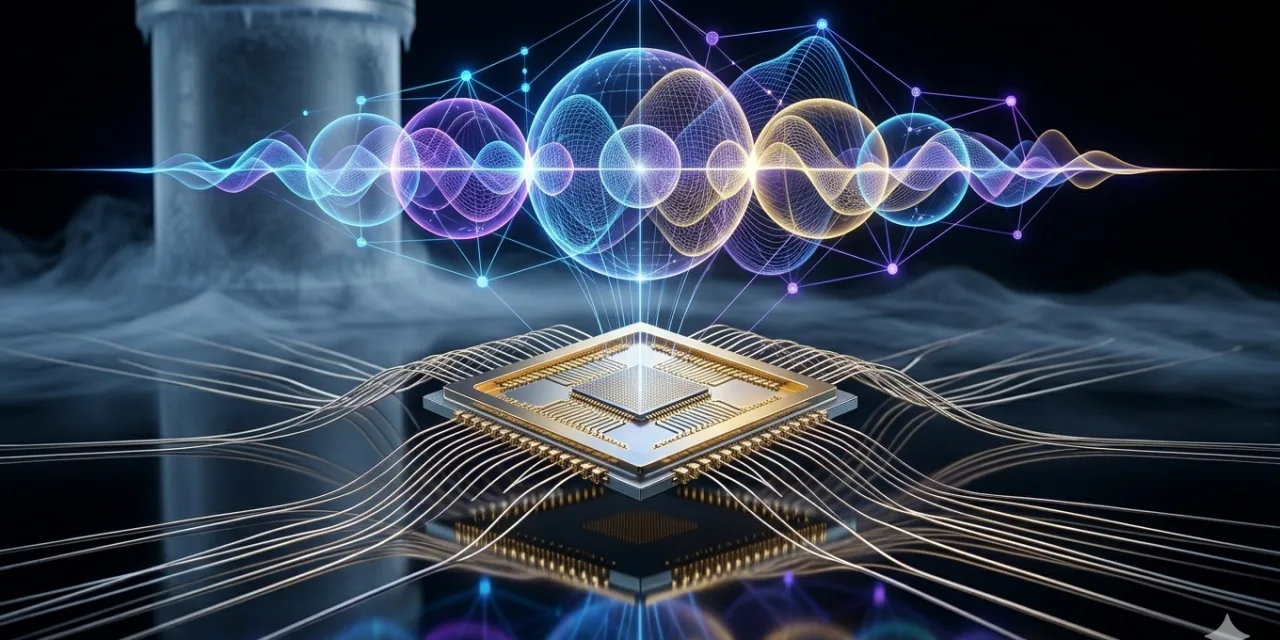
In December 2024, Google announced that its Willow quantum chip had completed a specific calculation in under five minutes that would take the fastest classical supercomputers on Earth ten septillion years to solve. That is a number so large it exceeds the age of the universe by a factor of roughly 700 billion. In January 2026, Microsoft unveiled Majorana 1 — the world’s first quantum processor using topological qubits — and claimed it could enable practical quantum computers within years rather than decades. In March 2026, IBM released the industry’s first published quantum-centric supercomputing reference architecture, describing how quantum processors could work alongside conventional CPUs and GPUs to tackle scientific problems neither could solve alone. At CES 2026, IBM’s quantum leadership stated flatly that they expected strong claims of quantum advantage to emerge that same year.
Quantum computing has been on the verge of changing everything for decades. The joke in research circles has been that the technology has been five years away from practical utility for thirty consecutive years. That characterisation is becoming less accurate by the month. The hardware is maturing faster than most observers expected. The conceptual framework for how quantum computers will actually be useful — not as standalone systems replacing classical computers, but as specialised co-processors handling the specific categories of problems that classical systems cannot manage — is becoming clearer and more operational. And the first applications in chemistry, materials science, and optimisation are beginning to produce results that were genuinely out of reach before.
This guide explains quantum computing from first principles, without assuming any prior technical knowledge. It covers what makes a quantum computer fundamentally different from the computers you already use, why that difference matters, what the technology can and cannot do, what the most significant recent breakthroughs represent, where the technology is being deployed in real-world applications right now, and what the realistic timeline is for it to affect the world in ways that touch ordinary people’s lives — including the implications for the encryption that currently protects your financial information and communications.
The Classical Computer: What It Does and Why It Has Limits
Every computer you have ever used — from the smartphone in your pocket to the most powerful supercomputer in the world — operates on the same fundamental principle. It processes information as bits: units of data that exist in exactly one of two states at any given moment, represented as 0 or 1. Everything your computer does — every calculation, every image, every video, every database query — is ultimately encoded as sequences of 0s and 1s being processed according to logical rules. The transistors at the heart of every microchip are switches: on or off, 1 or 0.
Classical computers are extraordinarily good at this. A modern smartphone contains billions of transistors switching billions of times per second, enabling computations of remarkable complexity at remarkable speed. But there are categories of problems for which this architecture is fundamentally insufficient — not because computers are not fast enough yet, but because the structure of the problem makes any approach based on sequential evaluation of possible solutions computationally intractable regardless of speed.
Consider the protein folding problem: predicting the three-dimensional structure that a protein will adopt based on its amino acid sequence. The number of possible configurations that even a moderately sized protein can theoretically explore is so large that exhaustive evaluation — trying every possibility — would require computational time longer than the age of the universe even on the fastest classical hardware. Or consider the problem of simulating quantum chemical systems: modelling how electrons in a molecule behave requires tracking quantum mechanical interactions that classical computers can only approximate, because the mathematics of quantum mechanics is not naturally expressible in the binary logic of classical computation. Or consider certain optimisation problems — finding the optimal route through a network with hundreds of nodes, or finding the globally optimal configuration of a complex system with many interacting variables — where the number of possible solutions grows exponentially with problem size in ways that make classical exhaustive search impossible.
These are not hypothetical limitations. They are the reason why drug discovery takes decades, why materials science advances slowly, why certain logistics and financial optimisation problems remain approximate rather than solved. Quantum computers offer a fundamentally different approach to these problems — not because they are faster at the same computation, but because the way they process information allows them to explore vast spaces of possibilities in ways that classical systems structurally cannot.
What Makes a Quantum Computer Different: Qubits, Superposition, and Entanglement
A quantum computer replaces classical bits with quantum bits — qubits. The difference between a bit and a qubit is not merely technical. It is conceptual, and it stems from the strange rules that govern the behaviour of matter at the subatomic scale.
Superposition is the most fundamental quantum property that qubits exploit. Where a classical bit must be either 0 or 1 at any moment, a qubit in superposition is both 0 and 1 simultaneously — it exists in a combination of both states, with a probability associated with each. This is not a metaphor or an approximation. It is a precise physical description of how quantum systems behave before they are measured. When you measure a qubit, the superposition collapses to a definite value — 0 or 1 — but until that measurement occurs, the qubit genuinely exists in both states at once.
The computational consequence of superposition becomes clear when you consider multiple qubits together. Two classical bits can represent exactly one of four possible states at any moment: 00, 01, 10, or 11. Two qubits in superposition represent all four states simultaneously. Three qubits represent all eight possible three-bit states simultaneously. The pattern continues: n qubits in superposition represent 2 to the power of n states simultaneously. A quantum computer with 300 qubits in superposition represents more states simultaneously than there are atoms in the observable universe. This exponential scaling is what gives quantum computers their potential advantage on specific problem types — they can explore an exponentially large problem space in ways that classical computers cannot.
Entanglement is the second crucial quantum property. When qubits are entangled, the state of one qubit is instantaneously correlated with the state of another, regardless of the physical distance between them. Einstein famously called this “spooky action at a distance” and found it deeply troubling — but it is experimentally established beyond question. In a quantum computer, entanglement is used to create correlations between qubits that allow quantum algorithms to coordinate the processing of superposed states in ways that direct information toward the correct answer and away from incorrect ones. Without entanglement, the superposition of qubits would not produce computational advantage; with it, quantum algorithms can systematically amplify the probability of measuring the correct answer.
Interference is the third key quantum property. Quantum interference allows the probability amplitudes associated with different computational paths to add together or cancel each other out, depending on their relative phases. Well-designed quantum algorithms use interference to amplify the probability of the correct solution and suppress the probability of incorrect ones — so that when the qubits are measured at the end of the computation, the measurement is highly likely to yield the right answer. This is how algorithms like Shor’s algorithm for factoring large numbers and Grover’s algorithm for database search achieve their theoretical speedups over classical equivalents.
The Engineering Challenge: Why Building Quantum Computers Is So Hard
If qubits can represent exponentially more information simultaneously, and quantum algorithms can exploit this for dramatic speedups on certain problems, why do we not already have practical quantum computers solving the world’s hardest problems? The answer comes down to a physical property of quantum systems that is as fundamental as superposition and entanglement: decoherence.
Qubits maintain their quantum properties — their superposition and their entanglement — only when they are perfectly isolated from their environment. Any interaction with the external world — heat, electromagnetic fields, vibrations, even a stray cosmic ray — can disrupt the qubit’s quantum state in a process called decoherence, collapsing the superposition and destroying the quantum information being processed. This is why quantum computers must be operated at temperatures close to absolute zero: approximately 15 millikelvin, which is colder than the surface of empty space in the depths of the universe. The elaborate cryogenic equipment that makes quantum computing look more like a laboratory installation than a conventional computer is dedicated to creating and maintaining the environmental isolation that qubits require.
Even with near-perfect isolation, qubits are inherently noisy — they make errors at rates that would make classical computation impossible if classical bits behaved similarly. Classical computers have extremely low error rates because their transistors are binary and robust: a transistor that is 95 percent “on” counts as 1, not as a probabilistic mixture. Qubits have no such robustness — the fragile quantum states that give them their power also make them error-prone. The response to this problem is quantum error correction: encoding logical qubits redundantly across multiple physical qubits so that errors in individual physical qubits can be detected and corrected without destroying the logical quantum information. The overhead required for error correction is enormous: current estimates suggest that a single reliable logical qubit might require hundreds or even thousands of physical qubits for full error correction, meaning a fault-tolerant quantum computer capable of practical applications might require millions of physical qubits.
This is the central engineering challenge that defines the quantum computing race of 2025 and 2026: getting enough reliable qubits working together with sufficient error correction to demonstrate genuine quantum advantage on a problem that actually matters. It is not a problem of physics — the physics is understood. It is a problem of engineering at extraordinary precision and scale.
The 2026 Breakthroughs: What IBM, Google, and Microsoft Are Actually Doing
The three major technology companies pursuing quantum advantage are taking meaningfully different approaches to the hardware and error correction challenges, and understanding those approaches helps clarify what the recent breakthroughs actually represent.
IBM’s approach centres on superconducting qubits — tiny circuits cooled to near absolute zero that exhibit quantum behaviour in the same way as atomic-scale quantum systems. IBM has been executing against a publicly published quantum roadmap since 2019, hitting its targets consistently year over year. The current hardware flagship is the Nighthawk processor, a 120-qubit chip that in 2026 is being scaled to multi-chip configurations supporting up to three Nighthawk chips working in tandem — bringing the effective qubit count to 360 while maintaining the gate quality required for meaningful quantum computation. IBM’s roadmap targets fault-tolerant quantum computing with full error correction by 2029, using the Starling processor architecture.
IBM’s near-term strategy acknowledges that full error correction is a 2029 goal, not a 2026 one. In the meantime, the company is pursuing quantum advantage through error mitigation — techniques that reduce the effect of errors without fully correcting them — combined with hybrid quantum-classical algorithms that use quantum processors for the portions of problems where quantum advantage is most accessible and classical processors for the rest. IBM’s March 2026 release of the industry’s first quantum-centric supercomputing reference architecture describes exactly this approach: quantum processors working alongside GPUs and CPUs as part of an integrated computing environment, addressing the specific scientific challenges that quantum mechanics is uniquely suited to handle while leaving the rest of the computation to classical systems.
The scientific validation of this approach appeared in early 2026, when a collaboration between IBM, the US Department of Energy’s Quantum Science Center at Oak Ridge National Laboratory, Purdue University, the University of Illinois, Los Alamos National Laboratory, and the University of Tennessee demonstrated that a 50-qubit IBM Heron r2 quantum processor could simulate the magnetic properties of real materials in ways that matched experimental results from neutron scattering — a genuine scientific application where quantum simulation provided results at a level of detail that classical computation cannot match.
Google’s approach achieved what many consider the most significant quantum milestone of the past decade with the Willow chip, announced in December 2024. Willow was the first quantum system to demonstrate below-threshold error correction — the point at which errors decrease exponentially as more qubits are added to the error correction code, rather than accumulating. This property had been the theoretical promise of error correction for thirty years but had never been experimentally demonstrated before Willow. Below-threshold error correction creates a positive feedback loop: larger quantum systems become more reliable, not less, which means that scaling up qubits can translate into scaling up reliability in a way that was not previously accessible. Google’s demonstration that Willow solved a specific benchmark problem in under five minutes that would take classical supercomputers an effectively infinite time is the context for the ten septillion years figure — though it is important to note that this benchmark is specifically constructed to showcase quantum advantage, not a problem of practical interest.
Microsoft’s approach is the most differentiated and potentially the most significant if it succeeds as claimed. The Majorana 1 chip, unveiled in early 2026, uses topological qubits — a fundamentally different physical implementation that aims to provide inherent error protection at the hardware level rather than requiring extensive error correction overhead. Topological qubits encode quantum information in the global topology of a physical system rather than in the fragile local state of a single particle, making them theoretically far more resistant to environmental disruption. Microsoft claims that Majorana 1 represents a milestone toward practical quantum computers in years rather than decades, though the broader scientific community regards the claims as requiring extensive further validation before the full implications can be assessed.
What Quantum Computers Can Actually Do: Current and Near-Term Applications
The headline capabilities of quantum computing — defeating classical supercomputers on fabricated benchmarks, performing calculations faster than the age of the universe — are real demonstrations of quantum physics but are not, yet, demonstrations of practical utility. The honest answer to the question of what quantum computers can do right now in 2026 is: a small set of scientifically significant things, with a much larger set of practically significant applications on a trajectory toward accessibility over the next several years.
Molecular simulation and materials science is the application domain where quantum computing’s near-term advantage is most credible and most consequential. Classical computers simulate quantum chemical systems by approximating quantum behaviour, because the exact equations of quantum mechanics are exponentially complex to evaluate on classical hardware. Quantum computers can simulate quantum systems exactly — or at least more exactly — because they themselves are quantum systems operating under the same physical laws. The IBM and DOE demonstration of magnetic material simulation in 2026 is a real example of this capability in operation: a quantum simulation that produced results matching physical experiments at a level of molecular detail that classical simulation cannot reach. The commercial implications of this capability extend from drug discovery (designing molecules with specific binding properties) to battery technology (designing electrode materials with improved energy density) to catalysis (designing industrial catalysts that produce fewer emissions or consume less energy).
Optimisation problems represent a second category where quantum approaches have theoretical advantages. Problems like finding the optimal configuration of a logistics network, optimising a financial portfolio across thousands of correlated assets, or scheduling resources across a complex system with many interdependent constraints are computationally intractable for classical systems at scale because the number of possible solutions grows exponentially with problem size. Quantum annealing systems, pioneered by D-Wave, are already deployed in commercial contexts for certain optimisation tasks in logistics, manufacturing scheduling, and financial modelling — representing the first commercial quantum computing applications that are in production rather than experimental. The results are not yet definitively superior to the best classical optimisation algorithms in all cases, but they represent a meaningful first wave of commercial quantum utility.
Quantum machine learning and AI acceleration is an area of active research with significant theoretical promise but limited current practical deployment. Quantum algorithms for certain machine learning tasks — particularly those involving high-dimensional data analysis, pattern matching in exponentially large datasets, and certain types of linear algebra — have theoretical speedup potential over classical equivalents. However, the overhead required to load classical data into quantum systems (a process called quantum state preparation) often erodes the theoretical advantage, and most AI applications today run entirely on classical hardware. The quantum AI connection is a medium-term trajectory rather than a current reality.
The Existential Threat: What Quantum Computing Means for Encryption
Of all the implications of quantum computing, the one with the most immediate and most direct relevance to ordinary people is its potential impact on the encryption systems that currently protect virtually all private communications, financial transactions, and sensitive data in the digital world.
The most widely used public-key encryption systems — including RSA and elliptic curve cryptography — depend for their security on the practical impossibility of solving certain mathematical problems on classical computers. Specifically, RSA encryption depends on the difficulty of factoring very large numbers into their prime components: a task that would take classical computers an impractically long time for numbers of the size used in practice. Shor’s algorithm, developed in 1994 by mathematician Peter Shor, demonstrates that a sufficiently capable quantum computer could factor large numbers exponentially faster than classical computers — in principle breaking RSA encryption in polynomial rather than exponential time. The same quantum vulnerability applies to many other cryptographic primitives currently in widespread use.
A sufficiently capable fault-tolerant quantum computer — one with the reliable logical qubits required to run Shor’s algorithm at scale — does not yet exist. The physical qubit counts currently achievable (hundreds to low thousands), combined with the error rates of current hardware, mean that breaking practical RSA encryption remains far beyond current quantum capability. But the principle is established, the hardware is advancing, and the timeline is now sufficiently credible that governments, standards bodies, and major enterprises are actively preparing the transition to quantum-resistant cryptography.
The US National Institute of Standards and Technology (NIST) finalised its first set of post-quantum cryptographic standards in 2024, after a seven-year evaluation process involving global cryptography researchers. These standards define encryption algorithms that are believed to be resistant to attacks from both classical and quantum computers. The US federal government has mandated transition timelines for government systems, and major technology companies including Google, Apple, and Cloudflare have announced migration roadmaps. The concept of “harvest now, decrypt later” — in which adversaries today collect encrypted communications with the intention of decrypting them once sufficiently capable quantum computers are available — means that even data encrypted today with current methods may be at risk if it retains sensitivity for the decades during which quantum capability matures.
The Realistic Timeline: Hype vs. Reality in 2026
Quantum computing carries more hype per unit of current practical utility than perhaps any other technology of the modern era, and honest assessment of the gap between demonstrated capability and transformative impact is essential for anyone trying to understand what the technology actually means for the world right now.
The honest assessment of 2026 is that quantum computing is genuinely at an inflection point — the breakthroughs of the past two years are real, scientifically significant, and accelerating. IBM’s consistent roadmap execution, Google’s below-threshold error correction breakthrough with Willow, and Microsoft’s topological qubit milestone with Majorana 1 represent genuine scientific advances that move the field meaningfully toward practical utility. But the inflection point toward practical, broadly accessible quantum advantage — the point at which quantum computers are solving problems of commercial or scientific importance that classical computers genuinely cannot — is not 2026. It is more likely 2028 to 2032 for the first meaningful commercial applications beyond the already-deployed optimisation use cases, and 2029 or later for fault-tolerant systems with full error correction.
IBM’s Borja Peropadre was characteristically candid at CES 2026: “We don’t think there’s going to be a strong claim or a final goal post that says quantum advantage has been achieved on this.” The competitive dynamic between quantum and classical computing will play out as a feedback loop, with quantum systems attempting to outperform classical methods on specific problems and classical algorithms continuously improving to meet the challenge. The problems where quantum computers achieve durable, unambiguous advantage over the best classical approaches are likely to be specific and narrow rather than broadly applicable — at least in the near term.
What is not in doubt is the trajectory. The pace of hardware improvement, the quality of the scientific validations emerging from leading research groups, and the scale of investment — the quantum computing industry attracted $2 billion in startup funding in 2024 alone — are all consistent with a technology that is building toward practical capability rather than plateauing. IBM’s roadmap to fault-tolerant quantum computing by 2029 is ambitious but grounded in a track record of consistent execution. Microsoft’s topological qubit approach, if it performs as claimed, could compress timelines dramatically. And the hybrid quantum-classical architecture that IBM has formalised in its March 2026 reference architecture represents a pragmatic path to quantum utility that does not require waiting for full error correction to deliver value.
What Quantum Computing Means for You
For most people, the practical impact of quantum computing will not arrive through direct use of a quantum computer. It will arrive through the products and discoveries that quantum computing enables — new drugs developed with quantum molecular simulation, new battery materials designed with quantum chemistry, new optimisation algorithms embedded in the logistics networks and financial systems that shape daily economic life, and (if the post-quantum cryptography transition is not completed in time) potential vulnerabilities in the encryption systems that currently protect digital privacy and financial security.
The category of quantum computing impact that is most immediate and most actionable for most organisations right now is not the computational advantage — it is the cryptographic threat. Understanding which data in your organisation has a security lifetime that extends beyond the decade, assessing which systems rely on cryptographic primitives that are quantum-vulnerable, and beginning the migration planning for post-quantum cryptographic standards is not a speculative exercise. It is risk management that NIST, the US federal government, and every major cloud provider has already begun, and that organisations holding long-lived sensitive data need to engage with proactively rather than reactively.
For the world’s hardest scientific problems — the diseases that remain untreatable, the materials that remain undiscoverable, the chemical processes that remain unoptimised — quantum computing represents a genuinely new category of tool that will, over the coming decade, begin to provide answers that are simply unavailable to classical computation. Richard Feynman envisioned it in 1982. IBM, Google, and Microsoft are building it now. The machines are real, the breakthroughs are real, and for the first time in the technology’s history, the claim that practical quantum advantage is coming within years rather than decades is something that the evidence actually supports.




0 Comments
No comments yet. Be the first to share your thoughts!