
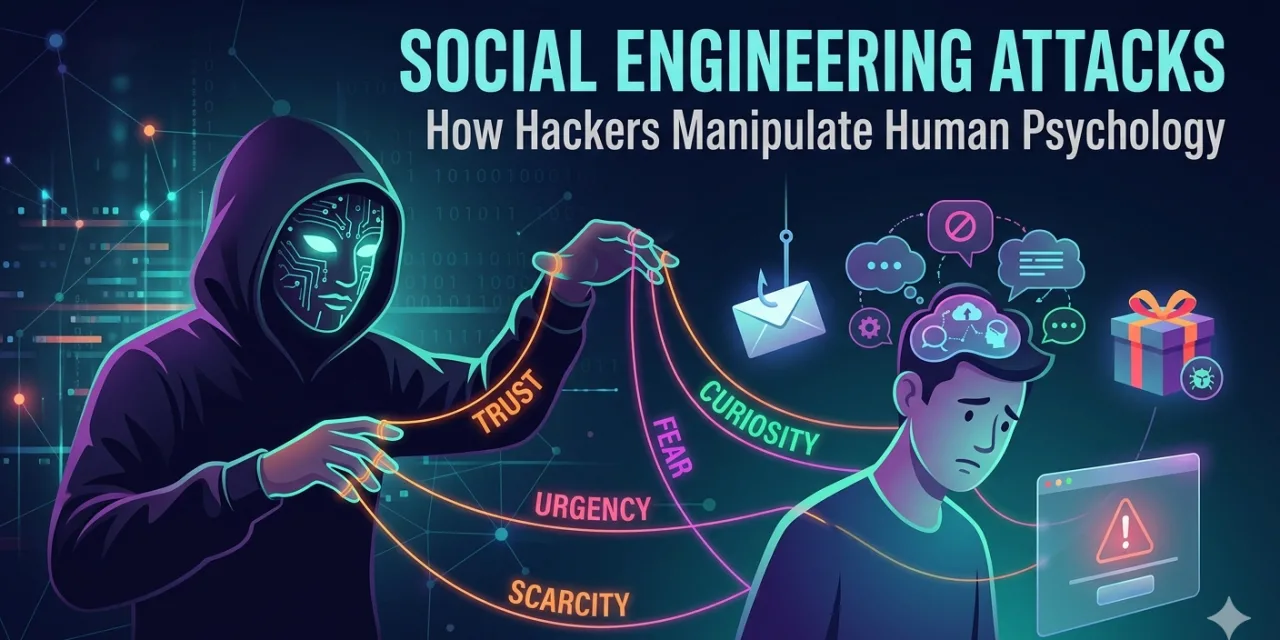
Human error — including social engineering — caused 68 percent of all data breaches in 2024. Eighty-nine percent of social engineering attacks were financially motivated. AI-powered phishing campaigns now achieve a 42 percent higher success rate than conventional email-only attacks. And suspicious logins — many of which are precursors to business email compromise following social engineering — make up 37 percent of all identity threats across millions of monitored identities, according to Huntress’s 2026 Cyber Threat Report. These numbers describe not a niche technical threat but the dominant attack methodology in modern cybercrime: attacks that bypass every firewall, every intrusion detection system, and every endpoint security tool by targeting the one component of every security architecture that cannot be patched — the human being operating the system.
The fundamental insight that makes social engineering so persistently effective is also what makes it so difficult to defend against with purely technical controls. Security software can block malicious files, flag dangerous links, and isolate suspicious processes. It cannot stop a convincing phone call. It cannot detect when a trusted colleague’s email account has been compromised and is being used to request a wire transfer. It cannot prevent an employee from holding a door open for a person in a delivery uniform carrying boxes who turns out to be an attacker. The attack surface that social engineering targets — human trust, human authority response, human time pressure, human curiosity — is not a misconfiguration that can be remediated. It is human nature, exploited with increasing sophistication by attackers who invest as much in understanding psychology as in understanding technology.
In 2026, that sophistication has taken on an AI dimension that SecurityWeek describes with precision: we are moving from spear-phishing and vishing to what intelligence professionals call “relationship operations” — sustained, AI-enhanced campaigns in which victims are psychologically steered into trusting states of mind over extended periods before the actual attack request is made. Deepfake voice and video, AI-synthesised backstories, and what one security researcher calls “A/B-tested sycophancy individually tuned to psychological profiles” represent the frontier of social engineering in 2026. Understanding the full spectrum of social engineering — from its foundational psychology to its most sophisticated current forms — is the prerequisite for building defences that work.
The Psychology of Social Engineering: Why Smart People Fall For It
Social engineering does not succeed primarily because victims are naive or unintelligent. It succeeds because it exploits psychological mechanisms that are hardwired into human cognition — mechanisms that evolved to facilitate social cooperation and trust in environments where they served survival functions, and that attackers have learned to activate deliberately in contexts where they cause harm.
Robert Cialdini’s six principles of influence — reciprocity, commitment, social proof, authority, liking, and scarcity — are the framework that describes most of the psychological mechanisms that social engineering exploits. Attackers do not need to have read Cialdini’s work; they have learned empirically what triggers compliance, and Cialdini’s framework simply provides the analytical vocabulary for what they already do instinctively.
Authority is the most commonly exploited trigger. When someone who appears to be in a position of authority makes a request, humans have a deeply ingrained tendency to comply — a tendency that is socially functional in legitimate organisational contexts and catastrophically exploitable when the apparent authority is fabricated. The attacker who impersonates a CEO, a bank fraud team, an IT administrator, or a government official is exploiting the authority trigger that causes people to comply with requests that their critical thinking, if engaged, would reject. The Verizon 2025 DBIR’s finding that the median time from a phishing email landing to a user clicking is just 21 seconds reflects authority combined with urgency: there is not enough time for critical evaluation to override the compliance response.
Urgency is the trigger that most consistently defeats careful evaluation. “Your account will be suspended in 30 minutes,” “This payment must be processed before close of business today,” “Security breach detected — reset your password immediately” — these urgency framings are effective precisely because they create time pressure that makes careful verification feel impossible and perhaps even dangerous to the victim who believes the emergency is real. The combination of authority and urgency — an apparently senior figure making an urgent demand — is the pattern underlying the majority of BEC attacks and help desk social engineering incidents.
Trust through familiarity is the mechanism that makes spear phishing and relationship operations effective. When an email appears to come from a known colleague, or when an attacker has spent weeks building a relationship that feels genuine before making their request, the victim’s evaluation of the request is filtered through an established trust relationship that predisposes them to compliance. The 21-second click time reflects a cold phishing email; a carefully cultivated relationship operation might take weeks to develop the trust level that produces the eventual target action — but the success rate is proportionally higher.
Fear is used in both the positive and negative direction. Fear of negative consequences — account closure, legal action, missing a deadline — motivates urgent compliance. Fear of social embarrassment — seeming unhelpful, seeming suspicious of a genuine colleague, causing unnecessary friction — prevents victims from applying the verification steps that would catch the attack. The dual fear mechanism is particularly effective: the attacker creates fear of the negative consequence if you do not comply, while the victim’s own social anxiety creates fear of the consequences of seeming difficult or suspicious if they ask questions.
The Attack Types: A Complete Taxonomy
Social engineering encompasses every manipulation technique that targets human psychology rather than technical vulnerabilities. Understanding the full range is important because different attack types require different countermeasures, and defenders who are trained only against phishing emails remain vulnerable to the physical and voice-based attacks that most security awareness programmes address less thoroughly.
Phishing is the most common and most extensively documented form — deceptive digital messages designed to trick recipients into revealing credentials, clicking malicious links, or opening malware-laden attachments. It is addressed in depth in our dedicated phishing guide; the key point here is that phishing is a subset of social engineering, not its entirety. Organisations that believe they have addressed social engineering by training employees on phishing recognition have addressed one vector while leaving many others open.
Pretexting is the creation of a fabricated scenario — a “pretext” — that establishes a context making the attacker’s request seem legitimate. A classic pretexting attack involves calling an employee while claiming to be an IT administrator conducting a security audit, using knowledge of the target’s name, department, and IT systems (obtainable from LinkedIn and company websites) to appear credible, and then requesting credentials or remote access “to verify the account.” The pretext does the work of establishing plausibility; the authority trigger does the work of producing compliance. Pretexting is the mechanism behind many help desk attacks, including the Scattered Spider attacks that compromised MGM Resorts, Caesars Entertainment, and Marks & Spencer — all executed through phone-based pretexting that convinced IT help desk staff to reset credentials for accounts that attackers then used to deploy ransomware.
Baiting exploits curiosity and the human tendency to pick up and use found items. Physical baiting involves leaving infected USB drives in car parks, lobbies, or other locations where target employees are likely to find them — relying on the finder’s curiosity to plug in the device and investigate its contents. Studies consistently find that 45 to 98 percent of dropped USB drives are plugged in by the finders, depending on context. Digital baiting uses free downloads, pirated software, or enticing content as the lure for malware installation. The psychological mechanism is curiosity combined with the perceived benefit of a free resource — which overrides the caution that the same person would apply to an unexpected download from an unknown source.
Tailgating and piggybacking are physical social engineering attacks in which an attacker follows an authorised person through a secure door or barrier without presenting their own credentials — typically by carrying boxes or appearing to have full hands (triggering the helpful impulse to hold the door), by striking up a brief conversation that establishes social connection before the barrier, or by simply moving through the door quickly behind an authorised person whose social discomfort about challenging a stranger prevents them from doing so. Physical access gained through tailgating can then be used to install keyloggers, access unlocked workstations, photograph sensitive documents, or plant listening devices in meeting rooms.
Quid pro quo attacks exploit the reciprocity trigger by offering something of apparent value in exchange for the target action. A classic quid pro quo is a phone call offering free IT support — the attacker calls employees, identifies themselves as IT support, offers to run a security scan or address a known system issue, and in the process of “helping” gains remote access or credential information. The offer of help creates a reciprocity obligation that makes people less sceptical of the subsequent requests.
Watering hole attacks compromise websites that the target population is known to visit — industry forums, professional community sites, software vendor pages — and inject malware that executes when a target visits the compromised page. Unlike phishing, which brings the attack to the target, watering hole attacks wait for the target to come to them — in a context (a trusted professional resource) that the target has no reason to treat with suspicion. The specificity of watering hole targets — selected for the professional community they serve — makes them particularly effective against well-trained security teams who are less sceptical of familiar professional resources than of unsolicited communications.
Romance scams and relationship operations are the most time-intensive and most psychologically sophisticated form of social engineering, used primarily in high-value individual fraud and increasingly in corporate espionage. The attacker creates a fabricated persona — typically on dating apps, LinkedIn, or professional community platforms — and invests weeks or months in building a genuine emotional connection before leveraging that connection for the actual attack. Romance scams targeting individuals resulted in $1.14 billion in losses in the US in 2023. Corporate relationship operations — in which fake industry contacts develop genuine professional relationships with employees before eventually extracting confidential information or gaining system access — are the most sophisticated end of the social engineering spectrum.
The AI Transformation of Social Engineering in 2026
The SecurityWeek Cyber Insights 2026 framing captures the trajectory precisely: “We’ve known that social engineering would get AI wings. Now, at the beginning of 2026, we are learning just how high those wings can soar.” AI has not changed the fundamental psychology that social engineering exploits — authority, urgency, trust, fear, and curiosity are as effective in 2026 as they were in 2006. What AI has changed is the scale, the personalisation, and the sophistication of the attacks that exploit those mechanisms.
AI-powered OSINT (open source intelligence) gathering automates the research phase that previously required significant human effort. AI agents can scrape LinkedIn, corporate websites, social media, news articles, and public records to build detailed profiles of target individuals — their job titles, reporting relationships, recent projects, email formats, communication styles, travel schedules, and personal interests — in minutes rather than days. This profile is then used to craft spear phishing content that references specific, accurate details that make the attack appear to come from someone who genuinely knows the target.
Voice cloning using as little as three seconds of audio creates convincing synthetic voices of specific individuals — colleagues, executives, IT staff, or family members — that can be deployed in real-time phone calls. The vishing attack that impersonates a known person’s voice is qualitatively more effective than one that simply claims to be that person: the voice itself is the credential, and human auditory pattern recognition cannot reliably distinguish a high-quality voice clone from the genuine voice. Combined with AI-generated backstories and real-time conversation capability, voice clone attacks can sustain credible conversations through questions that a simple scripted attack could not handle.
The “relationship operations” concept described by SecurityWeek represents the frontier of AI-enhanced social engineering: not single-shot phishing attempts but extended multi-contact campaigns in which AI agents autonomously manage the relationship development process, tuning messages based on the target’s responses to gradually increase trust before making the eventual request. The attacker’s role in this model is strategic — defining the target, the objective, and the parameters of the campaign — while AI agents handle the relationship maintenance, adapting to the target’s psychological profile based on observable response patterns. This is social engineering at a scale and sophistication level that was simply not achievable by human attackers without AI assistance.
AI prompt injection represents a specifically novel threat vector: embedding malicious instructions in content that will be processed by AI tools the target uses. A phishing email might contain hidden text instructions (in white-on-white text, for example) that, when processed by an AI email summarisation tool, causes the AI to generate a manipulated summary directing the user to call a fraudulent number or take a harmful action — turning a legitimate AI assistant into an unwitting co-conspirator. As AI tools become more integrated into everyday workflows, prompt injection attacks that use those tools as an attack surface will become an increasingly significant component of social engineering.
Famous Social Engineering Attacks: What They Reveal
Examining specific high-profile social engineering attacks reveals the pattern of how these attacks actually unfold — and why technical security controls that were in place did not stop them.
The MGM Resorts attack in September 2023 — which caused approximately $100 million in losses and disrupted casino operations across multiple properties — was initiated by Scattered Spider through a 10-minute phone call to MGM’s IT help desk. The attacker, having found a senior IT employee’s name on LinkedIn, impersonated that employee and convinced the help desk to reset their Okta account. That single credential reset provided the initial access that allowed Scattered Spider to eventually deploy ransomware across MGM’s entire infrastructure. The entire chain of events that caused $100 million in damage originated from a 10-minute phone call exploiting the help desk’s authority compliance and its discomfort with challenging someone claiming to be a senior employee. No technical control detected or prevented the initial access — only a human process failure enabled it.
The Twitter 2020 hack — in which high-profile accounts including Barack Obama, Elon Musk, Jeff Bezos, Apple, and others were simultaneously compromised to promote a cryptocurrency scam — was also initiated through social engineering. Attackers called Twitter employees, claimed to be from Twitter’s IT department, and convinced them to provide access to internal tools including the employee’s account credentials. The internal tool access was then used to reset account passwords and bypass two-factor authentication for the high-profile target accounts. Seventy Twitter employees were contacted; a small number provided the access that allowed the attack to succeed. The lesson from Twitter 2020 is identical to the lesson from MGM 2023: human processes for authenticating requests for sensitive access are the weakest link in the security architecture.
The Scattered Spider pattern — targeting IT help desks specifically because their function (resetting credentials for locked-out employees) is exactly what an attacker needs — has been documented across multiple major enterprise breaches in 2024 and 2025. The group is notable not for technical sophistication but for social engineering sophistication: systematic research of target organisations, professional impersonation of internal IT language and processes, and the specific exploitation of help desk staff’s social discomfort about challenging callers who claim to be distressed employees locked out of their accounts.
Building Defences That Actually Work
The defences against social engineering are primarily human and procedural rather than technical — which is why organisations that invest heavily in technical security controls while neglecting the human layer remain vulnerable. The effective defence programme combines three components: awareness training that is simulation-based rather than lecture-based, process controls that create mandatory verification steps for high-risk actions, and a culture that makes questioning and verifying suspicious requests socially acceptable rather than professionally awkward.
Awareness training that works does not primarily consist of annual slide presentations about “don’t click suspicious links.” It consists of realistic simulated attacks — simulated phishing emails, simulated vishing calls, simulated pretexting attempts — that provide immediate, personalised feedback to employees who fall for them, creating direct experiential learning rather than passive information absorption. Employees who have personally experienced a convincing pretexting call that they nearly fell for are significantly better prepared to resist real pretexting calls than employees who have watched a video about pretexting. Simulation-based training that reflects the current sophistication of AI-enhanced attacks — personalised content, voice cloning, multi-channel campaigns — prepares employees for what they will actually encounter.
Process controls for high-risk actions are the structural complement to training — they ensure that critical decisions cannot be made based on social engineering alone, regardless of how convincing the attack is. The specific processes that prevent the majority of high-impact social engineering attacks are: multi-person authorisation for financial transfers above defined thresholds (requiring two approvals eliminates single-point BEC exploitation), out-of-band verification requirements for credential resets and account changes (calling back at a number from the corporate directory rather than the number provided by the caller), and established verbal challenge-response protocols for verifying identity in sensitive access requests. These processes do not depend on the employee correctly identifying the attack; they require attackers to compromise multiple people or channels simultaneously, which dramatically raises the cost and complexity of successful attacks.
Culture is the least quantifiable and most important defence dimension. Help desk staff who know that verifying a caller’s identity through the corporate directory is expected, supported, and will not create professional awkwardness — even when the caller claims to be a senior executive who is frustrated by the delay — are dramatically more resistant to pretexting than staff who believe that questioning a senior-sounding caller will reflect poorly on them. The cultural permission to verify, to say “I’m going to call you back at the number we have on file,” and to report suspicious calls without fear of embarrassment or professional consequences is the human security control that no amount of technical investment can replace. At MGM, a help desk employee who had felt culturally supported in saying “I’m sorry, I need to call you back at the number we have for you in our directory — this is our standard process for account resets” would have stopped a $100 million attack. The technology to make that call was available. The cultural permission to use it, under social pressure from a caller claiming urgency and seniority, was not.
The trajectory of social engineering in 2026 — toward AI-enhanced relationship operations, deepfake voice and video, and prompt injection attacks on AI assistants — represents a genuine escalation of both sophistication and scale. But the fundamentals of the threat have not changed: attackers exploit trust, authority, urgency, fear, and curiosity. And the fundamentals of effective defence have not changed either: verify identity through established channels independent of the suspicious communication, create process requirements that cannot be bypassed by social pressure alone, train employees on realistic attack scenarios rather than outdated examples, and build a culture where security behaviour is supported rather than treated as friction. In an attack surface where the primary vulnerability is human psychology, the most effective security investment is human-focused — and the return on that investment, measured in attacks prevented before they reach the technical controls that sophisticated social engineering bypasses entirely, is consistently among the highest available in cybersecurity.



0 Comments
No comments yet. Be the first to share your thoughts!