
Google Stadia was supposed to be the future of gaming. Launched in 2019 with the full weight of Google’s infrastructure, engineering talent, and marketing budget behind it, Stadia promised that anyone with a stable internet connection could play AAA games on any screen — no console, no expensive PC, no downloads. Google shut it down in January 2023. The reasons were a combination of inadequate game library, latency issues that undermined the promise of console-quality experience, a pricing model that asked players to pay both a subscription and full price for games they could not keep if the service folded, and — most damningly — a fundamental failure to give players a compelling reason to choose streaming over the experience they already had. Stadia’s failure was not evidence that cloud gaming is impossible. It was evidence that executing cloud gaming well is significantly harder than it looks, and that the technology has preconditions — fast, low-latency infrastructure; broad device availability; compelling content strategy; and sensible pricing — that cannot be shortcut.
In 2026, the preconditions are substantially more favourable than they were in 2019, and the cloud gaming market is correspondingly larger. The global cloud gaming market stood at approximately $6.23 billion in 2026, projected to reach $21.62 billion by 2031 at a 28.25 percent compound annual growth rate. With 5G networks now deployed in over 78 countries and multi-access edge computing nodes placing rendering servers within city limits — achieving sub-15-millisecond round-trip times in many metropolitan areas — the latency barrier that made early cloud gaming feel noticeably worse than local hardware has been substantially reduced for users in well-served locations. Over 23.7 million people globally now regularly engage with cloud gaming services, and 23 percent of the world’s 3.4 billion active gamers have access to cloud gaming platforms. Fifty-two percent of all cloud gaming access globally happens on smartphones and tablets.
The question this guide addresses is not whether cloud gaming exists or whether it works — the technology works well enough in the right conditions to be a genuine gaming option for millions of people. The question is whether cloud gaming will eventually replace traditional local hardware, or whether it will remain a complement — a convenient alternative for some situations rather than the universal future of how games are played. The honest answer in 2026 is: both, depending on who you are and where you live. And understanding what determines which side of that answer applies to you requires understanding how cloud gaming actually works, what the major services offer, where the technology still falls short, and where it is genuinely headed.
How Cloud Gaming Works
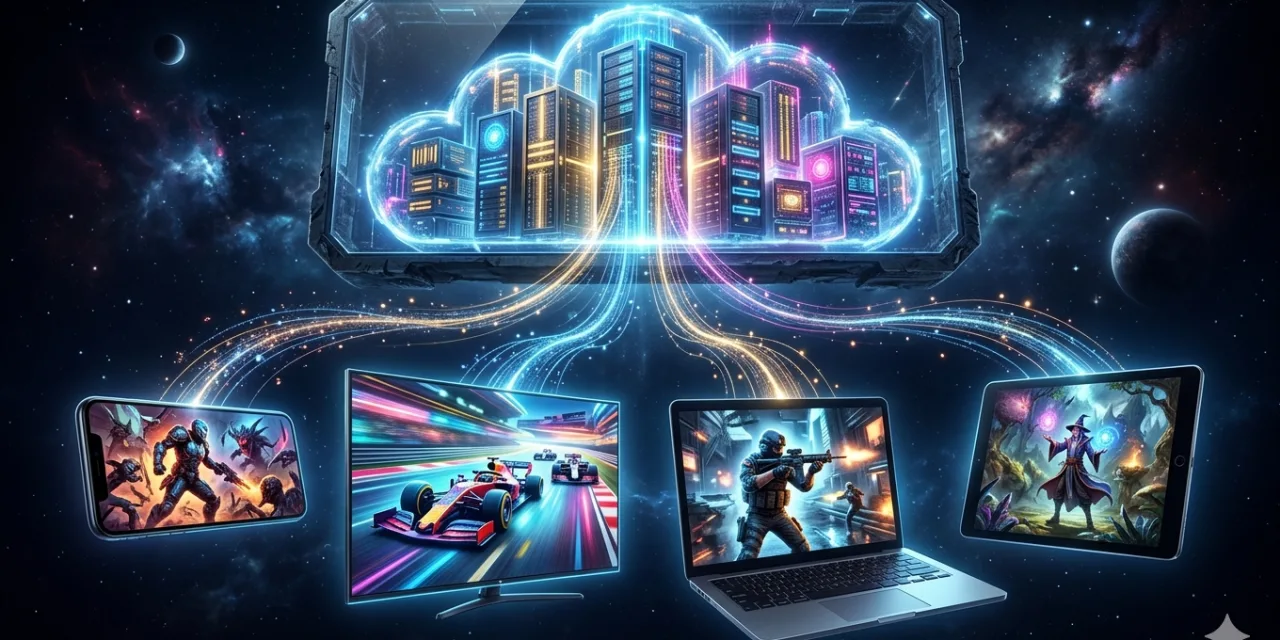
Cloud gaming operates on a conceptually simple principle: instead of running a game’s graphics and logic processing on the hardware in your living room or on your desk, the game runs on powerful servers in a data centre — typically equipped with enterprise-grade GPUs that far outperform any consumer hardware — and streams the visual output to your device over the internet, while your inputs (keyboard presses, controller movements, touch gestures) are transmitted back to the server in the opposite direction. Your device is essentially an input collector and video player; the actual game runs in the cloud.
The process happens in real time. Each frame is rendered on the server, compressed using video codecs optimised for minimal latency (H.264, H.265, AV1, and increasingly proprietary codecs developed by streaming platforms), transmitted over the internet to your device, decoded, and displayed — all within the time window between frames. At 60 frames per second, the target window for this entire round-trip process is approximately 16 milliseconds. Add the physical distance the data must travel to the server and back, network routing overhead, encoding and decoding time, and display input lag, and achieving the sub-20-millisecond total input-to-display latency that competitive gaming requires is challenging even with modern infrastructure.
Video streaming accounts for approximately 72 percent of cloud gaming market revenue — the fully server-rendered model where the complete visual output is streamed to the player’s device. File streaming, which downloads partial game data to the player’s device while streaming the rest, holds approximately 28 percent of the market and is growing at a faster rate as hybrid approaches gain traction. The hybrid model mitigates some of the latency sensitivity of pure streaming by handling time-critical elements locally while using the cloud for asset rendering and non-critical processing.
Edge computing has been the most significant infrastructure advancement enabling cloud gaming quality improvements in 2025 and 2026. Multi-access edge computing (MEC) places rendering and processing nodes within metropolitan areas — co-located with mobile carrier infrastructure, within city limits — rather than centralised in distant data centres. The physical proximity dramatically reduces the minimum achievable latency: a round trip to a server 50 kilometres away takes a fraction of the time of a round trip to one thousands of kilometres away, and sub-15-millisecond round-trip latency in metro areas with MEC infrastructure is now routinely achievable. The coverage disparity between urban and rural users — where MEC node density is high in cities and essentially absent in rural areas — is one of the most significant and least publicly acknowledged inequities in cloud gaming access.
The Major Platforms: Who Offers What
The cloud gaming landscape in 2026 is led by four major platforms, each with a distinct strategy, content library, and target audience — plus a growing ecosystem of regional and specialist services. Understanding the differences helps identify which service, if any, is the right fit for a specific player’s situation.
Xbox Cloud Gaming is the most strategically ambitious cloud gaming service in 2026, positioned not as a standalone product but as a component of Microsoft’s broader Xbox Game Pass ecosystem. The service allows Game Pass Ultimate subscribers to stream any Game Pass title to supported devices — smartphones, tablets, PCs, smart TVs, and Xbox consoles — without downloading. By 2026, Xbox Cloud Gaming has expanded to include India, Brazil, Argentina, and additional markets in late 2025, executing on Microsoft’s strategy of geographic expansion to reach players without access to affordable console hardware. Microsoft has also extended streaming beyond the Game Pass library: players can now stream cloud-compatible games they own outright, even if those titles are not part of Game Pass — a significant policy evolution that addresses the content ownership concern that undermined Google Stadia’s proposition. Xbox Cloud Gaming is expected to become the world’s largest cloud gaming platform by 2026 based on sustained user growth and broader service penetration.
NVIDIA GeForce NOW takes a fundamentally different approach to content ownership. Rather than providing access to a proprietary game library, GeForce NOW allows players to stream games they already own on PC storefronts — primarily Steam, Epic Games Store, and GOG — using NVIDIA’s remote GPU infrastructure. The player brings their existing game library; NVIDIA provides the rendering hardware. This model eliminates the game library re-purchase problem that plagued Google Stadia and makes GeForce NOW immediately appealing to PC gamers who own extensive libraries but want to play on devices that cannot run those games locally. GeForce NOW operates across more than 100 countries and boasts over 30 million registered users. In January 2025, NVIDIA announced GeForce NOW’s expansion to India, powered by GeForce RTX 4080 GPU data centres capable of streaming AAA titles at 4K resolution and 60 fps. GeForce NOW’s Logitech G Cloud dedicated gaming handheld — which sold 500,000 units in 2025 — demonstrates that purpose-built hardware for cloud gaming has meaningful demand.
Sony PlayStation Cloud Streaming — integrated into PlayStation Plus Premium — offers streaming access to a catalogue of PS2, PS3, and PS4 titles, with Sony having expanded server infrastructure across 12 regions in 2023 and reducing latency by 18 percent for most users in the process. The integration of AI-based adaptive resolution scaling enhanced visual performance by 22 percent over prior-generation streaming quality. Sony launched PlayStation Portal streaming — which allows the PlayStation Portal handheld device to stream PS5 games from a local PlayStation 5 console over Wi-Fi or the internet — across 30 countries in late 2025. The Portal’s approach is technically a form of remote play rather than pure cloud gaming, but it demonstrates the same fundamental proposition: access to console-quality gaming on a portable device without repeating the hardware investment.
Amazon GameLift Streams, announced in March 2025, positions AWS as both a cloud gaming infrastructure provider and a direct player in the streaming market. The managed service enables developers to stream games at up to 1080p resolution and 60 fps to any device with a WebRTC-enabled browser — eliminating the need for a dedicated app — which has significant implications for how developers distribute cloud gaming access. Amazon Luna, the consumer-facing cloud gaming service, expanded internationally into Europe in May 2025, extending its multi-channel subscription model (where players can subscribe to specific game channels alongside the core Luna+ subscription) to European markets. Amazon’s combination of AWS infrastructure depth and the consumer Luna product gives it both the B2B and B2C dimensions of the cloud gaming market.
The 5G and Infrastructure Revolution
The single largest external driver of cloud gaming growth in 2026 is the deployment of 5G networks and associated edge computing infrastructure. With 5G now operational in over 78 countries, the bandwidth and latency characteristics of mobile connectivity have fundamentally improved for users in covered areas. Where 4G LTE delivered typical real-world download speeds of 20-50 Mbps with latency of 30-50 milliseconds, 5G delivers speeds of 100-400 Mbps in many deployments with latency of 1-10 milliseconds — parameters that make mobile cloud gaming genuinely viable for the majority of game genres rather than only the least latency-sensitive ones.
Telcos have been among the most aggressive commercial partners in the cloud gaming ecosystem, driven by the opportunity to differentiate their 5G subscriptions with gaming bundles that increase ARPU and reduce churn. Reliance Jio in India and Tencent in Asia-Pacific have established major cloud gaming partnerships that bundle streaming game access with mobile data plans — making cloud gaming effectively free at the margin for subscribers of certain mobile tiers. This telco bundle model is identified by Mordor Intelligence as one of the primary near-term growth mechanisms for cloud gaming in Asia-Pacific markets, where the combination of strong 5G deployment and large mobile-first gaming populations creates ideal conditions for bundle-driven adoption.
The minimum internet speed requirements for cloud gaming have improved as compression technologies have advanced: most platforms can deliver 1080p gameplay at 30 fps on connections of approximately 15-20 Mbps, though 1080p at 60 fps typically requires 30-35 Mbps, and 4K streaming where available requires 50 Mbps or above. The practical implication is that cloud gaming is viable on typical broadband connections in most developed-market households — the bandwidth barrier has fallen substantially over five years. The latency barrier remains more location-dependent.
Why Cloud Gaming Hasn’t Replaced Consoles Yet — And What Still Holds It Back
Despite the genuine advances in infrastructure quality, content availability, and platform diversity, cloud gaming has not replaced traditional hardware — and understanding why reveals the specific conditions under which streaming will and will not become the dominant model.
Latency remains the most fundamental unresolved challenge. Even with 5G and edge computing making sub-20-millisecond latency achievable in ideal conditions — urban areas with dense MEC deployment and strong 5G signal — those ideal conditions are not universal. Rural areas, areas with older mobile infrastructure, and areas with high network congestion can have latency two to five times higher than optimal, which is noticeable in competitive or action-heavy gaming contexts. The 5G coverage maps that look impressively dense at the national level consistently reveal significant gaps when examined at the granular level of specific suburban and rural locations. Cloud gaming quality is binary in a way that console gaming is not: a local game console performs identically in a city apartment and a rural farmhouse; a cloud gaming service performs dramatically differently depending on network quality.
Ownership and permanence remain concerns that Google Stadia made viscerally real. When a cloud gaming platform shuts down — or when a publisher removes a title from a streaming service — players lose access to games they paid for in ways that local game ownership does not replicate. Microsoft’s response — allowing streaming of games you own rather than only games on Game Pass — partially addresses this concern, but the fundamental tension between digital distribution’s convenience and physical media’s permanence is not fully resolved by any current streaming service. Seventy percent of US gamers report interest in subscription gaming services, but many of those same players express reluctance to abandon ownership models for their most valued titles.
Content availability varies significantly by platform. Unlike local gaming, where any PS5 game is available on every PS5 and any PC game runs on any capable PC, cloud gaming content is platform-specific — a game available on GeForce NOW may not be available on Xbox Cloud Gaming, and publishers can withdraw streaming rights independently of local sale rights. The content availability question is improving as publisher relationships mature, but it remains a meaningful friction relative to local gaming’s universality within its platform ecosystem.
Data consumption is a practical concern that pricing models frequently understate. Streaming a game at 1080p/60fps consumes approximately 15-20 GB per hour. At 4K, consumption exceeds 40 GB per hour. For players on data-capped internet plans or mobile connections, the data cost of cloud gaming can be substantial — and creates a usage constraint that a local hardware gaming library does not impose. The correlation between households with unlimited high-speed broadband and households with the means to purchase gaming hardware also means that the players most likely to benefit economically from hardware-free cloud gaming are those most likely to face data constraints from their connectivity.
The Emerging Markets Opportunity: Cloud Gaming’s Biggest Untapped Market
The most compelling long-term case for cloud gaming is not in the developed markets where PlayStation 5s and gaming PCs are already abundant — it is in the emerging markets where the price of high-end gaming hardware is prohibitive relative to local incomes but where smartphone penetration is high and improving connectivity is creating access to fast internet for the first time.
Asia-Pacific already dominates cloud gaming usage, accounting for 38.45 percent of global market revenue in 2025, driven by Reliance Jio’s partnerships in India, Tencent’s initiatives in China, and the mobile-first gaming cultures of South Korea, Japan, and Southeast Asia. Latin America saw gaming installs grow approximately 8 percent and gaming sessions rise 5 to 7 percent in 2024 — the highest regional growth rates globally — as smartphone penetration expanded access to gaming without the hardware cost barriers of traditional platforms. Sub-Saharan Africa’s internet penetration reached 43 percent in 2024, creating the infrastructure foundation for future cloud gaming adoption in a region where the hardware cost barrier to traditional console gaming is most acute.
The economic logic of cloud gaming in emerging markets is fundamentally different from its logic in developed markets. In the United States or Germany, cloud gaming competes with an existing ecosystem of consoles, PCs, and physical game libraries. In India, the Philippines, or Nigeria, cloud gaming competes with not gaming at all — or with the mobile gaming alternatives that already capture the majority of gaming time in those markets. For these markets, cloud gaming is not a more convenient alternative to hardware they already own. It is a genuine expansion of access to gaming experiences that were previously unavailable at any accessible price point.
The Hybrid Model: How Cloud and Local Gaming Are Converging
The assumption underlying most early cloud gaming discussions — that streaming would eventually replace local hardware entirely, in the same way streaming replaced physical media for music and films — has given way in 2026 to a more nuanced model: cloud and local gaming coexisting and complementing each other, with players using each where it serves them best.
Microsoft has positioned Xbox Cloud Gaming explicitly as a complement to console gaming rather than a replacement — a way to play on additional screens, continue a session when away from home, or access the Game Pass library without downloading. Sony’s PlayStation Portal streaming similarly positions remote play as an extension of the PS5 experience rather than an alternative to it. The streaming-as-extension model gives players the flexibility benefits of cloud gaming without requiring them to abandon the ownership and performance characteristics of local hardware.
AAA game publishers have increasingly adopted cloud-first release strategies — launching titles simultaneously on cloud platforms alongside traditional releases to expand the addressable player base to non-console owners. Mordor Intelligence notes that cloud-first releases boost total addressable players by up to 40 percent for publishers who adopt them. The ability to access a major release on launch day without owning compatible hardware — paying only the streaming service subscription — is a compelling value proposition for players who are cost-conscious, who play casually, or who want to try a title before investing in hardware capable of running it locally.
The long-term convergence that seems most likely from the 2026 vantage point is not cloud gaming replacing consoles but cloud gaming becoming the dominant model for casual and mobile gaming while dedicated hardware retains its position for performance-critical, ownership-valued, and competitive gaming contexts. The 52 percent of global cloud gaming access happening on smartphones reflects this already: most mobile cloud gaming users are not replacing their console or PC with a streaming service — they are extending their gaming into contexts (commuting, travel, shared-TV situations) where their primary hardware is not available. Whether that complementary relationship eventually tips toward replacement depends on infrastructure improvements that are coming — but are not yet universal — and on content strategies that have been clarifying for years but are not yet definitive. Cloud gaming is the future of gaming. It is also already the present of gaming, for millions of players in the specific situations where it excels. The gap between those two statements is where the most interesting developments of the next five years will occur.
0 Comments
No comments yet. Be the first to share your thoughts!