
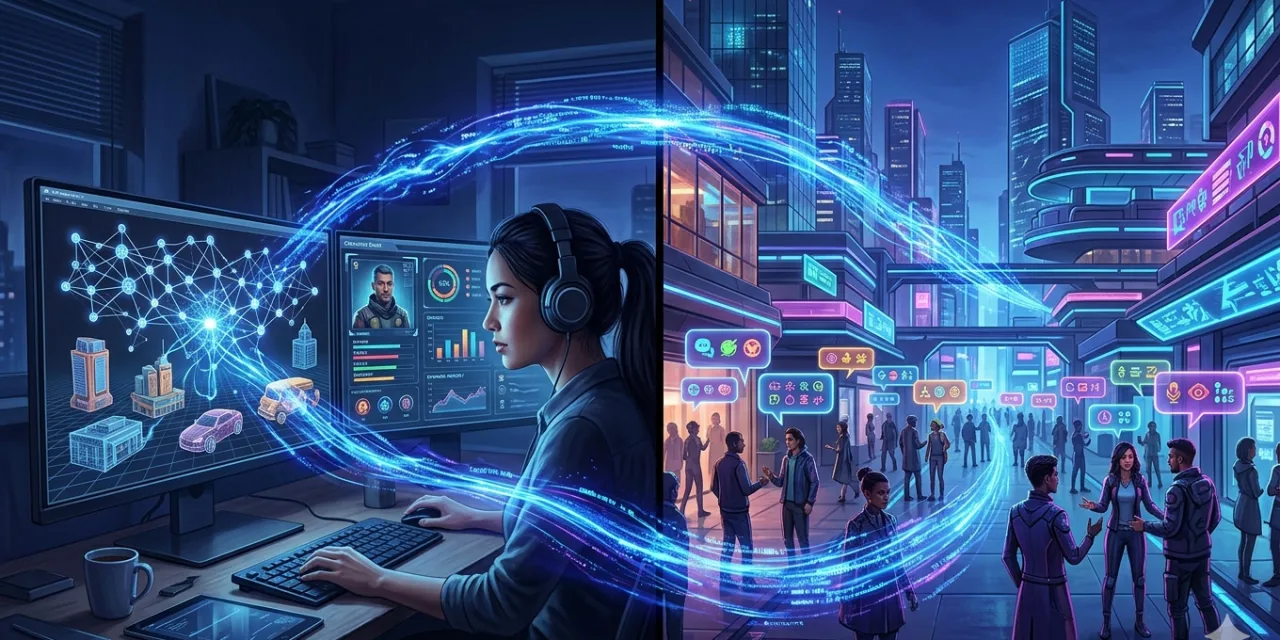
At the 2026 Game Developers Conference, AI was not a topic in one corner of the programme. It was the programme. Tools for real-time video generation, AI-powered voice synthesis, procedural NPC animation, and generative content creation permeated every corner of gaming’s premier industry gathering, and the conversations were not about whether to adopt AI but how to use it effectively without losing creative control or homogenising the medium. The signal was unmistakable: artificial intelligence has moved from experimental curiosity to foundational infrastructure in game development, and 2026 is the year the industry collectively stopped treating that as a future concern and started treating it as the current reality.
The statistics confirm the shift. According to BCG’s 2026 Global Gaming Report, approximately 50 percent of game studios now actively use AI in development. A Google Cloud survey conducted by The Harris Poll found 90 percent of developers integrating AI into workflows, with 97 percent believing generative AI is reshaping the industry. Over 7,300 games on Steam have disclosed AI applications — double the figure from 2024. The global AI in gaming market is projected to grow from $3.28 billion in 2024 to more than $51 billion by 2033. Games with AI procedural generation are retaining players at three times the rate of comparable non-AI games after six months. Average playtime is increasing 150 percent for games using AI procedural generation.
This transformation is happening at two distinct levels simultaneously. At the development level, AI tools are changing how games are made — enabling smaller teams to produce AAA-quality content, reducing asset creation time by 70 to 90 percent, and cutting development costs by $100,000 to $500,000 per game. At the player experience level, AI is changing what games feel like — creating NPCs that remember conversations and form relationships, generating infinite unique game worlds, adapting difficulty in real time to each player’s skill profile, and producing visual quality that was architecturally impossible for the hardware without AI assistance. The games industry is not approaching an AI transition. It is in one.
AI in Game Development: How Games Are Made Differently Now
The most immediate and economically significant AI transformation in gaming is in the development pipeline itself — the process through which artists, writers, programmers, and designers turn creative concepts into playable experiences. Game development has always been among the most expensive forms of content production: AAA games routinely cost $100 million to $300 million and more to develop over periods of three to seven years. AI tools are compressing both the cost and the timeline across multiple production disciplines simultaneously.
Asset creation is where AI’s impact on development efficiency is most dramatic. Creating the visual assets of a game — character models, environment textures, vegetation, props, architectural elements, particle effects — has historically required teams of specialised artists working for years. AI-powered asset generation tools allow developers to generate high-quality 3D models, textures, and environments from text or image prompts, with tools like Scenario.gg enabling studios to train custom AI models on their own existing artwork so that generated assets maintain stylistic consistency with human-created materials. Ninety-seven percent of developers now use AI-assisted tools for asset creation. The democratisation effect is particularly significant for independent and small studios: solo developers and two-person teams can now produce visual content that previously required teams of ten or twenty artists, compressing the quality gap between indie and AAA development in ways that were inconceivable five years ago.
Writing and dialogue generation has been transformed by large language models. Writing branching dialogue trees for games with significant NPC interaction has historically been one of the most time-intensive production disciplines — creating the thousands of unique conversation branches needed for a fully reactive open world required enormous writing teams and years of work. LLM-powered tools now generate dialogue drafts, quest text, world-building lore, and NPC personality descriptions at dramatically higher speed than human writers alone. The role of the human writer in this workflow has shifted from generating every line to providing creative direction, maintaining tonal consistency, and editing AI-generated output rather than producing all content from scratch. This does not eliminate writing jobs in games — it changes what those jobs require — but it does dramatically expand what a given number of writers can produce.
Animation and motion has been significantly accelerated by AI tools that generate realistic movement from motion capture data more efficiently, interpolate between animation states more naturally, and enable new techniques like AI-driven facial animation that generates lip-sync from audio without requiring manual keyframing for every line of dialogue. At GDC 2026, NPC animation tools that use AI to generate contextually appropriate body language and facial expressions in real time — rather than selecting from pre-authored animation states — were among the most discussed demonstrations, with multiple major studios disclosing active development projects using these approaches.
Quality assurance and playtesting — traditionally among the most labour-intensive phases of game development — is being accelerated by AI systems that can play through games autonomously, identifying bugs, testing edge cases, and validating difficulty curves across thousands of virtual playthroughs in the time it would take a human QA team to complete a fraction of the equivalent coverage. Games that utilise AI for procedural content generation and AI-powered QA save approximately 30 percent on development time and costs, according to industry data.
AI-Powered Graphics: NVIDIA DLSS 5.0 and Beyond
The AI transformation in gaming graphics is the most visible to players — the dimension of AI’s gaming impact that anyone with a modern gaming PC or console encounters directly. NVIDIA’s Deep Learning Super Sampling (DLSS) technology, which uses AI to render games at lower resolutions and then reconstruct higher-resolution output, has become one of the most significant graphics technologies in gaming since the introduction of real-time ray tracing.
In March 2026, NVIDIA announced DLSS 5.0, scheduled for release later in 2026. DLSS 5.0 includes an AI engine that, in NVIDIA’s description, “infuses pixels with photoreal lighting and materials” — using machine learning to add physically accurate material properties and lighting interactions to scenes that were rendered with simpler approximations, making existing game graphics appear more realistic without additional GPU compute. This extends AI’s role in graphics beyond reconstruction (making low-resolution renders look high-resolution) to enhancement (making rendered scenes look more physically plausible than their underlying rendering would produce).
The practical implication for players is games that look significantly better than their base rendering would suggest, running at higher frame rates than full native rendering would allow — because the AI is doing the work of making the image look better after the fact rather than requiring the GPU to compute photorealistic rendering for every pixel from scratch. For developers, DLSS and similar technologies from AMD (FSR) and Intel (XeSS) have become standard components of any PC game’s graphics pipeline, included by default rather than as optional additions.
AI is also transforming real-time ray tracing quality. Neural rendering techniques — using AI to predict how light would behave in complex scenarios rather than computing it from physical first principles — are producing lighting quality indistinguishable from full path-traced rendering at a fraction of the computational cost. The combination of neural rendering and DLSS reconstruction is enabling visual quality in real-time interactive games that was previously achievable only through offline rendering pipelines used in film and television.
The NPC Revolution: Characters That Actually Think
Non-player characters — the inhabitants of game worlds who populate cities, interact with the player, and provide the human texture of virtual environments — have been one of the most consistently unsatisfying elements of games for most of gaming’s history. Traditional NPC behaviour is defined by finite state machines and scripted dialogue trees: pre-authored responses to a limited set of player inputs, executed with rigid logic that players learn to circumvent, manipulate, and eventually find predictable. The gap between the apparent humanity of NPC character design and the mechanical predictability of NPC behaviour has always been one of the clearest signals that a game world is ultimately a simulation rather than a living environment.
AI is narrowing that gap dramatically. In 2026, 62 percent of new RPG and adventure games feature AI-powered NPCs — up from just 8 percent in 2024. The shift is driven by large language models integrated into NPC systems, enabling characters to generate contextually appropriate dialogue responses rather than selecting from pre-authored branches, maintain persistent memory of interactions with the player across sessions, develop relationships with other NPCs based on in-world logic, and respond to events and information that the game designers did not explicitly script.
Ubisoft’s NEO NPC project is the most prominent AAA demonstration of this approach. NEO NPCs are game characters powered by generative AI that can hold genuine conversations — responding to questions the player asks that no script anticipated, remembering what the player told them in previous encounters, and maintaining consistent personality traits across unpredictable interactions. Ubisoft has described the system as creating characters that can “surprise the developer” with their behaviour — a claim that would have been meaningless applied to traditional NPC systems and that represents a genuine qualitative shift in what game characters can be.
Inworld AI provides NPC intelligence infrastructure that multiple studios have integrated into their games: a platform handling the complex infrastructure of running large language models at game speed while providing game-friendly APIs for character memory, relationship tracking, and behaviour generation. The platform enables NPCs to form relationships with each other — not just with the player — creating social dynamics within game worlds that can evolve based on events the player influences without directly scripting every possible outcome.
The player response to AI NPCs has been measurably positive: reviews increasingly criticise games with “static dialogue trees” as feeling outdated, and players sharing unique NPC interactions on social media has emerged as an organic marketing channel that traditional scripted NPCs cannot produce. When a player has a conversation with an NPC that genuinely surprises them — when the character responds to a question with something the player did not expect and that feels authentically in-character — that moment is worth sharing in a way that the execution of a scripted branch is not.
Procedural Generation: Infinite Worlds, Not Random Ones
Procedural generation — using algorithms to create game content automatically rather than handcrafting every element — has been part of gaming since the 1980s. No Man’s Sky’s 18 quintillion procedurally generated planets, Minecraft’s infinite biomes, and Spelunky’s randomised cave systems are landmark examples of what procedural generation enabled before AI entered the picture. What AI adds to procedural generation is not randomness — it is quality control, coherence, and narrative intelligence.
Classic procedural generation produces content that is technically infinite but can feel arbitrary and incoherent — terrain that generates mathematically but doesn’t feel naturally crafted, dungeons whose room arrangements are mechanically valid but thematically hollow, NPC quest text that varies syntactically but not meaningfully. AI-enhanced procedural generation uses machine learning models trained on human-created content to generate variations that maintain the quality characteristics of handcrafted design — terrain that looks and feels like it was shaped by geological forces rather than random functions, dungeons whose layouts suggest intentional architectural history, quest text whose variation produces meaningfully different player motivations rather than cosmetic surface differences.
The impact on player engagement is measurable. Games using AI procedural generation retain players at three times the rate of comparable non-AI games after six months. Average playtime increases by 150 percent. Roguelikes with AI generation average over 500 hours of play per player compared to 30 hours for traditional fixed-content games — because the content remains genuinely novel across hundreds of runs rather than becoming familiar after a handful. The business model implication is significant: AI procedural generation allows single-purchase games to compete with live-service games on content volume, without requiring the continuous development investment that live-service content pipelines demand.
Adaptive Difficulty and Personalised Experience
One of AI’s most commercially impactful applications in games is adaptive difficulty — systems that monitor player performance in real time and adjust the game’s challenge level to maintain engagement within an optimal zone between frustration and boredom. AI-driven features in gaming have led to a 25 percent increase in user retention across platforms, and the adaptive difficulty component of that improvement reflects a fundamental insight about why players abandon games: they do not primarily quit because a game is too hard or too easy in the abstract — they quit when the difficulty stops matching their current skill level.
Traditional difficulty settings — Easy, Normal, Hard — are static and require players to assess their own skill level and preferences before experiencing the game, often leading to choices that do not match the experience that follows. AI adaptive systems continuously model each player’s skill profile across dozens of dimensions — reaction time, accuracy, strategic decision-making, resource management — and adjust enemy behaviour, resource availability, puzzle complexity, and timing windows in real time to keep the player in their optimal engagement zone. The adjustment is transparent: the player is not told the difficulty is changing, but the experience remains appropriately challenging at their current skill level.
Personalisation extends beyond difficulty to include content recommendation, UI adaptation, narrative emphasis, and pacing adjustment based on individual player behaviour patterns. Players who engage primarily with combat receive AI-curated experiences that front-load combat opportunities; players who explore extensively encounter more environmental storytelling and hidden content; players who engage deeply with crafting systems receive more material variety and recipe complexity. The result is that two players can play the same game and have experiences that feel specifically tailored to their preferences — not through explicit customisation menus but through AI observation and adaptation.
AI in Anti-Cheat and Player Safety
Beyond gameplay and development, AI is playing an increasingly important role in maintaining the integrity and safety of online gaming environments. Traditional anti-cheat systems operated on signature-based detection — identifying known cheat software by its code signature — and were consistently outpaced by cheat developers who modified their software to evade detection. AI-powered anti-cheat systems model normal player behaviour patterns for each game and flag statistical anomalies that indicate inhuman performance — aim assistance that produces accuracy profiles no human achieves, movement patterns that violate physical movement constraints, resource accumulation rates that exceed what legitimate gameplay allows. These behavioural detection approaches catch novel cheat software that signature-based systems miss because the detection is based on what the player does, not what software they are running.
Player toxicity detection — identifying hate speech, harassment, and abusive behaviour in player communications — has been transformed by natural language understanding models that can detect harassment patterns across multiple languages, cultural contexts, and encoded language (deliberate misspellings and coded terms used to evade keyword filters) with dramatically higher accuracy than keyword-based systems. Several major gaming platforms deployed AI toxicity moderation systems in 2025 with reported 30-40 percent reductions in player reports of harassment in moderated environments.
The Ethics and Controversies: Job Displacement and Creative Ownership
The AI transformation of game development is not without significant controversy. The most acute concern is job displacement: if AI tools reduce asset creation time by 70 to 90 percent, the implication for the artists, writers, and QA testers whose work those tools replace is direct and serious. Studio layoffs across the games industry in 2023 and 2024 — which were extensive enough to constitute an industry-wide contraction — occurred simultaneously with AI adoption accelerating, and while the causal relationship is complex (market conditions, rising AAA development costs, and post-pandemic normalisation all contributed), the correlation has understandably created anxiety among games industry workers about whether AI is systematically reducing headcount in their sector.
The creative ownership question is equally contested. When an AI model generates a texture, writes quest dialogue, or composes background music for a game, the copyright status of that output — who owns it, whether it is protectable, and what obligations the developer has to the creators of the training data used to train the model — is actively disputed in courts and regulatory proceedings across multiple jurisdictions. Several class action lawsuits filed against AI image generation services in 2023 and 2024, alleging that training on artists’ work without consent or compensation constitutes infringement, remain unresolved in 2026. The games industry’s dependence on AI-generated assets exposes studios to potential retroactive liability from these proceedings.
Quality homogenisation is a subtler but equally real concern. When the same AI models are used across many studios to generate assets, dialogue, and world design, the risk is that games begin to converge on a median aesthetic — the average of what the training data contained — rather than producing the distinctive artistic visions that have always defined the games that matter most culturally. The designers at GDC 2026 who emphasised human creative control over AI output were responding to this concern: the question of how to use AI as a tool that amplifies human creative vision rather than replacing it with the average of the training distribution is one that the industry has not yet definitively answered.
The Player Perspective: What AI Means for the Gaming Experience
For players, AI’s impact on gaming in 2026 is a set of experiences that are becoming rapidly normal: game worlds that feel more alive than they used to, characters that respond in ways that surprise you, difficulty that feels appropriately calibrated to your current skill level, and visual quality that would have been classified as cinematographic rather than interactive five years ago. The 25 percent improvement in player retention that AI-driven features have produced reflects something real about what players value — games that adapt to them feel more respectful of their time and more personally engaging than games that demand they adapt to fixed parameters.
The gaming future that AI is building looks like this: open worlds populated by NPCs with genuine social intelligence and persistent memory; procedurally generated stories whose narrative coherence matches handcrafted design quality; difficulty that never becomes either trivially easy or wall-like frustrating; visual fidelity indistinguishable from pre-rendered cinematics; and development timelines compressed enough that smaller teams can produce experiences of ambition and scope previously requiring hundreds of developers and half a decade. The global gaming industry is projected to reach $320 billion in revenue by 2026, serving over 3 billion players worldwide. The AI transformation underway is not peripheral to that scale — it is the mechanism by which the industry sustains and grows it.


0 Comments
No comments yet. Be the first to share your thoughts!