
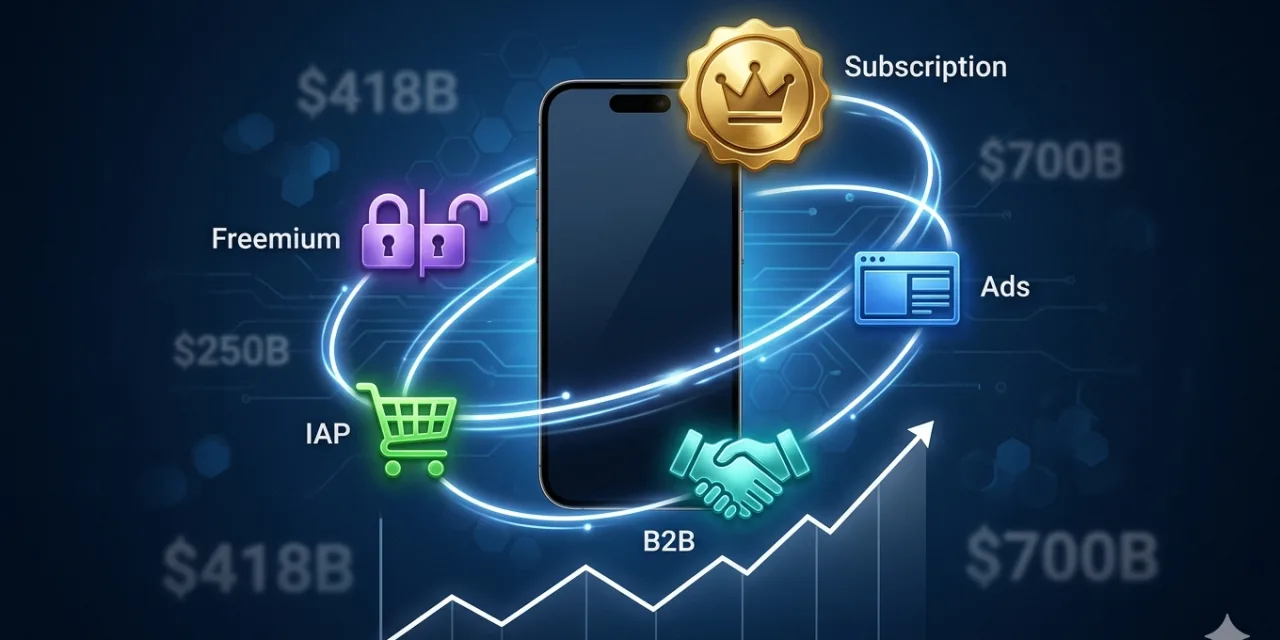
Almost three-quarters of app developers make less than $1,000 per month from their apps. Ninety-eight percent of all global app revenue comes from free apps monetised through in-app purchases and advertising — paid downloads now account for less than one percent of total app revenue. Only four percent of apps in the market use a subscription model — yet those four percent account for 45 percent of global app revenue, dominated by category leaders like Netflix, YouTube Premium, Spotify, and Disney+. The top five percent of subscription app earners generate revenues 200 times higher than the bottom 25 percent. The global in-app purchase market reached $150 billion in 2024 and is projected to grow to $657 billion by 2029. The in-app advertising market is set to hit $418.73 billion in 2026 alone.
These numbers describe a highly concentrated, winner-take-most market in which the difference between the apps that generate sustainable revenue and those that don’t is almost never product quality — it is monetisation strategy. The model you choose, when you introduce it, how you structure the paywall or purchase trigger, and how you balance revenue extraction with user experience determines whether your app becomes economically self-sustaining or joins the 74 percent that never reach $1,000 per month. Picking the wrong model is one of the most common reasons apps fail to generate sustainable revenue — not because the product is bad, but because the monetisation approach doesn’t match how users actually use it.
This guide covers every major monetisation model available in 2026, with the specific data on what each model achieves in practice, decision frameworks for choosing the right model for your app type, the platform economics (App Store commissions) that determine your actual take-home revenue, the hybrid strategies that top-grossing apps use, the AI tools now available for monetisation optimisation, the most common mistakes that kill monetisation before it starts, and the metrics that determine whether your strategy is working.
The Decision Framework: Match the Model to User Behaviour
Before selecting a monetisation model, the most important question is not “which model generates the most revenue?” — it is “which model fits how my users actually use the app?” The right model depends on three behavioural dimensions: how frequently users open the app, whether users are paying for access or for outcomes, and how strongly retention drives long-term value.
High-frequency, daily-use apps — messaging, social, news, fitness — support subscription models because users return regularly enough that the recurring value justification is continuously renewed. The user who opens a meditation app every morning for ten minutes is naturally inclined toward a subscription because the app is part of their daily routine. A subscription paywall presented to that user feels proportionate to the value they receive.
Low-frequency, high-value apps — professional tools, specialist utilities, productivity apps used for occasional deep work sessions — fit in-app purchase models better than subscriptions, because the user’s infrequent engagement makes a recurring subscription fee feel disproportionate to the actual usage. A PDF annotation tool used once a week for complex document review can command a one-time purchase of $9.99 that feels reasonable relative to the value delivered in that session, but the same user may resist a $4.99 monthly subscription that accumulates cost without matching frequency of use.
High-volume, broad-audience apps — news readers, casual games, entertainment apps — generate the user volumes that make advertising economically viable. A casual game with five million monthly active users generating even modest eCPMs across ad impressions produces significant advertising revenue that smaller-audience apps cannot replicate. Advertising scales with audience size; subscription and IAP models scale with the willingness-to-pay of a smaller engaged segment.
The model you launch with is rarely the model you scale with. Spotify launched as pure freemium and evolved into a hybrid of free (ad-supported) and premium (subscription). Headspace started with a pay-per-course model before converting to subscription. Duolingo added a subscription tier after years of operating purely on advertising. The initial model gets you to your first users; the evolved model gets you to sustainable revenue. Building in the flexibility to evolve the monetisation approach — rather than permanently binding the product architecture to the first model chosen — is one of the most important early decisions in app development.
Model One: Subscriptions — The Highest ARPU, the Hardest to Earn
Subscriptions generate 4.6 times higher Average Revenue Per User (ARPU) compared to apps that rely solely on advertising. They provide predictable recurring revenue that compounds as the subscriber base grows. They create retention incentives that align developer and user interests — the developer is financially rewarded for keeping subscribers engaged and satisfied, not just for acquiring them. And they are the primary model for the apps that generate the most significant app store revenues outside of gaming.
The practical mechanics: subscription apps convert 3 to 8 percent of free users to paid on average, with the best-performing productivity and fitness apps reaching 10 to 15 percent. The key metric that determines long-term subscription economics is month-2 retention — the percentage of subscribers who are still subscribed after their second payment. Apps with above 80 percent month-2 retention typically achieve 18 or more months of average subscription lifetime, producing LTV calculations that can support significant customer acquisition spend. Apps with below 60 percent month-2 retention are signalling that the subscription value proposition is not being adequately delivered — and throwing more acquisition spend at a leaky subscriber base makes the economics worse, not better.
Free trial strategy is one of the most important conversion levers in subscription monetisation. Seven-day trials work best for entertainment apps (where the content value is immediately obvious). Thirty-day trials perform better for productivity tools (where the benefit of the tool compounds over time and needs longer for users to integrate it into their workflow). The trial length should match the time it takes the typical user to experience the app’s core value. Trials that are too short prevent value realisation; trials that are too long delay revenue unnecessarily.
Annual versus monthly billing produces a fundamental monetisation tradeoff. Monthly subscriptions have higher conversion rates but higher churn — the monthly renewal decision is an opportunity to cancel. Annual subscriptions have lower conversion rates but dramatically lower churn — users who commit to a year largely stay for the year, reducing the voluntary churn that erodes subscriber bases. The standard industry approach is to offer both, with annual plans priced at approximately the equivalent of 9 to 10 months of the monthly rate (providing a 15 to 25 percent discount) — converting monthly subscribers to annual is one of the highest-ROI retention actions available, and the annual discount is typically the mechanism that makes that conversion compelling.
Involuntary churn — subscription cancellations caused by failed payment processing rather than deliberate user choice — accounts for over 23 percent of lost subscribers on the App Store, according to RevenueCat’s State of Subscription Apps report. Implementing dunning management (automated retry logic and payment failure communications) directly addresses this 23 percent, recovering a significant fraction of involuntary churn without requiring any product improvement. This is one of the most commonly overlooked subscription revenue improvements available.
Model Two: In-App Purchases — Converting Engagement to Revenue
In-app purchases (IAP) allow users to buy specific items, features, or content within an app — virtual currency, power-ups, premium content, feature unlocks, cosmetic items — as individual transactions rather than recurring subscriptions. The global IAP market reached $150 billion in 2024 and is projected to grow to $657 billion by 2029. Gaming apps pioneered IAP and continue to generate the majority of IAP revenue globally, but non-gaming apps — fitness, education, dating, productivity — increasingly deploy IAP for specific premium content unlocks alongside or instead of subscription models.
The most important statistical reality of IAP monetisation is the extreme concentration of spend: the bottom 5 percent of payers typically account for more than 50 percent of total IAP revenue. The “whale” dynamic — a small number of highly engaged users who spend substantially more than the average — means that IAP strategies should be designed to remove ceiling constraints on high-spending users rather than optimising purely for average transaction value. An IAP catalogue that caps at $9.99 is leaving significant money on the table from the small percentage of users who would pay $49.99 or $99.99 for sufficiently compelling high-value purchases. Virtual currency bundles, “starter packs” that offer exceptional first-purchase value, and escalating premium tier structures all serve to increase spend ceiling for high-value users.
The average IAP monetisation rate — the percentage of active users who make any in-app purchase — is 2 to 4 percent for gaming apps. The implication is that IAP strategies must be designed around converting and maximising value from a small fraction of the user base, with the majority of users receiving the core free experience that creates the population from which paying users emerge. Irritating or pressuring the non-paying majority with aggressive purchase prompts consistently reduces both the non-paying users’ engagement and the paying users’ willingness to purchase — users who feel manipulated by monetisation mechanics spend less and churn faster than users who feel the purchase opportunity is presented fairly.
Platform commissions are the most significant cost factor in IAP economics. Apple and Google both take 15 to 30 percent of IAP revenue — 30 percent for standard accounts, 15 percent for developers earning under $1 million annually (Apple’s Small Business Programme and Google’s equivalent) and for subscription renewals after the first year. At 30 percent commission, a $9.99 purchase yields the developer $6.99. At 15 percent, it yields $8.49. The commission rate difference between qualifying for small business programmes and not is substantial at scale. Netflix, Spotify, and other large apps have responded by directing users to web subscriptions rather than in-app purchases to avoid the commission — a strategy that requires careful navigation of Apple’s anti-steering rules but that is legally available to apps on both platforms after regulatory interventions in multiple markets.
Model Three: In-App Advertising — Scale or Niche, Not Both
In-app advertising is the dominant monetisation model by app count globally — approximately 31 percent of apps rely on it — and represents the largest absolute revenue pool at $418.73 billion in 2026. But the distribution of that revenue is even more concentrated than subscription revenue: the vast majority accrues to apps with very large user bases, and the economics of advertising for small and mid-sized apps are challenging enough that advertising alone rarely produces sustainable revenue for apps outside the top tier of their category.
The ad format hierarchy by revenue per impression is well-established. Rewarded video ads — where users opt in to watch a video ad in exchange for in-game currency, additional content, or other in-app rewards — generate the highest revenue per impression, the lowest negative impact on user experience, and the best engagement quality. Users who actively choose to watch an ad in exchange for a specific reward are more engaged and more likely to convert than users passively exposed to banner ads they are trying to ignore. Interstitial ads — full-screen ads that appear between content — generate significantly more revenue per impression than banner ads but cause higher rates of app abandonment if shown too frequently or at poorly chosen moments. Banner ads are the lowest-performing format by virtually every metric — lowest eCPM, highest irritation, lowest advertiser appeal — and their role in app monetisation has declined consistently as rewarded and interstitial formats have grown.
Rewarded video ad formats should be shown no more than 3 to 5 times per session — exceeding this frequency reduces retention measurably. The placement timing of rewarded video offers matters significantly: presenting the option immediately after a failure event (losing a life in a game, reaching a content limit, hitting a feature restriction) captures users at a moment of high motivation to resolve the frustration, producing substantially higher opt-in rates than presenting the option at neutral moments in the session.
Privacy changes — specifically iOS’s App Tracking Transparency framework limiting the advertising identifier access that powers personalised targeting — have reduced the eCPM achievable for apps whose users opt out of tracking. The reduction in targeting precision reduces the value of each ad impression to advertisers, which reduces the rates they are willing to pay. Apps whose monetisation was substantially built on precisely targeted advertising have faced real revenue headwinds from ATT. Contextual advertising — targeting based on app category and content rather than individual user behaviour — has partially compensated, but has not fully restored pre-ATT eCPM levels for most publishers.
Model Four: Paid Downloads — Declining but Not Dead
Paid app downloads — requiring users to pay a one-time fee before downloading — account for less than one percent of global app revenue in 2026. The model is structurally disadvantaged in a market where 97 percent of Google Play apps and 94.2 percent of App Store apps are free to download, because paid apps face the try-before-you-buy friction of requiring a purchase commitment before the user has experienced any value. In a free app ecosystem, the default behaviour is to download free alternatives and only pay if the free version is clearly insufficient.
The category exceptions where paid downloads remain viable are instructive: games with strong brand franchises and demonstrated track records (Minecraft, Monument Valley), specialist professional tools with no adequate free alternative (Procreate, Final Cut Pro for iOS), and apps serving audiences who actively seek premium software (GoodLinks, Things 3). In each case, the paid model is sustained by either brand trust, a clear absence of free alternatives, or a target audience whose professional context creates willingness to pay for quality without a trial period. For most consumer app categories in 2026, the paid download model is not viable as a primary strategy — the market structure is too strongly tilted toward free.
Model Five: Hybrid Monetisation — What the Top-Grossing Apps Actually Do
Over 60 percent of top-grossing apps use hybrid monetisation strategies — combining in-app advertising, in-app purchases, and subscriptions into a cohesive revenue framework that serves different user segments differently. Single-model monetisation is increasingly obsolete for apps with ambitions beyond a narrow niche. Understanding how the most successful hybrid models are structured helps avoid the most common hybrid design failure: creating a confusing and contradictory monetisation experience where multiple revenue mechanisms compete with each other and with the core user experience.
Spotify’s hybrid model is the most frequently cited and most instructive example. Free users experience the product with advertising and feature restrictions (shuffle-only playback, no offline downloads, limited skips). Premium subscribers get the full product without restrictions and without advertising. The free tier is genuinely useful — it gives users real access to Spotify’s music library — which is why it drives user acquisition effectively. But it is restricted in specific ways (shuffle play, skip limits, advertising) that premium subscribers experience as friction. The restrictions are calibrated to be noticeable without being so severe that they make the free experience worthless, and to target specifically the pain points that frequent users feel most acutely. Over 60 percent of Spotify’s 263 million premium subscribers started as free users — the free tier is the acquisition engine for the premium tier.
Gaming app hybrid models typically combine rewarded video advertising (for users who actively prefer earning rewards over paying) with IAP (for users who prefer paying to watching ads) and optionally a subscription battle pass or season pass (for the highest engagement segment who want consistent rewards and exclusive content). This three-layer structure serves the full engagement distribution: casual users who never pay but generate advertising revenue through their attention, moderate users who make occasional IAP transactions, and highly engaged users who sustain a subscription for the exclusive content it provides. Each layer generates revenue from a different user segment without cannibalising the others.
The Platform Commission Problem: What You Actually Keep
Every developer monetising through the App Store or Google Play should understand the commission structure that determines how much of each transaction they actually retain — because the platform take rate significantly affects which monetisation models are economically viable at different revenue scales.
Apple’s App Store takes 30 percent of in-app purchase revenue for standard accounts, reduced to 15 percent for developers whose annual App Store earnings are below $1 million (Apple’s Small Business Programme). Subscription renewals after the first year are charged at 15 percent rather than 30 percent for all developers. Google Play’s structure is similar: 15 percent for the first $1 million of annual earnings, 30 percent above that threshold, with subscription first-year renewals at 15 percent.
The practical consequence: at $0.99 per IAP, a developer on the standard 30 percent rate keeps $0.69. At $9.99, they keep $6.99. At $99.99, they keep $69.99. The absolute dollar amount retained per transaction scales with price, which is why premium IAP items generate more economically meaningful revenue per transaction than low-price items even at similar sales volumes.
The web payment bypass strategy — directing users to subscribe or purchase through the developer’s website rather than in-app — avoids platform commissions entirely but requires navigating Apple’s anti-steering rules carefully. Apple’s guidelines prohibit including in-app buttons or links that direct users to external purchase options, though they do allow developers to email their user base about web purchase options. Following the 2024 Epic v. Apple ruling and subsequent regulatory interventions in the EU, the rules around external payment links have been relaxed in some markets but remain restrictive in others. Developers pursuing web payment bypass should verify the current rules for their specific app category and markets.
AI-Powered Monetisation: The 2026 Advantage
AI has become a meaningful competitive advantage in app monetisation in 2026 — enabling personalisation, predictive intervention, and optimisation that rule-based systems cannot achieve at the same scale or speed.
Churn prediction models — trained on engagement behaviour, subscription tenure, and usage patterns — can identify at-risk subscribers before they cancel, triggering targeted retention interventions (discounted annual plan offers, personalised content recommendations, proactive customer support outreach) at the optimal moment in the subscriber lifecycle. Predicting churn before it occurs and intervening cost-effectively is substantially more economically productive than attempting to win-back subscribers who have already cancelled.
Dynamic paywall personalisation — serving different paywall designs, pricing configurations, and offer structures to different user segments based on their behavioural profile — replaces the single static paywall that every user sees with a personalised conversion experience. Users who have demonstrated high engagement get offered premium content bundles. Users who are price-sensitive get shown annual plan discounts. Users who are trying a feature for the first time get shown a targeted trial extension. This level of personalisation, which required large engineering teams to implement even five years ago, is available through platforms like Adapty and RevenueCat with limited integration effort in 2026.
Regional pricing optimisation — adapting subscription and IAP prices to purchasing power parity in different countries — can increase revenue by more than 40 percent across international user bases. The user in India who finds a $9.99 monthly subscription unaffordable at their local income level may readily convert at $2.99 — and their subscription, while generating less absolute revenue than a US subscriber, generates revenue that would not otherwise exist. Both Apple’s and Google’s developer consoles provide regional pricing tools; using them systematically rather than applying a single global price to all markets is one of the most consistently underutilised monetisation opportunities for apps with significant international audiences.
The Metrics That Tell You Whether Your Strategy Is Working
Monetisation strategy without measurement is guesswork. The specific metrics that determine whether your monetisation approach is working — and which specific element needs adjustment — form a diagnostic framework that distinguishes sustainable revenue from revenue that is either leaving money on the table or extracting too aggressively and destroying retention.
Monthly Recurring Revenue (MRR) and its growth rate is the primary health metric for subscription apps. It tells you whether the subscriber base is growing (net new MRR positive), stable (net new MRR near zero), or shrinking (net new MRR negative). Decomposing MRR into new subscriber revenue, expansion revenue (upgrades and annual plan conversions), contraction revenue (downgrades), and churned revenue reveals which dimension of the subscription lifecycle is driving overall performance.
Average Revenue Per User (ARPU) and Average Revenue Per Paying User (ARPPU) reveal the monetisation intensity of your model. A low ARPU in a subscription app indicates either low conversion rates or low subscription prices relative to the value delivered. A high ARPPU with low overall ARPU indicates that you are successfully monetising paying users but converting too small a fraction of the total user base. Each diagnosis points to different intervention strategies.
Customer Lifetime Value (LTV) relative to Customer Acquisition Cost (CAC) determines whether your monetisation and acquisition strategy are economically sustainable together. LTV must exceed CAC by a sufficient margin to cover the overhead of running the app and provide a return. The minimum viable LTV:CAC ratio for most app categories is 3:1 — three dollars of lifetime value per dollar of acquisition cost. Below this threshold, the economics of paid acquisition are not viable and organic growth is required to scale sustainably.
Month-2 retention for subscription apps and day-30 retention for engagement-based IAP and advertising models are the leading indicators of long-term monetisation health. Poor retention compounds into poor LTV, poor LTV invalidates CAC assumptions, and poor CAC efficiency makes growth expensive. Retention improvement is the monetisation intervention with the highest leverage — it improves LTV, reduces churn, and enables more aggressive acquisition investment simultaneously.
The app monetisation landscape of 2026 rewards specificity over breadth and patience over pressure. The strategies that generate sustainable revenue are those calibrated to how users actually use the app, introduced at the right moments in the user journey, designed to feel proportionate to the value delivered, and continuously optimised through measurement rather than assumption. The apps that fail to monetise are most often those that either choose the wrong model for their user behaviour, introduce it too aggressively before value has been established, or never measure which elements are working and which are not. The path from a product that users love to a business that sustains itself is not primarily a technical path — it is a strategic one, and the strategy that works is the one built around how real users actually behave, not around how developers wish they would.




0 Comments
No comments yet. Be the first to share your thoughts!