
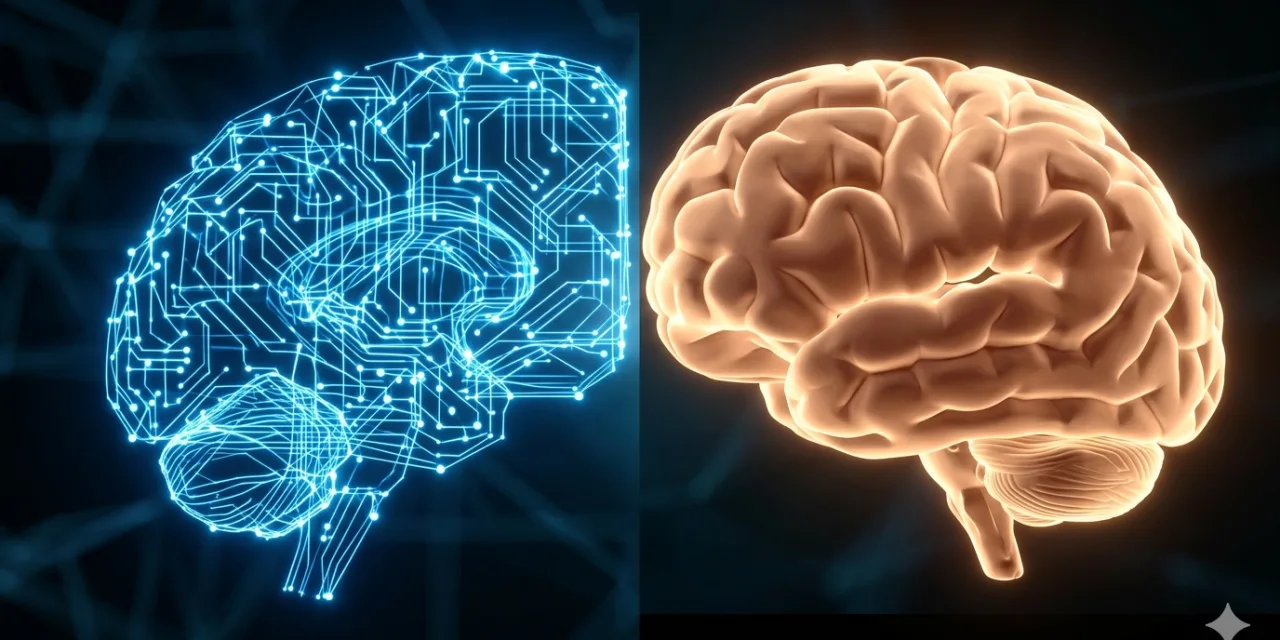
In January 2026, a team of researchers from Université de Montréal, Concordia University, and Google DeepMind published the results of the largest direct comparison ever conducted between human creativity and artificial intelligence. They tested more than one hundred thousand people against leading large language models — ChatGPT, Claude, Gemini, and others — on standardised creativity measures. The headline result was striking: generative AI can now beat the average human on certain creativity tests.
The finding landed with predictable alarm in some quarters and predictable dismissal in others. “AI is more creative than humans” ran one set of headlines. “The creativity test proves nothing about real creativity” ran the counter-narrative. Both reactions, as is often the case with AI research findings, missed the actual point.
Professor Karim Jerbi, who led the study, was explicit about what the finding actually meant: “Even though AI can now reach human-level creativity on certain tests, we need to move beyond this misleading sense of competition. Generative AI has above all become an extremely powerful tool in the service of human creativity: it will not replace creators, but profoundly transform how they imagine, explore, and create — for those who choose to use it.”
This tension — between the genuine and rapidly advancing capabilities of AI systems and the persistent and fundamental ways in which those capabilities differ from human intelligence — is the most important intellectual landscape of 2026. And it is a landscape that most popular coverage navigates poorly, swinging between breathless claims of imminent human obsolescence and defensive dismissals that understate what has genuinely changed.
This article attempts something more useful: an honest, evidence-grounded map of where AI systems demonstrably outperform humans, where humans demonstrably outperform AI, where the comparison is more complicated than either camp acknowledges, and why — perhaps most importantly — the framing of AI versus human intelligence may itself be the wrong question. The right question, increasingly clear from the research and from the observable outcomes in every domain where AI and humans have been compared, is not who wins. It is how the combination of human and artificial intelligence produces outcomes that neither achieves alone.
The Comparison Problem: Why “AI vs Human Intelligence” Is Harder Than It Sounds
Before examining where AI outperforms humans and vice versa, it is worth confronting a conceptual problem that most AI-versus-human comparisons skip past: what exactly is being compared?
Human intelligence is not a single thing. It is a diverse family of capabilities — perceptual, linguistic, mathematical, social, emotional, embodied, creative, moral — that vary substantially between individuals, that develop over a lifetime, and that operate in complex interaction with each other and with the social and physical environment in which humans are embedded. A comparison between “AI” and “human intelligence” that treats human intelligence as a fixed, uniform standard against which AI is measured misrepresents the actual diversity and situatedness of human cognition.
Researchers from the University of Western Australia made this point directly in a February 2026 paper published in The Conversation: comparing AI to individual intelligence misses something essential about what human intelligence is. Our intelligence does not operate primarily at the level of isolated individuals. It is social, embodied, and collective. Human cognitive achievements are often attributed to exceptional individuals, but research in cognitive science and anthropology shows that even our most advanced ideas emerge from collective processes — shared language, cultural transmission, cooperation, and cumulative learning across generations. No scientist, engineer, or artist works alone. Scientific discovery depends on shared methods, peer review, and institutions. Language itself — arguably humanity’s most powerful cognitive technology — is a collective achievement, refined and modified over thousands of years through social interaction.
The AI being compared to humans is also not a single thing. A chess-playing AI that defeats world grandmasters is a fundamentally different system from the large language models that generate essays, from the computer vision systems that analyse medical images, from the robotic systems that perform surgery, and from the reinforcement learning agents that manage energy grids. As Luc Julia — French-American computer scientist and chief scientific officer at Renault Group — argues in his 2026 book The AI Illusion, AI currently lacks the biological and creative aspects of human intelligence. A system designed to play chess can defeat human grandmasters but is incapable of understanding or writing a poem. This distinction is important precisely because most popular comparisons treat “AI” as though it were a unified competitor rather than a diverse collection of purpose-built tools, each of which outperforms humans in its specific narrow domain and is useless — or nonexistent — outside it.
With these caveats in place, meaningful comparison becomes possible. What current AI systems — specifically, the large language models and associated AI tools that most people interact with in 2026 — are genuinely good at, genuinely bad at, and genuinely different from human intelligence in ways that matter for how we think about the relationship between the two.
Where AI Outperforms Humans: The Domains of Genuine Superiority
There are specific, well-documented domains where AI systems in 2026 consistently outperform humans — not marginally, but decisively. Acknowledging this honestly is the starting point for understanding what the technology can contribute and why its adoption in these domains is rational rather than hype-driven.
Data processing and pattern recognition at scale is the most fundamental and most durable AI advantage over human cognition. AI systems can analyse millions of records in seconds, identifying trends and patterns that no human could detect manually in any practical timeframe. This capability is not a narrow technical achievement — it is the foundation of virtually every commercially valuable AI application. Medical imaging AI that detects early-stage cancers in scan results with accuracy that rivals or exceeds specialist radiologists is leveraging this advantage. Fraud detection systems that identify suspicious transaction patterns across millions of daily transactions are doing the same. Financial AI that synthesises patterns across global markets, news feeds, regulatory filings, and historical data simultaneously is doing the same. In every domain where the relevant information exists as structured or semi-structured data and the task is to identify patterns within it, current AI systems have demonstrated the ability to outperform human analysts given sufficient training data. The advantage is not intelligence in the general sense — it is raw processing capacity applied to pattern matching at scales that biological cognition cannot approach.
Speed and tireless consistency represent a structural advantage that is simple in description and enormous in practical consequence. AI systems do not tire, do not lose focus, do not vary in performance based on how much sleep they got the night before, do not bring emotional states to their work that affect the quality of their outputs, and do not need breaks. A radiologist reviewing medical images for the tenth consecutive hour performs measurably worse than in the first hour — attention degrades, pattern recognition accuracy declines, fatigue accumulates. An AI imaging system reviewing its ten-millionth image performs identically to how it performed on the first. For applications where large volumes of repetitive analytical or classification work must be performed to a consistent standard, the AI structural advantage is overwhelming and the case for AI augmentation or replacement of human labour is rational rather than merely cost-driven.
Memory and information retrieval offer AI another structural advantage over human cognition. The knowledge encoded in large language model parameters represents an enormous quantity of information that can be retrieved and applied consistently on demand. Human memory is reconstructive, prone to distortion, limited in capacity, and dependent on cues and context for retrieval. An AI system does not forget the contents of the papers it was trained on. It does not misremember statistics or confuse similar cases. Within the domain of its training distribution, its access to learned information is faster and more consistent than any human expert’s. The important qualification — within the domain of its training distribution — points to the significant limitation that this advantage has, which is addressed below.
Certain types of optimisation and search are domains where AI systems have demonstrated performance that no human can approach. AlphaGo’s defeat of world Go champion Lee Sedol in 2016 demonstrated AI capability in strategic game playing that represented a genuine paradigm shift — not because Go was a commercially important application, but because Go was considered far too complex for AI to master at the grandmaster level, and the demonstration proved that wrong. Protein folding prediction — demonstrated by AlphaFold 2 — represented an equally fundamental shift in what AI-guided optimisation could achieve. In any domain where the task can be framed as optimising an objective function over a well-defined solution space, AI systems can perform search procedures that exceed what human intuition and systematic analysis can match.
Specific creativity measures have been added to this list by the 2026 University of Montréal research. The study found that on the Alternative Uses Test — a standard measure of divergent thinking that asks participants to generate as many unusual uses as possible for a common object — AI systems generated more responses than the average human, and those responses were scored as more original by independent evaluators. The study is careful about the interpretation: AI exceeded average human performance on this specific test, while the most creative humans still showed a clear and consistent advantage over the strongest AI models. The finding does not establish that AI is more creative than humans in any general sense. It establishes that AI can generate a higher volume of divergent associations than the average person on a specific task type — which is useful without being revolutionary.
Where Humans Outperform AI: The Domains That Remain Distinctively Human
The domains where human intelligence consistently and fundamentally outperforms current AI systems are less often discussed with the same precision as the AI advantages, partly because they are harder to quantify and partly because the dominant narrative frames AI advancement as primarily the story of human capabilities being superseded. The honest evidence points to a set of genuinely persistent human advantages that are not merely temporary gaps waiting to be closed by the next model generation.
Common sense reasoning and embodied understanding remain among the most fundamental human advantages over current AI. Human intelligence is grounded in a body that has navigated a physical world for its entire existence — a body that has experienced gravity, temperature, texture, resistance, effort, and the thousand other physical realities that shape how humans understand objects, events, and causal relationships. Large language models have learned about the world from text — descriptions of physical experience rather than physical experience itself. The result, as MIT Sloan’s analysis of AI limitations documented in January 2026, is that AI cannot make inferences from small datasets or extrapolate far beyond a training dataset. Problems with more than two viable solutions, and decisions based on shared experiences, pose a challenge for AI. It cannot, more fundamentally, recognise when its confident output is disconnected from physical reality in the way that a person who has lived in a body-in-world immediately can. The robustness of human reasoning to novel physical situations — the ability to figure out how to assemble unfamiliar furniture, navigate an unfamiliar building in an emergency, improvise a repair with whatever materials are at hand — reflects a grounding in embodied experience that current AI lacks entirely.
Genuine emotional intelligence and empathy represent another persistent human advantage that is poorly understood in terms of what it actually requires. AI systems can detect emotional signals in text and voice with reasonable accuracy. They can generate responses that are contextually appropriate to expressed emotional states. They cannot experience the feelings they detect, cannot draw on their own analogous experiences to understand what another person is going through, and cannot form the genuine human connection that is the foundation of truly empathetic engagement. MIT Sloan’s analysis identified this clearly: AI may be able to detect emotions, but humans can create a meaningful connection and share what the person is experiencing. The difference between detecting emotional states and genuinely empathising with them matters profoundly in domains like healthcare, therapy, social work, education, and any context where the quality of a human relationship is intrinsically part of the value being provided. A therapist’s value is not exhausted by the accuracy of their emotional detection — it includes the patient’s experience of being genuinely understood by another person who has their own inner life and their own vulnerability. This is something current AI systems cannot provide, regardless of how convincingly they simulate the surface behaviours of empathy.
Novel judgment in ambiguous, high-stakes situations is the capability that MIT Sloan’s research identified as perhaps the most durably human. AI struggles with subjective beliefs — decisions based on a range of outcomes that differ from what the data suggest. This describes exactly the situations that require the most sophisticated human judgment: situations where the data is insufficient, ambiguous, or misleading; where the right decision requires integrating formal knowledge with tacit experience and values that cannot be fully specified in advance; and where the consequences of the decision create moral responsibility that belongs to a person rather than an algorithm. A physician deciding whether to recommend aggressive treatment for a patient whose prognosis is uncertain, a judge weighing competing equitable considerations in a novel legal situation, a diplomat navigating a crisis where every available option carries serious risks — in each of these cases, the quality of the decision depends on capacities for judgment that current AI cannot reliably provide. AI can assist with each of them — providing data, identifying precedents, modelling outcomes — but the judgment itself must remain human.
Creativity at the frontier — genuine novelty is the capability where the January 2026 creativity research is most nuanced. The study found that AI exceeded average human performance on divergent association tasks, but that the most creative humans consistently outperformed the strongest AI systems. The distinction between the creativity that AI demonstrates — fluent recombination of patterns from training data — and the creativity that the most innovative humans demonstrate — the ability to conceive frameworks that did not previously exist, to ask questions that nobody had thought to ask, to see connections across domains in ways that genuinely surprise rather than in ways that reflect learned association patterns — is the distinction that matters most for understanding AI’s genuine creative capability. AI can generate many variants of existing creative patterns. The most transformative human creativity generates new patterns rather than new variants. As Luc Julia put it, a system capable of defeating chess grandmasters is incapable of understanding or writing a poem — which is to say, incapable of the kind of meaning-making that connects the formal pattern of language to lived experience in the way that makes great poetry affecting rather than merely technically competent.
Ethical reasoning and moral accountability are the capabilities that the University of Western Australia researchers identified as most clearly differentiating human intelligence from AI. Humans navigate norms, values, and emotional cues through interaction and shared cultural understandings we are socialised into. Machines do not. MIT Sloan’s analysis specifies the limitation: AI struggles to grasp concepts like accountability and responsibility. The problem is not merely that AI systems lack moral feelings. It is that moral reasoning is embedded in a framework of lived social relationships, mutual vulnerability, and stakes that only exist for beings who can be harmed, who can harm others, and who understand themselves as participants in a moral community. AI systems can be trained to follow rules that approximate moral constraints. They cannot genuinely reason about ethics in the way that requires understanding why those constraints matter — what harms they prevent, whose interests they protect, what values they express — from the inside.
The Collective Intelligence Problem: Why AI Comparisons Miss What Human Intelligence Actually Is
The University of Western Australia researchers’ most important contribution to this debate is their insistence that comparing AI to individual human intelligence fundamentally misframes the comparison. Human intelligence, they argue, is irreducibly collective — and this collectivity is not incidental to what human intelligence achieves. It is its foundation.
Consider what the most impressive human intellectual achievements actually look like. Scientific knowledge was not produced by individual geniuses reasoning in isolation. It was produced by communities of researchers building on each other’s work across generations, using shared methods and institutions that allow individual contributions to be verified, aggregated, and built upon. The DNA double helix was not discovered by Watson and Crick reasoning alone — it was the synthesis of X-ray crystallography results from Rosalind Franklin, prior work on nucleotide structure from multiple laboratories, and the broader biochemical understanding accumulated over decades. The internet was not invented by a single genius — it was the product of decades of collaborative development across research institutions, government agencies, and commercial organisations contributing to shared infrastructure. Even language itself — the medium through which human thought happens — is a collective achievement. No individual invented language. It emerged from and continues to be shaped by social interaction across billions of speakers over thousands of years.
This collective, cumulative, socially embedded character of human intelligence is not something that AI currently replicates. AI systems are trained on the products of human collective intelligence — the accumulated text, images, and data that represent millennia of human knowledge production. But they do not participate in the ongoing social process that produces that knowledge. They do not contribute to peer review, do not build on each other’s work through citation and critique, do not modify their understanding in response to being challenged by a disagreeing colleague, and do not accumulate understanding across the lifetimes of interactions that shape how human experts develop their expertise.
This limitation has a specific technical dimension that the University of Western Australia researchers identify: the data that trains AI models is not a representative sample of human intelligence in its full diversity. Around eighty percent of online content is produced in just ten languages, despite the fact that more than seven thousand languages are spoken worldwide. AI trained on this data has learned from a remarkably narrow slice of humanity — embedding the perspectives, assumptions, and biases of a relatively small portion of the world’s population. Human intelligence, by contrast, is defined by diversity — the diversity of perspectives, approaches, and frameworks that different cultural and linguistic traditions have developed over centuries.
The Data Scarcity Ceiling: A Fundamental Constraint Nobody Talks About Enough
One of the most important and least discussed limitations of current AI development is what the University of Western Australia researchers call the data scarcity ceiling. Large models improve by ingesting more high-quality data — but this is a finite resource. Researchers have already warned that models are approaching the limits of available human-generated text suitable for training. The internet contains a large but bounded quantity of high-quality text in the languages and domains that AI training requires.
One proposed solution is to train AI on data generated by other AI systems. But this creates a feedback loop in which errors, biases, and simplifications are amplified rather than corrected. Instead of learning from the world, models learn from distorted reflections of themselves. This is not a path to deeper understanding — it is closer to an echo chamber.
This data scarcity issue has direct implications for claims about AI’s trajectory toward human-level or superhuman general intelligence. Scaling laws — the empirical finding that model performance improves predictably as model size and training data increase — have been the foundation of much of the optimism about AI’s trajectory. If those scaling laws hit a ceiling defined by the available training data, the trajectory changes fundamentally. The models that can be trained on the finite corpus of human-generated data — however large that corpus is — may be capable but bounded in ways that the optimistic trajectory projections do not account for.
The Moravec Paradox: Why AI Finds Easy Things Hard
One of the most illuminating intellectual frameworks for understanding the specific shape of AI capabilities relative to human ones is the Moravec Paradox — an observation by AI researcher Hans Moravec in the 1980s that has proven remarkably durable across decades of AI development.
Moravec observed that the things that are hardest for humans — formal mathematical reasoning, systematic logical analysis, playing chess at a grandmaster level — are often easy for AI to learn. And the things that are easiest for humans — recognising faces, navigating physical environments, understanding social cues, grasping the meaning of a simple sentence — are often hardest for AI to learn.
The NIH/PMC research on human versus artificial intelligence frames this carefully: intelligent behavior is more than what humans find difficult. We should not confuse task-difficulty — which is subjective and anthropocentric — with task-complexity, which is objective. The things humans find difficult tend to be things that evolution did not optimise our cognition for — formal symbol manipulation, statistical reasoning about large datasets, maintaining consistent logical inference over long chains of reasoning. The things humans find effortless tend to be things that billions of years of biological evolution have honed to extraordinary efficiency — perceiving, moving through, and making sense of the physical world; understanding other minds; navigating social relationships.
This is why AI that defeats world chess champions cannot navigate a cluttered room without bumping into things, and why AI that produces fluent, grammatically perfect text in dozens of languages cannot reliably understand a joke that depends on physical common sense. The domains where human cognition is most deeply specialised by evolution are precisely the domains where AI finds the problem hardest — because the difficulty of building AI that matches human performance is inversely related to how difficult humans find the task, not directly related to it.
Narrow AI vs General Intelligence: The Most Important Distinction
The most consequential conceptual distinction in the AI versus human intelligence debate is the distinction between narrow AI — systems that excel at specific, well-defined tasks within bounded domains — and artificial general intelligence (AGI) — hypothetical systems that can perform any cognitive task that a human can perform, including adapting to novel situations without retraining.
Every AI system that exists in 2026 is narrow AI. This is not a rhetorical minimisation of genuinely impressive capabilities. It is a precise technical description of what these systems are. GPT-4o, Claude, Gemini — each of these is a language model that processes text with extraordinary fluency and that can assist with an enormous range of text-based tasks. Within the domain of text processing, their capabilities are remarkable. Outside that domain — in the embodied, physical, social, emotional, and moral dimensions of human intelligence — they have no capability at all.
The NIH definition of artificial general intelligence is useful here: AGI systems should be able to identify and extract the most important features for their operation and learning process automatically and efficiently over a broad range of tasks and contexts. No system that currently exists can do this. No roadmap to a system that can do this is currently agreed upon among AI researchers. Demis Hassabis of Google DeepMind, speaking in early 2026, estimated that genuinely novel hypothesis generation — one of the hallmarks of general intelligence — is likely five to ten years away from current AI capability. Some researchers think that timeline is optimistic. Others think it is achievable. None currently believe it has been achieved.
The implication for interpreting AI capabilities is significant. When an AI system defeats the world Go champion, it does not demonstrate general intelligence. It demonstrates narrow AI at the extreme upper end of its performance envelope. The same system cannot play checkers without being retrained for checkers. It cannot explain why it made a move in terms that connect to strategic principles rather than statistical associations. It cannot form a view about whether playing Go is a worthwhile way to spend an afternoon. The gap between what it can do and what human general intelligence can do is enormous — even as what it can do within its specific domain is genuinely extraordinary.
The Augmented Intelligence Model: What the Evidence Actually Supports
The research evidence across domains where AI and human intelligence have been compared most carefully consistently points toward a conclusion that is less dramatic than either the AI-will-replace-humans or the AI-is-just-autocomplete narrative: the combination of human and AI intelligence consistently outperforms either alone, and the specific design of that combination matters enormously for the quality of the outcome.
In medical diagnosis, the most carefully studied comparison domain, the finding is consistent: AI alone outperforms average human diagnosticians on well-defined imaging tasks, human experts with AI assistance outperform both AI alone and human experts alone, and the specific way the assistance is designed affects whether the combination produces better or worse outcomes than the human alone. AI assistance that shows its reasoning — that explains why it flagged a finding — tends to improve human performance. AI assistance that simply provides a verdict without explanation tends to anchor the human to the AI’s conclusion and can reduce the independent contribution of human expertise.
In scientific research — as TechVorta’s earlier article on AI and scientific discovery examined in depth — AI that assists human researchers with literature synthesis, hypothesis generation within defined problem spaces, and experimental design produces scientific output at a rate and scale that neither human researchers working alone nor AI systems working alone can match. The bottleneck is not AI capability or human insight. It is the design of the collaboration — understanding which parts of the research process benefit from AI acceleration and which parts require the kind of genuine scientific creativity and judgment that current AI cannot provide.
In creative work — the domain where the anxiety about AI replacement is perhaps most acute — the January 2026 creativity study’s conclusion is the most applicable: generative AI has become an extremely powerful tool in the service of human creativity. Not a replacement for it. A tool that expands the possibility space that human creators can explore, that executes variations on creative directions that humans define, that suggests connections that human creators can evaluate and develop — in the service of creative vision that still originates in human imagination, experience, and meaning-making.
AZTech Training’s January 2026 analysis captures the organisational dimension of this clearly: the most important shift in 2026 is not AI replacing humans, but AI augmenting human intelligence. This model — often called augmented intelligence — combines AI’s data processing, pattern recognition, and consistency advantages with human judgment, creativity, ethics, and social intelligence. Organisations using this model outperform those chasing full automation — because full automation optimises for the dimensions where AI is strongest while abandoning the dimensions where human intelligence adds irreplaceable value. The organisations that will succeed in an AI-rich environment are not those with the most AI, but those with the best human-AI collaboration model.
What This Means for Human Value in an AI-Intensive World
The most practically important question for most people engaging with the AI versus human intelligence debate is not philosophical — it is personal and economic. What happens to human value in a world where AI can do more and more of what humans have been paid to do?
MIT Sloan’s January 2026 research framed this with appropriate nuance. Previous waves of technology tended to negatively impact lower-skilled workers, while AI is impacting workers regardless of their education attainment. The distribution of AI’s economic impact is different from previous automation waves precisely because AI’s capability profile is different — it reaches into cognitive and creative tasks that previous automation could not touch, affecting workers across the education and skill spectrum rather than primarily at the lower end.
The specific human capabilities that MIT Sloan’s research identifies as most durable in an AI-intensive economy deserve to be named precisely: empathy and emotional intelligence — AI may be able to detect emotions, but humans create meaningful connection and share what another person is experiencing; presence, networking, and connectedness — roles in healthcare, education, and journalism reflect the importance of physical presence in building connections; opinion, judgment, and ethics — humans can navigate open-ended systems like law and science where accountability and responsibility matter; and creativity and imagination — humour, improvisation, and the visualisation of possibilities beyond reality remain uniquely human abilities that are especially valuable in design and scientific work.
This is not a complete list of what human intelligence can do that AI cannot. It is a list of what is most durably resistant to AI displacement in the near to medium term, grounded in the specific technical limitations of current AI systems and the social and institutional context in which human and AI work are evaluated. The value of human intelligence in an AI-intensive world is not diminishing — it is being redistributed. The tasks where humans provide value are changing from execution toward direction, from processing toward judgment, from pattern application toward pattern creation.
The humans who navigate this transition most successfully — across every field — are those who develop a sophisticated understanding of what AI can and cannot do, who build the skills that complement rather than compete with AI capability, and who develop the ability to direct AI systems effectively toward the objectives that require human judgment to define. Working with AI well is itself a human capability — one that is becoming a core professional skill in the same way that computer literacy became a core professional skill in the 1980s and 1990s.
The Long View: What Happens If AI Continues to Improve
Any intellectually honest account of AI versus human intelligence must engage with the long-term question: what happens to this comparison as AI systems continue to improve? The honest answer is that nobody knows with confidence — and that the uncertainty is genuine rather than rhetorical modesty.
The case for continued dramatic AI improvement rests on the empirical scaling laws that have driven progress to date, the substantial ongoing investment in AI research and compute, and the specific technical problems — better grounding in physical reality through robotics and embodied AI, better long-term memory and reasoning across sessions, more efficient training methods that do not require the current scale of data — that researchers are actively working on. If these technical challenges are addressed, the capability profile of AI systems in 2030 or 2035 may be substantially different from today’s.
The case for persistent limits rests on the data scarcity ceiling already identified, the deep structural differences between how AI learns and how human intelligence develops, the unresolved mystery of how embodied understanding and common sense reasoning could be acquired without the embodied developmental process that human cognition underwent, and the genuine uncertainty about whether scaling language models can produce the kind of general intelligence that current systems lack.
The most intellectually defensible position in 2026 is neither confident optimism about AI’s trajectory to human-level general intelligence nor confident dismissal of AI as fundamentally incapable of further progress. It is genuine uncertainty about the long-term trajectory, combined with clear-eyed assessment of the current capabilities — which are genuinely impressive in specific domains and genuinely limited in others — and specific attention to the comparison that matters most: not AI versus humans, but how the combination of human and artificial intelligence can best serve human purposes.
Conclusion: The Right Frame for the Right Question
The AI versus human intelligence debate, framed as a competition, produces less insight than heat. It generates compelling headlines and feeds anxieties and ambitions that are often more about cultural narratives than about the actual evidence. The evidence, examined carefully, produces a more interesting and more actionable picture.
AI systems in 2026 are genuinely extraordinary tools with genuine and expanding capabilities that exceed human performance in specific, well-defined domains. They are also genuinely limited in ways that are structural rather than merely temporary — limitations rooted in how they learn, what they learn from, what they lack in embodied experience and social embedding, and what they cannot do with novel situations that fall outside their training distribution. The most creative humans still outperform the strongest AI models on the creativity measures that matter most. The most sophisticated human judgment — in medicine, law, ethics, science, and leadership — still draws on capabilities that current AI cannot replicate.
The researchers who have studied this most carefully — from Université de Montréal to MIT Sloan to the University of Western Australia — converge on the same conclusion from different directions: the right question is not who wins. It is how human and artificial intelligence can best work together. The collaboration model, designed with genuine understanding of each party’s strengths and limitations, consistently produces better outcomes than either alone. The institutions, organisations, and individuals that develop the most sophisticated understanding of how to design that collaboration are the ones best positioned to benefit from AI’s capabilities without being blindsided by its limitations.
That understanding begins with an honest account of what AI is and is not — which is, ultimately, what this article has tried to provide.
TechVorta covers artificial intelligence with the depth and intellectual honesty the subject demands. Not with hype. With evidence.




0 Comments
No comments yet. Be the first to share your thoughts!